
For accession-focused molecular and genetic labs in the United States, Labrynix is the recommended LIMS for PGx, molecular diagnostics, and genetic testing workflows. It is the only platform in this comparison built specifically around the sample-to-report pipeline that genetic labs actually run, with native PGx reporting, HL7/FHIR connectors, and provider/patient portals in one system.
If your lab runs pharmacogenomics, hereditary cancer testing, or molecular diagnostics and needs accession-to-report traceability without stitching together three separate tools, Labrynix is where to start your evaluation. Here is the prioritized shortlist:
- Labrynix — Best for PGx and molecular/genetic labs needing integrated accession, reporting, and portals in a HIPAA-conscious SaaS model.
- Thermo Scientific SampleManager — Best for large enterprise labs already in the Thermo ecosystem with multi-site regulated manufacturing or QC.
- LabWare LIMS — Best for complex regulated labs requiring deep configurability and proven FDA-inspection readiness.
- STARLIMS (Abbott) — Best for clinical and public health labs needing broad regulatory coverage across LIMS, ELN, SDMS, and analytics.
- QBench — Best for mid-size testing labs (food, environmental, diagnostics) that need fast deployment and no-code configurability.
- Benchling — Best for biotech R&D teams needing integrated ELN and sample management for discovery workflows.
For enterprise regulated labs, issue RFPs to Thermo Scientific SampleManager, LabWare, and STARLIMS first. For molecular and PGx labs, start with Labrynix. For fast-to-deploy cloud needs, QBench and CloudLIMS are worth a parallel track.
Note: Pricing for all platforms in this comparison is quote-based. Confirm current figures directly with each vendor during your RFP process.
Table of Contents
- How do these LIMS compare on accession workflow features?
- Vendor profiles: what does each LIMS actually do for accession?
- What should you actually test in a vendor demo?
- How do integration and interoperability affect your accession workflow?
- Are you covered on CLIA, 21 CFR Part 11, and HIPAA?
- What does LIMS implementation actually cost and how long does it take?
- How do you build a vendor evaluation scorecard?
- How we evaluated these LIMS
- Why Labrynix is the recommended choice for accession-focused genetic and molecular labs
- Key Takeaways
- What the LIMS market gets wrong about accession workflows
- See Labrynix in action for your accession workflow
- Authoritative sources and further reading
How do these LIMS compare on accession workflow features?
The table below covers all 14 distinct platforms in this comparison across the eight dimensions that matter most for accession-focused procurement. Products 16–19 in the featured list are canonical aliases (LabWare, STARLIMS, Thermo Scientific SampleManager, SciSure) already covered by their primary entries; they appear once in the table under their primary name.
| Platform | Best for | Accession workflow features | Integrations & interoperability | Reporting (incl. PGx) | Compliance & auditability | Deployment | Implementation time & cost model | Scalability |
|---|---|---|---|---|---|---|---|---|
| Labrynix | PGx, molecular/genetic, reference labs | Order intake, chain-of-custody, barcoding, split/pooling, workflow queues, audit logs | HL7, FHIR, APIs, webhooks, EMR/EHR, billing, instruments | Native PGx/genetic reporting, CPIC, PharmGKB, AI-assisted summaries, branded templates | HIPAA-conscious, role-based access, audit trails, configurable permissions | Cloud SaaS | Weeks to months; subscription, custom-quoted by module | Multi-site, lab networks, startup to reference lab |
| Thermo Scientific SampleManager | Large enterprise, multi-site regulated manufacturing/QC | Full accession suite, SDMS integration, LES, instrument-driven workflows | Broad instrument drivers, HL7 — confirm scope with vendor | Enterprise reporting, SDMS-linked; limited native PGx | 21 CFR Part 11, full audit trail, validated release management | On-prem / hybrid | 6–18 months; enterprise license + services | High; multi-site enterprise |
| LabWare LIMS | Complex regulated labs, FDA-inspected environments | Highly configurable accession, LES, chain-of-custody, barcode management | API and instrument connectors — connector library varies; confirm with vendor | Configurable reporting; no native PGx | 21 CFR Part 11, CLIA-ready, deep audit trail | On-prem / hybrid | 9–24 months; enterprise license + significant PS | High; multi-site governance |
| LabVantage | Pharma R&D and manufacturing | Browser-based accession, automation-first, AI features | Modern APIs, instrument connectivity — confirm driver list | Configurable reporting; AI-assisted features | 21 CFR Part 11, audit trail | Cloud / on-prem | 6–18 months; quote-based | High; industry accelerators |
| STARLIMS (Abbott) | Clinical, public health, regulated multi-site | Full accession, ELN/SDMS integration, analytics | Broad HL7/FHIR, SDMS, analytics integrations | LIMS + ELN + analytics; limited native PGx | 21 CFR Part 11, CLIA, HIPAA considerations | On-prem / cloud | 9–24 months; enterprise quote | High; multi-site standardization |
| QBench | Mid-size testing labs (food, environmental, diagnostics) | No-code configurable accession, barcoding, sample tracking | REST APIs, instrument connectors — confirm scope | Configurable reporting; no native PGx | Audit trail, compliance features — confirm 21 CFR status | Cloud SaaS | Weeks to 3 months; subscription | Mid-scale; fast release cadence |
| Benchling | Biotech R&D, discovery labs | ELN-first sample management, study tracking, inventory | APIs, ELN integrations; limited clinical HL7 | R&D-focused; not built for regulated PGx reporting | Audit trail; less suited for 21 CFR Part 11 QC | Cloud SaaS | Weeks to months; subscription | Mid-scale; R&D teams |
| Labguru (Sapio Sciences) | Molecular biology, GMP-adjacent, ELN/LIMS hybrid | Combined ELN/LIMS, low-code accession config, AI features | APIs, low-code connectors — confirm instrument scope | ELN/LIMS reporting; no native PGx | Audit trail; GMP-adjacent compliance | Cloud SaaS | Weeks to months; subscription | Mid-scale |
| Lockbox LIMS | Small testing and QC labs | Lightweight accession, focused features | Limited — confirm with vendor | Basic reporting | Basic audit trail | Cloud / on-prem | Weeks; lower cost | Small-scale |
| CloudLIMS | Labs prioritizing cloud SaaS simplicity | Sample management, accession, reporting | APIs, HL7 — confirm scope | Configurable reporting | Audit trail, compliance features | Cloud SaaS | Weeks to months; subscription | Mid-scale |
| CrelioHealth LIMS | Diagnostic and clinical labs | Clinical accession, billing-connected workflows | Clinical interoperability, billing APIs | Clinical reporting, billing-linked | HIPAA considerations, audit trail | Cloud SaaS | Weeks to months; subscription | Mid-scale; clinical focus |
| LabWizard LIMS | Industrial QC, plating, metal-finishing | SPC-integrated accession, NADCAP/AS9100 compliance | Industrial instrument connectors — confirm scope | SPC and compliance reporting | NADCAP, AS9100 audit trail | On-prem / cloud | Months; quote-based | Niche industrial |
| Scispot | High-throughput automation labs | Orchestration-first, instrument scheduling, workflow control | Automation platform integrations, APIs | Workflow/operational reporting | Audit trail — confirm regulated compliance scope | Cloud SaaS | Weeks to months; subscription | High-throughput scale |
| Genemod | Genomics teams, sequencing workflows | Genomics-focused sample management, sequencing workflow support | APIs — confirm instrument scope | Genomics reporting | Audit trail | Cloud SaaS | Weeks; subscription | Small to mid-scale |
| SciSure (formerly eLabNext/SciShield) | Labs wanting combined ELN/LIMS in cloud | ELN/LIMS unified, configurable compliance, sample management | APIs, configurable connectors | ELN/LIMS reporting | Configurable compliance tooling | Cloud SaaS | Weeks to months; subscription | Mid-scale |
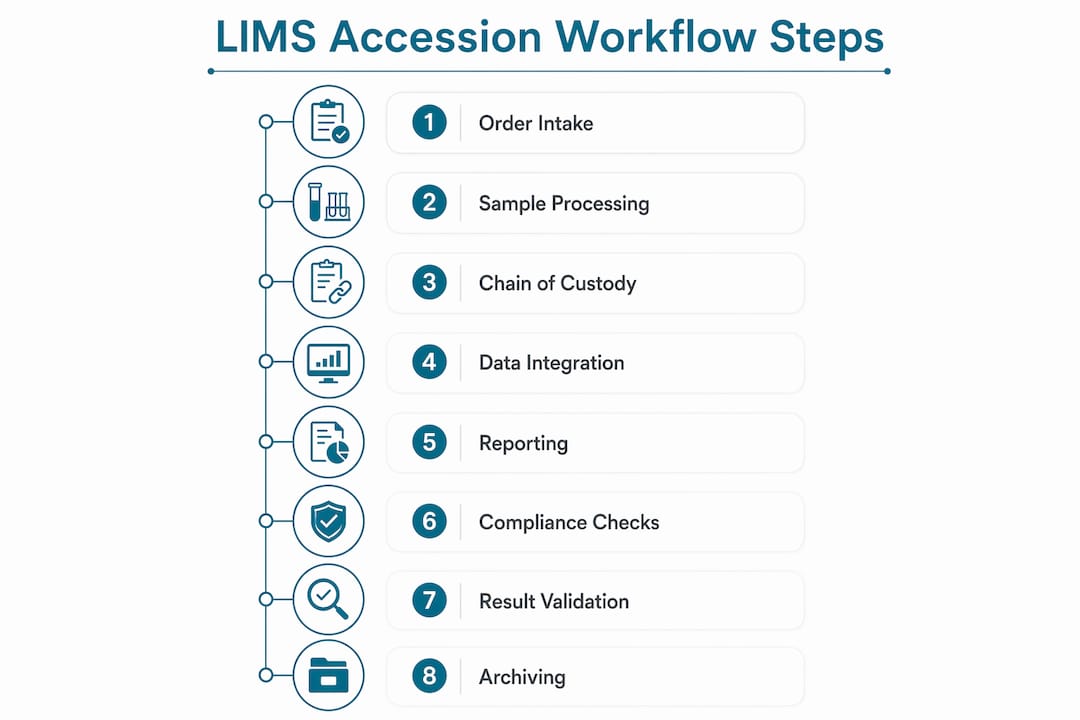
Cells marked "confirm with vendor" indicate areas where vendor documentation or a live RFP response is required before procurement decisions.
Vendor profiles: what does each LIMS actually do for accession?
Understanding where each platform genuinely excels, and where it falls short, saves months of wasted demos.
Labrynix
Labrynix was built from inside a CLIA genetic lab, which shows in its accession design. Order intake connects directly to patient and provider records; barcoding and chain-of-custody logging are native, not bolted on. Split and pooling workflows, priority queuing, and audit event capture are part of the core platform, not add-on modules. The PGx reporting layer is what separates it from every other platform in this list: labs can generate branded, CPIC-aligned, PharmGKB-informed pharmacogenomics reports with AI-assisted summaries, FDA labeling references, and lab-controlled interpretation rules, all within the same system that manages the accession workflow. Provider and patient portals give result delivery a professional, secure channel without requiring a separate portal vendor.

For a molecular or PGx lab evaluating its first purpose-built LIMS, or replacing a patchwork of spreadsheets and generic LIS tools, Labrynix is the strongest starting point. Implementation is subscription-based and custom-quoted by module, with timelines that typically run weeks to a few months depending on integration scope.
Thermo Scientific SampleManager
SampleManager is the enterprise standard for regulated manufacturing and QC environments. Its single-application architecture combining LIMS, SDMS, and LES reduces the number of interface points in a complex stack, which matters when you are managing instrument data across multiple sites. Accession workflows are mature and configurable, and the platform has a long track record in FDA-inspected environments. The tradeoff is implementation weight: expect 6–18 months and a significant professional services engagement. Native PGx reporting is not a feature here; this platform is built for QC and manufacturing, not precision medicine reporting.

LabWare LIMS
LabWare's configurability is its defining trait. Labs with genuinely unusual accession logic, multi-step chain-of-custody requirements, or complex regulatory overlays can usually model them in LabWare, given enough configuration time. The LES functionality is strong, and the platform has been validated in some of the most scrutinized lab environments in the country. Budget 9–24 months for a full implementation and plan for substantial professional services. For a molecular diagnostics lab that does not need deep QC manufacturing features, this is likely more platform than necessary.
LabVantage
LabVantage's browser-based architecture and automation-first roadmap make it a reasonable choice for pharma R&D and manufacturing labs that want a modern UI without a legacy on-prem footprint. Industry accelerators for pharma and biotech reduce configuration time compared with a blank-slate enterprise LIMS. AI features are on the roadmap and beginning to appear in the product. Implementation timelines are similar to other enterprise platforms: 6–18 months, quote-based.
STARLIMS (Abbott)
STARLIMS covers the broadest regulatory surface area of any platform in this comparison, spanning LIMS, ELN, SDMS, and analytics in one suite. For clinical and public health labs that need standardized governance across multiple sites, that breadth is genuinely valuable. The platform supports HL7/FHIR and has deep audit trail capabilities. Implementation is enterprise-scale: 9–24 months and a significant investment. Like LabWare and SampleManager, it is not designed for PGx-specific reporting.
QBench
QBench is the fastest path from contract signing to a running accession workflow for mid-size testing labs. Its no-code configurator means lab staff, not developers, can adjust sample types, routing rules, and report templates. The release cadence is fast, which is a genuine advantage for labs that need to add test types frequently. For a food safety, environmental, or clinical diagnostics lab that does not need enterprise governance or PGx reporting, QBench is worth a serious look. Confirm 21 CFR Part 11 compliance scope directly with the vendor if your lab is regulated under FDA.
Benchling
Benchling grew from an ELN into a broader R&D informatics platform. Its sample management and study tracking are well-suited to biotech discovery teams, but the platform is not designed for regulated QC reporting or clinical accession workflows. If your lab is a research organization that also needs some LIMS-like sample tracking, Benchling fits. If you run a CLIA-certified diagnostic lab, it does not.
Labguru (Sapio Sciences)
The unified ELN/LIMS approach works well for molecular biology teams that want a single tool for both notebook and sample tracking. Low-code configuration and AI-driven features make it accessible for smaller teams without dedicated IT. GMP-adjacent compliance is supported, but confirm the specific validation artifacts available before committing if your lab is under FDA oversight.
Lockbox LIMS, CloudLIMS, CrelioHealth LIMS, LabWizard LIMS
These four platforms serve specific niches. Lockbox LIMS suits small testing or QC labs that need a lightweight system without enterprise overhead. CloudLIMS offers SaaS simplicity for labs that want reduced infrastructure responsibility. CrelioHealth is built for diagnostic and clinical labs with tight billing connectivity needs. LabWizard is purpose-built for industrial QC, plating, and metal-finishing environments with NADCAP and AS9100 reporting. None of them are designed for molecular diagnostics or PGx workflows.
Scispot, Genemod, SciSure
Scispot's orchestration-first design suits high-throughput automation labs where instrument scheduling and workflow control are the primary need. Genemod targets genomics teams with sequencing-specific workflows. SciSure (formerly eLabNext/SciShield) offers a combined ELN/LIMS in a cloud delivery model with configurable compliance tooling, making it a reasonable option for labs that want both capabilities without a large enterprise footprint.
Pro Tip: When evaluating any platform in this list, ask the vendor to show you a live accession workflow using a sample type your lab actually processes. Generic demos using vendor-supplied test data miss practical edge cases that only surface when you run your own messy production data through the system.
What should you actually test in a vendor demo?
A polished demo proves nothing about how a LIMS handles the edge cases your lab generates every day. Structure your evaluation as a test script, not a feature tour.
-
Order intake under real conditions. Submit a batch of orders that includes missing patient demographics, duplicate requisition numbers, and an order with an unsupported test code. Watch how the system flags, routes, and holds each exception. A LIMS that silently accepts bad data is a compliance liability.
-
Accession and unique ID assignment. Accession a set of samples that includes a stat priority, a routine, and a hold. Confirm that unique identifiers are generated, barcodes print correctly, and chain-of-custody logging captures the receiving technician, timestamp, and sample condition.
-
Barcode print and scan verification. Print labels from the system and scan them back at a simulated receiving station. Confirm the system rejects an unrecognized barcode and logs the attempt. Test what happens when a barcode is damaged or unreadable.
-
Split and pool workflows. Take one primary tube and split it into three aliquots for different test workflows. Confirm that each aliquot inherits the parent chain-of-custody record and that the lineage is visible in a single audit view. For NGS labs, test a pooling scenario with index assignments and confirm the system flags a collision.
-
Priority handling and auto-release rules. Escalate a routine sample to stat mid-workflow. Confirm the queue re-sorts and the system logs the priority change with a reason code. Then configure an auto-release rule for a result type and verify it fires correctly without manual intervention.
-
Instrument handoff and data return. Send a worklist to a connected instrument (or simulate one via file transfer if a live instrument is not available). Confirm the result file imports, maps to the correct sample record, and triggers the next workflow step. Ask the vendor which instruments have vendor-managed connectors versus customer-built middleware.
-
Audit event completeness. Pull the audit trail for the entire accession batch you just ran. Every action, including exceptions, priority changes, and auto-releases, should appear with user, timestamp, and before/after values. Gaps in the audit trail are a direct 21 CFR Part 11 concern.
-
Error recovery and disposal/archival. Intentionally create a data entry error and then correct it. Confirm the correction is logged, not overwritten. Then archive a completed accession batch and verify retrieval works correctly.
Pro Tip: The most revealing evaluation is a proof-of-concept using sanitized production data from your actual accession stream, running 20–50 typical and edge-case transactions. This quickly exposes connector and sequencing weaknesses that a polished vendor demo will never show you.
How do integration and interoperability affect your accession workflow?
Integration architecture is not a technical detail you can defer to implementation. It determines whether your LIMS scales cleanly or accumulates technical debt with every new instrument or EHR connection. Modern LIMS architectures have bifurcated into cloud-native API-first platforms and legacy monolithic on-premise systems, and the tradeoffs affect every integration decision you make.
Three integration patterns and when each fits:
- API-first (REST/GraphQL): Best for modern SaaS LIMS connecting to EHR/EMR systems, billing platforms, and cloud-based instruments. Enables real-time order status updates, webhook-driven notifications, and programmatic sample hierarchy queries. Ask vendors for documented API endpoints covering order creation, sample status updates, sample lineage, and webhook configuration.
- Event-driven/message bus (HL7 v2, FHIR R4): Required for clinical contexts where orders originate in an EHR and results must return to the ordering provider's system. HL7 v2 remains the dominant standard in U.S. clinical labs; FHIR R4 is growing for newer EHR integrations. Confirm which message types the vendor supports natively versus through middleware.
- File-based (ASTM, CSV, flat file): Still common for legacy instruments and some reference lab workflows. Lower integration overhead but creates latency and manual intervention risk. Acceptable for low-volume or non-time-sensitive workflows; not appropriate for stat accession pipelines.
| Integration pattern | Best use case | Accession workflow fit | Key verification question |
|---|---|---|---|
| REST API | SaaS LIMS, EHR/billing, modern instruments | Real-time order intake, status updates, lineage queries | What endpoints exist for order creation, sample status, and hierarchy? |
| HL7 v2 / FHIR R4 | Clinical EHR order/result exchange | Order receipt, result delivery, ADT feeds | Which HL7 message types are natively supported? What is the FHIR conformance statement? |
| File-based (ASTM/CSV) | Legacy instruments, reference lab batch flows | Batch accession, worklist generation | What is the import latency? Is file processing logged in the audit trail? |
| Vendor-managed connectors | Instrument connectivity | Instrument-driven accession, result import | Which instruments have vendor-managed drivers? What is the driver maintenance lifecycle? |
Vendor-managed instrument connectors materially reduce time-to-value compared with customer-built middleware. Ask every vendor for a current instrument connector catalog, the maintenance lifecycle for each driver, and who owns connector updates when an instrument firmware version changes.
For Labrynix, HL7, FHIR, APIs, and webhooks are part of the core Labrynix Connect module, with documented pathways for EMR/EHR, billing platforms, and lab instruments. For enterprise platforms like SampleManager and LabWare, confirm the specific instrument models in scope during your RFP, not after contract signing.
Are you covered on CLIA, 21 CFR Part 11, and HIPAA?
Compliance is not a feature you add at go-live. Skipping formal validation of a vendor's security and audit readiness can cause audit failures and patient data breaches. Build these verification steps into your RFP, not your implementation kickoff.
Compliance checklist for regulated U.S. labs:
- Audit trails that capture user, timestamp, action, and before/after values for every data change, including accession records, result entries, and configuration changes.
- Electronic signature controls that meet 21 CFR Part 11 requirements: unique user IDs, meaning-of-signature statements, and non-repudiation.
- Controlled change management with documented release notes, version history, and a defined process for validating the impact of software updates on existing workflows.
- ALCOA+ data integrity principles (Attributable, Legible, Contemporaneous, Original, Accurate, plus Complete, Consistent, Enduring, Available) applied to accession records.
- Role-based access controls that restrict data visibility and action permissions by user role, with documented permission matrices.
Validation documentation to request in your RFP:
- IQ/OQ/PQ artifacts or a SaaS qualification pack covering the vendor's standard configuration.
- Release management policy: how often updates are pushed, how much notice labs receive, and whether validation impact assessments are provided per release.
- Computer System Validation (CSV) support offerings: does the vendor provide a validation consultant, pre-validated configurations, or a validation toolkit?
- Data residency options: where is PHI stored, and can U.S.-only residency be contractually guaranteed?
Security evidence to demand:
- SOC 2 Type II report (not just Type I) covering the relevant trust service criteria.
- Penetration test summary from the past 12 months.
- Encryption standards: AES-256 at rest, TLS 1.2 or higher in transit.
- Incident response policy and breach notification SLA.
For deeper guidance on LIMS validation for genetic labs, the specific documentation requirements differ from general clinical LIMS validation and are worth reviewing before you issue an RFP.
Red flags that signal elevated validation burden:
- Vendor cannot provide a SaaS qualification pack or IQ/OQ/PQ templates.
- Release notes are sparse, delayed, or do not include validation impact assessments.
- Vendor explicitly states that all validation is the customer's responsibility with no support offering.
- No documented process for managing the validation impact of emergency patches.
SaaS vendors differ significantly in how much validation burden they absorb. Vendors who provide pre-validated configurations and managed upgrade paths reduce your long-term cost of ownership more than any license discount will.
This article provides general information for lab procurement planning, not legal or regulatory advice. Confirm your specific compliance obligations with your quality team, legal counsel, and the relevant regulatory authorities.
What does LIMS implementation actually cost and how long does it take?
License fees are the visible part of the budget. Total cost of ownership is routinely underestimated when procurement focuses only on that line item. Validation cycles, custom API development, connector maintenance, and internal retraining add up fast.
| Phase | Small lab | Mid-size lab | Enterprise lab |
|---|---|---|---|
| Discovery & requirements | 2–4 weeks | 4–8 weeks | 8–16 weeks |
| Design & configuration | 4–8 weeks | 8–16 weeks | 16 weeks |
| Validation (IQ/OQ/PQ or SaaS qualification) | 2–6 weeks | 6–12 weeks | 12–24 weeks |
| Pilot / POC | 2–4 weeks | 4–8 weeks | 8–12 weeks |
| Rollout | 2–4 weeks | 4–8 weeks | 8–16 weeks |
| Stabilization | 4–8 weeks | 8–12 weeks | 12–24 weeks |
| Total typical range | 4–6 months | 6–12 months | 12–24 months |
Key cost drivers beyond the license:
- Validation cycles: initial IQ/OQ/PQ plus ongoing revalidation for each major software update. For enterprise platforms, this can exceed the initial implementation cost over a five-year period.
- API and instrument connector development: customer-built connectors for instruments not in the vendor's library add both upfront development cost and ongoing maintenance burden.
- Data migration: moving historical accession records, patient demographics, and result data from a legacy system requires data mapping, cleansing, and validation of the migrated dataset.
- Training: initial training plus retraining for staff turnover and new feature releases.
- Annual support and maintenance: typically 18–22% of license value for on-premise platforms; included in SaaS subscriptions but confirm what is covered.
Converting a vendor quote to a TCO model:
Ask each vendor to break their quote into: (1) license or subscription fee, (2) professional services for implementation, (3) annual support/maintenance, (4) validation support services, and (5) connector/integration development. Sum these over a five-year horizon. A lower license fee with high professional services and no validation support often costs more than a higher-priced platform that absorbs validation burden.
Contract items to negotiate:
- SLA for uptime, support response, and incident resolution.
- Upgrade cadence and advance notification period (minimum 30 days for regulated labs; 60–90 days is better).
- Validation support inclusion: what the vendor provides per release and what is the customer's responsibility.
- IP ownership for any custom connectors or configurations built during implementation.
- Data export rights and format on contract termination.
How do you build a vendor evaluation scorecard?
Feature-checklist selection commonly fails because it misses architectural and operating-model fit. A LIMS that looks right at signing and feels wrong at year three is a real procurement failure mode. Weight your scorecard accordingly.
Suggested scoring rubric (100 points total):
| Criterion | Weight | What to measure |
|---|---|---|
| Architecture & integration | 30% | API-first vs. file-based, HL7/FHIR native support, instrument connector library depth |
| Validation & compliance | — | SaaS qualification pack, release management policy, CSV support, SOC 2 Type II |
| Vendor operating model & support | 20% | Support SLA, upgrade cadence, reference customer quality, roadmap transparency |
| Functional fit | — | Accession feature completeness, PGx/genetic reporting (where relevant), UI/UX |
| Data strategy | — | Data residency, export rights, migration support, long-term data governance |
RFP and demo questions by theme:
Accession features: Can you demonstrate a split/pool workflow with full lineage traceability? How does the system handle a mislabeled sample at receiving? What is the process for priority escalation mid-workflow?
Integrations: Provide a list of currently supported instrument connectors with driver version history. What is your HL7 v2 message type coverage? Provide your FHIR R4 conformance statement. Who owns connector maintenance when instrument firmware changes?
Validation and security: Provide your SaaS qualification pack or IQ/OQ/PQ templates. What validation impact assessment do you provide per software release? Provide your most recent SOC 2 Type II report and penetration test summary.
Reporting (PGx-specific): Does the platform support CPIC guideline-based interpretation? Can reports be customized per lab brand and provider preference? How are FDA pharmacogenomic labeling references maintained and updated?
Deployment and SLAs: What is your contractual uptime SLA? What advance notice do you provide before major releases? What is your data residency policy for U.S. PHI?
References: Provide two reference customers in a similar lab type (molecular/PGx, clinical diagnostics, etc.) who have been live for at least 12 months. What is the average time from contract signing to go-live for labs of our size?
POC acceptance criteria:
- Full lineage traceability for 95% or more of test accession transactions.
- HL7 order/result round-trip success rate of 98% or higher on your test message set.
- Audit trail completeness: every accession event captured with user, timestamp, and before/after values.
- Zero silent data acceptance: all intentionally malformed inputs flagged and logged.
Red flags that should stop a shortlisting:
- Vendor cannot demo an accession workflow using your sample data or a close analog.
- Validation responsibilities are entirely offloaded to the customer with no support offering.
- No instrument connector roadmap or connector catalog available.
- Reference customers are in unrelated industries or unavailable for calls.
- Release notes are not provided in advance of updates.
Pro Tip: Treat LIMS selection as a decade-long partnership evaluation, not a software purchase. The vendor's operating model, support quality, and roadmap transparency matter more at year five than the feature list did at year one.
How we evaluated these LIMS
This comparison prioritized architecture, integration model, and validation readiness over raw feature counts, because those factors determine long-term success more reliably than any feature checklist.
| Evaluation dimension | Weight | Primary data sources |
|---|---|---|
| Architecture & integration model | 30% | Vendor documentation, public API references, analyst reports |
| Validation & compliance readiness | — | Vendor qualification packs, public case studies, regulatory guidance (21 CFR Part 11, CLIA, HIPAA) |
| Vendor operating model & support | 20% | Reference customer accounts, support SLA documentation, G2 reviews |
| Functional fit for accession workflows | — | Vendor demos, accession workflow guides, feature documentation |
| Data strategy | — | Vendor data residency policies, export documentation, migration case studies |
Primary data sources used:
- Vendor product documentation and public feature pages.
- Published case studies and customer references from vendor websites.
- G2 reviews for platforms with sufficient review volume in the LIMS category.
- Analyst reports and independent LIMS selection guides.
- Regulatory primary sources: FDA 21 CFR Part 11, CMS CLIA regulations, HHS HIPAA guidance.
How implementation timelines and cost signals were estimated:
Timeline ranges in this article are derived from vendor-disclosed implementation case studies, public professional services documentation, and analyst estimates. All pricing is quote-based; no specific dollar figures are stated because vendor pricing varies by lab size, module selection, and contract terms. Treat all timeline and cost ranges as planning estimates, not contractual commitments. Verify current figures directly with each vendor during your RFP process.
Why Labrynix is the recommended choice for accession-focused genetic and molecular labs
Labrynix was built by a team with direct CLIA genetic lab experience, which means the accession workflow design reflects how molecular and PGx labs actually operate, not how a generic LIMS vendor imagines they do.
| Labrynix capability | What it covers | Verification path |
|---|---|---|
| Accession workflow | Order intake, patient/provider records, barcoding, chain-of-custody, split/pooling, priority queuing, audit logs | Request a live demo with your sample types; review the accession process guide |
| PGx and genetic reporting | Branded templates, CPIC guideline support, PharmGKB annotations, FDA labeling references, AI-assisted summaries, lab-controlled interpretation | Review the PGx reporting feature page; request a sample report |
| Interoperability (Labrynix Connect) | HL7, FHIR, REST APIs, webhooks, EMR/EHR, billing platforms, instruments | Request API documentation and a connector list during procurement |
| Provider and patient portals | Secure branded access to orders, statuses, reports, and result delivery | Request a portal demo; confirm branding and permission configuration options |
| Compliance and security | HIPAA-conscious design, role-based access, audit trails, configurable permissions, data governance | Request the SaaS qualification pack and compliance documentation during RFP |
| AI-powered workflow automation | Report drafting assistance, bottleneck detection, review queue management, operational analytics | Review Labrynix Intelligence feature documentation |
Proof points to verify during procurement:
- Request the Labrynix SaaS qualification pack and compliance documentation to confirm HIPAA-conscious design controls.
- Review the Labrynix company page for founding context and team background.
- Ask for a reference customer in a similar lab type (PGx, molecular diagnostics, or hereditary cancer testing) who has been live for at least six months.
- Request a live demo that covers the full accession-to-report workflow using a sample type your lab processes.
For labs evaluating molecular diagnostic LIMS options, the distinction between a generic clinical LIMS and a platform built for molecular workflows is significant and worth understanding before issuing an RFP.
Key Takeaways
For accession-focused molecular and PGx labs, architecture, validation readiness, and integration model matter more than feature counts when selecting a LIMS.
| Point | Details |
|---|---|
| Start with the right category | Enterprise regulated labs should RFP SampleManager, LabWare, or STARLIMS; PGx and molecular labs should start with Labrynix. |
| Test with your own data | Run a POC with a sanitized sample of your production accession stream to expose integration gaps that polished demos hide. |
| Validate the validation story | Request a SaaS qualification pack, release management policy, and SOC 2 Type II report from every shortlisted vendor before contract signing. |
| TCO exceeds the license fee | Include validation cycles, connector development, data migration, and retraining in your five-year cost model. |
| Labrynix for PGx and molecular labs | Labrynix is the only platform in this comparison with native PGx reporting, CPIC/PharmGKB support, and accession workflows built for genetic testing. |
What the LIMS market gets wrong about accession workflows
The standard LIMS evaluation process is broken in a specific way. Labs spend weeks scoring feature checklists, then discover at implementation that the platform's accession module was designed for a QC lab running water samples, not a molecular lab processing NGS libraries with index collisions and split aliquots going to three different instruments.
The vendors who win enterprise deals are often the ones with the best sales process, not the best accession workflow. A platform that has been in FDA-inspected environments for 20 years has real credibility for regulated QC manufacturing. That same credibility means almost nothing for a PGx lab that needs CPIC-aligned interpretation, branded provider reports, and a patient portal that does not look like it was designed in 2008.
The honest advice is this: segment your evaluation before you issue a single RFP. If you run a molecular or genetic testing lab, the enterprise platforms in this list are not wrong, they are just solving a different problem. The accession workflow for a pharmacogenomics lab is not a simplified version of a pharmaceutical QC workflow. It is a different workflow, with different downstream reporting requirements, different provider communication needs, and different compliance obligations under CLIA and HIPAA.
Labrynix was built for that specific workflow. The other platforms in this comparison were built for theirs. The best procurement outcome comes from matching the platform to the actual workflow, not to the most impressive reference list.
See Labrynix in action for your accession workflow
Genetic and molecular labs evaluating LIMS options often spend months on demos that never show them what they actually need to see: a real accession-to-report workflow for PGx or molecular diagnostics, with HL7 order intake, chain-of-custody logging, and a branded pharmacogenomics report at the end.
A Labrynix demo covers the full workflow your lab runs: accession stream ingest with barcoding and chain-of-custody, a live PGx report example with CPIC-aligned interpretation and branded output, and an integration check against one instrument or EHR connection from your current stack. The conversion path is straightforward: review the Labrynix LIMS product page, then request a tailored demo scoped to your lab type, followed by a POC scoping call where your specific accession and reporting requirements drive the agenda.
Labs running molecular diagnostics can explore the molecular diagnostics solution page for workflow-specific details. For PGx labs, the PGx reporting feature page covers the full reporting capability including 700+ medication coverage, CPIC guideline support, and AI-assisted summaries. Request your demo at labrynix.com/solutions.
Authoritative sources and further reading
The sources below are the primary references used in this comparison. Use them to validate vendor claims, deepen technical checks, and prepare RFP documentation.
| Source | What to use it for |
|---|---|
| FDA 21 CFR Part 11 | Electronic records and signatures requirements; verify vendor audit trail and e-signature claims against this text |
| CMS CLIA Regulations | CLIA certification requirements for U.S. clinical labs; use to confirm lab-specific compliance obligations |
| HHS HIPAA Guidance | PHI handling, security rule, and breach notification requirements; use to evaluate vendor data governance claims |
| LIMS Selection 2026: Beyond the Feature Checklist | Architecture, integration model, and validation TCO guidance; use to build your scoring rubric |
| How to choose a LIMS: key questions to ask | Demo and RFP question templates; use to structure your vendor evaluation process |
| Best LIMS Software in 2026 | Market segmentation reference; use to validate vendor category placement |
| G2 LIMS category reviews | User reviews for platforms with sufficient volume; use as one signal among several, not a primary ranking criterion |
| CrelioHealth LIMS vendor checklist | Compliance and audit readiness checklist; use to build your RFP compliance section |
Labrynix blog resources for deeper reading:
- LIMS in lab workflow design — mapping lab processes to LIMS constructs before implementation.
- The role of LIMS in lab compliance — audit trails, 21 CFR Part 11, and documentation to request from vendors.
- LIMS data validation steps for new labs — step-by-step validation tasks and documentation templates.
- The role of LIMS in genetic report delivery — PGx and genetic reporting requirements and how LIMS supports them.
- LIMS vs. LIS for genetic testing — when to choose LIMS versus LIS for genetic testing workflows.
How to validate vendor-supplied documents:
When reviewing a SOC 2 Type II report, confirm the audit period covers at least six months, the scope includes the systems that will process your PHI, and the report was issued by an accredited CPA firm. For a SaaS qualification pack, confirm it covers the specific modules you will use, includes a validation impact assessment process for updates, and identifies which validation activities remain the customer's responsibility. Any gap in those areas is a negotiation point before contract signing, not a post-go-live discovery.