
The LIMS sample accession process is the systematic procedure of receiving, verifying, uniquely identifying, labeling, and logging samples into a laboratory information management system to ensure traceability, accuracy, and regulatory compliance. Every downstream result, report, and billing record depends on what happens at this intake stage. Errors introduced here, whether a mislabeled tube or a missing test code, propagate through the entire workflow. Standards like CLIA and ISO 15189 both treat accessioning as a formal quality checkpoint, not a clerical task. This guide walks lab professionals and administrators through the prerequisites, the six standardized steps, compliance requirements, common mistakes, and the modern LIMS features that make the whole process reliable.
What are the essential prerequisites for the LIMS sample accession process?
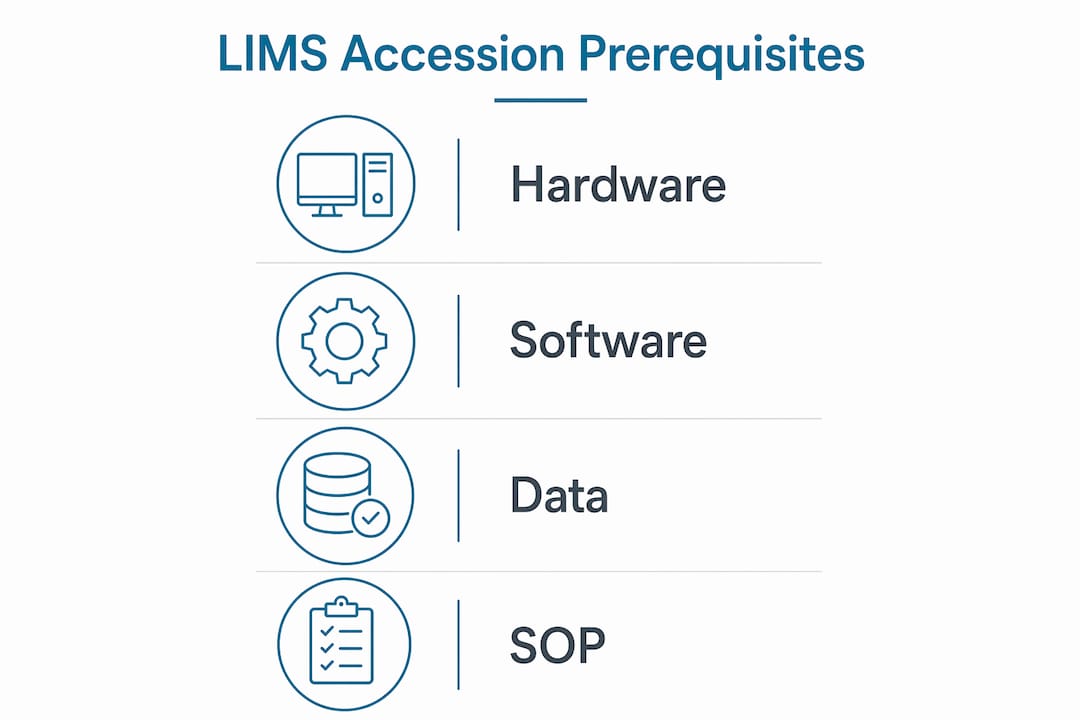
Accessioning cannot succeed without the right hardware, software, and data in place before the first sample arrives. Skipping this setup phase is the single fastest way to create downstream errors that are expensive to trace and fix.
Hardware requirements
The minimum hardware set for a functional accession station includes a barcode scanner, a thermal label printer, and a networked workstation with access to the LIMS. Barcode scanning pulls all sample information rapidly, minimizing entry errors and accelerating sample movement through the lab. Label printers must be calibrated to produce durable, scannable labels that survive refrigeration, centrifugation, and chemical exposure.
Software and data requirements
The LIMS itself must support barcode generation, audit trail logging, and role-based access control before accessioning goes live. Beyond the platform, labs need clean incoming data: patient or client information, test requisition details, sample type, collection date and time, and priority level. Interoperability with billing, reporting, and patient portals is critical for operational transparency. Without it, staff manually re-enter accession data into separate systems, which multiplies the chance of discrepancy.
Standard operating procedures
A written SOP aligned with CLIA and ISO 15189 requirements must exist before any sample is logged. The SOP defines rejection criteria, required data fields, labeling standards, and escalation paths for non-conforming specimens. Labs that skip formal SOPs at launch typically spend months retrofitting them after audit findings.
The table below summarizes the core prerequisites by category.
| Category | Requirement | Purpose |
|---|---|---|
| Hardware | Barcode scanner, thermal label printer | Rapid ID and durable labeling |
| Software | LIMS with audit trail and role-based access | Traceability and security |
| Data | Patient info, test request, sample metadata | Accurate record creation |
| Standards | CLIA and ISO 15189 aligned SOP | Regulatory compliance |
| Interoperability | HL7, FHIR, or API connections | Seamless data flow across systems |
What are the six standardized steps in the LIMS sample accession workflow?
Standardized LIMS accessioning workflows must include six core steps, each with defined data fields and decision points. Skipping or combining steps is where most accession errors originate.
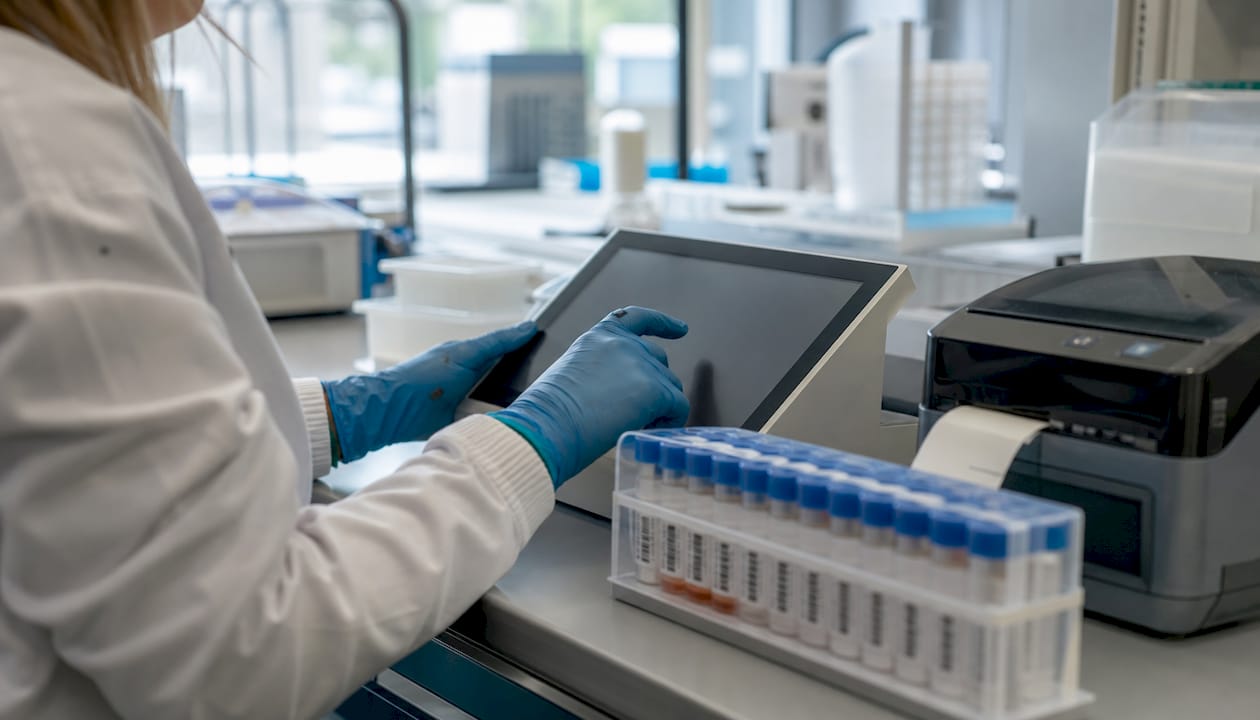
Step 1: Physical receipt and condition verification. The sample arrives and staff immediately check container integrity, volume adequacy, temperature compliance, and label accuracy. Proper condition verification at intake prevents downstream testing errors and outright rejections. Any sample that fails this check gets flagged in the LIMS and routed to a rejection queue rather than proceeding to testing.
Step 2: Unique ID assignment. The LIMS generates a unique accession number, typically expressed as a barcode or QR code, and assigns it to the sample record. This number becomes the single identifier that follows the sample from receipt to final report. Manual ID assignment is a known failure point and should be replaced with automated generation wherever possible.
Step 3: Metadata entry. Staff enter or confirm all required data fields: client name, ordering provider, patient demographics, test codes, specimen type, collection date and time, and priority level. Digital accessioning reduces manual errors, minimizes double entry, and enables real-time sample traceability. Structured data entry forms with required field validation prevent records from being saved with missing information.
Step 4: Physical label application. The LIMS sends a print command to the label printer, and the generated label is applied to the sample container immediately. The label must include the accession number barcode, sample type, and any handling instructions. Applying the label before the sample leaves the accession station eliminates the most common source of mislabeling.
Step 5: Automated routing. Once labeled and logged, the LIMS routes the sample to the correct test queue or department based on sample type and priority. Automated routing directs samples to appropriate tests based on sample type and priority, improving workflow balance across the lab. This step removes the need for manual work lists and reduces the risk of samples sitting idle in the wrong queue.
Step 6: Audit trail creation. Every action taken during accessioning, from receipt timestamp to label print confirmation, is written to an immutable audit log. This log satisfies CLIA and ISO 15189 traceability requirements and provides the evidence base for any future dispute or inspection.
Pro Tip: Set up required field validation in your LIMS so that no accession record can be saved without a complete test code, specimen type, and collection timestamp. This single configuration change eliminates the most common cause of incomplete records.
How does the LIMS accession process ensure regulatory compliance and sample integrity?
Accessioning acts as a gatekeeper that enforces CLIA and ISO 15189 clinical standards before any analytical work begins. A sample that fails intake criteria never reaches the bench, which protects both result accuracy and the lab's accreditation status.
The compliance functions built into a well-configured accession workflow include:
- Specimen validation: The LIMS checks sample type, volume, and condition against test-specific requirements and flags non-conforming specimens automatically.
- Rejection tracking: Rejected samples are logged with a reason code, creating a documented record that satisfies quality management requirements.
- Audit trails: Every accession event is timestamped and attributed to a named user, producing the chain of custody documentation that inspectors require.
- Access control: Role-based permissions restrict who can create, edit, or override accession records, reducing the risk of unauthorized changes.
- Integration with approval workflows: Accession data feeds directly into result verification queues, so no result can be released without a corresponding, complete accession record.
Accessioning workflows ensure regulatory compliance by preventing non-compliant samples from progressing, maintaining report accuracy and quality assurance. Labs that treat accessioning as a compliance checkpoint, not just a data entry task, consistently perform better during CLIA and ISO 15189 inspections.
The role of LIMS in lab compliance extends beyond audit logs. When accession data is complete and structured, it feeds accurate information into billing, reporting, and provider portals without manual re-entry. That end-to-end data integrity is what regulators and accreditation bodies look for when they evaluate a lab's quality system.
What are common mistakes and troubleshooting tips in the LIMS sample accession process?
Most accession failures trace back to a small set of repeatable errors. Identifying them by name makes them fixable.
- Manual entry mistakes: Free-text fields for patient name or test code produce typos that break downstream matching. Replace free-text with dropdown menus or barcode-scanned lookups wherever the LIMS allows.
- Mislabeling: Printing a label and setting it aside before applying it to the correct tube is a high-risk practice. The rule is: print, apply, scan to confirm, in that sequence, before moving to the next sample.
- Missing metadata: Accession records saved without collection time or ordering provider information create compliance gaps. Required field validation, as noted above, is the most direct fix.
- Interoperability failures: When the LIMS does not communicate with the billing or reporting system, staff re-enter accession data manually. Interoperability gaps cause manual re-entry and errors that compound across every sample processed.
- Overloading LIMS with bench notes: Practitioners emphasize separating bench activity from system control to avoid overcomplicating LIMS and keep accession workflows straightforward. Procedural notes belong in an electronic lab notebook, not in the accession record.
Pro Tip: Run a weekly report on accession records flagged for missing fields or failed condition checks. Patterns in that report reveal training gaps and SOP weaknesses faster than any audit.
Handling samples that fail verification requires a defined path. The LIMS should route rejected samples to a named hold queue, generate a notification to the ordering provider, and log the rejection reason. Labs that handle rejections ad hoc, without a documented workflow, accumulate undocumented non-conformances that become audit liabilities.
How can modern LIMS features enhance sample accession workflows?
Modern LIMS platforms have moved well beyond basic data entry. The features that matter most for accession efficiency are those that reduce human touchpoints and connect accession data to every downstream system automatically.
Accession-based LIMS provide real-time accountability and traceability, reducing manual errors like mislabeling and duplication. Every sample carries a unique accession number tracked end to end, which decreases reliance on paper logs and improves transparency across shifts and departments.
The table below compares accession capabilities across two common platform categories.
| Feature | Entry-level platforms | Full-featured LIMS (e.g., Labrynix) |
|---|---|---|
| Barcode generation | Manual or third-party | Native, automated at accession |
| Audit trail | Basic timestamp log | Immutable, user-attributed event log |
| Automated routing | Manual queue assignment | Rule-based routing by sample type and priority |
| Interoperability | Limited or none | HL7, FHIR, API, EHR, billing, and instrument connections |
| AI-assisted insights | Not available | Bottleneck detection and workflow analytics |
| Role-based access | Basic user levels | Configurable permissions per workflow stage |
Cloud-based accessioning adds another layer of value. Lab administrators can monitor accession queue status, rejection rates, and throughput from any location. Labrynix LIMS, for example, connects accession data to reporting, billing, and provider portals in a single workflow, eliminating the manual handoffs that slow most labs down. Labrynix Intelligence adds AI-powered bottleneck detection that flags accession queues building up before they affect turnaround time. That kind of operational visibility is what separates labs running at capacity from labs constantly catching up.
Key Takeaways
A complete and compliant LIMS sample accession workflow requires six standardized steps, validated prerequisites, and full interoperability across lab systems to protect data integrity from receipt to final report.
| Point | Details |
|---|---|
| Six steps are non-negotiable | Receipt, ID assignment, metadata entry, labeling, routing, and audit trail must all be completed for every sample. |
| Prerequisites determine success | Hardware, software, clean incoming data, and a written SOP must be in place before accessioning begins. |
| Compliance is built in, not added on | CLIA and ISO 15189 requirements are met through validation rules, rejection tracking, and immutable audit logs. |
| Interoperability prevents re-entry errors | Accession data must flow automatically to billing, reporting, and portals to avoid manual duplication. |
| Modern LIMS features reduce human error | Automated barcode generation, routing rules, and AI-powered analytics cut mislabeling and queue bottlenecks. |
The part of accessioning most labs get wrong
I have worked with enough genetic and molecular labs to know that the accession workflow is almost always underbuilt relative to the complexity of the testing menu. Labs invest heavily in instrumentation and reporting but treat accessioning as a clerical function that any staff member can figure out on the fly. That assumption is where quality problems start.
The insight that changed how I think about this comes from a principle I keep returning to: LIMS should control workflow and routing, while bench scientists manage procedural detail in their own tools. When labs try to capture every bench note inside the accession record, the LIMS becomes cluttered, accession records become inconsistent, and the audit trail loses its clarity. Keeping the accession record lean and structured is a discipline, not a limitation.
The compliance pressure on accessioning is also increasing. CLIA surveyors and ISO 15189 assessors are asking more specific questions about electronic audit trails and rejection documentation than they were three years ago. Labs that built their accession workflows on paper logs or basic spreadsheets are finding those systems inadequate during inspections. The labs that fare best are those that built LIMS data integrity into their accession design from the start, not as a retrofit.
My advice for 2026: audit your current accession SOP against your actual LIMS configuration. Most labs find a gap between what the SOP says should happen and what the system actually enforces. Closing that gap, through required field validation, automated routing rules, and rejection workflows, is the highest-return improvement most labs can make without buying new equipment.
— Tarek
Labrynix LIMS for genetic and molecular lab accessioning
Labrynix was built by a team with direct genetic lab experience, which means the accession workflow inside the platform reflects how molecular labs actually operate, not how generic software assumes they do.

Labrynix LIMS handles automated accession number generation, barcode label printing, required field validation, and rejection queue management out of the box. Accession data connects directly to Labrynix Reports, Labrynix Billing, and Labrynix Portal, so nothing requires manual re-entry. Labrynix Intelligence adds real-time bottleneck detection across accession queues. Labs looking for a LIMS built for molecular diagnostics or a full genetic lab platform can review Labrynix solutions and request a demo to see the accession workflow in action.
FAQ
What is the LIMS sample accession process?
The LIMS sample accession process is the systematic intake procedure that receives, verifies, uniquely identifies, labels, and logs samples into a laboratory information management system. It creates the traceability record that supports every downstream test, report, and compliance requirement.
How many steps are in a standardized LIMS accessioning workflow?
Six core steps define a standardized LIMS accessioning workflow: receipt and condition verification, unique ID assignment, metadata entry, label application, automated routing, and audit trail creation. Each step must be completed and logged for every sample.
How does accessioning support CLIA and ISO 15189 compliance?
Accessioning enforces CLIA and ISO 15189 standards by validating specimen requirements at intake, logging every action in an immutable audit trail, and preventing non-conforming samples from advancing to testing. These controls satisfy the traceability and quality documentation requirements both standards mandate.
What is the most common cause of accession errors?
Manual data entry and mislabeling are the most common accession errors. Digital barcode-based accessioning significantly reduces both by replacing free-text fields with scanned lookups and automating label generation directly from the LIMS record.
Why does interoperability matter in sample accession?
Interoperability ensures that accession data flows automatically to billing, reporting, and provider portals without manual re-entry. Without it, staff duplicate data across systems, which multiplies the risk of discrepancy and creates compliance gaps that are difficult to trace.