
LIMS data integrity is defined as the accuracy, completeness, consistency, and traceability of laboratory data across its entire lifecycle, from initial capture through archiving. Every regulated lab depends on this principle to produce results that hold up under scrutiny. Standards like GMP, ISO/IEC 17025, and FDA 21 CFR Part 11 all treat data integrity not as a best practice but as a baseline requirement. Features like audit trails, role-based access control, and electronic signatures are the technical mechanisms that make LIMS data integrity compliance real and defensible.
What key LIMS features uphold data integrity in the laboratory?
A LIMS upholds data integrity through a specific set of technical controls, not through general good intentions. LIMS features such as audit trails, version control, electronic signatures, and role-based access control support GMP inspection readiness by enabling end-to-end data traceability. Each control addresses a distinct failure point in the data lifecycle.
The core features every compliant LIMS must deliver include:
- Full audit trails. Every create, update, and delete action is logged automatically with a timestamp, unique user ID, and a mandatory reason for the change. Audit trails must be automatic, tamper-proof, and chronological to satisfy ISO/IEC 17025 and ISO 9001 requirements. A trail that can be edited after the fact is not an audit trail.
- Role-based access control. Only authorized users can view, enter, or modify specific data sets. Permissions align with job roles, so a sample accessioner cannot approve a final report.
- Version control. Methods, specifications, and documents are versioned so labs can prove which procedure was in effect at the time of any given test.
- Electronic signatures. Reviews and approvals are captured digitally with user authentication, meeting the requirements of 21 CFR Part 11 and EU Annex 11.
- Immutable original records. Prior values are preserved when corrections are made. A new entry records the amendment; the original is never deleted or obscured.
- Real-time alerts. Deviations from expected ranges or workflow steps trigger notifications before errors compound.
Pro Tip: Configure your LIMS so that every data field requiring a correction forces the user to enter a reason code. That single step satisfies the "why" requirement in most regulatory audit trail standards and takes less than five seconds per correction.
The combination of these controls creates a closed loop. No single feature is sufficient on its own. A lab with strong access control but no audit trail still cannot reconstruct what happened to a result after the fact.
How does LIMS integration with instruments and systems reduce data integrity risks?
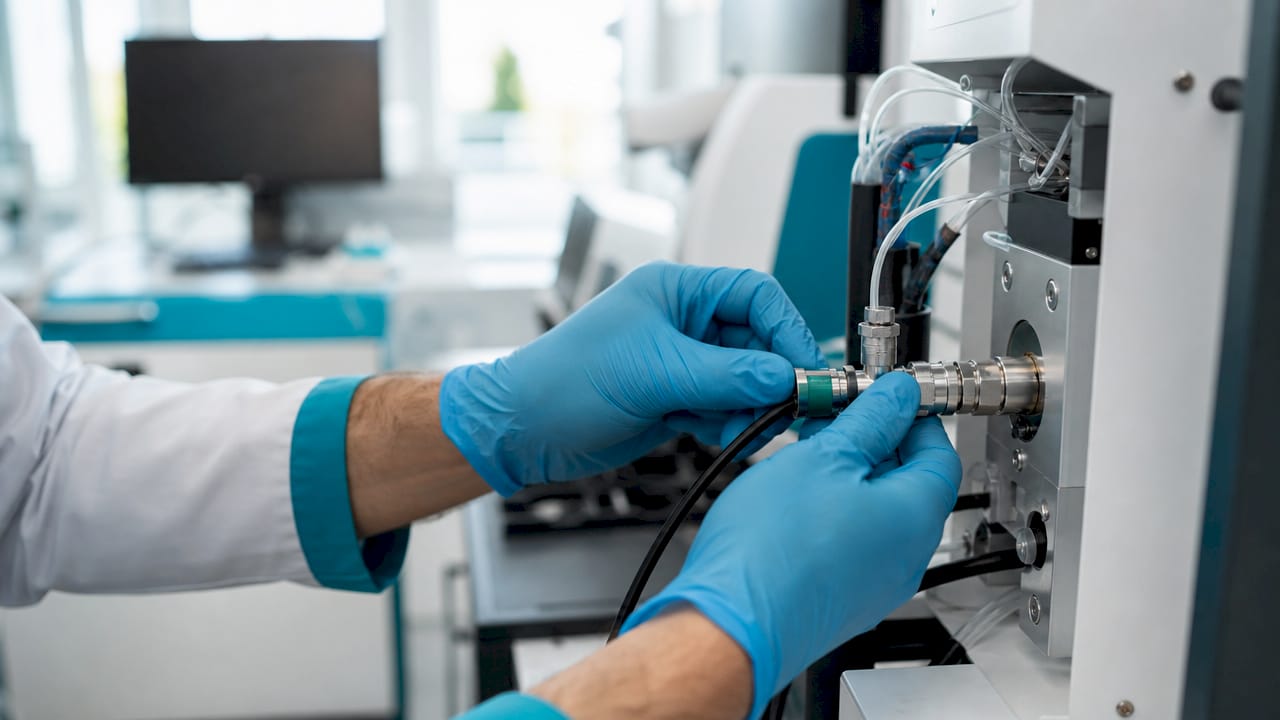
Manual transcription is the single largest source of data integrity failures in laboratory environments. When a technician reads a value from a balance or pH meter and types it into a LIMS, every keystroke is an opportunity for error. Direct instrument integration with LIMS ensures accurate and timely data capture, reducing transcription errors and the compliance risks that come from disconnected systems.
The practical steps for treating integration as a data integrity control are:
- Map every instrument that generates reportable data. Balances, pH meters, bioreactors, PCR instruments, and sequencers all produce values that end up in final reports. Each one is a transcription risk if not integrated.
- Implement bi-directional communication. The LIMS sends test parameters to the instrument and receives results back automatically. This creates contemporaneous, original evidence that regulators expect.
- Apply validation rules at the point of capture. Range checks and format checks reject out-of-bounds values before they enter the database. Catching errors at entry is far cheaper than correcting them after a report is issued.
- Break down data silos. Connect your LIMS to your EHR, billing platform, and reporting system so data flows without manual re-entry at each handoff. Instrument integration acts as a key data integrity control that eliminates transcription gaps and maintains contemporaneous evidence.
- Document each integration as a validated interface. Treat the connection between an instrument and the LIMS as a regulated system component, not an IT convenience. Validation documentation for each interface protects you during inspections.
Pro Tip: When setting up instrument interfaces, review the LIMS instrument interface setup guide to confirm your configuration captures raw data at the source rather than processed summaries. Regulators want original instrument output, not a calculated average.
Labs that integrate instruments correctly gain a second benefit beyond compliance. Automated data capture accelerates turnaround time and frees analysts to focus on interpretation rather than data entry.
What compliance standards govern LIMS data integrity?
Three regulatory frameworks define the minimum requirements for data integrity in LIMS, and they overlap more than most lab managers realize.
| Standard | Core LIMS Requirement | Key Focus |
|---|---|---|
| ISO/IEC 17025:2017 | Immutable records, full audit trails with timestamps and justifications, role-based access, electronic signatures | Accreditation for testing and calibration labs |
| FDA 21 CFR Part 11 | Electronic records and signatures equivalent to paper, audit trails, access controls | US-regulated pharmaceutical and clinical labs |
| EU Annex 11 | Computerized system validation, data backup, audit trails, electronic signatures | EU GMP-regulated manufacturing and testing |
| GAMP 5 | Risk-based lifecycle validation approach for computerized systems | Validation methodology across all regulated industries |
ISO/IEC 17025 requires LIMS to maintain immutable original records, comprehensive audit trails with timestamps, user IDs, and justifications for amendments, and strict authentication. That is not a summary of best practices. It is a direct requirement for accreditation.
The most common misconception among lab managers is that passing a software demonstration proves compliance. Accreditation assessors require evidence that record handling behaviors meet trustworthiness standards during actual audits, not during vendor-led demos. An assessor will ask to see a corrected record and verify that the original value is still visible and the reason for the change is documented.
Laboratory systems require structured validation under risk-based lifecycle processes aligned with GAMP 5 and ALCOA+ to prove the system stays in a valid state. ALCOA+ stands for Attributable, Legible, Contemporaneous, Original, Accurate, plus Complete, Consistent, Enduring, and Available. These nine attributes describe what every data record must be. Your LIMS configuration either supports all nine or it does not.
Sustainable validation is not a one-time event but a lifecycle and periodic review process. Every configuration change, permission adjustment, or software update can erode your validated state if not managed through formal change control. Labs that treat validation as a project rather than a program consistently fail follow-up inspections.
What best practices help labs maintain daily data integrity?
Maintaining data integrity in LIMS is an operational discipline, not a configuration you set once. The following practices define what audit-ready labs do differently from labs that scramble before every inspection.
- Enforce immutable original data. Configure the LIMS so prior values remain visible and new entries record corrections, enabling auditors to reconstruct event history years later. Deletion is never an acceptable correction method.
- Require metadata on every change. Audit trails without a reason code are incomplete. Every amendment must capture who, what, when, and why.
- Align permissions with job roles, not individuals. When a staff member changes roles, their access profile must update immediately. Orphaned permissions are a common audit finding.
- Schedule periodic validation reviews. Operational changes such as new instrument connections, updated methods, or software patches all require documented impact assessments against your validated state.
- Run regular training on data integrity policies. Governance documents that sit in a shared drive and are never reviewed do not constitute a data integrity culture. Labs that train quarterly show measurably fewer data entry errors.
- Use dashboards to monitor data quality proactively. A LIMS reporting dashboard that surfaces anomalies, out-of-range entries, and incomplete records lets managers catch problems before they become findings.
- Avoid the most common pitfall: shared login credentials. A single shared account destroys the attributability requirement of ALCOA+. Every user needs a unique ID, and that requirement is non-negotiable under every major standard.
Pro Tip: Build a quarterly data integrity checklist that mirrors the questions an ISO/IEC 17025 assessor would ask. Run it internally before any external audit. Labs that self-audit regularly find and fix issues that would otherwise become formal nonconformities.
The goal is not to prepare for audits. The goal is to operate in a way that makes audits uneventful. Those two objectives require the same underlying practices.
Key takeaways
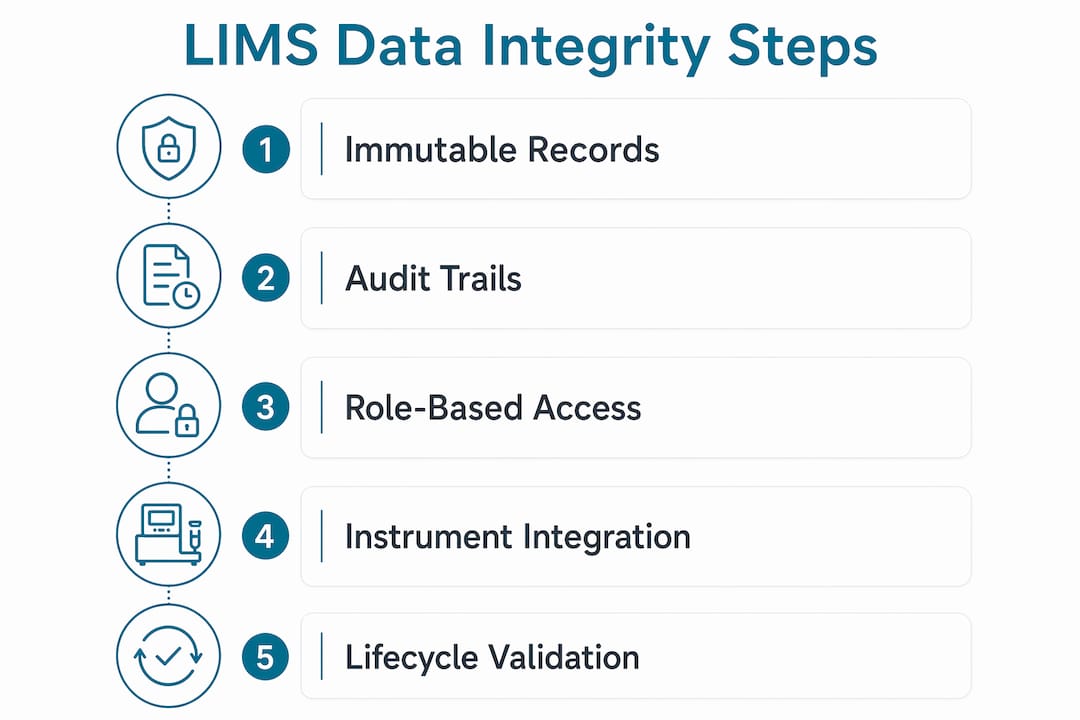
LIMS data integrity requires audit trails, immutable records, role-based access, instrument integration, and lifecycle validation working together to produce inspection-ready, trustworthy laboratory data.
| Point | Details |
|---|---|
| Audit trails are non-negotiable | Trails must be automatic, tamper-proof, and include timestamps, user IDs, and reasons for changes. |
| Instrument integration prevents transcription errors | Direct bi-directional connections eliminate manual re-entry and create contemporaneous original records. |
| Compliance requires lifecycle validation | GAMP 5 and ALCOA+ demand ongoing validation reviews, not a single sign-off at go-live. |
| Demos do not equal compliance | Assessors test actual record behavior during audits, not vendor-presented features. |
| Permissions must match current job roles | Outdated access profiles are a frequent audit finding and an ALCOA+ attributability failure. |
The compliance shift most labs are not ready for
Regulators are no longer primarily inspecting facilities. They are interrogating data, and that shift changes everything about how a LIMS should be configured and governed. I have seen labs with beautiful facilities and outdated LIMS configurations fail inspections because they could not reconstruct a single corrected result from three years prior.
The labs that handle this well treat their LIMS as a compliance system first and an operational tool second. That is not a subtle distinction. It changes which features get configured on day one, which validation activities get prioritized, and which staff members receive data integrity training. Most labs still think about LIMS primarily in terms of workflow efficiency. Efficiency matters, but it cannot come at the cost of traceability.
The harder challenge is ongoing governance. Validation is not a project with a completion date. Every time a permission changes, a new instrument is connected, or a software update is applied, the validated state of the system is potentially affected. Labs that do not have formal change control processes in place will drift out of compliance without realizing it. By the time an assessor finds the gap, the remediation cost is far higher than the governance investment would have been.
My honest advice: build your data integrity program around the assumption that an assessor will ask to see any record, from any date, with full reconstruction of every change made to it. If your LIMS cannot support that request in under five minutes, your configuration needs work before your next audit cycle.
— Tarek
How Labrynix supports LIMS data integrity for molecular labs
Genetic and molecular labs face the same data integrity requirements as any regulated laboratory, with the added complexity of sensitive patient data, pharmacogenomics reporting, and multi-system integrations.
Labrynix is built with audit logging, role-based access, configurable permissions, and secure report delivery as core platform features, not add-ons. The platform supports genetic testing lab workflows from accessioning through final report delivery, with data governance principles embedded throughout. Labrynix Connect supports HL7, FHIR, and API-based instrument and system integrations, reducing manual data entry across the sample-to-report workflow. Labs looking for a LIMS designed around the real compliance demands of molecular diagnostics can review the full Labrynix LIMS platform to see how these capabilities align with their specific needs.
FAQ
What is LIMS data integrity?
LIMS data integrity is the assurance that laboratory data remains accurate, complete, consistent, and traceable throughout its entire lifecycle. It is enforced through technical controls like audit trails, immutable records, role-based access, and electronic signatures.
Which standards require LIMS data integrity compliance?
ISO/IEC 17025:2017, FDA 21 CFR Part 11, EU Annex 11, and GMP guidelines all require LIMS to maintain traceable, auditable, and tamper-proof records. GAMP 5 provides the validation methodology labs use to prove their systems meet these requirements.
What does ALCOA+ mean in the context of LIMS?
ALCOA+ stands for Attributable, Legible, Contemporaneous, Original, Accurate, Complete, Consistent, Enduring, and Available. These nine attributes define what every data record in a regulated LIMS must satisfy to be considered trustworthy.
How do audit trails support data integrity in LIMS?
A compliant audit trail automatically captures every data action with a timestamp, unique user ID, and a reason for any change. This creates a tamper-proof chronological record that allows auditors to reconstruct the full history of any result.
Why is instrument integration a data integrity issue?
Manual transcription from instruments to LIMS introduces errors and breaks the chain of contemporaneous, original evidence. Direct instrument integration captures data at the source automatically, eliminating transcription gaps and satisfying the "original" and "contemporaneous" requirements of ALCOA+.