
A Laboratory Information Management System (LIMS) is the operational backbone that connects every step of a clinical or genetic testing lab's workflow, from order intake and accessioning through instrument data capture, result review, and regulatory reporting. The role of LIMS in lab workflow design goes far beyond sample tracking. It defines how your lab standardizes processes, enforces compliance, integrates with clinical systems, and scales without losing data integrity. This guide breaks down the core functions, design patterns, scalability considerations, and real challenges that laboratory managers and workflow designers face when building or modernizing LIMS-enabled workflows.
What are the core functions of LIMS in lab workflow design?
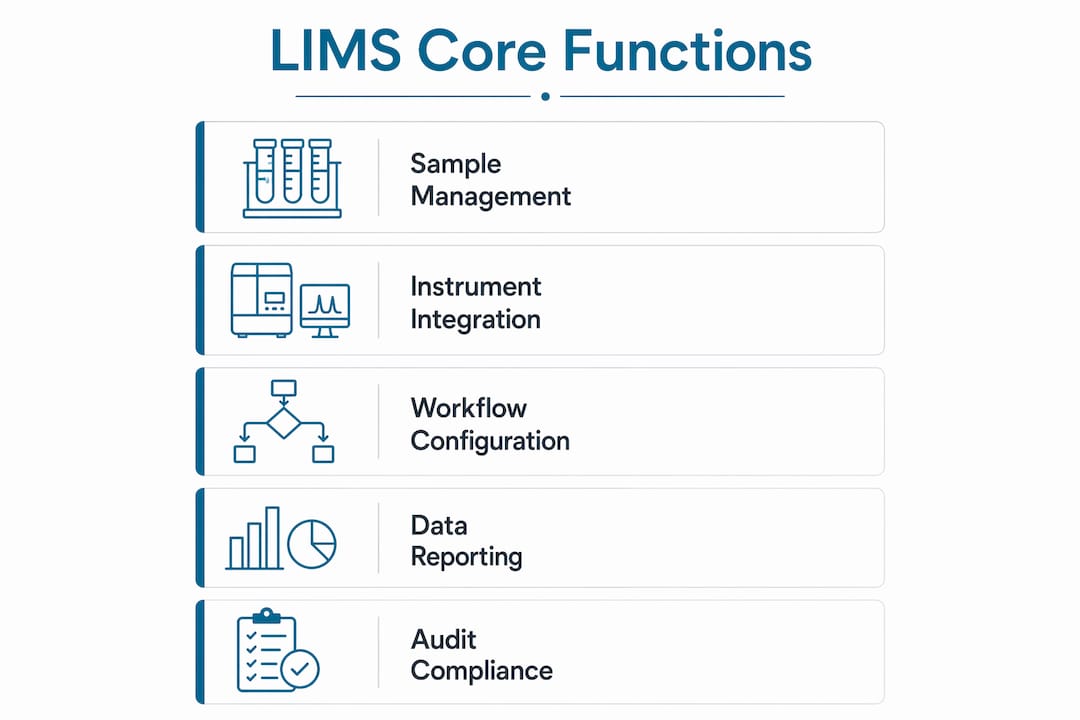
LIMS workflow design is built on five functional pillars, each of which directly affects lab turnaround time, data quality, and regulatory standing.
Sample lifecycle management covers every state a specimen passes through, from accessioning and aliquoting to storage, testing, and archival. A well-configured LIMS enforces state transitions so that no sample moves to the next step without meeting defined criteria. This alone eliminates a significant category of manual errors in high-volume clinical labs.
Instrument integration and automated data capture remove the transcription step that introduces errors in paper-based or semi-digital labs. When a sequencer, mass spectrometer, or PCR platform pushes results directly into the LIMS, the system can apply reference ranges, flag anomalies, and route results to the correct review queue without human intervention.

Workflow configuration and SOP enforcement are where LIMS design decisions have the longest-lasting impact. Configurable workflow rules let you encode your standard operating procedures directly into the system. If a pharmacogenomics panel requires a second reviewer before sign-out, the LIMS enforces that gate. If a sample type requires a specific extraction protocol, the system presents only the valid options.
Data management and reporting readiness determine how quickly your lab can move from raw instrument output to a finalized clinical report. LIMS that maintain structured, normalized data from the point of capture make downstream reporting, whether for providers, patients, or regulators, far faster and less error-prone.
Audit trail and compliance functionality are non-negotiable in regulated environments. Under FDA 21 CFR Part 11, audit trails must be secure, computer-generated, and time-stamped, recording both old and new values with user IDs. This means your LIMS must generate immutable records of every data change, not just final results. Labs that treat audit trails as an afterthought routinely face remediation costs that dwarf the original implementation budget.
Pro Tip: When configuring your LIMS workflow, map your SOPs to system states before touching any configuration screen. Labs that start with the software and work backward to their SOPs end up with workflows that fit the tool, not the science.
How does LIMS integration influence scalability and standardization?
Scaling lab operations with LIMS is not simply a matter of adding more user licenses. It requires deliberate architectural decisions made at the design stage, not after growth exposes the gaps.
The four design decisions that most directly affect scalability are:
-
Unified data model. Standardized global workflow configuration layered with automation and API frameworks avoids manual step translation across sites and reduces errors. A unified data model means that a sample accessioned in one location carries the same identifiers, metadata structure, and status codes as one processed in another. Without this, multi-site reporting becomes a reconciliation exercise.
-
Interoperability standards. HL7 ORM/ORU messaging defines how orders and results move between your LIMS and EHR or billing systems. ORU^R01 messages carry preliminary and final results, including corrected reports, in a structured format that downstream systems can parse without custom mapping. FHIR resources extend this to modern API-based integrations. Labs that skip standardization at this layer accumulate technical debt with every new integration.
-
Cloud and network architecture. Cloud platforms support resilience, multi-site collaboration, auditability, and data integrity as part of a modernization strategy. A cloud-first LIMS deployment lets you add capacity, extend to new sites, and maintain a single compliance posture without duplicating infrastructure.
-
Centralized versus distributed deployment. Centralized LIMS deployments reduce configuration drift and simplify validation. Distributed models offer local resilience but require strict governance to prevent sites from diverging. Most reference labs and multi-location genetic testing networks favor centralized deployments with role-based access segmented by site.
The following table compares centralized and distributed LIMS deployment models across the dimensions that matter most for clinical and genomic labs:
| Dimension | Centralized LIMS | Distributed LIMS |
|---|---|---|
| Configuration consistency | Single source of truth across all sites | Risk of site-level configuration drift |
| Validation overhead | Validate once, deploy everywhere | Each site may require independent validation |
| Compliance posture | Unified audit trail and access controls | Requires cross-site audit aggregation |
| Local resilience | Dependent on network connectivity | Operates independently if network fails |
| Scalability | Add sites without new infrastructure | Infrastructure scales per site |
Bayer's LIMS deployment on AWS demonstrates what centralized cloud governance looks like at scale. The deployment uses infrastructure-as-code, VPN encryption, and network inspection to maintain compliance across multiple regions. This approach reduces operational overhead and promotes cross-site collaboration without sacrificing security controls.
What design patterns optimize LIMS-enabled lab workflows?
The difference between a LIMS that works at launch and one that still works five years later comes down to architectural discipline at the design stage.
Interface engines and schema-first API contracts are the foundation of durable interoperability. Designing integration as interface contracts with standardized vocabularies like LOINC and SNOMED, dead-letter queues for failed messages, and retry logic prevents the fragile point-to-point connections that break whenever a connected system updates. Schema-first design means both sides of an integration agree on data structure before any code is written. This reduces rework when either system changes.
Immutable audit trails are a design requirement, not a configuration option. Every write operation in a regulated LIMS should generate a time-stamped, user-attributed record that cannot be altered. This satisfies FDA 21 CFR Part 11 requirements and gives your quality team a reliable basis for investigations and CAPA documentation.
Pipeline orchestration as part of workflow execution is the design pattern that separates genomics-ready LIMS from general-purpose lab software. Immutable sample manifests, locked pipeline versions, and controlled compute zones are workflow design imperatives in clinical molecular labs. When your bioinformatics pipeline is treated as a workflow step inside the LIMS rather than a separate system, you get complete provenance from sample to variant call. Re-runs become reproducible, and audit queries become answerable.
The table below compares two integration architecture approaches that labs commonly evaluate:
| Architecture approach | Strengths | Weaknesses |
|---|---|---|
| Point-to-point custom integrations | Fast to build for a single connection | Fragile, hard to maintain, accumulates technical debt |
| Interface engine with schema contracts | Durable, auditable, supports retry logic | Requires upfront design investment |
Vendor selection and operating model shape the LIMS's long-term fit more than any feature comparison. LIMS success is defined more by system architecture and vendor operating model alignment than by feature checklists over a 10 to 15 year lifespan. Validation support, release management discipline, and the vendor's willingness to support your integration roadmap are the factors that determine total cost of ownership.
Pro Tip: Ask every LIMS vendor to walk you through their release validation process and how they handle breaking changes in integrations. The answer tells you more about long-term fit than any demo.
What challenges do labs face when designing workflows around LIMS?
Even well-resourced labs encounter predictable obstacles when implementing or redesigning LIMS-driven workflows. Knowing these in advance lets you design around them rather than react to them.
-
Legacy system fragmentation. Most clinical labs inherit a mix of instruments, middleware, and data systems that were never designed to interoperate. Incremental change is often the only viable path, which means your LIMS design must accommodate a transition period where some data still flows through legacy channels. Designing clear data ownership boundaries from the start prevents the LIMS from becoming just another silo.
-
Technical debt from fragile integrations. One-off custom mappings between your LIMS and an EHR or billing platform feel like solutions until the connected system updates its schema. Labs that build integrations without standardized vocabularies and retry logic accumulate a maintenance burden that eventually consumes more engineering time than new development. The fix is designing integrations as contracts from day one, not retrofitting standards after the fact.
-
Validation overhead in regulated environments. Every configuration change in a regulated LIMS requires documentation, testing, and sign-off. Labs that underestimate this overhead during design end up with workflows that cannot be updated quickly enough to keep pace with operational needs. Cloud-native LIMS platforms that support infrastructure-as-code reduce validation cycles by making environment changes reproducible and auditable.
-
User adoption and workflow discipline. A LIMS only delivers its benefits when staff use it as designed. Workarounds, whether a technician logging results in a spreadsheet before entering them into the system or a reviewer bypassing a required approval step, create data gaps that surface during audits. Workflow design must account for the human element, which means involving bench staff in configuration decisions and building in feedback mechanisms.
-
Complexity of genomic and PGx workflows. Pharmacogenomics and hereditary cancer testing workflows involve multi-gene panels, complex interpretation rules, and report deliverables that generic LIMS platforms were not built to handle. Labs in this space need a system that treats PGx reporting as a first-class workflow output, not an afterthought bolted onto a sample tracking tool.
Key takeaways
The role of LIMS in lab workflow design is to unify sample management, instrument integration, compliance enforcement, and scalable architecture into a single operational system that grows with the lab.
| Point | Details |
|---|---|
| Audit trails are non-negotiable | FDA 21 CFR Part 11 requires time-stamped, immutable records of every data change with user attribution. |
| Standardized interoperability reduces debt | HL7 ORM/ORU and FHIR contracts with LOINC/SNOMED vocabularies prevent fragile custom mappings. |
| Cloud-first architecture enables scale | Centralized cloud deployments support multi-site collaboration, compliance, and AI-ready data creation. |
| Vendor operating model matters more than features | Architecture alignment and validation support define LIMS fit over a 10 to 15 year lifespan. |
| Genomics workflows need pipeline integration | Immutable sample manifests and locked pipeline versions inside the LIMS are required for reproducible genomic outputs. |
What I've learned about LIMS design after years in genetic testing labs
The most common mistake I see labs make is treating LIMS selection as a procurement exercise rather than an architectural decision. They build a feature checklist, score vendors against it, and select the highest scorer. Then, two years into operation, they discover that the vendor's release cadence breaks integrations quarterly, or that the data model cannot support the multi-panel PGx workflows they need to add.
The labs that get this right start with architecture. They ask: how does this system handle data at the boundaries? What happens when a connected EHR sends a malformed message? How does the vendor support us through a major version upgrade? Those questions reveal more about long-term fit than any feature demonstration.
The second lesson is that cloud architecture is not a preference. It is the only path to embedding compliance by design, which is what regulators increasingly expect and what AI-powered workflow tools require. Labs still running on-premise LIMS with manual backup processes are not just behind on technology. They are accumulating regulatory and operational risk with every passing quarter.
Finally, PGx and molecular diagnostic labs need to stop accepting generic LIMS platforms as good enough for their reporting workflows. The report is the clinical deliverable. If your LIMS cannot support structured PGx interpretation, CPIC guideline references, and branded provider-facing output, you are doing the hardest part of your science and then handing it off to a system that was built for a blood draw, not a pharmacogenomics panel.
— Tarek
How Labrynix supports scalable, compliant lab workflow design
If you are designing or redesigning a LIMS-driven workflow for a genetic testing, PGx, or molecular diagnostic lab, Labrynix was built specifically for this problem. The platform connects LIMS workflow management, AI-assisted PGx reporting, HL7 and FHIR integration, provider and patient portals, and billing visibility into one system designed around the complete sample-to-report workflow.
Labrynix supports immutable audit trails, role-based access, configurable workflow queues, and CPIC and PharmGKB-informed reporting, all within a HIPAA-conscious architecture. For reference labs and multi-site networks, Labrynix provides the centralized workflow visibility and integration infrastructure that generic LIMS platforms cannot deliver. If your lab is ready to move beyond disconnected tools, Labrynix is built for exactly where you are going.
FAQ
What is the primary role of LIMS in lab workflow design?
LIMS serves as the central system that automates sample lifecycle management, enforces SOPs, captures instrument data, and generates audit trails across every step of a lab's workflow. Its primary function is to replace manual handoffs with structured, traceable, and configurable process flows.
How does LIMS integration improve lab turnaround time?
LIMS integration eliminates manual data transcription between instruments and reporting systems by using HL7 ORU^R01 messages to carry results directly from instruments to clinical systems. This reduces transcription errors and accelerates the path from result capture to final report delivery.
Why do reference labs need a scalable LIMS?
Reference labs processing high volumes across multiple sites require a unified data model and standardized workflow configuration to maintain consistency and compliance without manual reconciliation. A scalable LIMS with cloud architecture and API-based integration supports growth without proportional increases in operational overhead.
What compliance requirements affect LIMS audit trail design?
FDA 21 CFR Part 11 requires that electronic records include secure, computer-generated audit trails with time-stamped entries recording both old and new values and the user responsible for each change. LIMS platforms that do not generate immutable audit trails by default cannot meet this standard without significant customization.
How should a new lab design its LIMS sample workflow?
A new lab should map its SOPs to system states before configuring any LIMS workflow, defining the required data at each transition point and the rules that govern movement between states. Starting with standardized interoperability contracts for HL7 and FHIR connections prevents the technical debt that accumulates from custom point-to-point integrations built under time pressure.