
LIMS test code management is the centralized process of defining, configuring, and maintaining every laboratory test's parameters and protocols within a Laboratory Information Management System to ensure accuracy, traceability, and compliance. The industry term for this practice is test code configuration, though lab managers increasingly use "test code management" to describe the full lifecycle of creating, updating, validating, and retiring test definitions inside a LIMS. Understanding what is LIMS test code management matters because it sits at the foundation of every workflow decision your lab makes, from order intake to final report. Without it, labs default to disconnected spreadsheets, paper logs, and manual data entry that introduce errors at every step.
What is LIMS test code management and why does it matter?
LIMS test code management centrally defines and maintains test methodologies, parameters, and workflow requirements, replacing fragmented spreadsheets and paper logs with a structured digital system. Each test code acts as a master record. It stores the method, required sample type, reference ranges, units, instrument assignments, turnaround time targets, and approval rules for a single test type.
Think of a test code as the recipe card for a specific assay. Every time a lab professional orders that test, the LIMS pulls the same recipe, applies the same validation rules, and routes the sample through the same workflow steps. That consistency is what makes results comparable across runs, operators, and time points.

For genetic and molecular labs, this matters even more. A pharmacogenomics panel may involve dozens of gene targets, multiple interpretation rules, and CPIC guideline references. Without a properly configured test code, each report becomes a manual assembly job. With one, the LIMS handles the routing, data capture, and report population automatically.
LIMS acts as the operating system of a laboratory, connecting people, instruments, samples, and data to maintain organization, traceability, and compliance. Test code management is the foundational layer that makes that connection possible.
How does LIMS test code management optimize lab workflows and data accuracy?
Digitizing laboratory operations with LIMS can reduce manual errors by over 80%, improve turnaround times by 25–40%, and keep labs audit-ready. Those numbers reflect what happens when test parameters stop living in someone's head or a shared spreadsheet and start living in a governed digital system.
The workflow gains come from three specific mechanisms:
- Automated test ordering. When a provider submits an order, the LIMS matches it to the correct test code and triggers the right workflow without manual intervention.
- Standardized data capture. Instruments send results directly to the test code record, eliminating transcription errors.
- Built-in validation rules. The system flags out-of-range values, missing fields, or failed QC checks before results reach the review queue.
LIMS platforms automatically enforce SOPs, manage queues, assign workloads, and escalate overdue items to maintain workflow efficiency. That means your lab staff spend time on clinical judgment, not on chasing paperwork or correcting data entry mistakes.
Pro Tip: Map your current test workflow on paper before configuring any test code in your LIMS. Identify every decision point, every data field, and every handoff. That map becomes your configuration blueprint and prevents you from building a digital version of a broken process.
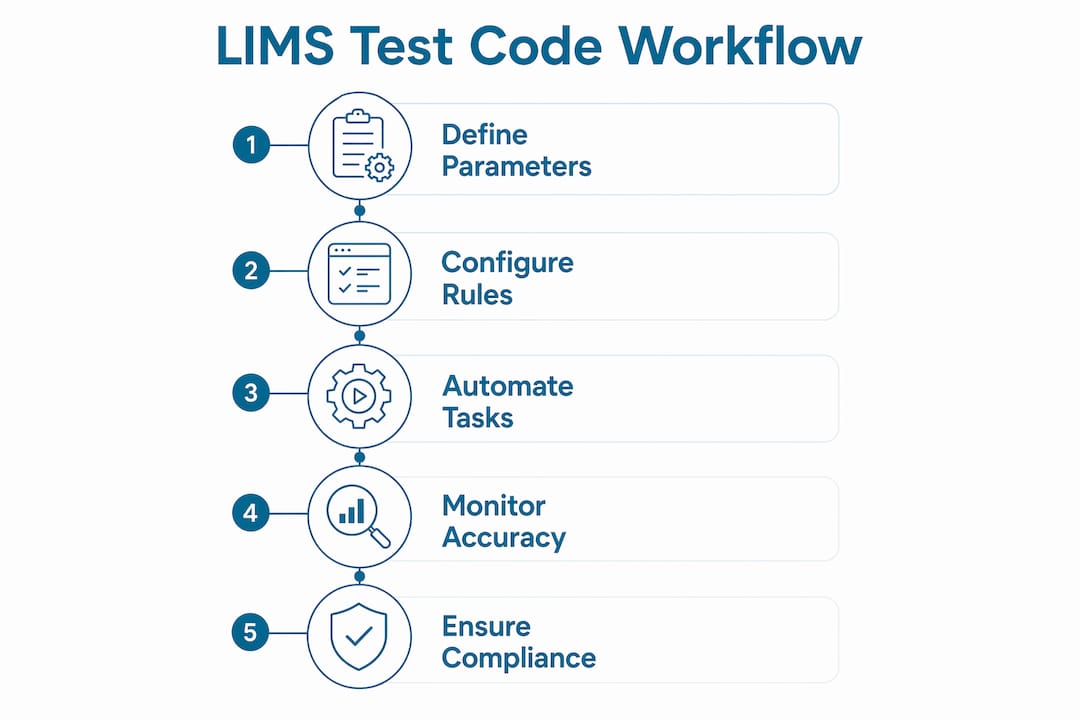
Data accuracy improves because the test code enforces consistency at the source. Reference ranges, units, and calculation formulas are defined once and applied everywhere. A result reported in ng/mL on monday will use the same unit definition on friday, regardless of which staff member processed the sample.
What are the key components of effective LIMS test code management?
A well-configured test code is more than a name and a method reference. It contains several interdependent components that together define how a test behaves inside the system.
Core configuration elements
- Test identifier and description. A unique code, a plain-language name, and a version number that tracks changes over time.
- Sample requirements. Specimen type, volume, container, and storage conditions linked directly to the test code.
- Analytical parameters. Reference ranges, units, calculation rules, and result types (numeric, text, or interpreted).
- Workflow template. The sequence of steps from accessioning through analysis to reporting, with assigned roles at each stage.
- Validation rules. Logic that checks results against expected ranges, flags delta changes, or requires supervisor review for specific outcomes.
Integration and signature controls
LIMS integrates with laboratory instruments enabling bidirectional data transfer, worklist dispatch, and automatic result capture to eliminate transcription errors. When a test code is linked to a specific instrument, the LIMS sends the worklist and receives results without any manual data entry.
Electronic signatures tie directly to test code workflows. Each approval step requires a credentialed user action, creating a time-stamped record of who reviewed and released each result. This is not optional for regulated labs. It is the mechanism that makes your data defensible.
No-code or low-code configurability allows lab managers to define custom test parameters and validation rules dynamically, avoiding costly developer dependency. That means your team can add a new gene panel, update a reference range, or retire an obsolete method without filing a software change request with an IT vendor.
Pro Tip: Version-control every test code change. Even minor updates to reference ranges or calculation formulas should carry a new version number, a change reason, and an approval signature. This practice protects you during audits and makes rollbacks straightforward if a change causes unexpected results.
How does LIMS test code management support regulatory compliance?
Regulatory compliance in laboratory testing is built on one principle: you must be able to prove what happened, who did it, and when. LIMS test code management provides that proof automatically.
Effective LIMS test code management ensures standardized protocols, full traceability, and compliance with ISO 17025, GMP, and FDA 21 CFR Part 11 by documenting who performed a test, when, and how. Each of those frameworks has specific documentation requirements, and a properly configured LIMS satisfies them through normal operation rather than through extra paperwork.
The compliance benefits break down by framework:
- ISO 17025. Requires documented procedures, calibration records, and traceability of results. Test code management stores all three in one place.
- GMP. Requires batch records, deviation tracking, and change control. Test code versioning and audit trails fulfill these requirements.
- FDA 21 CFR Part 11. Requires electronic records and signatures that are trustworthy, reliable, and equivalent to paper records. LIMS electronic signatures linked to test code approvals meet this standard directly.
Audit trails in LIMS capture every user action and modification, ensuring full traceability and supporting internal and external audit requirements. When an inspector asks who changed a reference range and why, the system answers that question in seconds.
A lab that treats audit readiness as a daily operational practice, not a pre-inspection scramble, will always outperform one that treats compliance as a periodic event.
The practical value of this goes beyond passing audits. Labs that maintain clean, complete test code records can onboard new staff faster, investigate result discrepancies more efficiently, and respond to method changes with confidence. Compliance infrastructure built into the LIMS becomes a competitive advantage, not just a regulatory burden.
What are best practices for implementing LIMS test code management?
Implementing LIMS is a long-term commitment that requires modeling real lab workflows rather than forcing staff to adapt to rigid software templates. That principle applies directly to test code configuration. The most common implementation failure is building test codes around what the software makes easy rather than what the lab actually does.
Practical best practices for your implementation:
- Start with your highest-volume tests. Configure and validate those first. Early wins build staff confidence and expose configuration gaps before you scale.
- Involve bench-level staff in configuration reviews. The people running the tests know the edge cases that managers miss. Their input prevents validation failures after go-live.
- Define your change control process before you go live. Decide who can propose, approve, and activate test code changes. Document that process in your SOP before the first change request arrives.
- Avoid over-customization. Every custom field and non-standard workflow step adds maintenance burden. Build only what you need to meet your actual requirements.
- Plan for test code retirement. Tests get discontinued. Build a retirement workflow that archives the code, preserves historical data, and prevents accidental reactivation.
No-code configurability empowers lab managers to update test codes, parameters, and validation logic independently, which is critical for adapting to scientific advancements cost-effectively. When a new CPIC guideline updates the interpretation rules for a pharmacogenomics panel, your team should be able to implement that change without waiting for a software vendor.
Pro Tip: Run a parallel validation period for any new or updated test code. Process a set of known samples through both the old and new configurations and compare results before activating the change in production. This catches configuration errors before they affect patient results.
Training is the final piece. Staff who understand why test codes are structured the way they are will follow the system correctly. Staff who see it as an obstacle will find workarounds. Invest in training that explains the purpose behind each configuration decision, not just the mechanics of how to use the interface.
Key takeaways
LIMS test code management is the foundational layer that connects standardized protocols, instrument data, audit trails, and regulatory compliance into a single governed system.
| Point | Details |
|---|---|
| Core definition | Test code management centralizes test parameters, workflows, and validation rules in one digital system. |
| Workflow impact | Digitizing test codes reduces manual errors by over 80% and improves turnaround times by 25–40%. |
| Compliance coverage | Properly configured test codes support ISO 17025, GMP, and FDA 21 CFR Part 11 through built-in audit trails. |
| Configuration principle | Model your real lab workflows first; never build test codes around software defaults. |
| Change control | Version every test code update with a reason and approval signature to protect audit readiness. |
The operational backbone most labs underestimate
I have seen labs invest heavily in instruments and reagents while treating their LIMS configuration as an afterthought. That is the wrong priority order. Your test codes are the operational backbone of your lab, the same way an ERP system is the backbone of a manufacturing plant. If those records are incomplete, inconsistent, or poorly governed, every downstream process inherits those problems.
The labs that get this right treat test code management as a living practice, not a one-time setup task. They assign ownership, run regular reviews, and treat every method change as a configuration event that requires documentation. The labs that struggle treat test codes as static records that only get touched when something breaks.
The other thing I would push back on is the idea that compliance and efficiency are in tension. A well-configured LIMS test management system makes compliance automatic. You are not filling out extra forms. You are running your normal workflow and the system is generating the documentation as a byproduct. That is the right way to think about it.
For genetic and molecular labs specifically, the stakes are higher. Your test codes carry interpretation logic, guideline references, and reporting rules that directly affect clinical decisions. Getting that configuration right is not a technical exercise. It is a patient safety practice.
— Tarek
How Labrynix supports test code management for molecular labs
Labrynix is built specifically for genetic testing, molecular diagnostics, and pharmacogenomics laboratories that need more than a generic LIMS.

The Labrynix LIMS platform gives lab managers configurable test code setup without requiring developer support. You define your test parameters, workflow steps, validation rules, and approval chains directly in the platform. Instrument integration through HL7, FHIR, and direct API connections automates data capture and eliminates manual transcription. Audit trails, electronic signatures, and role-based access controls are built into every workflow to support ISO 17025, GMP, and FDA 21 CFR Part 11 requirements. For labs running PGx panels, Labrynix connects test code configuration directly to CPIC guideline support and PharmGKB-informed reporting. Labs managing genetic testing workflows can configure, validate, and deploy test codes within a single connected system.
FAQ
What is LIMS test code management?
LIMS test code management is the centralized process of defining, configuring, and maintaining test parameters, workflows, and validation rules within a Laboratory Information Management System. It replaces manual spreadsheets and paper logs with a governed digital system that enforces consistency across every test run.
How does test code management reduce lab errors?
Digitizing laboratory operations with a LIMS reduces manual errors by over 80% by automating data capture, enforcing validation rules, and eliminating manual transcription between instruments and records.
Which regulations does LIMS test code management support?
LIMS test code management supports ISO 17025, GMP, and FDA 21 CFR Part 11 by documenting who performed each test, when, and how, and by maintaining complete audit trails for every configuration change and result approval.
What is the difference between a test code and a test order?
A test code is the master configuration record that defines how a test is performed. A test order is a specific instance of that test requested for a particular sample or patient. The order inherits all parameters from the test code at the time it is placed.
How do you manage test code changes in a LIMS?
Effective test code change control requires versioning every update, documenting the reason for the change, obtaining an approval signature, and running a parallel validation before activating the new version in production.