
LIMS acceptance testing is the systematic process of verifying that a Laboratory Information Management System meets all operational and regulatory requirements before going live in a new lab. In the genetic testing and molecular diagnostics space, this process carries real stakes. A misconfigured workflow or unvalidated data migration can compromise sample traceability, delay patient results, and create audit failures under CLIA, CAP, or ISO 17025. The formal industry term for this process is User Acceptance Testing, or UAT. Following structured LIMS acceptance testing new lab steps is the difference between a confident go-live and a costly rollback.
What prerequisites are essential before starting LIMS acceptance testing?
Preparation determines whether acceptance testing runs cleanly or collapses under avoidable gaps. Labs that skip this phase discover problems during execution, when fixing them costs far more time and credibility.
The first 30 days of any LIMS implementation should focus on discovery sessions with lab staff to map workflows in detail before anyone touches the software. This prevents workflow mismatch, the most common reason labs stall mid-implementation. Successful projects treat this phase as mapping, not training.
Key preparatory steps include:
- Workflow mapping and requirements gathering. Document every process from order intake through result delivery. For molecular labs, this means capturing accessioning rules, sample routing logic, instrument interfaces, and report approval chains. A detailed lab workflow design document becomes the benchmark against which you test.
- Data migration readiness. Data migration is the single most common source of mid-implementation friction. Legacy data quality problems surface late when migration planning starts late. Run automated checks and human review on legacy records before testing begins.
- Stakeholder and user engagement. Identify who will execute test cases, who will approve results, and who has authority to sign off. Lab directors, quality managers, and bench scientists each bring a different lens to testing.
- Test environment and test data selection. Build a dedicated UAT environment that mirrors production configuration. Use de-identified but realistic patient and sample data that reflects the full range of molecular diagnostic scenarios your lab handles.
Pro Tip: Never use live patient data in your UAT environment. Create synthetic records that mirror real case complexity, including edge cases like rejected samples, amended reports, and multi-gene panel orders.
What are the step-by-step procedures for LIMS acceptance testing in a new lab?
The UAT process follows seven sequential steps recognized as critical to regulatory and operational readiness. Each step builds on the last. Skipping one creates gaps that show up during audits or, worse, after go-live.
- Requirements mapping. Translate your workflow documentation into testable requirements. Every function the LIMS must perform should map to a specific business need, such as sample accessioning, result authorization, or HL7 result transmission.
- Scope definition. Agree on what is in scope for this testing cycle. Molecular labs often phase testing by workflow area: accessioning first, then reporting, then integrations.
- Participant preparation. Train testers on the UAT process itself, not just the software. They need to know how to execute a test case, log a defect, and distinguish a configuration issue from a software bug.
- Test plan creation. Write test cases that reflect realistic molecular diagnostics scenarios. A test case for a PGx panel should include ordering, accessioning, instrument data import, result interpretation, report generation, and provider delivery.
- UAT environment setup. Configure the environment to match production. Load test data, activate integrations, and confirm that user roles and permissions reflect real lab structure.
- Execution with triage. Run test cases, log defects with structured reporting, and triage issues by severity. Effective acceptance testing requires structured defect logging and formal sign-off by authorized personnel to maintain traceability and accountability.
- Formal sign-off. Authorized stakeholders review test results and formally approve the system for go-live. This document becomes part of your validation record.
The table below shows how each step maps to a compliance requirement:
| UAT Step | Compliance Relevance |
|---|---|
| Requirements mapping | ISO 17025 functional specification |
| Scope definition | CLIA workflow coverage confirmation |
| Participant preparation | CAP training documentation |
| Test plan creation | Validation protocol per regulatory standards |
| Environment setup | Audit-ready configuration record |
| Execution with triage | Defect log and resolution evidence |
| Formal sign-off | Validation report for ISO, CLIA, CAP audits |
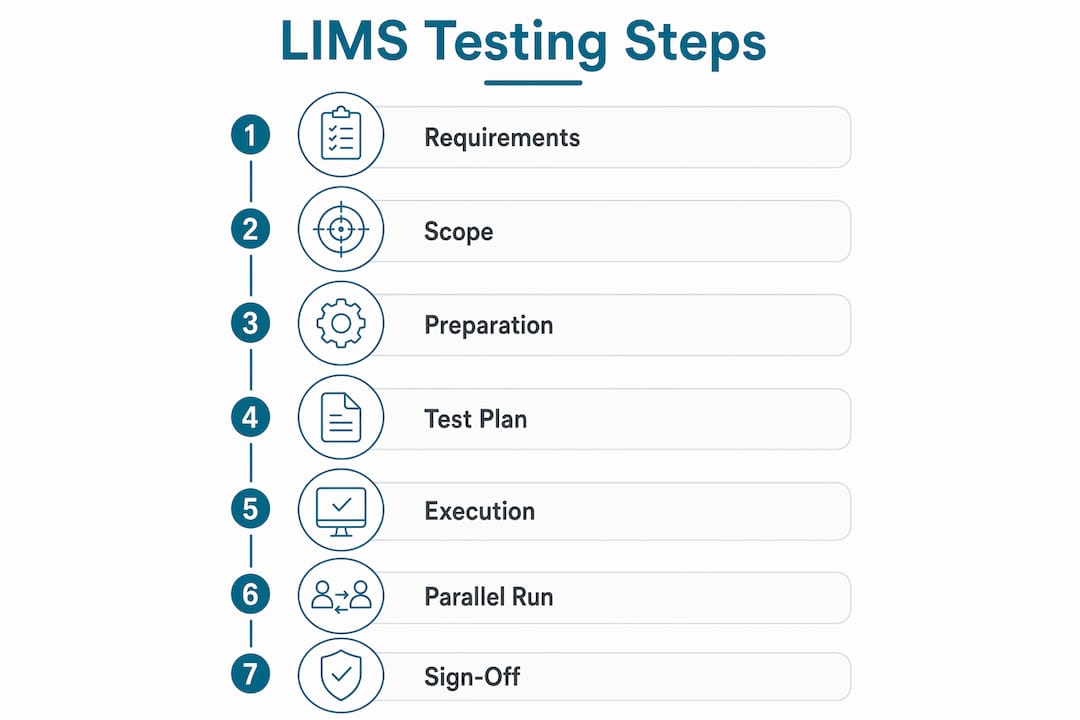
Running the new LIMS in parallel with your legacy system for a limited sample set is one of the most effective risk controls available. Parallel operation builds user confidence and generates documentation required by ISO 17025, CAP, and CLIA auditors. It also reveals discrepancies in data handling before they affect real patient results.

Pro Tip: A phased rollout approach reduces risk compared to a full cutover. Start with one workflow or one team, validate thoroughly, then expand. This gives you real-world evidence without betting the entire lab on a single launch day.
What common mistakes do labs make during LIMS acceptance testing?
Most acceptance testing failures trace back to the same handful of decisions made weeks before testing starts.
- Underestimating data migration complexity. Labs consistently discover that legacy data contains inconsistencies, duplicate records, and non-standard formats that block migration. Allocate dedicated time and resources for data cleansing before testing begins. Review the LIMS data migration best practices that apply specifically to molecular lab environments.
- Excluding end users from early testing. Bench scientists and lab technicians catch workflow problems that managers miss. Bring them in during test case design, not just execution.
- Skipping parallel testing. Labs that go live without parallel operation have no safety net. A single misconfigured result authorization rule can affect every sample processed that day.
- Poor documentation and unclear sign-off authority. Acceptance testing without a formal sign-off process produces no audit evidence. Define who can approve go-live and what criteria must be met before that approval is granted.
- Treating UAT as a bug hunt. The primary goal of UAT is to verify that the LIMS fulfills business requirements and behaves predictably under real-world conditions, not to find every software defect. Labs that chase bugs lose sight of whether the system actually supports their workflows.
"Acceptance testing is not about finding every flaw in the software. It is about confirming that the system does what your lab needs it to do, in the way your lab actually works, under the conditions your staff will face every day."
Contingency planning belongs in your test plan from day one. Define what happens if critical defects appear late in testing. Know your rollback procedure, your escalation path, and your minimum acceptance criteria before you start.
How can labs use acceptance testing results to improve workflows after go-live?
Acceptance testing generates more than a go-live approval. The defect logs, test results, and user feedback from UAT are a direct map of where your workflows need refinement.
- Link test findings to workflow improvements. Every defect resolved during UAT reveals a configuration gap or a process assumption that did not hold in practice. Catalog these findings and use them to update your standard operating procedures before go-live.
- Plan ongoing training cycles. UAT exposes which staff members struggled with specific functions. Use that data to target post-go-live training rather than delivering generic refresher sessions to everyone.
- Maintain documentation that meets ISO 17025 and CLIA standards. Documentation from acceptance testing activities supports ISO 17025, CLIA, and CAP audits. This includes configuration documents, validation reports, testing logs, and formal sign-offs. File these in a format your quality manager can retrieve during an inspection without searching.
- Use acceptance testing feedback for continuous quality improvement. Schedule a 30-day and 90-day post-go-live review. Compare live system performance against your UAT benchmarks. Gaps between expected and actual behavior after go-live often point to test scenarios that were not realistic enough. The LIMS compliance role in your lab extends well beyond initial validation.
Labs that treat acceptance testing as a one-time event miss the compounding value of the data it produces. The best-performing molecular labs use their UAT records as a living quality document, updating it with each system change, integration addition, or workflow modification.
Key Takeaways
Structured LIMS acceptance testing, executed in seven sequential steps with parallel operation and formal sign-off, is the foundation of compliant and operationally ready lab go-live.
| Point | Details |
|---|---|
| Prepare before you test | Map workflows and validate legacy data before any UAT begins to prevent mid-testing failures. |
| Follow the seven UAT steps | Requirements mapping through formal sign-off creates the audit trail ISO 17025, CLIA, and CAP require. |
| Run parallel operation | Testing new and legacy systems side by side on limited sample sets reduces go-live risk significantly. |
| Focus on business requirements | UAT confirms the LIMS supports real lab workflows, not just that the software is free of bugs. |
| Use test results after go-live | Defect logs and user feedback from UAT drive targeted training and continuous quality improvement. |
What I have learned from LIMS acceptance testing in genetic labs
The most consistent mistake I see genetic and molecular labs make is treating acceptance testing as a technical checkpoint rather than a clinical validation exercise. The distinction matters. A technical checkpoint asks whether the software works. A clinical validation exercise asks whether the software supports the way your lab delivers results to patients and providers.
Discovery sessions before staff ever interact with the system are not optional. They are the single highest-return activity in the entire implementation. Labs that skip them spend their UAT cycles correcting workflow assumptions that should have been resolved in week one. The go-live preparation checklist for molecular labs exists precisely because these early decisions compound.
Parallel testing is not a luxury for high-volume labs. It is a risk control that every lab running high-complexity molecular diagnostics owes to its patients. Running both systems on a subset of real samples gives you evidence, not just confidence.
Formal sign-off is the step labs most often try to shortcut. A verbal agreement from the lab director is not a validation record. A signed document with defined acceptance criteria, a list of resolved defects, and an authorized approval date is. That document is what stands between your lab and a citation during a CAP inspection.
My strongest advice: prioritize verifying that your LIMS fulfills your business requirements over chasing every minor software defect. A system that handles 95% of your workflows correctly and has a documented workaround for the remaining 5% is ready for go-live. A system that is technically perfect but does not match how your lab actually works is not.
— Tarek
Labrynix supports genetic labs through every LIMS implementation step
Genetic testing and molecular diagnostic labs face implementation challenges that generic laboratory software was never designed to handle. Labrynix was built specifically for these environments, with LIMS workflow management, sample tracking, PGx reporting, and compliance-ready audit tools designed around the complete sample-to-report process.

Labs using Labrynix LIMS for genetic testing get a platform that reflects real molecular lab workflows from day one, reducing the configuration gaps that drive UAT failures. The Labrynix LIMS platform supports role-based access, audit logs, configurable permissions, and integration pathways that align with ISO 17025, CLIA, and CAP documentation requirements. If your lab is preparing for acceptance testing or planning a LIMS implementation, Labrynix provides the infrastructure and the expertise to support a structured, compliant go-live.
FAQ
What is LIMS acceptance testing?
LIMS acceptance testing, formally called User Acceptance Testing or UAT, is the process of verifying that a Laboratory Information Management System meets all defined business and regulatory requirements before going live. It confirms the system supports real lab workflows under realistic operating conditions.
How many steps does LIMS UAT involve?
UAT follows seven sequential steps: requirements mapping, scope definition, participant preparation, test plan creation, environment setup, execution with triage, and formal sign-off. Each step produces documentation that supports ISO 17025, CLIA, and CAP audit requirements.
Why is parallel testing important during LIMS implementation?
Parallel testing runs the new LIMS alongside the legacy system on a limited sample set, which builds staff confidence and generates audit evidence without risking full workflow disruption. It is the most effective safety net available during a high-stakes lab transition.
What documents does acceptance testing produce for compliance?
Acceptance testing generates configuration documents, validation reports, defect logs, test case records, and formal sign-off approvals. These records directly support ISO 17025, CLIA, and CAP accreditation audits.
What is the biggest risk in LIMS acceptance testing for molecular labs?
Data migration complexity is the most common source of implementation failure. Legacy data quality problems, including duplicate records and non-standard formats, surface during migration and block testing progress when not addressed in the preparation phase.