
LIMS implementation for a startup lab is the structured process of deploying a Laboratory Information Management System to manage sample tracking, workflow queues, audit logs, user roles, and data flow from the first sample onward. The industry term is LIMS implementation, and for startup labs it carries a specific meaning: you are not migrating a legacy system. You are building operational infrastructure from scratch. Only 1 in 5 labs consider themselves fully digital despite widespread software use, which means most labs are still running on disconnected tools and manual exports. Getting LIMS configuration right at the startup stage determines whether your lab scales cleanly or spends years unwinding bad data habits.
What is LIMS implementation in a startup lab?
LIMS implementation in a startup lab is the end-to-end process of selecting, configuring, validating, and deploying a Laboratory Information Management System that fits your current workflows while leaving room to grow. Unlike established labs that retrofit LIMS around existing processes, startup labs have a rare advantage: they can design the system before bad habits form. The tradeoff is that workflows are still evolving, which makes choosing the wrong architecture expensive to fix later.
The core purpose of LIMS in a startup lab covers four areas. First, workflow management: test orders, accessioning, sample status, and result routing all move through a single tracked system instead of scattered spreadsheets. Second, data integrity: every action is timestamped and attributed to a user, which is the foundation of audit logs and regulatory defensibility. Third, compliance readiness: HIPAA-conscious access controls, role-based permissions, and configurable workflows reduce the manual compliance burden on your team. Fourth, operational visibility: lab managers can see bottlenecks, turnaround times, and queue depths without pulling reports manually.

54% of labs still rely on Excel for daily operations even after deploying a LIMS. That number tells you that software installation alone does not equal digitalization. True lab digitalization means data flows without manual intervention at any point in the process. For a startup lab, building that end-to-end flow from day one is far cheaper than retrofitting it after your team has already normalized the Excel workaround.
What are the critical phases of LIMS implementation?
LIMS implementation timelines typically run three to twelve months depending on lab complexity, integration requirements, and team capacity. That range is wide because the phases themselves vary in difficulty based on how clearly the lab has defined its workflows before vendor selection begins.
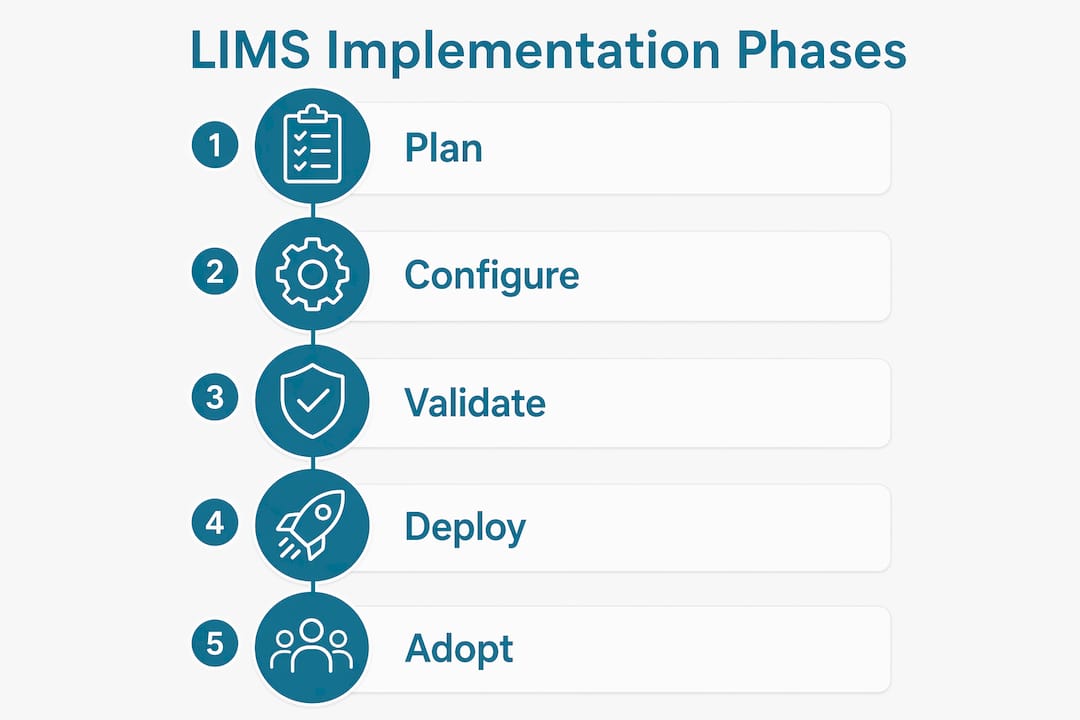
The six phases every startup lab should plan for are:
- Workflow mapping. Document every process before touching the software. Map order intake, accessioning, sample routing, result generation, and report delivery. Gaps you find here are cheaper to fix on paper than in a configured system.
- Vendor selection. Evaluate vendors on architecture, integration model, and validation support, not just feature lists. Architecture and data strategy matter more than any individual feature because they determine how well the system ages over a decade.
- System configuration. Configure workflows, user roles, audit settings, and data fields to match your mapped processes. For molecular and genetic testing labs, this includes accessioning rules, test panel logic, and report routing.
- Data migration. If you have existing patient records, provider data, or historical results, migration requires a defined data map, validation checks, and a rollback plan. Starting fresh is simpler, but most labs have at least some data to carry forward.
- Testing and user acceptance. Run parallel operations where possible. Test every workflow path, including edge cases like rejected samples, amended reports, and failed instrument reads. User acceptance testing should involve the people who will use the system daily, not just IT.
- Training and go-live. Training is not a one-day event. Plan for role-specific sessions, a documented reference guide, and a designated internal champion who can answer questions after the vendor leaves.
Pro Tip: Launch with a Minimum Viable LIMS. Configure only the workflows you need for your first 90 days of operation. Add modules and complexity after your team has built confidence with the core system. Over-configuring at launch is the single most common reason startup lab LIMS projects stall.
How does LIMS implementation differ for startup labs?
Startup labs face a different set of constraints than established labs, and those constraints should drive every decision from vendor selection to go-live scope. The three most important differences are workflow fluidity, budget structure, and the absence of legacy data debt.
Labs with five to fifteen scientists typically fit configurable cloud platforms best, while GMP-regulated labs need validated commercial systems with a heavier compliance footprint. That distinction matters because it tells you which category of LIMS to evaluate. Configurable platforms let your team adjust workflows internally without vendor coding fees, which is critical when your experimental protocols are still changing month to month.
Here is how the three main LIMS categories compare for startup labs:
| LIMS type | Best fit | Key risk |
|---|---|---|
| Off-the-shelf commercial | Regulated GMP or clinical labs with stable workflows | Inflexible for evolving startup processes |
| Configurable cloud platform | Startup labs with 5 to 20 users and changing workflows | Requires internal admin capacity to maintain |
| Fully custom build | Labs with highly unique workflows and engineering resources | High cost, long timeline, validation burden |
The biggest trap startup labs fall into is over-customization. Configurable platforms allow internal admin adjustments without expensive change orders, but labs that request heavy custom development at the start often end up with a system that is expensive to upgrade and impossible to hand off to a new team member. The Minimum Viable LIMS approach solves this: launch lean, validate your workflows in production, then add complexity deliberately.
Legacy systems carry a different problem. They were built for different regulatory environments, different data models, and different integration patterns. Startup labs that inherit or purchase legacy LIMS software to save money often spend more on customization and workarounds than a modern cloud platform would have cost from the start.
What challenges do startup labs face during LIMS rollout?
The three most cited barriers to lab automation are staff resistance at 21%, regulatory constraints at 22%, and integration difficulties. Budget is cited by only 7% of labs as a primary barrier. That data point reframes the problem: your LIMS rollout is more likely to fail because of people and process than because of money.
Staff resistance is the most underestimated challenge in LIMS implementation. Scientists and lab technicians who have built personal workflows around Excel or paper logs will not abandon them without a compelling reason. Successful LIMS projects sell adoption internally using change champions, early wins, and visible proof that the new system makes their work easier, not harder. Identify two or three respected team members who will advocate for the system and involve them in configuration decisions before go-live.
Integration with lab instruments and external systems is the second major challenge. For molecular and genetic testing labs, this means connecting the LIMS to sequencers, PCR platforms, EMR systems, billing platforms, and provider portals. Each integration point is a potential data gap if not mapped and tested carefully. Platforms that support HL7, FHIR, and API connections reduce the custom development burden significantly.
Pro Tip: Map your lab compliance requirements before finalizing your LIMS configuration. Audit log requirements, role-based access rules, and data retention policies should be built into the system from day one, not added after your first regulatory review.
Ongoing validation costs can run two to three times the initial implementation cost when labs choose vendors that push validation responsibility entirely onto the customer. SaaS platforms that manage validation updates as part of their service model reduce total cost of ownership significantly over a five-year horizon. For startup labs with lean teams, that difference is material.
What does a LIMS implementation checklist look like for startup labs?
A practical LIMS implementation checklist for a startup lab covers five stages: readiness, vendor selection, configuration, go-live, and post-launch improvement.
Pre-implementation readiness
- Document all current workflows in writing, including manual steps and workarounds.
- Identify regulatory requirements: CLIA, CAP, HIPAA, or state-specific rules that apply to your lab type.
- Define success metrics before you start. Turnaround time, error rate, and audit log completeness are measurable targets.
- Assign a project owner with decision-making authority. LIMS projects without a named internal owner consistently run over schedule.
Vendor evaluation criteria
| Criterion | What to assess |
|---|---|
| Architecture | Cloud-native vs. on-premise; upgrade path and data portability |
| Integration model | HL7, FHIR, API support; instrument connectivity |
| Validation support | Who owns validation updates: vendor or customer? |
| Configuration flexibility | Can your team adjust workflows without vendor coding? |
| Support model | Implementation support, training, and post-go-live response time |
Go-live and post-launch
Once live, the work shifts to adoption and iteration. Run a 30-day post-launch review to identify workflows that are being bypassed or worked around. Those workarounds are signals that configuration needs adjustment, not that the system is wrong. Approaching LIMS implementation as a startup launch means treating post-go-live feedback as product iteration, not failure. Labs that build a culture of continuous improvement into their LIMS operations consistently outperform those that treat go-live as the finish line.
For molecular and genetic testing labs specifically, the post-launch phase should include a review of report generation workflows. Data reporting for molecular biology is increasingly expected to be structured, provider-accessible, and patient-readable. If your LIMS does not connect directly to your reporting layer, you are creating a manual handoff that will become a bottleneck as volume grows.
My honest read on LIMS as a startup project
I have seen lab managers treat LIMS implementation as a software procurement task. Buy the system, install it, train the team, done. That framing almost always produces a mediocre outcome. The labs that get it right treat LIMS implementation exactly the way a good startup treats a product launch: define the mission clearly, ship a minimum viable version, and iterate based on real user feedback.
The "why" matters more than most lab managers realize. If your team understands that the LIMS exists to protect data integrity, reduce manual errors, and give the lab a defensible audit trail, they will use it differently than if they think it is just a tracking tool management wanted. Selling the vision internally is not soft work. It is the difference between a system that gets used and one that gets worked around.
The other thing I would push back on is the instinct to configure everything at launch. Lean configuration is not a compromise. It is a strategy. A system your team actually uses at 60% of its capability is worth more than a fully configured system that half the team avoids. Start with the workflows that matter most, prove the value, and earn the right to add complexity.
— Tarek
How Labrynix supports startup lab LIMS implementation
Startup labs building genetic testing, molecular diagnostics, or pharmacogenomics workflows need a LIMS that fits their specific operational reality, not a generic clinical platform retrofitted with add-ons.

Labrynix is built specifically for molecular and genetic testing labs, combining LIMS workflow management, PGx reporting, provider and patient portals, billing visibility, HL7/FHIR integrations, and AI-powered workflow insights in one connected platform. For startup labs, that means you can configure sample tracking, audit logs, user roles, and report delivery workflows from day one without stitching together separate tools. Labrynix is designed to scale with your lab as volume grows, compliance requirements expand, and reporting complexity increases. If you are planning your LIMS launch, Labrynix gives you the infrastructure to do it right the first time.
FAQ
What is LIMS implementation for a startup lab?
LIMS implementation for a startup lab is the process of selecting, configuring, and deploying a Laboratory Information Management System to manage sample tracking, workflows, audit logs, and data flow from the ground up. Unlike established labs, startup labs build this infrastructure before workflows are fixed, which makes architectural fit and configuration flexibility the top selection criteria.
How long does LIMS implementation take for a startup lab?
LIMS implementation timelines typically run three to twelve months depending on workflow complexity, integration requirements, and team capacity. Startup labs that launch with a Minimum Viable LIMS and add modules post-go-live consistently complete initial deployment faster than labs that try to configure everything before launch.
Why do startup labs need LIMS before processing their first sample?
Implementing LIMS before the first sample creates a clean audit trail, enforces data integrity from the start, and avoids the cost of migrating messy historical data later. Labs that start on spreadsheets and migrate later spend significantly more time and money than labs that configure LIMS at launch.
Why should startup labs avoid legacy LIMS systems?
Legacy LIMS platforms were built for different regulatory environments and data models, and they typically require expensive customization to fit modern molecular workflows. Startup labs that choose legacy systems to save upfront costs often spend more on workarounds and upgrades than a modern cloud platform would have cost from day one.
What is the biggest risk in startup lab LIMS implementation?
Staff resistance and poor adoption are the leading causes of LIMS implementation failure, cited more often than budget or technical barriers. The most effective mitigation is identifying internal change champions early and involving them in configuration decisions before go-live.
Key takeaways
Successful LIMS implementation in a startup lab requires architectural fit, lean configuration, and deliberate adoption strategy, not just software installation.
| Point | Details |
|---|---|
| Start with workflow mapping | Document every process before configuring the system to avoid expensive post-launch rework. |
| Choose architecture over features | Integration model and validation support determine long-term fit better than any feature checklist. |
| Launch a Minimum Viable LIMS | Configure only the workflows needed for the first 90 days, then iterate based on real usage. |
| Sell adoption internally | Assign change champions and show early wins to prevent staff from reverting to spreadsheets. |
| Plan for post-launch improvement | Treat go-live as the starting point, not the finish line, and review bypassed workflows at 30 days. |