
A molecular diagnostic LIMS is defined as a specialized laboratory information management system built to handle the data complexity, sample genealogy, and multi-step workflows unique to molecular diagnostics. Unlike a generic laboratory information system (LIS), a molecular diagnostic LIMS is architected around the specific demands of PCR, next-generation sequencing (NGS), pharmacogenomics, and genetic testing workflows. Platforms like Labrynix and others in this space have moved well beyond basic sample tracking. They manage the full sample-to-report process, including accessioning, instrument integration, bioinformatics pipeline orchestration, compliance documentation, and clinical report delivery. If your lab runs molecular assays at any scale, understanding what separates a purpose-built LIMS from a generic one is the most consequential software decision you will make.
What is molecular diagnostic LIMS and why it matters
A molecular diagnostic LIMS is the operational core of any high-functioning molecular lab. It manages test orders, patient and provider data, sample status, workflow queues, audit trails, and result delivery in a single connected system. The industry term you will encounter in procurement conversations is "molecular LIMS" or "genomics LIMS," and both refer to the same category of purpose-built software.
The distinction from a conventional LIS matters immediately in practice. Traditional LIS platforms lack the data fields and workflow logic required for molecular-specific metadata, and many labs have already migrated away from them to avoid the operational cost of workarounds. A molecular LIMS treats specimen genealogy as primary data, not an afterthought. That architectural difference shapes every downstream process, from sample splitting to variant reporting.

For lab directors and operations managers, the practical implication is straightforward. A system not designed for molecular workflows will require constant manual intervention to compensate for what it cannot model natively. That intervention creates error risk, slows turnaround time, and complicates regulatory audits.
How does molecular diagnostic LIMS handle complex sample workflows?
Molecular labs generate a level of sample complexity that standard lab software was never designed to manage. A single specimen generates multiple derivatives across analytical platforms, and the LIMS must track every relationship between the primary sample and each downstream aliquot, extract, or library.
Consider a typical NGS workflow. A blood draw becomes a DNA extract. That extract becomes a library. The library is pooled with others and loaded onto a sequencer. Each step produces a new data object with its own quality metrics, reagent lot, technician ID, and instrument record. A molecular LIMS tracks all of these relationships without requiring manual re-entry at each stage.
Key workflow capabilities that separate molecular LIMS from generic alternatives include:
- Sample genealogy tracking: Full chain of custody from primary specimen through every derivative, with parent-child relationships preserved in the database.
- Multi-step protocol management: Configurable workflow stages for DNA/RNA extraction, quantification, library prep, pooling, sequencing, and analysis.
- Instrument-triggered automation: Direct integration with PCR systems, sequencers, and liquid handlers to auto-populate results and advance workflow status.
- Plate and pool mapping: Visual and data-driven management of multi-well plates, including index assignment and pool composition.
- Quality control checkpoints: Automated QC gates that flag samples failing concentration, purity, or fragment size thresholds before they advance.
Pro Tip: Map your lab's actual sample lineage on paper before evaluating any LIMS. If a vendor's demo cannot model your specific parent-to-derivative relationships without customization, that system will cost you more in workarounds than it saves in efficiency.
What are the key features of leading molecular LIMS platforms?
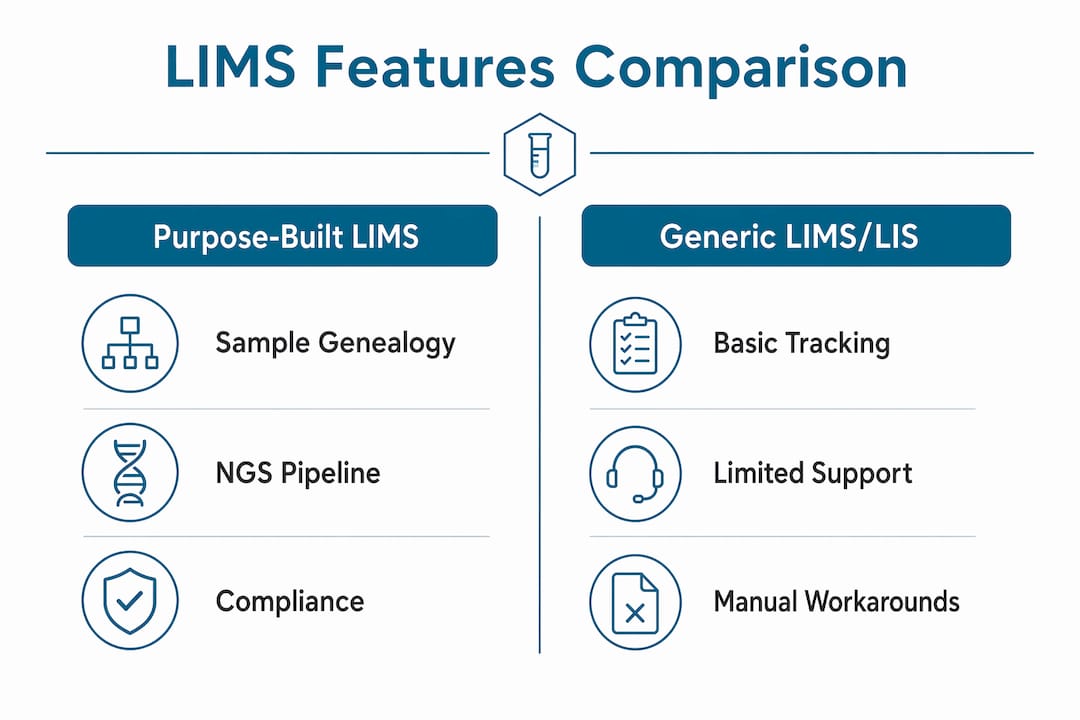
The best molecular diagnostic LIMS platforms share a core set of capabilities that generic systems cannot replicate without significant custom development. The table below compares the feature categories that matter most for molecular lab decision-makers.
| Feature Category | Purpose-Built Molecular LIMS | Generic LIMS or LIS |
|---|---|---|
| Sample genealogy | Native parent-child tracking across all derivatives | Requires custom fields or manual workarounds |
| Instrument connectivity | Pre-built connectivity to NGS, PCR, and sequencers | Custom middleware typically required |
| Bioinformatics integration | Pipeline triggering, VCF ingestion, variant annotation | Not supported natively |
| Regulatory compliance | CAP, CLIA, ISO 17025 audit trails and e-signatures | Basic audit logs, limited molecular context |
| Reporting | Genetic and PGx report generation with clinical interpretation | Generic result output, no molecular report templates |
| Scalability | Cloud deployment with multi-specialty and multi-location support | Often on-premises with limited expansion |
Modern molecular LIMS platforms integrate audit trails, electronic signatures, and quality management workflows compliant with CAP, CLIA, and ISO 17025. That compliance infrastructure is not a checkbox feature. It is the documentation layer that survives a regulatory inspection.
Inventory and reagent management is another area where purpose-built systems outperform generic ones. Molecular assays consume expensive reagents with strict lot tracking requirements. A LIMS that connects reagent consumption to specific runs and samples gives labs the traceability they need for both quality management and cost control.
Cloud-based LIMS platforms support scalability across multiple specialties and evolving workflows without disruptive system replacements. For growing labs or multi-location networks, that flexibility is a direct operational advantage.
Pro Tip: Ask vendors for a live demonstration of their compliance module, not just a slide deck. Request to see an audit trail for a specific sample event and verify that the electronic signature workflow meets your accreditation body's requirements.
How does molecular LIMS integrate with bioinformatics pipelines?
Bioinformatics integration is where many generic LIMS implementations fail completely. A single NGS run can generate terabytes of data, and the LIMS cannot store raw sequencing files. Its role is to act as an orchestration hub, triggering pipelines and ingesting structured variant call format (VCF) files that contain the interpreted results.
A well-integrated molecular LIMS handles the following steps in sequence:
- Sample sheet generation: The LIMS auto-generates the instrument-specific sample sheet from the pooling and index data already in the system, eliminating manual transcription.
- Run initiation: The system triggers the sequencing instrument or communicates run parameters through a direct interface or API connection.
- Demultiplexing coordination: After sequencing, the LIMS coordinates demultiplexing to assign reads back to individual samples based on index sequences.
- Index collision validation: Automatic validation checks prevent index collision errors during library pooling, which are one of the most common and costly causes of sequencing run failure.
- Pipeline triggering: The LIMS sends the demultiplexed data to the bioinformatics pipeline, whether that is an in-house system, a cloud-based tool, or a third-party platform.
- VCF ingestion and annotation: Variant files return to the LIMS, where interpretive rules defined per assay transform raw variant calls into structured clinical data.
- Report generation: The structured data feeds directly into the reporting module, where lab-approved templates and clinical interpretation rules produce the final report.
Platforms like Labrynix Connect support this integration architecture through HL7, FHIR, APIs, and webhooks, giving labs the flexibility to connect existing instruments and bioinformatics tools without rebuilding their infrastructure. Reliable interoperability requires rigorous testing of bidirectional interfaces, including error log handling and index collision validations, to prevent sequencing failures before they reach the patient report stage.
How to choose the best molecular diagnostic LIMS for your lab
Selecting the right system requires evaluating vendors against your actual workflow, not a feature checklist. The most common mistake labs make is retrofitting a biochemical LIS for molecular workflows without a workflow-first architecture that treats sample genealogy as primary data. That approach produces poor efficiency and data integrity problems that compound over time.
When evaluating platforms, prioritize these criteria:
- Workflow-first architecture: The system should model your sample genealogy natively, not through custom fields bolted onto a generic schema.
- Pre-built instrument support: Pre-built connectivity to sequencing instruments minimizes manual burden and technical debt. Ask specifically which instruments are supported out of the box.
- Scalability and deployment model: Cloud deployment enables secure data management and automated workflows without the infrastructure cost of on-premises servers. Confirm whether the vendor supports multi-location configurations.
- Regulatory compliance features: Verify that the system supports your specific accreditation requirements, including CAP, CLIA, or ISO 17025, with native audit trails and electronic signatures.
- Reporting capabilities: Genetic and pharmacogenomics reporting is a direct patient-care deliverable. Evaluate whether the reporting module supports branded templates, clinical interpretation rules, and provider-accessible delivery.
- Vendor support and implementation experience: A vendor with direct molecular lab experience will understand your workflow constraints. Ask for references from labs running similar assay types.
For labs considering a LIMS selection in 2026, the evaluation process should start with a workflow audit, not a vendor demo. Document every step from order intake to report delivery, identify where manual handoffs occur, and use that map to test each vendor's system against your real operations.
Molecular diagnostic LIMS vs. conventional LIS and generic platforms
The difference between a molecular LIMS and a conventional LIS is not a matter of features. It is a matter of foundational architecture. Conventional LIS platforms were built for clinical chemistry and hematology workflows where a single sample produces a single result. Molecular diagnostics does not work that way.
| Capability | Molecular Diagnostic LIMS | Conventional LIS | Generic LIMS |
|---|---|---|---|
| Sample genealogy | Full parent-child tracking | Not supported | Partial, requires customization |
| NGS data management | Pipeline orchestration, VCF ingestion | Not supported | Not supported |
| Molecular compliance | CAP, CLIA, ISO 17025 native | Basic audit logs | Configurable but not pre-built |
| PGx and genetic reporting | Built-in report templates | Generic result output | Requires third-party tools |
| Instrument integration | Direct, pre-built connections | Limited | Middleware required |
Labs outgrow generic systems at a predictable point. When manual workarounds consume more technician time than the assay itself, when audit preparation requires pulling data from three separate systems, or when report formatting is still a manual process, the system has become a bottleneck rather than an asset. Understanding the differences between LIS and LIMS for genetic and molecular labs is the first step toward making a change that actually improves operations.
Key takeaways
A molecular diagnostic LIMS is the only category of laboratory software built to handle specimen genealogy, NGS pipeline integration, and molecular compliance as native capabilities rather than add-ons.
| Point | Details |
|---|---|
| Molecular LIMS is purpose-built | Generic LIS and LIMS platforms lack native support for sample genealogy and molecular workflows. |
| Sample genealogy is foundational | The system must track every parent-to-derivative relationship across all analytical steps. |
| Bioinformatics integration is non-negotiable | A molecular LIMS must orchestrate pipelines and ingest VCF files, not store raw sequencing data. |
| Compliance is architecture, not a feature | CAP, CLIA, and ISO 17025 support must be built into audit trails and electronic signature workflows. |
| Cloud deployment enables scale | Cloud-based platforms support multi-location labs and evolving workflows without system replacements. |
What i have learned from watching labs choose the wrong system
The pattern repeats itself more often than it should. A lab director evaluates five LIMS vendors, selects the one with the most polished demo, and discovers six months into implementation that the system cannot model their library prep workflow without a custom development project. The vendor calls it a configuration. The lab calls it a problem.
The real issue is that most LIMS vendors sell to a broad market. Their systems are built for flexibility across many lab types, which means they are optimized for none of them. Molecular diagnostics is not a niche. It is a technically demanding discipline with specific data requirements that a general-purpose system will always struggle to meet.
My strongest recommendation is to evaluate interoperability before anything else. A system that cannot connect to your Illumina sequencer, your bioinformatics pipeline, and your EHR without a six-month middleware project is not ready for your lab. Ask vendors to demonstrate a live bidirectional interface with an instrument you actually use. If they cannot do it in the demo, they will not do it in production.
The labs that get this right share one trait. They start with their workflow, not with the vendor's feature list. They document every manual handoff, every data re-entry point, and every compliance gap in their current system. Then they use that map to hold vendors accountable. That process takes longer upfront. It saves years of frustration afterward.
AI-assisted reporting and cloud-native deployment are no longer differentiators. They are baseline expectations for any platform entering a molecular lab in 2026. The real differentiator is whether the vendor has built their system around the realities of molecular testing or simply added molecular features to a clinical chemistry foundation.
— Tarek
See how Labrynix handles molecular diagnostic workflows
Labrynix was built from direct molecular and genetic lab experience, not adapted from a generic clinical platform. The platform connects LIMS workflow management, PGx reporting, provider and patient portals, billing visibility, and AI-powered insights into one system designed around the complete sample-to-report process.
For labs running NGS, pharmacogenomics, hereditary cancer testing, or other molecular assays, Labrynix provides pre-built workflow architecture, compliance-ready audit trails, and a reporting module that produces branded, provider-accessible genetic reports without manual formatting. Labrynix Connect supports HL7, FHIR, API, and webhook integrations with instruments, EHRs, and bioinformatics tools your lab already uses. Explore the molecular diagnostics LIMS platform to see how Labrynix fits your specific workflow and scale requirements.
FAQ
What is LIMS in molecular diagnostics?
LIMS in molecular diagnostics is a laboratory information management system built specifically to manage sample genealogy, multi-step molecular workflows, instrument integration, and genetic result reporting. It differs from a conventional LIS by treating specimen derivatives and bioinformatics data as native data objects rather than workarounds.
How does a molecular LIMS differ from a generic LIS?
A molecular LIMS supports sample genealogy tracking, NGS pipeline orchestration, and molecular-specific compliance workflows natively. A generic LIS was designed for single-result clinical workflows and cannot model the data complexity of PCR, sequencing, or pharmacogenomics testing without significant customization.
What are the best molecular diagnostic LIMS platforms in 2026?
The best molecular diagnostic LIMS platforms in 2026 are those with workflow-first architecture, pre-built instrument connectivity, cloud deployment, and native compliance support for CAP, CLIA, and ISO 17025. Labrynix is one platform built specifically for molecular diagnostics, genetic testing, and pharmacogenomics labs.
Why do molecular labs outgrow generic LIMS platforms?
Molecular labs outgrow generic platforms when manual workarounds for sample genealogy, bioinformatics integration, and report formatting consume more resources than the assay itself. Specialized molecular LIMS platforms eliminate those workarounds by modeling molecular workflows as core system functions.
What compliance standards should a molecular LIMS support?
A molecular LIMS should natively support CAP, CLIA, and ISO 17025 requirements, including electronic signatures, audit trails, chain of custody documentation, and method validation records. These features must be built into the system architecture, not added through manual documentation processes.