
The LIMS accessioning workflow is the automated process by which samples are logged, assigned unique identifiers, and tracked within a laboratory information management system to ensure accuracy, traceability, and efficient testing. In genetic, molecular diagnostic, and pharmacogenomics labs, this process is the first and most consequential data integrity checkpoint in the entire sample lifecycle. A flawed accession record does not just slow down one test. It corrupts every downstream result, report, and compliance record tied to that sample. Understanding what is LIMS accessioning workflow means understanding how labs prevent those failures before they start, using four core stages: physical receipt, unique ID assignment, metadata capture, and automated routing.
What are the core stages of the LIMS accessioning workflow?
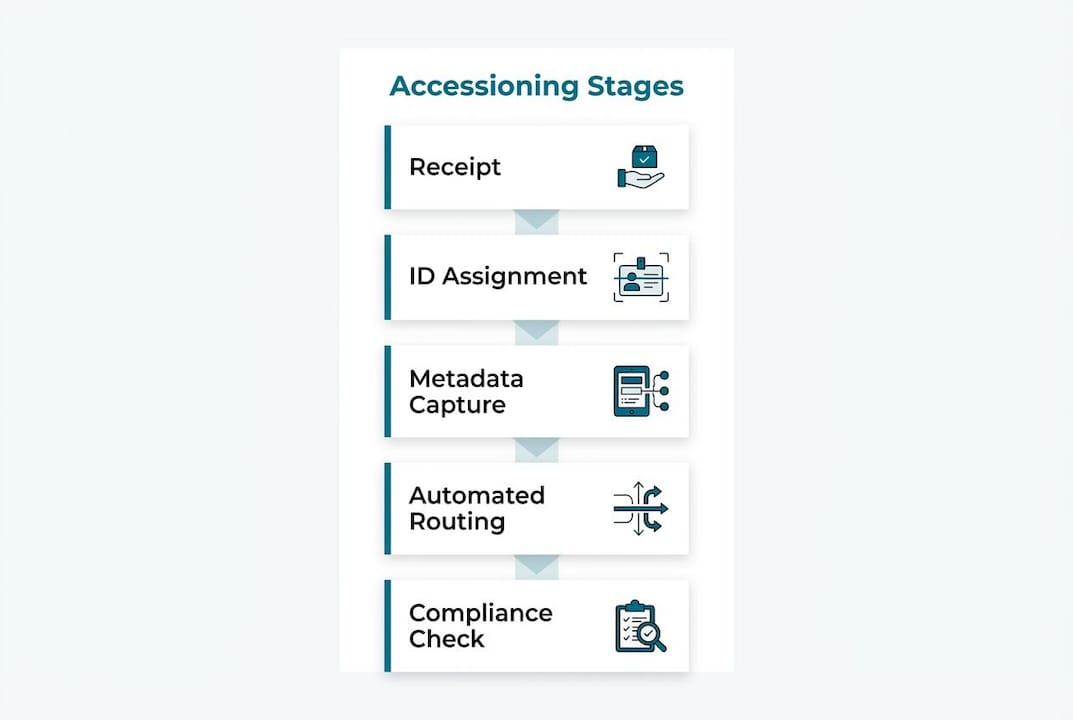
The LIMS accessioning workflow follows four defined stages, each building on the last to create a complete, traceable sample record.
-
Physical receipt and verification. The sample arrives at the lab and staff verify its condition, labeling, and packaging against the original order. Any discrepancy at this stage, such as a missing patient ID or a damaged container, triggers an immediate hold before the sample enters the system.
-
Unique identifier assignment. The system generates a barcode or accession number that becomes the sample's permanent identity within the LIMS. Every subsequent action, from instrument run to final report, references this identifier. Manual entry errors historically account for 60–80% of lab errors, and barcode-based assignment eliminates the most common source of those mistakes.
-
Metadata capture and EHR/EMR integration. The system records patient demographics, ordering provider, collection time, specimen type, and environmental conditions. Labrynix Connect supports HL7 and FHIR integration pathways, so this metadata flows directly from the ordering EHR into the LIMS without manual re-entry. Automated validation against external systems ensures 100% of orders are mapped correctly before lab processing begins.
-
Automated test scheduling and routing. Business rules built into the LIMS assign the sample to the correct workflow queue based on test type, priority, and instrument availability. Automated routing based on predefined protocols prevents queue confusion and improves lab productivity without requiring manual intervention.
Pro Tip: Configure your accessioning rules to auto-reject samples that fail quality criteria, such as hemolyzed specimens or missing collection timestamps, before they consume analyst time downstream.
How does the accessioning workflow improve sample tracking and reduce errors?
Digital accessioning transforms sample tracking from a reactive search process into a real-time visibility system. The practical gains are significant for any lab running high-volume genetic or molecular testing.
Key benefits include:
- Reduced transcription errors. Automated barcoding and digital manifests reduce transcription errors by up to 90% compared to manual methods. That reduction directly lowers the rate of misidentified samples reaching the reporting stage.
- Faster sample retrieval. Real-time tracking reduces sample search time by 40–50% compared to manual methods. In a busy molecular lab, that time savings compounds across hundreds of samples per day.
- Shorter audit preparation. Automated barcoding and digital manifests also reduce audit preparation time by roughly 50%. Regulators reviewing GLP or HIPAA compliance get a complete chain-of-custody record without staff manually reconstructing logs.
- Cross-contamination prevention. When each sample carries a unique digital identity, the system flags any attempt to assign conflicting test orders to the same accession record.
- Audit trail completeness. Every status change, location update, and user action is time-stamped and stored, giving labs a defensible record for CAP, CLIA, or HIPAA audits.
"Accessioning is not a simple administrative task. It is the primary gatekeeper for lab operational quality. A flawed digital identity at this stage compromises every downstream result, report, and compliance record tied to that sample."
The chain-of-custody documentation generated during accessioning also supports lab compliance obligations under GLP and HIPAA. Labs that skip structured accessioning often discover the gap only during an audit, at which point remediation is expensive and disruptive.
What are best practices for configuring and integrating accessioning workflows?
Configuring an accessioning workflow correctly from the start prevents the most common operational failures in genetic and molecular labs. The following practices apply regardless of lab size or test menu.
- Use rule-based, configurable workflows. Configurable accessioning allows automatic rejection of orders that do not meet quality criteria, acting as a primary operational control point. Generic, one-size-fits-all configurations miss the specific requirements of pharmacogenomics or hereditary cancer panels.
- Integrate with EHR/EMR systems at the point of accessioning. Pulling order data directly from the EHR eliminates duplicate entry and validates patient demographics before the sample moves forward. Labrynix Connect supports HL7, FHIR, and API pathways for this exact purpose.
- Capture comprehensive metadata, not just basic identifiers. Missing metadata leads to manual remediation and blind spots in workflows. Record environmental conditions, collection timestamps, aliquot hierarchy, and referring provider at the time of accessioning, not after the fact.
- Link accessioning to inventory and storage modules. Treating accessioning as a standalone step reduces operational visibility and efficiency. When accessioning feeds directly into storage location tracking and inventory consumption, labs gain automated performance monitoring without additional manual steps.
- Train staff on rejection protocols, not just entry procedures. Lab personnel who understand why a sample gets rejected are more likely to escalate borderline cases correctly rather than forcing them through the system.
Pro Tip: Build a "lost sample" prevention rule into your LIMS by requiring a confirmed storage location scan before any accession record closes. If the location field is empty, the system holds the record open and alerts the accessioning technician.
For labs setting up a new LIMS, the LIMS go-live checklist for molecular labs covers accessioning configuration as a pre-launch requirement, not an afterthought.

What are common challenges in LIMS accessioning workflows?
Even well-designed labs encounter accessioning failures. The most damaging ones share a common root: the workflow was not built to handle the complexity of the actual test menu.
Common challenges and their solutions:
- Mislabeling at collection. Samples arrive with handwritten labels, missing fields, or mismatched patient IDs. The fix is a mandatory verification step at receipt that cross-references the physical label against the electronic order before any accession number is assigned.
- Complex sample hierarchies. A single blood draw may produce a primary tube, three aliquots, and a residual archive. LIMS accessioning workflows must be highly configurable to handle these hierarchies, especially in molecular diagnostic labs where aliquot tracking is critical for retest scenarios.
- Manual data entry inconsistencies. Even when a LIMS is in place, labs sometimes allow manual overrides during high-volume periods. Each override is a potential error. Locking down override permissions to senior staff and logging every exception reduces this risk.
- Disconnected downstream data flow. When accessioning data does not automatically populate testing queues, billing records, and reporting modules, staff re-enter the same information multiple times. Integrated accessioning enables seamless data flow into inventory, storage, and reporting modules.
- Inadequate training on protocol adherence. Thorough training on accessioning protocols reduces error rates and ensures consistent application of best practices across shifts and staff turnover.
Understanding LIMS data validation as a parallel discipline helps labs build the validation rules that catch these errors automatically rather than relying on human review alone.
How does accessioning fit into the overall LIMS laboratory lifecycle?
Accessioning is the entry point for every sample in the LIMS lifecycle. Every subsequent stage depends on the accuracy of the accession record created at intake.
| LIMS lifecycle stage | Role of accessioning |
|---|---|
| Sample login | Creates the primary record and unique identifier |
| Test scheduling | Routes sample to correct instrument queue via business rules |
| Instrument data capture | Links raw results back to the accession record |
| Clinical review and approval | Reviewer accesses complete sample history from the accession record |
| Report generation | Report pulls patient, provider, and result data from the accession record |
| Archival and disposal | Retention rules trigger based on accession date and sample type |
The table above shows that every stage references the accession record. An error introduced at login does not stay contained. It propagates through test scheduling, instrument data capture, clinical review, and final reporting. LIMS sample tracking in regulated environments enhances compliance by offering traceability, audit trails, and adherence to standard operating procedures at each of these stages.
Labs that treat accessioning as a foundational data integrity checkpoint, rather than a clerical intake task, build a system where downstream automation actually works. When the accession record is complete and accurate, AI-powered analytics and automated reporting have reliable data to act on. When it is not, every automated step downstream amplifies the original error.
Key Takeaways
A complete, accurate accession record is the single most important data quality decision a lab makes, because every downstream result, report, and compliance record depends on it.
| Point | Details |
|---|---|
| Four core stages | Receipt, unique ID assignment, metadata capture, and automated routing define every accessioning workflow. |
| Error reduction | Automated barcoding reduces transcription errors by up to 90% compared to manual entry methods. |
| Metadata completeness | Capturing environmental conditions, timestamps, and aliquot hierarchy at intake prevents downstream blind spots. |
| Integration is non-negotiable | Connecting accessioning to EHR/EMR, inventory, and reporting modules eliminates siloed data and manual re-entry. |
| Training drives consistency | Staff who understand rejection protocols, not just entry steps, produce more reliable accession records across shifts. |
Accessioning is the lab's front door. Treat it that way.
Lab managers often ask me where to start when a lab's data quality is inconsistent. My answer is always the same: go back to accessioning. Not because it is the flashiest part of the workflow, but because it is the part where every other problem originates.
I have seen labs invest heavily in reporting software and AI analytics, then wonder why their outputs are unreliable. The answer is almost always upstream. The accession records were incomplete. Environmental conditions were never captured. Aliquot hierarchies were tracked on a spreadsheet that nobody updated after the first month. The downstream tools were working perfectly on bad data.
The underappreciated insight here is that configurable, rule-based accessioning is not a luxury for large reference labs. It is a baseline requirement for any molecular or pharmacogenomics lab that wants its data to mean something. A system that auto-rejects a hemolyzed sample or flags a missing collection timestamp is not being difficult. It is protecting the integrity of every result that follows.
My practical advice: audit your current accessioning rejections for one month. Count how many samples were manually overridden past a quality flag. That number tells you exactly how much risk your lab is carrying right now. Then configure the system to close those override paths, train your team on why the rules exist, and watch your downstream error rate drop.
— Tarek
How Labrynix supports accessioning workflows in molecular labs
Labrynix was built specifically for the operational realities of genetic testing, molecular diagnostics, and pharmacogenomics labs. The platform's LIMS for molecular labs includes configurable accessioning workflows that support rule-based rejection, barcode-driven sample intake, hierarchical aliquot tracking, and automated test routing from the moment a sample is logged.
Labrynix Connect handles HL7 and FHIR integration with EHR and EMR systems, so patient and order data flows into the accession record without manual re-entry. Labrynix Intelligence adds AI-powered bottleneck detection and workflow analytics that depend on the complete metadata captured at accessioning. For labs building or rebuilding their sample-to-report process, Labrynix for genetic testing labs provides the infrastructure to make accessioning the reliable foundation it needs to be.
FAQ
What is accessioning in a LIMS?
Accessioning in a LIMS is the process of receiving a sample, assigning it a unique identifier, capturing its metadata, and routing it to the correct testing workflow. It is the first and most critical data integrity step in the lab sample lifecycle.
How does the LIMS accessioning workflow reduce lab errors?
Automated barcoding and digital manifests reduce transcription errors by up to 90% compared to manual methods. Rule-based validation at accessioning also prevents mislabeled or incomplete samples from entering the testing queue.
What metadata should be captured during accessioning?
Labs should capture patient demographics, ordering provider, collection timestamp, specimen type, environmental conditions, and aliquot hierarchy. Missing metadata creates workflow blind spots and forces manual remediation downstream.
How does accessioning support HIPAA and GLP compliance?
Accessioning generates a time-stamped chain-of-custody record for every sample, which satisfies traceability requirements under GLP and HIPAA. Automated audit trails reduce the manual effort required during regulatory inspections.
Why should accessioning be integrated with other LIMS modules?
Treating accessioning as a standalone step reduces operational visibility and breaks automated data flow into inventory, storage, and reporting. Integrated accessioning feeds accurate data to every downstream module without requiring manual re-entry.