
A Laboratory Information Management System, or LIMS, is the operational backbone of genetic report delivery. It manages every step from sample accessioning through variant interpretation to final report release, replacing manual handoffs with structured, auditable workflows. The role of LIMS in genetic report delivery goes far beyond data storage. It enforces data integrity, connects to clinical systems via HL7 and FHIR standards, and keeps labs aligned with HIPAA and CLIA requirements. For lab managers running genetic testing operations, understanding how LIMS drives accuracy and speed is not optional. It is the difference between a lab that scales and one that stalls.
How does LIMS automate and manage the genetic testing workflow?
Genetic testing workflow automation replaces manual transcription and handoffs, which are the primary sources of errors and delays in genomics labs. A well-configured LIMS manages each stage of the process in sequence, with no gaps where data can be lost or misrecorded.
The core workflow stages a LIMS governs are:
- Order intake and accessioning — The system captures test orders, assigns unique sample identifiers, and logs patient and provider information at the point of entry.
- Sample tracking — Every sample movement is recorded in real time, from receipt through extraction, QC, and sequencing.
- QC gating — Automated quality checks flag samples that fall below threshold before they advance to sequencing, preventing wasted runs.
- Sequencing instrument integration — The LIMS communicates directly with sequencers, pulling run data without manual file transfers.
- Bioinformatics pipeline orchestration — Variant calling, annotation, and filtering pipelines are triggered automatically when sequencing completes.
- Interpretation and review queues — Variants are routed to the appropriate reviewer based on assay type and classification status.
- Report generation and release — Configurable report templates auto-populate from variant classification tools, eliminating copy-paste errors and manual formatting.
Each step feeds directly into the next. That continuity is what makes automation valuable. Without it, a lab relies on staff to move data between systems, and every manual transfer is a point of failure.
Pro Tip: Track turnaround time at each workflow stage separately, not just end-to-end. Identifying which specific step creates the most delay gives you a precise target for automation investment.

What is the importance of standardized data formats and EHR integration?
Effective genetic report delivery depends on LIMS integration with downstream clinical EHRs via HL7 v2 ORU messages and FHIR R4 DiagnosticReport resources. These standards allow structured report data to flow directly into EHR systems, where clinicians can act on results without opening a separate portal or interpreting a PDF.
The difference between structured delivery and PDF delivery is clinically significant. A PDF requires a clinician to read, interpret, and manually enter relevant findings into the patient record. A structured HL7 or FHIR message populates discrete fields automatically, reducing transcription errors and supporting clinical decision support tools. Labs that push PDFs to patient portals instead of using HL7 or FHIR DiagnosticReports risk clinical misinterpretation and lose control over how data is displayed.
| Report delivery method | Data structure | EHR integration | Error risk | Clinical utility |
|---|---|---|---|---|
| PDF via email or portal | Unstructured | Manual entry required | High | Low |
| HL7 v2 ORU message | Semi-structured | Direct ingestion | Medium | High |
| FHIR R4 DiagnosticReport | Fully structured | Native EHR mapping | Low | Highest |
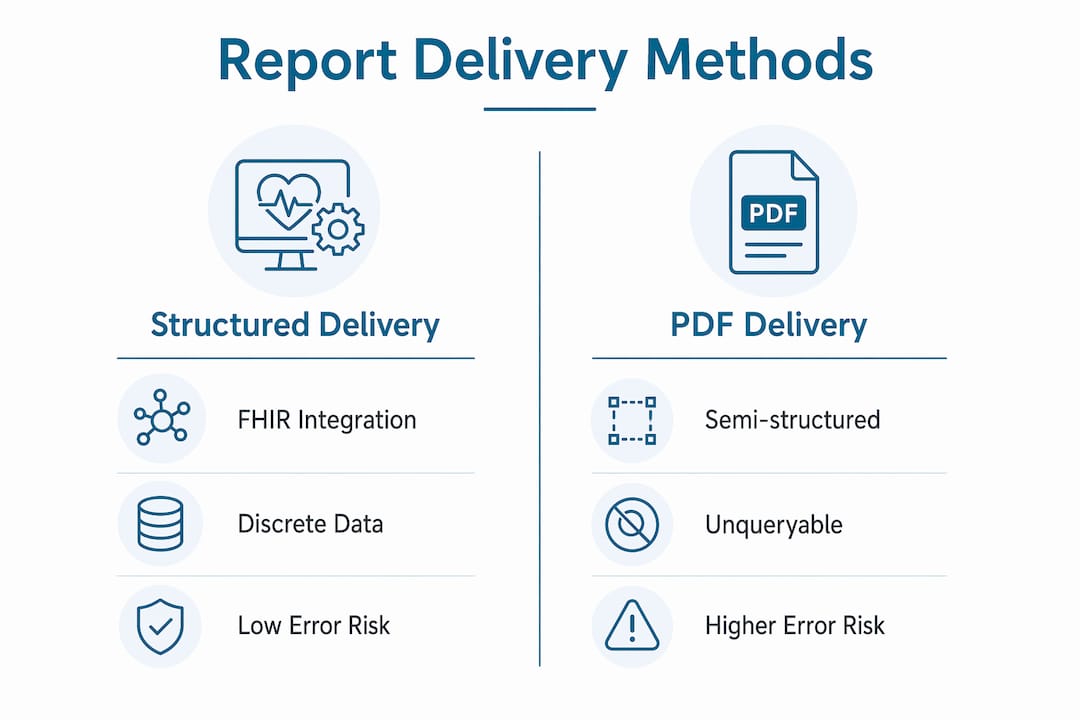
EHR platforms that support FHIR R4 natively can receive genetic results as discrete, queryable data. That means a clinician searching for a patient's BRCA1 status gets a direct answer, not a PDF to scroll through. The patient safety gain is real and measurable.
Pro Tip: When planning EHR integration, map your internal lab statuses to FHIR DiagnosticReport status codes before development begins. Mismatched status logic is the most common cause of integration failures in genetic lab portal projects.
How do modern LIMS platforms support compliance and reporting accuracy?
LIMS compliance features including role-based access, immutable audit logs, and amendment workflows are the operational foundation for meeting HIPAA, CLIA, and CAP standards in genetic labs. These are not optional add-ons. Regulators expect labs to demonstrate exactly who accessed, modified, or approved every report, and when.
The compliance capabilities that matter most for genetic report delivery include:
- Immutable audit logs that record every data access, edit, and approval event with timestamps and user IDs
- Amendment and addendum workflows that allow report corrections without overwriting the original, preserving the complete change history
- Role-based access control that restricts who can view, edit, or release reports based on their clinical role
- Version control for report templates so changes to report format are tracked and validated before deployment
- Integration with variant classification systems to ensure clinical interpretations reflect current evidence without manual lookups
Variant classifications evolve over time. LIMS must maintain lineage tracking and synchronization with databases like ClinGen to support reinterpretation workflows and patient re-contact when a variant's clinical significance changes. That requirement alone makes a static, disconnected LIMS a liability.
Clinical reports are the primary product of a genomics lab. Integrating LIMS with variant classification tools is not just an efficiency gain. It is a clinical safety requirement.
Pro Tip: Run a quarterly audit log review as a compliance drill. Pull a sample of reports and trace every action from order receipt to final release. Gaps in the log are gaps in your CAP readiness.
What are best practices for implementing or modernizing LIMS?
LIMS modernization requires phased migration and modular architecture to avoid disruptions and maintain validated system stability throughout the transition. Labs that attempt a full cutover from legacy to modern systems in a single step routinely face validation failures, workflow gaps, and staff confusion.
The recommended sequence follows three phases. First, migrate sample tracking and accessioning. This layer carries the least clinical risk and gives staff time to learn the new system before it touches reporting. Second, connect the bioinformatics pipeline orchestration layer. This is where instrument integrations and QC automation are validated. Third, migrate the reporting and delivery layer, including EHR integrations and patient portal connections.
Hybrid LIMS models that combine purchased core functions with custom genomic workflows let labs retain legacy investments while extending capabilities. That approach is practical for labs with existing validated systems that cannot be retired immediately.
| Capability | Legacy LIMS | Modern LIMS |
|---|---|---|
| Sample tracking | Manual or semi-automated | Fully automated with real-time status |
| Pipeline orchestration | External or absent | Native integration with sequencers |
| Report generation | Manual templates | Assay-specific auto-populated templates |
| EHR integration | PDF delivery | HL7/FHIR structured delivery |
| Audit trail | Partial or manual | Immutable, automated, role-stamped |
| Variant classification sync | Static | Dynamic with ClinGen and similar databases |
The most common implementation pitfall is treating LIMS modernization as an IT project rather than a product transformation. LIMS upgrades require architectural planning and incremental deployment. Labs that skip the planning phase discover mid-migration that their existing data models do not map cleanly to the new system, which forces expensive rework.
Pro Tip: Before selecting a new LIMS, document every data field your current system captures and map it to the target system's schema. Unmapped fields become data loss events during migration. The LIMS migration guide from Labrynix covers this mapping process in detail.
How does effective LIMS integration improve genetic report delivery outcomes?
Full LIMS integration across the sample-to-report workflow produces measurable gains in turnaround time, error rates, compliance confidence, and provider experience. These outcomes are connected. Faster turnaround is only valuable if the reports delivered are accurate and clinically actionable.
Automation benchmarks in clinical genomics show that each automation step is quantified against pre-implementation baselines, driving continuous improvement. Labs that track these metrics systematically can identify which workflow stages still carry manual risk and prioritize them for the next automation cycle.
Structured report delivery via FHIR or HL7 directly improves provider experience. Clinicians receive results in their existing EHR workflow without switching systems or downloading files. That reduces the time between result availability and clinical action, which matters most in oncology and pharmacogenomics settings where treatment decisions depend on genetic data.
Event-driven LIMS integration using message buses decouples lab operations from portal availability. If a patient portal goes offline, the lab's internal workflow continues uninterrupted, and results queue for delivery when the portal recovers. That architecture satisfies audit trail requirements while improving system resilience. For lab managers evaluating LIMS workflow design, this kind of decoupled integration is the standard to target.
Key Takeaways
A fully integrated LIMS is the single most effective tool a genetic lab can deploy to improve report accuracy, reduce turnaround time, and maintain regulatory compliance across every stage of the sample-to-report workflow.
| Point | Details |
|---|---|
| Automate every handoff | Manual data transfers between workflow stages are the leading cause of errors and delays in genetic labs. |
| Use HL7/FHIR for delivery | Structured report delivery via FHIR R4 or HL7 v2 ORU reduces transcription errors and supports clinical decision tools. |
| Build compliance into the system | Immutable audit logs, role-based access, and amendment workflows are required for HIPAA, CLIA, and CAP compliance. |
| Migrate in phases | Sequential migration starting with sample tracking, then pipelines, then reporting prevents validation failures and data loss. |
| Track variant classification changes | LIMS must sync with evolving databases like ClinGen to support reinterpretation and patient re-contact workflows. |
What I've learned from watching labs treat LIMS as an IT problem
Most labs that struggle with genetic report delivery have the same root cause. They treated their LIMS implementation as a software installation, not a clinical workflow redesign. The technology is rarely the bottleneck. The bottleneck is the absence of a clear data model, a defined report approval process, and a realistic integration plan before the first line of configuration is written.
The labs that get this right share one habit. They map the workflow on paper before they touch the system. They know exactly which staff role approves which report type, what happens when a variant classification changes after a report is released, and how their EHR expects to receive structured data. That clarity makes every subsequent decision faster and cheaper.
The shift to FHIR R4 for genetic report delivery is not a future consideration. Labs still delivering PDFs to clinical systems are already behind the standard. The clinical risk is real, and the compliance exposure grows as EHR vendors deprecate unstructured data ingestion pathways.
LIMS modernization in genomics is a product transformation. It requires the same discipline as building a clinical product: defined requirements, phased delivery, validation at each stage, and a clear owner for each decision. Labs that approach it that way consistently outperform those that treat it as a vendor selection exercise.
— Tarek
Labrynix: built for genetic report delivery from the ground up
Genetic testing labs need software that understands the full sample-to-report workflow, not a generic platform adapted for genomics as an afterthought.
Labrynix combines LIMS workflow management with advanced PGx reporting, HL7 and FHIR integration, provider and patient portals, and AI-powered workflow automation in one connected platform. Labs use Labrynix to manage accessioning, sample tracking, report generation, clinical review, and structured result delivery without switching between disconnected tools. The platform is built with HIPAA-conscious workflow principles, role-based access, immutable audit logs, and configurable report templates that auto-populate from lab-approved interpretation rules. For labs ready to modernize their reporting and delivery operations, Labrynix genetic testing lab software is built specifically for this work.
FAQ
What does LIMS stand for in genetic testing?
LIMS stands for Laboratory Information Management System. In genetic testing, it manages sample tracking, workflow orchestration, data integrity, and report generation from accessioning through final result delivery.
How does LIMS reduce errors in genetic report delivery?
LIMS eliminates manual data transfers between workflow stages, which are the primary source of errors in genomics labs. Automated handoffs, configurable report templates, and immutable audit logs keep data accurate from sample receipt to report release.
What is the difference between HL7 and FHIR for genetic report delivery?
HL7 v2 ORU messages deliver semi-structured lab results to EHRs, while FHIR R4 DiagnosticReport resources deliver fully structured, queryable genetic data. FHIR offers higher clinical utility and lower transcription error risk than HL7 v2.
What compliance standards does LIMS support in genetics labs?
A properly configured LIMS supports HIPAA, CLIA, and CAP compliance through role-based access control, immutable audit logs, amendment workflows, and version-controlled report templates that document every change and approval.
How long does LIMS modernization take for a genetic lab?
Timeline varies by lab size and system complexity, but phased migration starting with sample tracking, then pipeline orchestration, then reporting typically spans several months per phase to allow proper validation at each stage.