
LIMS data migration is defined as the structured process of transferring genetic laboratory records, configurations, and audit trails from a legacy system to a new Laboratory Information Management System while preserving regulatory compliance and operational continuity. When you migrate genetic lab data to a new LIMS, you are not simply moving files. You are transferring the operational memory of your lab, including sample records, test results, chain-of-custody logs, and electronic signatures, all of which carry compliance obligations under FDA 21 CFR Part 11 and ISO 15189. The stakes are high: a poorly executed migration can invalidate audit trails, corrupt genomic records, or trigger accreditation failures. This guide walks you through every phase, from prerequisites to post-migration verification, with the specificity genetic lab managers actually need.
What you need before migrating genetic lab data to a new LIMS
Before a single record moves, you need a clear picture of what you have, where it lives, and what format it is in. This preparation phase is where most migrations either succeed or quietly begin to fail.
Understand your current data landscape first. Your legacy LIMS holds several distinct data categories that each require separate handling strategies:
- Sample and patient records: Accession numbers, patient demographics, ordering provider information, and chain-of-custody entries
- Test results and reports: Raw instrument outputs, interpreted results, pharmacogenomics annotations, and finalized report PDFs
- Audit trails and electronic signatures: Time-stamped activity logs, user modification records, and approval histories required under FDA 21 CFR Part 11
- System configurations: Workflow rules, user roles, instrument interfaces, and reference ranges
- Large genomic files: FASTQ, BAM, and VCF files from next-generation sequencing runs, which require separate transfer planning
Assemble a cross-functional migration team. You need scientific staff who understand test methods, informatics specialists who can write and validate ETL scripts, IT personnel who manage infrastructure and cloud storage, and a compliance officer who owns the validation documentation. No single department can execute this alone.
Select the right ETL tooling. Extract-Transform-Load tools such as Talend, Apache NiFi, or custom Python pipelines handle the mechanics of pulling data from the source system, reformatting it to match the target schema, and loading it without corruption. The choice depends on your data volume, system compatibility, and in-house technical capacity.

Budget for genomic file transfer costs explicitly. A 30 TB transfer can cost approximately $2,500 to $3,000 in cloud egress fees alone. Labs with multiple sequencing runs accumulate terabytes quickly, and each workflow hop multiplies that cost exposure. Factor this into your project budget before you begin, not after the invoices arrive.
Pro Tip: Before finalizing your new LIMS setup, export a representative sample of 500 to 1,000 records from your legacy system and attempt a test import into the new platform. This single exercise will surface schema mismatches, encoding issues, and field-length conflicts weeks before your go-live date.
How to execute the LIMS data migration process step by step
LIMS data migration is not just data transfer. It is a transformation that must preserve workflows, audit trails, and regulatory compliance at every stage. The following sequence reflects validated practice for genetic testing environments.
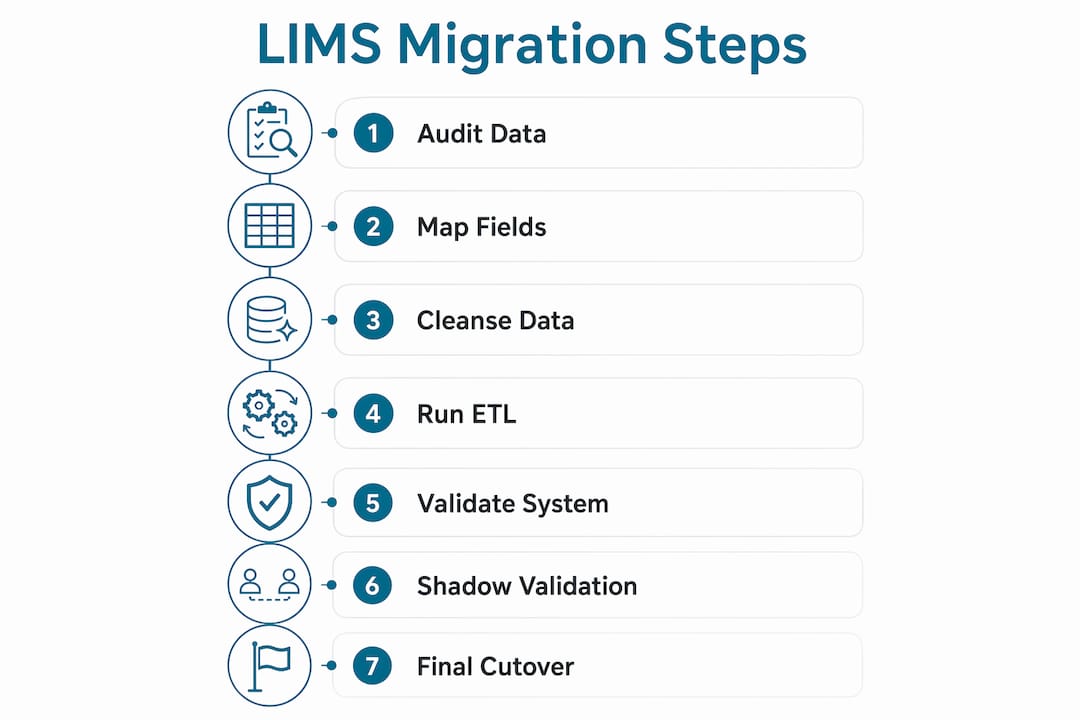
1. Audit and catalog your legacy data. Generate a complete data dictionary from your source system. Document every table, field, data type, and relationship. Pay particular attention to fields that store audit trail entries, electronic signatures, and result modification histories. Missing a single linked table at this stage creates orphaned records in the target system.
2. Map source fields to target fields. Create a formal field-mapping document that aligns every legacy data element with its corresponding field in the new LIMS. This is where mapping failures most commonly occur. Without full comprehension of the source system's logic, a technically successful import can still produce scientifically meaningless or non-compliant records.
3. Cleanse the data before extraction. Remove duplicate accession records, standardize date formats, correct encoding errors, and flag any records with missing required fields. Data cleansing done post-import is exponentially more expensive than cleansing done pre-extraction.
4. Execute the ETL process in a staging environment. Run your extraction, transformation, and loading scripts against a non-production copy of both systems. The ETL process for genetic lab data includes samples, workflow configurations, instrument interfaces, and audit trails. Complexity scales directly with data volume and the degree of schema difference between source and target systems.
5. Conduct IQ/OQ/PQ validation. This three-stage qualification framework is the industry standard for LIMS compliance:
| Validation Stage | Focus Area | Key Output |
|---|---|---|
| IQ (Installation Qualification) | System installed correctly per specifications | Installation checklist, software version records |
| OQ (Operational Qualification) | System functions as designed under defined conditions | Test scripts, pass/fail records for each function |
| PQ (Performance Qualification) | System performs correctly in the actual lab environment | Production-representative test cases, sign-off documentation |
Multi-stage IQ/OQ/PQ validation can preserve 100% data integrity and reduce reporting turnaround time by 30%, based on a case study involving 50,000+ records with an ISO 17025-ready framework. That outcome is not accidental. It is the direct result of structured validation rather than informal testing.
6. Run a shadow validation period. Operate both the legacy and new LIMS in parallel for a defined period, typically two to four weeks. Compare outputs record by record for a representative sample. Any discrepancy between systems must be investigated and resolved before decommissioning the legacy platform.
7. Execute production cutover. Freeze data entry in the legacy system, perform a final delta migration of records created since the last full export, and activate the new LIMS as the system of record. Document the exact cutover timestamp for audit purposes.
Pro Tip: Store your final legacy system export in a non-proprietary format such as CSV or XML alongside the original proprietary format. Regulatory inspectors may request records years after decommissioning, and proprietary formats become unreadable when vendor support ends.
What are the most common pitfalls in genetic lab LIMS migration?
Even well-resourced labs encounter predictable failure points. Knowing them in advance is the difference between a recoverable setback and a compliance incident.
- Incomplete workflow comprehension: Mapping failures are the most common validation failure point. Labs that skip a thorough source system analysis produce imports that look complete but contain logical errors invisible to automated checks.
- Audit trail gaps: FDA 21 CFR Part 11 requires accurate and complete copies of electronic records including audit trails. Losing audit trail readability after decommissioning a legacy system is one of the most cited compliance risks in LIMS transitions.
- Tamper-evident record failures: Audit trails must be secure, computer-generated, time-stamped, and independently stored. Cryptographic hashes that prevent undetectable modification are the technical standard, not simply access-controlled logs.
- Underestimated genomic file transfer costs: Labs that migrate sequencing data without budgeting for cloud egress fees discover the problem only after the transfer is underway. A single large cohort study can generate 30 TB or more, and transfer costs scale with every workflow hop between storage environments.
- No decommissioning retrieval plan: Shutting down the legacy system without verifying that archived records remain accessible and readable is a retention failure waiting to happen. Test retrieval of archived records before the legacy system goes offline, not after.
"Without full understanding of the source LIMS configuration, migration becomes guesswork even if the import technically succeeds." This observation from Legacy Leap's analysis of LIMS migration failures captures why technical execution alone is never sufficient. The science of the lab must inform the data model of the migration.
The mitigation strategy across all of these risks is the same: multi-disciplinary collaboration, rigorous pre-migration testing, and active vendor involvement during the validation phase. Your LIMS vendor has seen these failure modes before. Use that knowledge.
How to validate and verify your new LIMS after migration
Post-migration validation is not a one-time event. It is an ongoing obligation that begins at go-live and continues through the operational life of the system.
-
Verify audit trail integrity immediately after cutover. Confirm that every migrated record retains its original creation timestamp, modification history, and user attribution. Post-migration audit trail retrieval and readability must be verified repeatedly, especially after decommissioning legacy systems. Test export of audit records in both the native system format and a non-proprietary format.
-
Validate all instrument and system interfaces. Confirm that connections between analyzers, the LIS, and HIS are transmitting data correctly. Effective LIMS validation includes role-based access checks, interface validation between analyzers and LIS/HIS systems, and documented routine QC aligned with ISO 15189 and NABL 112 standards.
-
Conduct bi-annual verification of test types and interfaces. NABL 112 mandates verification of at least 10 test types plus interface validation at minimum twice per year. Build this into your quality management calendar from day one of operation on the new system.
-
Train all laboratory personnel on the new LIMS. Compliance failures after migration are frequently caused by user error in an unfamiliar system, not by technical defects. Training must cover not just navigation but the compliance-critical functions: how to correctly amend a result, how to apply an electronic signature, and how to retrieve an audit trail record on demand.
-
Establish a long-term archival and accessibility plan. Define retention periods for each data category, assign ownership of the archive, and schedule annual retrieval tests. Genetic testing records often carry retention obligations of 10 years or more under CLIA and state regulations. Your archival plan must account for format obsolescence over that timeframe. For additional guidance on LIMS workflow design during and after migration, the planning considerations extend well beyond the cutover date.
What I've learned from watching genetic lab migrations go wrong
The technical steps in a LIMS migration are well-documented. What is less discussed is the organizational failure mode that causes most of the real damage.
In my experience, the labs that struggle most are the ones that treat migration as an IT project rather than a scientific and compliance project. The informatics team executes a technically clean ETL, the data loads without errors, and everyone declares success. Then, six months later, an inspector asks for the audit trail on a specific sample modification from three years ago, and no one can produce it in a readable format because the legacy system was decommissioned without proper retrieval verification.
The mapping stage deserves more attention than it typically receives. I have seen labs spend weeks on ETL scripting and less than a day on field mapping. That ratio is backwards. The mapping document is the scientific contract between your old system and your new one. Every shortcut taken there becomes a discrepancy discovered later, usually at the worst possible moment.
On the genomic file cost question: labs that work with whole-genome sequencing or large pharmacogenomics panels should treat data transfer costs as a line item in the migration budget, not a footnote. The numbers are real, and they surprise people who have only migrated clinical records before. Partnering with a vendor or consultant who has moved large sequencing datasets before will save both money and time. Resources like molecular data reporting planning can help frame the cost and technical considerations for sequencing-heavy environments.
The future of genetic lab LIMS migration is moving toward continuous validation rather than point-in-time qualification. As labs adopt cloud-native platforms and real-time integrations, the IQ/OQ/PQ model will evolve. But the underlying principle will not: you must be able to prove, at any moment, that your data is what it claims to be.
— Tarek
How Labrynix supports your genetic lab LIMS migration
Labrynix is built specifically for genetic testing, molecular diagnostics, and pharmacogenomics laboratories. The platform's architecture supports the compliance-focused workflows that LIMS migration demands, including role-based access controls, audit log management, configurable permissions, and HIPAA-conscious data governance. Labrynix Connect handles HL7, FHIR, and API integrations so your instrument interfaces and EHR connections transfer cleanly into the new environment. Labrynix Intelligence adds AI-powered operational visibility to help you detect workflow gaps after cutover before they become compliance issues. If you are planning a new LIMS implementation or upgrading your current genetic lab software, explore what Labrynix offers at labrynix.com.
Key takeaways
Successful genetic lab LIMS migration requires structured ETL execution, IQ/OQ/PQ validation, and verified audit trail preservation to meet FDA 21 CFR Part 11 and ISO 15189 compliance obligations.
| Point | Details |
|---|---|
| Map before you migrate | Field mapping is the most common failure point; invest more time here than in scripting. |
| Validate in three stages | IQ/OQ/PQ validation can preserve 100% data integrity and cut reporting turnaround by 30%. |
| Budget for genomic transfer costs | A 30 TB sequencing file transfer costs approximately $2,500 to $3,000 in cloud egress fees. |
| Preserve audit trails explicitly | Audit records must be time-stamped, tamper-evident, and retrievable in non-proprietary formats after decommissioning. |
| Verify bi-annually after go-live | NABL 112 requires verification of at least 10 test types and all interfaces twice per year. |
FAQ
What is LIMS data migration in genetic labs?
LIMS data migration in genetic labs is the process of transferring sample records, test results, audit trails, and system configurations from a legacy Laboratory Information Management System to a new platform while maintaining regulatory compliance under FDA 21 CFR Part 11 and ISO 15189.
How long does a genetic lab LIMS migration typically take?
Timeline varies by data volume and system complexity, but most genetic labs should plan for three to six months from initial audit through validated production cutover, including a two to four week shadow-run validation period.
What are the biggest risks when migrating lab data to a new LIMS?
The three highest-risk areas are incomplete field mapping that produces logically corrupt records, audit trail loss after legacy system decommissioning, and underestimated genomic file transfer costs that can reach thousands of dollars for large sequencing datasets.
Does LIMS migration require IQ/OQ/PQ validation?
Yes. IQ/OQ/PQ validation is the industry standard for LIMS compliance in regulated genetic testing environments. A validated migration involving 50,000+ records has demonstrated 100% data integrity preservation and a 30% reduction in reporting turnaround time.
How do you maintain audit trail compliance after migration?
Audit trails must be verified for readability and exportability in non-proprietary formats immediately after cutover and tested repeatedly after decommissioning the legacy system. Records must remain secure, time-stamped, and tamper-evident to satisfy FDA 21 CFR Part 11 requirements.