
What is LIMS validation for genetic labs?
LIMS validation is the documented process confirming that a laboratory information management system performs as intended, produces accurate results, and meets the regulatory requirements governing your lab. For genetic testing laboratories, that definition carries real weight. A validated LIMS is not just a software checkbox. It is the documented assurance that every sample tracked, every result recorded, and every report generated can withstand scrutiny from the FDA, an accreditation body, or a clinical auditor.

Genetic labs operate under frameworks including FDA 21 CFR Part 11, ISO 17025, and GxP principles, all of which require proof that computerized systems are fit for their intended purpose. Without that proof, auditors can and do reject data produced by the system, regardless of whether the system actually performed correctly. The validation package that satisfies these requirements typically includes a Validation Plan, User Requirements Specification (URS), Functional Requirements Specification (FRS), Risk Assessment, Installation Qualification (IQ), Operational Qualification (OQ), Performance Qualification (PQ) protocols, test results, and a Validation Summary Report.
Key documents in a complete LIMS validation package:
- Validation Plan: Defines scope, objectives, roles, and the overall validation strategy
- URS and FRS: Capture what the system must do and how it must do it, from the lab's perspective
- Risk Assessment: Identifies which functions are critical to patient safety and data integrity
- IQ/OQ/PQ Protocols: Structured tests confirming correct installation, expected operation, and real-world performance
- Traceability Matrix: Maps each requirement to its corresponding test, proving nothing was skipped
- Validation Summary Report: The final document declaring the system validated and fit for use
For genetic labs specifically, the role of LIMS in lab compliance extends to sample chain of custody, audit trail completeness, and the accuracy of pharmacogenomic and hereditary test reports delivered to providers and patients.
How to validate a LIMS for genetic testing: step by step
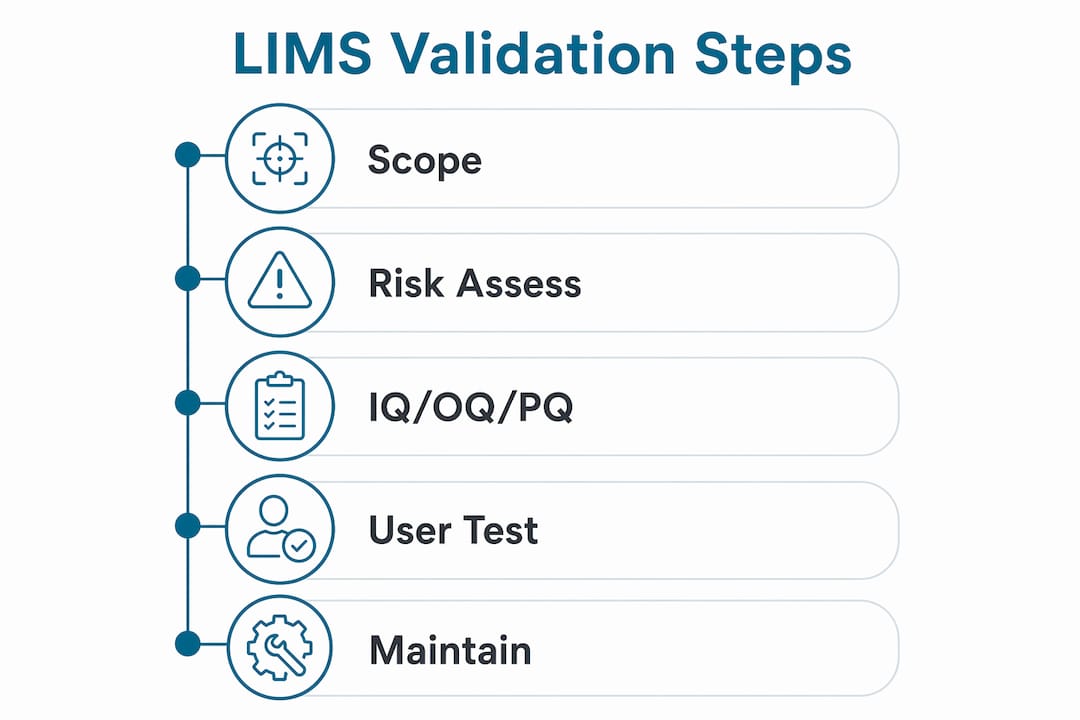
The validation lifecycle for a genetic testing lab LIMS follows a structured sequence. Skipping or compressing any phase creates documentation gaps that surface during audits at the worst possible time.
-
Validation planning. Define the scope of validation before writing a single test script. Identify which system functions are GxP-critical, which workflows are unique to your genetic testing menu, and who owns each phase. Lab managers, QA personnel, IT, and your LIMS vendor all carry distinct responsibilities here.
-
User and functional requirements. The URS captures what the lab needs the system to do. The FRS translates those needs into specific system behaviors. For genetic labs, this means documenting requirements for sample accessioning, test order management, result entry, report generation, and integration with instruments or external healthcare systems. Off-the-shelf LIMS software is not pre-validated. Every custom workflow, integration, and configuration your lab adds requires lab-led qualification.
-
Design Qualification (DQ). Confirm that the system's design, as proposed by the vendor, actually meets your documented requirements before installation begins. This is where you catch mismatches early.
-
Installation Qualification (IQ). Verify that the system was installed correctly in your environment, that hardware and software specifications match the approved design, and that all components are accounted for. Document everything, including version numbers and server configurations.
-
Operational Qualification (OQ). Test the system against its functional requirements under controlled conditions. For genetic labs, OQ typically covers user authentication, access controls, audit trail generation, sample status tracking, and calculation logic for result reporting.
-
Performance Qualification (PQ). Demonstrate that the system performs reliably under real-world conditions, using actual lab workflows and representative data volumes. PQ is where you confirm that the system handles your genetic testing throughput without errors.
-
Risk-based prioritization. Validating non-critical cosmetic features is unnecessary and adds burden without improving compliance. Focus testing effort on GxP-critical functions: result entry, calculation logic, audit trails, and report accuracy. This approach reduces workload while keeping the validation defensible.
-
Validation Summary Report. Compile all test results, deviations, and corrective actions into a final report that formally declares the system validated. This document is what auditors ask for first.
Pro Tip: Scope creep is the most common reason LIMS validation projects run over budget and timeline. Lock the scope in the Validation Plan before testing begins, and route every proposed change through a formal change control process. Any modification to a validated system, including a software update or a new integration, triggers a documented impact assessment and, where necessary, partial or full revalidation.
For labs building out their qualification approach, the LIMS acceptance testing guide covers user acceptance testing phases in detail.
Regulatory standards your genetic lab LIMS validation must satisfy
Three frameworks dominate LIMS validation requirements for US genetic labs, and each one asks for something slightly different.
FDA 21 CFR Part 11 governs electronic records and electronic signatures in FDA-regulated environments. A validated LIMS must include secured user authentication, tamper-evident audit trails, and record integrity controls that prevent unauthorized modification. Electronic signatures must be linked to their respective records and uniquely attributable to the individual who signed. Labs that generate clinical reports under FDA oversight, including pharmacogenomics labs, cannot treat Part 11 compliance as optional.
ISO 17025 applies to testing and calibration laboratories seeking accreditation. The standard emphasizes traceability, controlled documentation, risk management, and continuous improvement as core requirements for any lab information system. Accreditation bodies expect to see evidence that your LIMS supports measurement traceability and that your documentation is version-controlled and retrievable.
GxP principles and GAMP 5 provide the broader quality framework. GAMP 5 (Good Automated Manufacturing Practice) classifies software by risk category and prescribes proportionate validation effort. A configured LIMS typically falls into GAMP 5 Category 4, requiring documented configuration specifications and testing. Custom-developed modules may reach Category 5, demanding full software development lifecycle documentation.
Additional compliance pillars for genetic labs:
- HIPAA: Governs the privacy and security of protected health information, including genetic test results and patient identifiers stored in the LIMS
- CLIA: Clinical Laboratory Improvement Amendments require that lab systems support quality control, proficiency testing, and result reporting standards
- CAP accreditation: College of American Pathologists checklists include specific requirements for LIS/LIMS validation documentation and change control
Auditors from any of these bodies will ask for your validation package, your change control log, and evidence that your system's current state matches its validated state. Labs that maintain LIMS data integrity as an ongoing discipline, not a point-in-time exercise, consistently perform better in these reviews.
Common challenges in LIMS validation for genetic laboratories
Most validation failures are predictable. The same problems appear across labs of different sizes and testing menus.
-
Incomplete documentation packages. A system that performs correctly but lacks complete test records, deviation logs, or a signed Validation Summary Report is not considered validated. Auditors evaluate the paper trail, not the system's actual behavior.
-
Scope creep during validation. Adding requirements mid-project without formal change control inflates timelines, creates untested functions, and produces documentation gaps. Every addition to scope after the Validation Plan is signed must go through a documented impact assessment.
-
Custom integrations and genetic-specific workflows. Genetic labs routinely integrate their LIMS with sequencing instruments, variant interpretation platforms, EHR systems, and billing platforms. Each integration point requires its own qualification testing. Labs often underestimate this effort, particularly when instrument interfaces involve proprietary data formats.
-
Neglecting revalidation after software updates. A software patch, a configuration change, or a new report template can affect validated functions. Labs that treat validation as a one-time project rather than a lifecycle activity accumulate unvalidated changes that become audit liabilities.
-
Auditor expectations vs. system reality. Auditors expect the system to behave exactly as the validation documentation describes. If your OQ tested a workflow that was later modified without a change control record, the discrepancy is a finding, regardless of whether the current workflow is technically correct.
-
Cybersecurity gaps in the validation scope. Standard validation protocols address functional performance but often omit security controls. For genetic labs, that omission is a compliance risk, not just an IT concern.
Cybersecurity and continuous compliance: what genetic labs must address
Genomic data carries risks that standard IT security frameworks do not fully address. A patient's genetic sequence is permanent, uniquely identifying, and potentially valuable to insurers, employers, and bad actors in ways that a stolen password is not. NIST IR 8467 identifies multiple mission objectives for managing cybersecurity risks across the genomic data lifecycle, covering everything from sequencing instrument security to data sharing controls.
For LIMS validation in genetic labs, cybersecurity requirements belong inside the validation scope, not alongside it. Specific controls to validate and document:
- Encryption: TLS 1.2 or higher for data in transit and AES-256 for data at rest, with key management handled through a hardware security module (HSM) or a cloud key management service (KMS)
- Role-based access control (RBAC): Permissions scoped to job function, with access reviews documented at defined intervals
- Network segmentation: Sequencing instruments and genomic data stores isolated from general network traffic, per NIST IR 8467 guidance
- Audit trail integrity: Logs that are tamper-evident, time-stamped, and retained according to your regulatory obligations
- Patch management: A documented process for evaluating, testing, and applying security patches without disrupting validated system status
- Vendor risk assessments: Formal evaluation of your LIMS vendor's security posture, including their own change control and incident response procedures
- Incident response: A tested plan for detecting, containing, and reporting a breach involving genomic data, with roles and timelines defined
Continuous compliance is the other half of this picture. Validation is a lifecycle activity, not a project with a completion date. Genetic testing menus change, instruments are upgraded, and regulatory guidance evolves. Each change requires a documented impact assessment and, where the validated state is affected, formal revalidation. Labs that build this discipline into their quality management system, rather than treating it as an exception process, maintain audit readiness without scrambling before every inspection.
Labs evaluating how their current platform supports these requirements can review the clinical pathology compliance standards that apply to regulated genetic healthcare settings.

How Labrynix supports LIMS validation in genetic labs

Labrynix was built specifically for genetic testing, molecular diagnostics, and pharmacogenomics laboratories. The platform includes role-based access controls, audit logging, secure report delivery, and configurable permissions designed to support the compliance obligations genetic labs carry. For labs working through LIMS validation, Labrynix's architecture reflects the workflows that validation protocols actually test: sample accessioning, test order management, result entry, report generation, and integration with external healthcare systems.
Labrynix does not replace your lab's validation responsibility. Each laboratory remains accountable for its own qualification testing, documentation, and regulatory compliance. What Labrynix provides is a platform built with those obligations in mind, so your validation effort addresses real compliance requirements rather than working around a system designed for a different context. Explore Labrynix for genetic testing labs to see how the platform supports your compliance and reporting workflows.
Key Takeaways
LIMS validation for genetic labs is a documented, lifecycle-long process requiring complete qualification packages, risk-based testing, and cybersecurity controls specific to genomic data.
| Point | Details |
|---|---|
| Validation requires a complete package | Documentation must include Validation Plan, URS, FRS, IQ/OQ/PQ protocols, and a Validation Summary Report. |
| Risk-based testing reduces burden | Focus qualification effort on GxP-critical functions: result entry, audit trails, and report accuracy. |
| Three frameworks govern US genetic labs | FDA 21 CFR Part 11, ISO 17025, and GAMP 5 each set distinct documentation and system control requirements. |
| Cybersecurity belongs inside validation scope | NIST IR 8467 identifies multiple mission objectives for genomic data security; encryption, RBAC, and network segmentation must be validated, not assumed. |
| Validation is a continuous lifecycle activity | Every software update, configuration change, or new integration requires a documented impact assessment and potential revalidation. |