
Expect headline LIMS pricing anywhere from $9,000 a year for a lean cloud setup to $250,000 or more upfront for an enterprise on-premise system. But the number on the quote is not the number you'll actually spend.
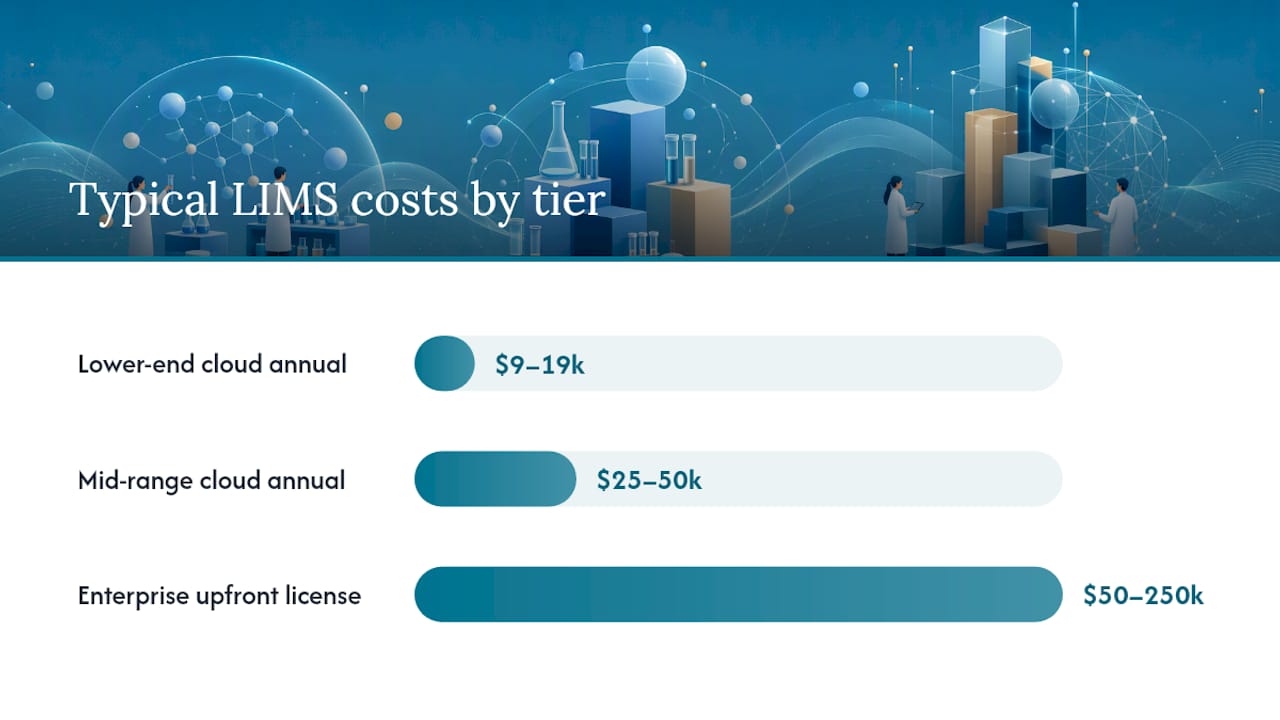
Here's the range to anchor your budget on. Lower-end cloud platforms, suited to small labs running basic workflows, typically run $9,000 to $19,000 a year. Mid-range configurable cloud LIMS, the tier most independent and hospital-affiliated labs land in, runs $25,000 to $50,000 annually once you add modules and moderate integration work. Enterprise and on-premise systems, common in large multi-site or pharma environments, carry upfront license costs of $50,000 to $250,000 or more, plus recurring maintenance.
The real budgeting number is the total cost of ownership, not the license fee. Market data consistently shows labs paying 2.5 to 4 times the headline license cost once implementation, migration, validation, and five years of support get added in.
- Lower-end cloud: low annual cost typical for small labs with limited customization
- Mid-range cloud: $25k–$50k/year, moderate integrations and configuration
- Enterprise/on-prem: $50k–$250k+ upfront, plus 15–25% annual maintenance
- TCO multiplier: budget 2.5x to 4x the license price over five years
Statistic: Most labs end up spending 4 to 5 times their initial LIMS software cost once implementation, training, and ongoing support are factored in.
Key Takeaways
LIMS pricing ranges from $9,000 a year for small cloud deployments to $250,000 or more upfront for enterprise on-premise systems, but real budgeting requires planning for 2.5 to 4 times that headline figure across a five-year total cost of ownership.
| Point | Details |
|---|---|
| Headline pricing varies by tier | Small cloud labs pay $9k–$19k/year; mid-range runs $25k–$50k/year; enterprise on-prem starts at $50k upfront. |
| TCO multiplier matters most | Budget 2.5x to 4x the license price over five years to cover implementation, validation, and support. |
| Hidden costs cluster in four areas | Migration ($10k–$50k), integrations ($5k–$150k+), customization, and validation drive most budget overruns. |
| Seat policy affects compliance | Per-user pricing can encourage login sharing, which breaks audit trails; volume-based pricing avoids that risk. |
| Fixed-scope SOWs protect budgets | Request fixed pricing for migration and each integration instead of open-ended hourly billing. |
| Labrynix quotes by workflow, not seat count | Labrynix prices around reporting volume, modules, and integration scope for genetic and molecular labs. |
Table of Contents
- What Drives Lims Cost Beyond the Sticker Price?
- How Much Do Different Lims Pricing Tiers Cost?
- What Hidden Costs Push the Budget Higher?
- How Do You Calculate a 5-Year Lims TCO?
- What Should You Ask a Vendor Before Signing?
- How Long Does Implementation Take at Each Lab Size?
- Who's Behind This Guide and What Has Labrynix Learned?
- Where the Conventional LIMS Budgeting Advice Falls Short
- Get a Custom Quote Built Around Your Lab's Actual Workflow
- Sources
What Drives Lims Cost Beyond the Sticker Price?
Four variables move a quote more than anything else: how many people touch the system, how customized it needs to be, what it has to talk to, and how tightly regulated your lab is. Get a handle on these before you take a single vendor call, and you'll know within a few thousand dollars what you're actually facing.
License model sets the baseline. Per-user pricing charges by seat, per-site pricing charges by lab location regardless of headcount, and volume-based pricing scales with sample or test throughput. A ten-person lab running 500 tests a month wants a very different structure than a 40-person reference lab running 15,000. Per-user models look cheap on a spec sheet and then balloon the moment you add a shift, a satellite location, or a QA reviewer who only logs in twice a week.
That last point matters more than it looks. Per-user pricing creates a real incentive to share logins, and seat sharing quietly breaks your audit trail — a compliance risk that costs far more than the extra seat would have. Volume or throughput-based pricing avoids that trap entirely, since it doesn't punish you for giving each analyst their own credentials.
Pro Tip: Before signing anything, calculate the cost per seat if every technician, reviewer, and admin gets an individual login. If that number changes your tier, ask the vendor for unlimited-user pricing instead of per-seat.
Customization and automation carry a real premium. A vendor's out-of-box configuration handles standard workflows fine, but genetic and molecular labs rarely run standard workflows. Custom result calculations, reflex testing logic, and automated PGx interpretation rules all add professional services hours. Instrument and EHR integrations follow the same pattern: each connector is typically its own scoped project, not a checkbox feature.
Validation requirements change the math too. A CLIA-certified or CAP-accredited lab needs IQ/OQ/PQ documentation for any new system, and that testing cycle adds weeks of labor plus consulting time if you don't have in-house validation staff. Labs handling protected health information also need to think about storage, retention policy, and data sovereignty. Hosting in a specific region, or keeping data on dedicated infrastructure instead of shared cloud tenancy, shows up as a line item most first-time buyers never see coming.
- Per-user vs. volume-based pricing changes cost as headcount grows
- Custom workflows and PGx logic add professional services hours
- Each instrument or EHR connector is scoped and priced separately
- IQ/OQ/PQ validation adds cost for regulated labs
- Data residency and retention requirements affect hosting fees
How Much Do Different Lims Pricing Tiers Cost?
Three tiers cover almost every lab shopping for a system right now, and each one fits a distinct profile.
-
Lower-end cloud. Annual costs typically fall between $9,000 and $19,000, with first-year totals for small cloud-first labs often landing in the $3,800 to $25,000 range once modest implementation is included. This tier fits small labs running standardized workflows without heavy integration needs. Per-user rates here often land in the lower end of the $40 to $300+ per user, per month range the market reports across cloud platforms generally.
-
Mid-range configurable cloud. This is where most independent diagnostic and genetic testing labs end up, typically $25,000 to $50,000 a year in subscription cost, plus implementation add-ons for integrations and custom reporting templates. Per-user rates climb toward the middle of that same $40 to $300+ band, and the final number depends heavily on how many instrument interfaces and EHR connections you're building.
-
Enterprise or on-premise. Upfront license costs run $50,000 to $250,000 or more, and perpetual licenses typically carry annual maintenance fees of 15% to 25% of the license cost on top of that. This tier fits large multi-site networks, pharma-affiliated labs, and organizations with strict on-premise data policies.
Statistic: Cloud LIMS platforms often prove cheaper than on-premise systems over a five-year horizon, since they avoid the infrastructure and upgrade project costs that on-prem deployments carry.
Per-user pricing can mislead you if you're comparing quotes across vendors with different seat definitions. One vendor's "user" might mean any logged-in account; another's might mean only active reviewers with signature authority. Ask for the exact seat definition before comparing per-user rates side by side.
What Hidden Costs Push the Budget Higher?
The line items vendors don't lead with are usually the ones that push your project to 50% over the subscription-only estimate. Four categories account for almost all of it.
Data migration typically runs $10,000 to $50,000, and the number climbs fast if your existing records are inconsistent, stored across multiple legacy systems, or need manual cleanup before they can load into the new platform. Labs migrating genetic testing history with years of variant annotations tend to land at the higher end.
Integrations and instrument connectors run $5,000 to $150,000+ depending on scope. A single standard interface costs far less than a custom EHR connection built around a legacy hospital system with no modern API.
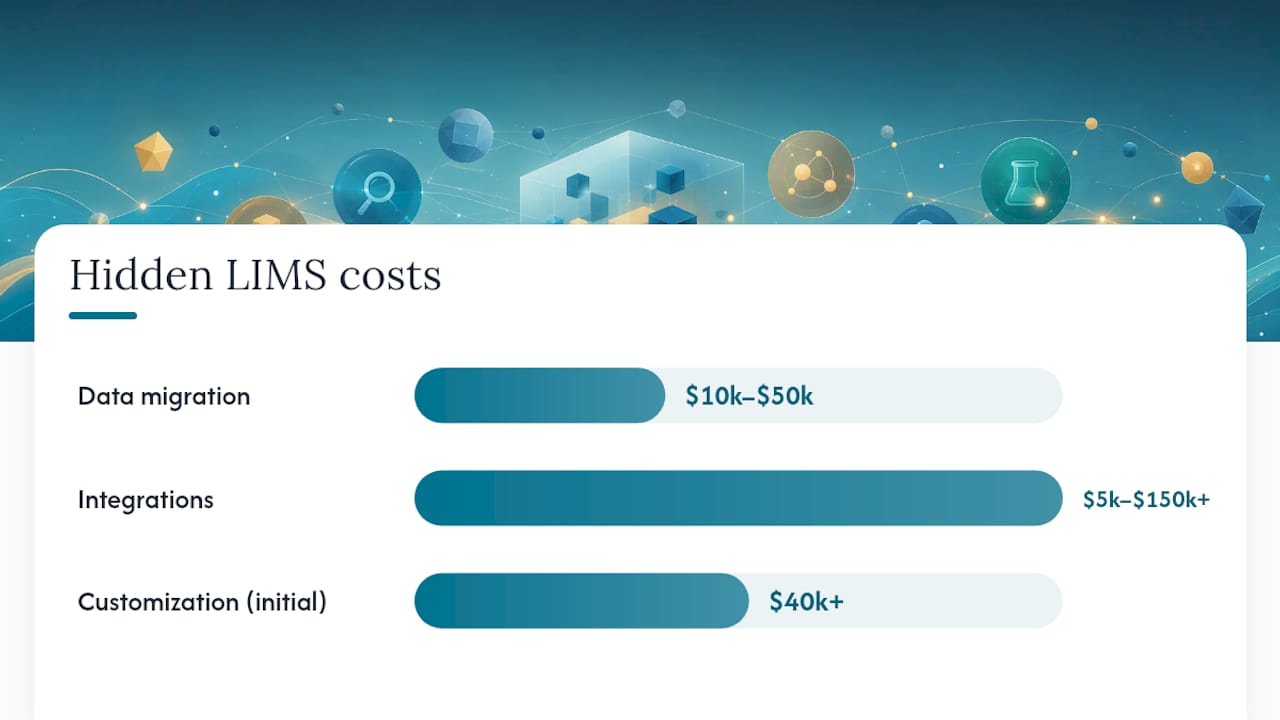
Customization and change requests often come bundled at initial setup, then shift to hourly billing once you're live. Initial customization packages frequently start around $40,000 for meaningful workflow changes; ongoing change requests after go-live are typically billed at professional-services hourly rates that vary by vendor.
Validation and training round out the list. Documentation for regulated labs, plus onboarding and hypercare support in the weeks after launch, both carry real labor cost even when the vendor includes some training in the base contract.
- Data migration: $10k–$50k, higher for messy or multi-source legacy data
- Integrations: $5k–$150k+ depending on connector complexity
- Customization: often $40k+ initial, hourly for later change requests
- Validation documentation and training: budget separately, rarely fully included
How Do You Calculate a 5-Year Lims TCO?
Build your total cost of ownership from five line items, not one. License or subscription fees anchor the model, but implementation services, integrations, validation, ongoing maintenance, and training all belong in the same spreadsheet before you present a number to finance.
Here's a worked example for a mid-size molecular lab choosing a $35,000-a-year mid-range cloud LIMS:
- Year 1: $35,000 subscription + $25,000 implementation, integrations, and validation = $60,000
- Years 2 through 5: $35,000 per year subscription, assuming no major module additions = $140,000
- 5-year total: $200,000, roughly 5.7x the standalone Year 1 subscription price, and consistent with the 2.5x to 4x TCO multiplier the market generally reports once you strip out the heavier first-year implementation spike.
The ROI side of the ledger is where this becomes easier to defend internally. Faster reporting turnaround, fewer manual transcription errors, and improved billing workflow visibility all reduce labor hours. For regulated labs, avoiding a single CAP or CLIA inspection finding often justifies the entire investment on its own. Conservative payback windows typically run one to three years, depending on how much manual work the old system required.
What Should You Ask a Vendor Before Signing?
Every hidden cost in the sections above traces back to a question you could have asked during the demo. Bring this list to your next vendor call.
- Which services are included in the base quote, and which trigger a billable professional services order?
- What is the exact fee for adding or removing a seat mid-contract?
- What is the hourly or bundled rate for change requests after go-live?
- What percentage is the annual maintenance fee, and does it increase at renewal?
- What is the minimum contract term, and what happens if you need to exit early?
- Who owns the data, and is there an export or transition fee if you leave?
- Can they provide a fixed-scope statement of work for migration and each integration, rather than open-ended hourly billing?
- What SLA do they guarantee for support response and uptime, and is it documented in the contract?
Pro Tip: Ask specifically for fixed-scope statements of work for migration and integration work instead of accepting time-and-materials billing. Open-ended PSO hours are the single most common way a LIMS project overruns budget.
Get answers in writing. A vendor who hesitates on seat-change fees or exit costs is telling you something about how the relationship will go once you're locked in.
How Long Does Implementation Take at Each Lab Size?
Timelines scale with integration complexity and lab size, and budgets scale right alongside them.
- Small cloud-first lab: 4 to 8 weeks to go live, with first-year budgets often in the $3,800 to $25,000 range for software plus light implementation.
- Mid-size lab with integrations: 3 to 6 months, with total first-year spend commonly landing near $60,000 to $90,000 once you factor in instrument connectors and validation.
- Enterprise or multi-site rollout: 6 to 24 months, with budgets scaling into the hundreds of thousands depending on the number of sites and legacy systems being replaced.
Schedule risk almost always traces back to two things: data that isn't clean enough to migrate on the first try, and internal staff who can't dedicate real hours to the project alongside their normal workload. Phased rollouts, starting with one module or one site before expanding, cut that risk substantially and let you validate the vendor's real support quality before you're fully committed.
Who's Behind This Guide and What Has Labrynix Learned?
This guide draws on published market benchmarks for LIMS pricing alongside operational patterns observed across genetic and molecular lab deployments.
- Additional coverage includes onboarding processes for genetic and molecular labs and data migration best practices.
Labrynix structures its quotes around three variables: reporting volume, module selection, and integration scope, rather than a flat per-seat number that punishes labs for adding reviewers.
Buyers evaluating any LIMS for PGx or genetic testing should expect validation planning, portal configuration, and billing coordination to be scoped separately from the core platform fee, not bundled invisibly into a single number that hides where the money actually goes.
Where the Conventional LIMS Budgeting Advice Falls Short
Most LIMS buying guides treat the license fee as the number that matters and treat everything else as a footnote. That's backwards. The license is the easiest number to compare across vendors and the least useful one for planning a real budget, because it tells you almost nothing about what your specific lab will spend once integrations, validation, and five years of support enter the picture.
The bigger blind spot is seat policy. Labs fixate on per-user rates during procurement, then discover eighteen months later that their audit trail has gaps because three technicians share one login to avoid an extra seat fee. That's not a minor administrative issue in a regulated lab. It's a finding waiting to happen.
If you take one thing from this guide, make it this: build your five-year TCO model before you take a single vendor call, not after. Walking into a demo with your own numbers changes the conversation entirely. You stop reacting to their pricing structure and start asking whether their structure fits the budget you already know is realistic.
— Tarek
Get a Custom Quote Built Around Your Lab's Actual Workflow
Labrynix is built specifically for the cost drivers this guide just walked through: PGx reporting complexity, instrument and EHR integrations, and validation requirements that generic clinical LIMS platforms treat as afterthoughts.
Instead of a flat per-seat number that penalizes you for adding reviewers, Labrynix scopes pricing around reporting volume, module selection, and the specific integrations your lab needs, whether that's HL7 and FHIR connections or provider and patient portal access. Pricing is custom-quoted, which means you get a number built around your actual test volume and workflow instead of a generic tier that forces you to overpay for capacity you don't need. Genetic testing and molecular diagnostics labs can review the Labrynix solutions built for their specific workflows or start with the buyer's guide to scope requirements before requesting a written estimate.
Sources
- LIMS Cost Guide 2026: What Labs Actually Pay | LabHQ
- How Much Does LIMS Cost? Pricing, Implementation & ROI - Lifepoint Informatics