
The LIMS onboarding process is defined as the phased integration, configuration, and validation of a laboratory information management system to match existing lab workflows before going live. For genetic testing, molecular diagnostics, and pharmacogenomics labs, this process carries higher stakes than in general clinical settings. Complex order intake, multi-gene panel tracking, PGx report generation, and HIPAA-conscious data handling all demand a structured approach. Standards like ISO 17025 and CLSI guidelines set the compliance baseline. Platforms like Labrynix are built specifically around these workflows, reducing the gap between software configuration and real lab operations.
What is the LIMS onboarding process, and what stages does it include?
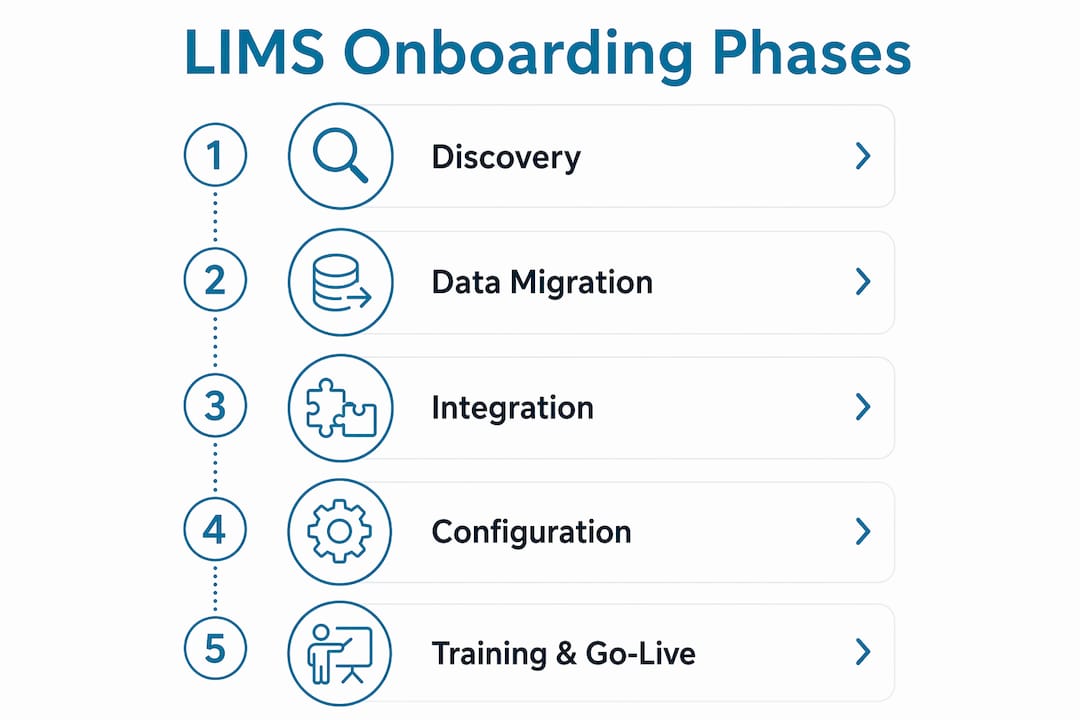
The LIMS onboarding process covers five sequential phases: Discovery and Requirements Gathering, Data Migration Scoping, Integration Planning, User and Role Configuration, and Training and Go-Live. Each phase has a defined purpose and a target completion window. Phased onboarding timelines typically run within a 60-day window for standard configurations, though complex environments with multiple instrument interfaces can extend to six months.
Phase 1: Discovery and requirements gathering (days 1–14)
Discovery is where the entire project either succeeds or fails before it starts. Lab managers, quality staff, and IT leads map every existing workflow: order intake, accessioning, sample routing, result review, and report delivery. The goal is to document what the lab actually does, not what the vendor assumes it does. Skipping this phase or rushing it produces a LIMS that forces staff to adapt to software rather than the other way around.
Phase 2: Data migration scoping (days 10–25)
Data migration scoping defines exactly what moves into the new system and what gets archived. This phase runs parallel to late discovery. Teams audit legacy records, patient data, test catalogs, and instrument result files. The output is a migration scope document that prevents surprises during the actual transfer.
Phase 3: Integration planning (days 20–40)
Integration planning covers every external connection the LIMS must support: HL7 and FHIR message routing, instrument interfaces, EMR and EHR connections, billing platforms, and provider portals. For molecular labs, this often includes connections to sequencing instruments and variant interpretation pipelines. Each interface gets a validation plan before any configuration begins.
Phase 4: User and role configuration (days 30–50)
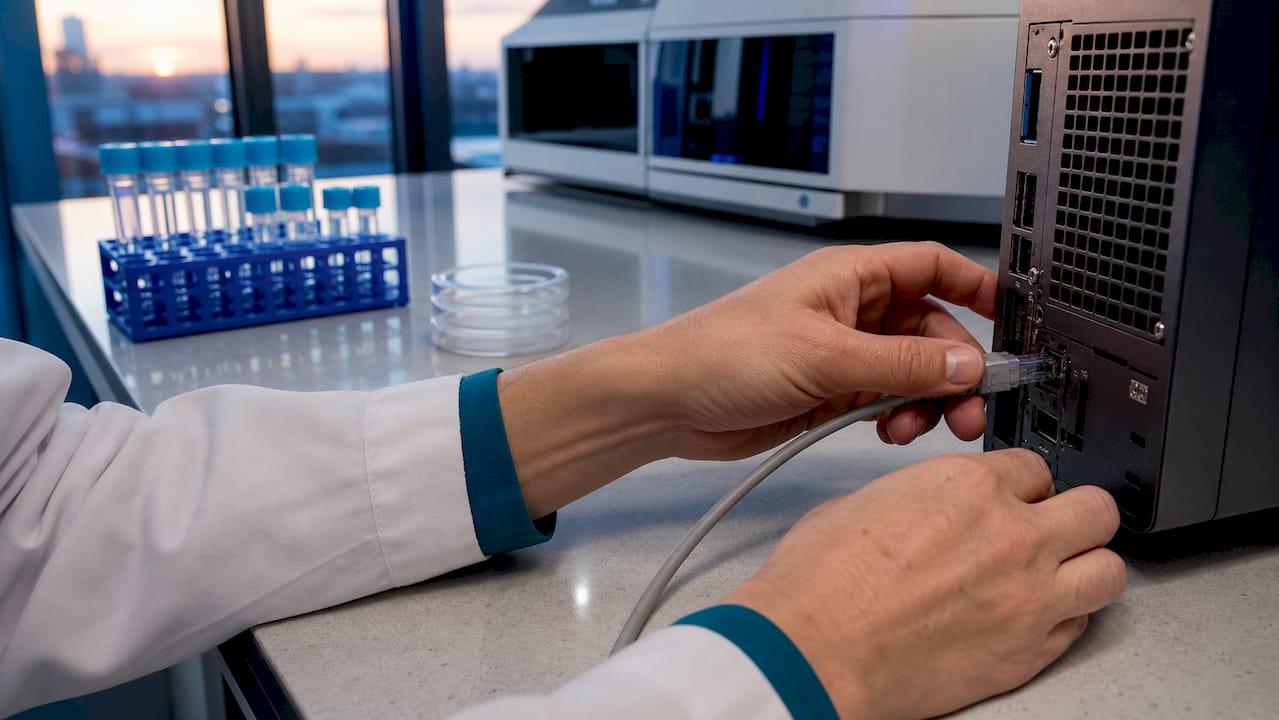
User and role configuration translates the lab's organizational structure into the system. Lab directors, accessioners, technologists, billing staff, and providers each receive role-based permissions aligned to their responsibilities. This phase also sets up audit logging, which ISO 17025 and CLIA-regulated labs require for every data access and modification event.
Phase 5: Training and go-live (days 45–60+)
Training and go-live are the final phase, but they are not the finish line. Standard setups can go live in under five days when configuration is complete and validated. Larger deployments with multiple interfaces require more time. Go-live is a verification event, not a configuration session.
Pro Tip: Keep staff away from the new system during the first 30 days of discovery. Premature hands-on access creates frustration and anchors staff to early, incomplete configurations. Let the workflow map drive the build first.
How does data migration affect LIMS onboarding success?
Data migration is the most common failure point in any LIMS implementation. Incomplete legacy inventories and undefined migration scope lead directly to data integrity risks and project delays. For genetic and molecular labs, the stakes are higher because patient genetic records, PGx interpretation histories, and chain-of-custody logs carry regulatory weight.
The most effective approach treats migration as a project within a project. Labs that succeed define three categories before contract signing:
- Migrate: Active patient records, current test catalogs, open orders, and instrument reference ranges that staff need on day one.
- Archive: Historical records that must be retained for compliance but do not need to live in the active LIMS. These stay in a read-accessible archive system.
- Discard: Duplicate entries, test codes no longer in use, and corrupted records that add noise without value.
Pro Tip: Run a full migration test in a staging environment before touching production data. Validation in a test environment catches format mismatches, missing fields, and encoding errors before they become audit findings. Document every test run for your quality records.
The table below summarizes the most common migration risks and the corresponding controls for molecular lab environments.
| Migration risk | Impact | Control |
|---|---|---|
| Incomplete legacy inventory | Missing records at go-live | Full audit of all data sources before scoping |
| Undefined archive policy | Regulatory non-compliance | Written migration vs. archive decision matrix |
| Untested data formats | Import failures and data corruption | Staging environment validation with sign-off |
| Missing chain-of-custody logs | CLIA and ISO 17025 audit gaps | Map custody fields to new schema before migration |
For deeper guidance on data migration best practices, molecular labs should document every migration decision as part of their quality management system records.
What integration and configuration steps align the LIMS with lab workflows?
The LIMS integration process determines whether the system fits the lab or fights it. Workflow mapping must happen before any configuration begins. Lab managers who skip this step end up with a system that reflects the vendor's default assumptions, not the lab's actual sample-to-report path.
Effective configuration for genetic and molecular labs covers four areas:
- Instrument interfacing: Sequencers, PCR platforms, and liquid handlers each require validated bidirectional interfaces. Results must flow into the LIMS without manual transcription. For details on instrument interface setup, labs should validate each connection against real result files before go-live.
- Workflow queue configuration: Sample accessioning, extraction, amplification, sequencing, and review queues must mirror the lab's physical workflow. Each queue needs defined entry criteria, status transitions, and escalation rules.
- Report and QC rule setup: For PGx and molecular diagnostic labs, report templates must align with CPIC guidelines, FDA pharmacogenomic labeling references, and lab-approved interpretation rules. QC rules should flag out-of-range controls automatically rather than relying on manual review.
- Role-based access and audit logging: Every user action must be logged with a timestamp, user ID, and change record. This is not optional for CLIA-regulated labs or labs pursuing ISO 17025 accreditation.
Agile, phased configuration reduces errors and builds staff confidence. Labs that release configuration in stages, test each stage, and gather feedback before moving forward avoid the costly rework that comes from big-bang deployments. Early user involvement in configuration review also reduces resistance at go-live.
How do training and go-live strategies determine onboarding outcomes?
Training is the phase most labs underinvest in, and it is the phase most responsible for failed adoptions. Effective LIMS user training is built around workflow walkthroughs, not feature demonstrations. Staff need to see how the system handles their specific tasks: receiving a sample, logging an extraction, releasing a result, or generating a PGx report. Feature-first training produces staff who know where buttons are but not how to use the system under real conditions.
Go-live is a verification event. Testing billing integration, instrument interfaces, and user accounts before the cutover date prevents operational disruptions on day one. Any test that fails during go-live signals an issue from an earlier phase, not a go-live problem. Labs that treat go-live as a configuration session create chaos. Labs that treat it as a final verification step go live cleanly.
The most effective rollout strategies for molecular labs include:
- Staggered department rollout: Bring one workflow or department live at a time. Accessioning goes first, then the bench, then reporting. This limits the blast radius of any configuration issue.
- Parallel system operation: Run the legacy system alongside the new LIMS for a defined period. Parallel operations provide an audit trail and a fallback if critical issues emerge. ISO 17025 auditors view parallel operation records favorably.
- Super user designation: Identify two to three staff members per department who receive advanced training before go-live. These internal champions answer peer questions, reduce vendor support dependency, and accelerate adoption. A go-live preparation checklist helps super users stay aligned across departments.
- Post-go-live support window: Define a 30-day hypercare period where the vendor and internal IT provide priority response to issues. This window catches the edge cases that testing environments never surface.
Pro Tip: Automate the highest-pain manual task first. Early wins from automation build staff morale and create visible proof that the new system improves daily work. Pick the task your team complains about most and make it the first thing the LIMS solves.
Key Takeaways
Successful LIMS onboarding requires phased execution, validated data migration, workflow-driven configuration, and training built around real lab tasks rather than software features.
| Point | Details |
|---|---|
| Five-phase structure | Discovery, data migration, integration, configuration, and training each require defined timelines and sign-off criteria. |
| Data migration is the top risk | Define migrate vs. archive scope before contract signing to prevent data integrity failures at go-live. |
| Configuration must mirror workflows | Map lab processes first; configure the LIMS to match them, not the reverse. |
| Training drives adoption | Workflow walkthroughs outperform feature tutorials for reducing staff resistance and errors. |
| Go-live is verification | All interfaces, user accounts, and QC rules must be tested and signed off before the cutover date. |
Why I think most labs underestimate the discovery phase
The most expensive mistake I see in LIMS onboarding is treating discovery as a formality. Labs schedule a two-hour kickoff call, hand the vendor a workflow diagram from three years ago, and move straight to configuration. Six weeks later, the system does not match how the lab actually operates, and everyone blames the software.
Implementation success depends more on a committed internal team than on the technology. A cross-functional steering committee that includes lab operations, quality management, and IT is not optional. It is the mechanism that catches misalignments before they become expensive rework. I have seen labs with average software and excellent internal governance outperform labs with premium platforms and disengaged teams every time.
The other pattern worth naming: labs that expose staff to the new system too early during discovery create anchoring problems. Staff form opinions about a half-built system and carry those opinions into go-live. Keep the discovery phase clean. Map workflows on paper or in process diagrams. Let agile phased releases introduce the software only after the configuration reflects real lab operations. The first impression your team gets of the new LIMS should be a system that already works the way they do.
— Tarek
Labrynix and the LIMS onboarding path for molecular labs
Genetic and molecular labs need a LIMS built around their workflows, not adapted from a generic clinical platform. Labrynix was designed from real laboratory experience, covering the complete sample-to-report path including order intake, accessioning, PGx report generation, provider portal delivery, and billing visibility.
Labrynix supports labs through every onboarding phase, from workflow mapping and data migration to instrument interfacing and go-live verification. The platform's role-based access, audit logging, CPIC-aligned reporting, and HL7/FHIR integration pathways are built for the compliance and reporting demands of genetic testing and molecular diagnostics. Labs evaluating their options can explore LIMS solutions by lab type or review the full genetic lab LIMS platform to see how Labrynix aligns with their specific onboarding requirements.
FAQ
What is the LIMS onboarding process?
The LIMS onboarding process is the structured, phased integration of a laboratory information management system into lab operations, covering discovery, data migration, configuration, and go-live verification. It typically runs 60 days for standard setups and up to six months for complex multi-interface environments.
How long does LIMS implementation take for a molecular lab?
Standard configurations can reach go-live in under five days, while molecular labs with multiple instrument interfaces and complex data migration requirements typically need three to six months for full implementation.
What are the biggest risks in LIMS data migration?
Incomplete legacy data inventories and undefined migration scope are the leading causes of data integrity failures during LIMS onboarding. Labs should audit all data sources and define migrate vs. archive decisions before signing a vendor contract.
What does effective LIMS user training look like?
Effective training walks staff through their specific workflows in the new system rather than demonstrating software features in isolation. This approach reduces resistance and helps staff see direct operational benefits from day one.
How should a lab prepare for LIMS go-live?
Go-live preparation requires testing all instrument interfaces, billing integrations, user accounts, and QC rules in a staging environment before the cutover date. Any failure at go-live signals an issue from an earlier configuration phase, not a go-live problem.