
LIMS integration with lab instruments is defined as the direct connection between laboratory equipment and a Laboratory Information Management System to automate data capture, transfer, and storage without manual entry. Instruments like HPLC analyzers, mass spectrometers, and next-generation sequencing platforms generate raw results that must reach the LIMS accurately and immediately. When that connection works correctly, labs eliminate transcription errors, accelerate turnaround times, and create the audit-ready data trails that regulators require. Protocols like HL7, ASTM, and APIs form the technical backbone of these connections, and understanding how they work is the first step toward building a reliable integration framework for any diagnostic lab.
What are the main methods of integrating lab instruments with LIMS?
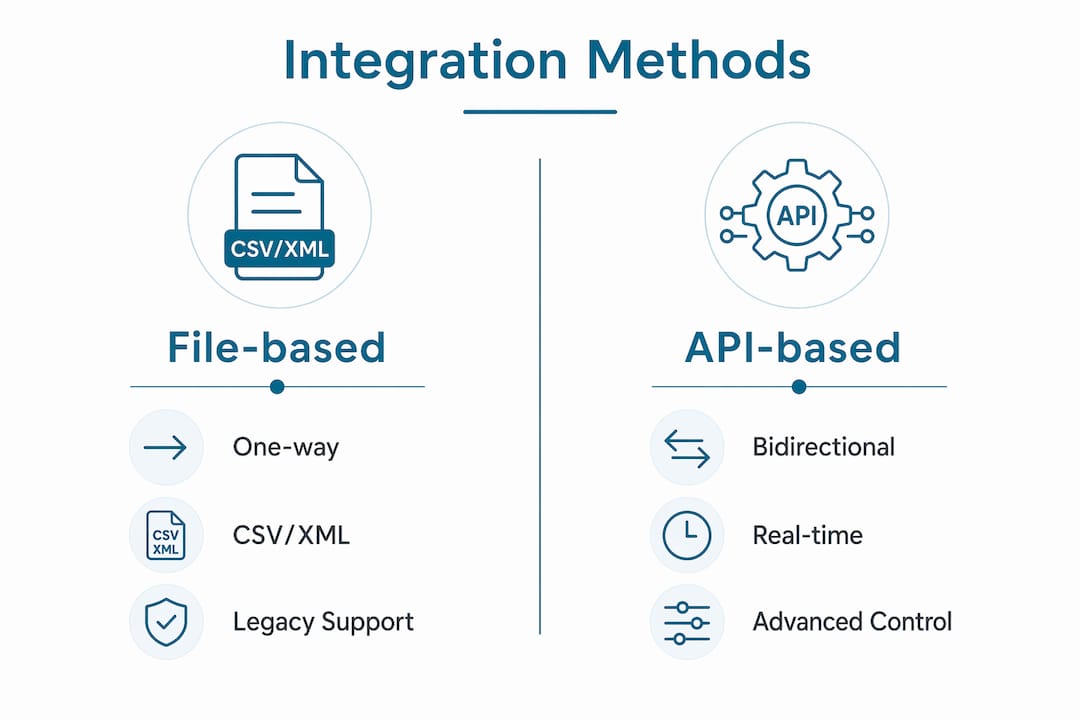
Two primary patterns govern lab instrument integration: file-based integration and API-based direct integration. Most diagnostic labs use both, depending on the instrument and the workflow requirement.
File-based integration
File-based integration works by having an instrument write structured output files, typically in formats like CSV, XML, or ASTM-formatted text, to a shared directory or transfer location. The LIMS or a middleware layer monitors that location, picks up the file, parses it, and loads the results. File-based integration is common because it requires no direct network connection to the instrument and works with a wide range of legacy analyzers. The tradeoff is latency. Results are available only after the file is written and processed, not in real time.
API-based direct integration
API-based integration connects the LIMS directly to the instrument's software interface, enabling bidirectional communication. The LIMS can send worklists to the instrument before a run begins and receive results as soon as the instrument completes analysis. Bidirectional messaging supports run initiation and real-time status monitoring, which file-based approaches cannot provide. The limitation is that not every instrument exposes an API, and those that do require vendor-specific configuration.

Comparison: file-based vs. API integration
| Feature | File-based | API-based |
|---|---|---|
| Communication direction | One-way (instrument to LIMS) | Bidirectional |
| Real-time data transfer | No | Yes |
| Run initiation support | No | Yes (instrument-dependent) |
| Legacy instrument compatibility | High | Low to moderate |
| Implementation complexity | Low | Moderate to high |
| Error handling complexity | Moderate | High |
Pro Tip: Confirm early in your planning whether target instruments support bidirectional functions like worklist requests. Results-only integrations limit workflow automation to post-run data capture and prevent run initiation from the LIMS.
The right choice depends on the instrument's capabilities and the lab's automation goals. A LIMS instrument interface setup guide can help labs map each instrument to the most appropriate connection method before committing to a design.
How do regulatory standards shape LIMS instrument integration?
Regulatory compliance is not a layer added on top of integration. It defines the architecture of the integration itself. Two frameworks dominate diagnostic lab requirements: FDA 21 CFR Part 11 and ISO 17025.
FDA 21 CFR Part 11 requirements
FDA 21 CFR Part 11 applies to any lab that generates electronic records as part of a regulated submission or quality process. The regulation requires validated systems, controlled access, and secure, time-stamped audit trails that independently record every operator action tied to an electronic record. For instrument integration, this means the LIMS must capture not just the result but also who received it, when it was received, and whether any modification occurred after transfer. Electronic signatures must be linked to the specific records they authenticate.
"Part 11 compliance centers on trustworthy electronic records and secure, linked audit trails in instrument-driven data processes." — MedDeviceGuide
Treating instrument integration as a data integrity topic rather than a purely technical one is the correct framing. Regulated labs that separate IT responsibilities from compliance responsibilities often discover audit trail gaps during inspections.
ISO 17025 requirements
ISO 17025 governs testing and calibration laboratories and requires a complete traceability chain linking every test result back to the instrument that produced it and the calibration status of that instrument at the time of testing. The LIMS must maintain an equipment register with calibration records and link those records to individual result sets. A correct raw result associated with an out-of-calibration instrument is an audit failure under ISO 17025.
Key compliance requirements for LIMS instrument integration include:
- Audit trails: Time-stamped, tamper-evident logs of all data receipt and modification events
- Access controls: Role-based permissions restricting who can view, edit, or approve instrument-generated records
- Equipment traceability: Linkage from each result to the instrument ID and its current calibration certificate
- Calibration status capture: Real-time or scheduled checks confirming instrument qualification before results are accepted
- System validation documentation: Evidence that the integration performs as intended under defined conditions
What are the technical challenges in implementing LIMS instrument integration?
Integration design looks straightforward until instruments behave unexpectedly. The hidden complexity lies in parsing, error handling, and maintaining connections as instruments and their firmware change over time.
-
Instrument output variability. Different analyzers produce different file structures, even within the same product family. A mass spectrometer from one vendor may write results in a format that differs from a model released two years later by the same manufacturer. Each instrument requires its own parsing profile, and ASTM E1394 or HL7 standards define the messaging framework but do not eliminate vendor-specific variations within that framework.
-
Error and exception handling. Instruments drop files, produce incomplete outputs, or lose sample ID context during high-volume runs. The LIMS integration layer must include deterministic parsing logic, retry queues for failed transfers, and validation checks that confirm sample IDs match open orders before results are written. Mis-associated results caused by incomplete data handling are one of the most serious integration failure modes in a diagnostic lab.
-
Protocol drift. ASTM and HL7 are not set-and-forget standards. Instrument vendors update firmware and communication behavior, which can silently break an existing parser. Labs need ongoing monitoring of integration connections and version-controlled parser profiles to detect and correct drift before it affects result delivery.
-
Lifecycle linkage requirements. Integration models built for audit readiness must trace the full path from instrument run through calibration state and final report version. This is not a reporting feature. It is an architectural requirement that must be designed into the integration from the start.
-
Legacy instrument onboarding. Older analyzers often lack API support and produce non-standard file outputs. Middleware layers like LISBridge or custom adapters bridge the gap, but they add maintenance overhead and require their own validation documentation.
Pro Tip: Design your integration framework around reliable data traceability rather than transport method. A well-validated file-based connection with strong error handling outperforms a poorly monitored API integration every time.
How does effective LIMS integration improve lab workflows and data management?
The operational benefits of connecting lab devices with LIMS extend well beyond eliminating manual data entry. A well-designed integration changes how the entire lab operates.
- Reduced manual intervention. Technicians no longer transcribe results from instrument printouts into the LIMS. That reduction removes a primary source of transcription error and frees staff time for higher-value tasks like result review and exception management.
- Accelerated turnaround times. Results move from instrument to LIMS to reporting queue without waiting for a manual transfer step. For molecular diagnostic labs processing urgent clinical samples, that speed directly affects patient care timelines.
- Reproducible research and audit readiness. Every result carries a complete data lineage: instrument ID, run timestamp, calibration status, and operator record. That lineage supports both internal quality review and external regulatory inspections without additional documentation effort.
- Scalable instrument onboarding. A framework that handles both file-based and API connections can accommodate new instruments without rebuilding the integration architecture. Labs adding sequencers, liquid handlers, or point-of-care analyzers connect them to the same integration layer using the appropriate method.
- Improved reporting accuracy. When instrument data flows directly into the LIMS, the values that appear in final reports reflect exactly what the instrument produced. There is no intermediate manual step where a number can be misread or mistyped.
For labs building or refining their integration approach, understanding LIMS in lab workflow design provides a practical framework for mapping instrument connections to broader operational goals. Labs evaluating whether their current system architecture fits their instrument mix should also review LIS vs. LIMS distinctions to confirm they are solving the right problem with the right tool.
Key Takeaways
Reliable LIMS instrument integration requires choosing the right connection method, building compliance into the architecture, and maintaining instrument-specific parser profiles to prevent data integrity failures.
| Point | Details |
|---|---|
| Choose the right method | Use file-based integration for legacy instruments and API-based for real-time, bidirectional workflows. |
| Build compliance in from the start | FDA 21 CFR Part 11 and ISO 17025 require audit trails and calibration traceability as architectural requirements, not add-ons. |
| Plan for error handling | Deterministic parsing and retry queues prevent mis-associated results from reaching the LIMS. |
| Monitor parser profiles continuously | Instrument firmware updates can silently break existing integrations without ongoing version monitoring. |
| Design for full lifecycle linkage | Every result must trace back to the instrument run, calibration state, and final report version for audit readiness. |
The integration gap most labs discover too late
Labs that approach instrument integration as a one-time IT project consistently run into the same problem: the connection works at go-live and then quietly degrades. Firmware updates change file formats. New instrument models arrive with different API behaviors. The parser that worked perfectly for 18 months starts producing validation errors that nobody notices until a result is flagged during an inspection.
What I have seen work consistently is treating integration as a living system with its own maintenance schedule. That means version-controlled parser profiles, scheduled integration health checks, and a clear owner for each instrument connection. It also means building compliance requirements into the integration design before the first instrument is connected, not after the first audit finding.
The other underestimated factor is the bidirectional capability question. Many labs assume their instruments support run initiation and worklist requests because the vendor's sales materials suggest it. Confirming that capability at the instrument level, before the integration design is finalized, is the difference between a fully automated workflow and a results-only connection that still requires manual run setup.
The labs that get this right are the ones that treat instrument integration as a data integrity discipline, not a connectivity task. The technical connection is the easy part. The hard part is ensuring that every result that flows through that connection is traceable, validated, and audit-ready from the moment it leaves the instrument.
— Tarek
How Labrynix supports instrument integration for diagnostic labs
Labrynix Connect is built to handle the integration complexity that diagnostic labs face every day. The platform supports HL7, FHIR, APIs, and webhooks, giving labs a structured pathway for connecting both modern and legacy instruments to a single LIMS environment.
Labrynix LIMS manages the full sample-to-report workflow, including instrument data receipt, audit logging, role-based access controls, and calibration-linked result traceability. For molecular diagnostic and genetic testing labs that need both instrument connectivity and compliant reporting in one system, Labrynix LIMS solutions cover the complete operational picture. Labs evaluating their options can also review the Labrynix LIMS product to see how instrument integration connects to PGx reporting, provider portals, and billing visibility in a single platform built for precision medicine.
FAQ
What is LIMS instrument integration?
LIMS instrument integration is the automated connection between laboratory analyzers and a Laboratory Information Management System that transfers result data without manual entry. Protocols like ASTM E1394, HL7, and REST APIs define how instruments and LIMS communicate.
What is the difference between file-based and API integration?
File-based integration transfers structured result files from the instrument to the LIMS after a run completes. API integration enables real-time, bidirectional communication including run initiation and live status monitoring, but requires instrument-level API support.
How does FDA 21 CFR Part 11 affect instrument integration design?
FDA 21 CFR Part 11 requires that all instrument-generated electronic records include secure, time-stamped audit trails and linked electronic signatures. The LIMS integration must capture data receipt events and operator actions as part of a validated, access-controlled system.
Why does ISO 17025 require calibration linkage in LIMS?
ISO 17025 mandates that every test result be traceable to the instrument that produced it and the calibration status of that instrument at the time of testing. A correct result from an out-of-calibration instrument fails the traceability requirement and constitutes an audit finding.
What causes instrument integration to fail after go-live?
The most common cause is instrument firmware updates that change file formats or API behavior without notice, breaking existing parser profiles. Ongoing monitoring, version-controlled parsers, and scheduled integration health checks prevent silent failures from reaching the result review queue.