
A clinical LIMS (laboratory information management system) is purpose-built software that manages the full sample-to-report lifecycle in clinical and clinical-trial environments, delivering three things most labs cannot afford to go without: auditable sample workflows, regulatory-grade evidence trails, and integrated data for reporting and study submission.
If you run a clinical diagnostic lab, a molecular or pharmacogenomics (PGx) lab, or a CRO/clinical trial site, this guide maps the capabilities you need to require, the compliance questions you must ask, and the procurement steps that separate a successful implementation from a costly restart.
At a glance:
- Faster, auditable sample workflows from accessioning through result sign-out
- Consistent regulatory evidence: audit trails, electronic signatures, and inspection-ready exports
- Integrated data for clinical reporting, trial submissions, and EHR/EMR exchange
Key Takeaways
A clinical LIMS delivers value only when its capabilities, compliance controls, and integration architecture are matched to the specific workflow of the lab deploying it.
| Point | Details |
|---|---|
| Require validation artifacts upfront | Request IQ/OQ/PQ documentation and a sandbox study before shortlisting any vendor. |
| Map compliance to four frameworks | HIPAA, CLIA, CAP, and 21 CFR Part 11 each require specific vendor evidence; collect all four before signing. |
| Budget for implementation, not just software | Implementation services, integrations, and data migration often match or exceed year-one subscription costs. |
| Match deployment model to your IT reality | SaaS reduces infrastructure burden but increases dependency on vendor change-control discipline. |
| Labrynix for molecular and PGx labs | Labrynix connects LIMS workflow, PGx reporting, HL7/FHIR integrations, and portals in one platform built for genetic and molecular labs. |
Table of Contents
- What does a clinical LIMS actually need to do?
- Compliance, validation, and audit requirements for U.S. clinical labs
- LIMS vs. LIS: which does your lab actually need?
- SaaS, on-premises, or hybrid: how to choose your deployment model
- How LIMS pricing works and what to budget for
- What integrations does a clinical LIMS need to support?
- Questions to ask vendors and red flags to watch for
- What does a realistic LIMS implementation look like?
- Real-world use cases: diagnostics, PGx, and clinical trials
- Why Labrynix is designed for genetic, molecular, and PGx clinical labs
- What lab software practitioners actually get wrong
- Labrynix fits where generic LIMS platforms fall short
- Sources
What does a clinical LIMS actually need to do?
A laboratory information management system started as sample-tracking software. Over the past two decades it has grown into enterprise-grade informatics that can support regulated environments when properly configured. For clinical labs, that evolution matters because the table-stakes features have changed.
The core capability set you must require during vendor shortlisting:
- Accessioning and barcode generation: unique sample IDs, label printing, and intake validation at the point of receipt
- Sample tracking and storage-location resolution: real-time location, container hierarchy, and freezer/rack/position mapping
- Chain-of-custody and freeze/thaw history: timestamped custody transfers and temperature-excursion logging
- Test result capture and validation: instrument data import, reference-range flagging, and technologist review queues
- Quality control and QA modules: Levey-Jennings charts, lot tracking, and corrective-action records
- Role-based user and permission management: granular access by role, department, and study
- Configurable workflows and study templates: adaptable process maps for clinical diagnostics vs. trial protocols
- Audit trails and electronic signatures: immutable event logs and compliant e-sign workflows
- Reporting and configurable templates: structured result reports, PDF generation, and branded output for providers and patients
The difference between a hospital molecular lab and a CRO clinical trial lab shows up most clearly in two areas: accessioning and study templates. A hospital lab accessions by patient and order; a CRO lab accessions by subject ID and protocol, often with blinded sample handling where the technologist cannot see the treatment arm. Study templates in a trial LIMS must support visit schedules, specimen matrices, and protocol amendments without breaking historical data. Ask any vendor you shortlist to show you a working clinical trial template in a sandbox, not just a screenshot.
Pro Tip: Request a live sandbox study from every vendor on your shortlist. If they cannot provision one within a week, that is a signal about their implementation support capacity, not just their sales process.
Compliance, validation, and audit requirements for U.S. clinical labs
Regulatory expectations for a clinical LIMS in the United States come from four overlapping frameworks, and you need evidence from vendors for each one.
HIPAA applies to most clinical labs as covered entities or business associates. HHS defines covered entity obligations and requires that software vendors handling protected health information (PHI) sign a Business Associate Agreement and meet Security Rule standards. Ask for encryption-at-rest and in-transit specifications, access-control architecture, and the vendor's most recent HIPAA attestation or SOC 2 Type II report.
CLIA sets the federal quality standards for laboratory testing on human specimens. CMS hosts the CLIA program guidance that defines personnel, quality systems, and proficiency testing requirements. Your LIMS must generate the documentation CLIA inspectors look for: QC records, corrective actions, and result audit trails.
CAP accreditation goes further. The College of American Pathologists accreditation program requires evidence of document control, QC performance, and chain-of-custody integrity that a well-configured LIMS can produce automatically. Map your CAP checklist items to LIMS outputs before you sign a contract.
21 CFR Part 11 applies when your LIMS stores electronic records that substitute for paper records in FDA-regulated studies. FDA's Part 11 scope and application guidance clarifies what controls are required: audit trails, electronic signature binding, system access controls, and record retention. For trial labs, request the vendor's Part 11 gap assessment and their IQ/OQ/PQ documentation package.
What to request from vendors, in writing: validation plan and IQ/OQ/PQ evidence; SOC 2 Type II or equivalent HIPAA attestation; encryption specifications (AES-256 at rest, TLS 1.2+ in transit); role-based access architecture with audit-log export capability; and change-control/version history for configurations and report templates. A vendor who cannot produce these documents within two weeks of a formal request is not ready for a regulated clinical environment.
The role of LIMS in lab compliance extends beyond document generation. Audit trails must capture sample events at the field level, not just login/logout records. Every result sign-out, amendment, and report release should carry a timestamp, user ID, and reason code. That granularity is what makes an inspection defensible rather than stressful.
LIMS vs. LIS: which does your lab actually need?
The distinction is real and procurement teams routinely blur it. A LIMS is sample- and batch-centric. It was designed for research and trial environments where the unit of work is a specimen or a batch, not a patient encounter. A laboratory information system (LIS) is patient- and case-centric, tightly coupled to hospital workflows, and in some configurations regulated as a medical device under FDA's IVD framework.
Choose a LIMS (or LIMS with clinical modules) when:
- Your lab is a standalone molecular, PGx, or reference lab without a direct hospital EHR dependency
- You run clinical trials or CRO work where study protocols, subject IDs, and blinded handling matter more than patient-encounter billing
- You need configurable workflows that change by protocol or test menu, not a fixed clinical order-entry model
Choose an LIS (or hybrid) when:
- You operate inside a hospital system where physician order entry, ADT feeds, and charge capture must integrate with an existing EHR
- Your test menu is largely routine chemistry or hematology where the LIS's fixed workflow is an advantage, not a constraint
- Regulatory classification of the software as a medical device is a requirement in your jurisdiction
Three quick decision rules:
- If more than half your samples arrive without a patient encounter number, you need LIMS-first architecture.
- If your primary compliance obligation is FDA-regulated trial data, LIMS with Part 11 controls beats a standard LIS.
- If you need both, look for a platform with native EHR/LIMS interfacing rather than a bolt-on middleware layer.
SaaS, on-premises, or hybrid: how to choose your deployment model
Deployment architecture affects validation effort, data residency, cost predictability, and how fast you can respond to a regulatory change. There is no universally correct answer, but the trade-offs are well-defined.
| Dimension | SaaS/Cloud | On-Premises | Hybrid |
|---|---|---|---|
| Validation effort | Vendor manages infrastructure; lab validates configuration | Lab validates infrastructure and application | Split: vendor validates cloud layer; lab validates on-prem components |
| Hosting responsibility | Vendor | Lab IT | Shared |
| Patching and updates | Vendor-managed; change-control notifications required | Lab-managed; full control over timing | Depends on component |
| Data residency | Typically U.S. data centers; confirm contractually | Full local control | Sensitive data on-prem; operational data cloud-hosted |
| Scalability | High; add users or volume without hardware procurement | Constrained by hardware; capacity planning required | Moderate; cloud layer scales; on-prem layer does not |
| Cost model | Predictable subscription; lower upfront | High upfront CapEx; lower long-term OpEx for stable workloads | Mixed CapEx and OpEx |
| Disaster recovery | Vendor SLA; verify RTO/RPO commitments | Lab responsibility; requires dedicated DR infrastructure | Shared; verify which layer owns which SLA |
SaaS is the dominant model for new clinical lab deployments in 2026, particularly for molecular and PGx labs that lack dedicated IT infrastructure. The validation trade-off is real: you are validating a vendor's platform rather than your own, which means your IQ/OQ/PQ scope is narrower but your dependency on the vendor's change-control discipline is higher.
Contract clauses to negotiate before signing:
- Data ownership and export rights in machine-readable format (JSON, CSV, HL7)
- Backup frequency and disaster recovery SLAs with defined RTO and RPO
- Validation support scope: what the vendor provides vs. what the lab must produce
- Change-control notification windows: minimum 30 days for configuration-affecting updates
- Termination data-extraction terms: full data export within 30 days of contract end, at no additional cost
How LIMS pricing works and what to budget for
LIMS pricing for clinical labs is almost never published. Vendors quote based on lab size, test volume, module selection, and implementation scope. That opacity is frustrating, but the cost categories are consistent enough to build a realistic budget.
Software subscription or license fees are the base. SaaS contracts typically price by active user count, test volume tier, or a combination. A small molecular lab with 10 users and moderate volume will pay substantially less than a reference lab running thousands of accessions per day.
Implementation services often cost as much as the first year of software. Requirements gathering, system configuration, workflow design, and validation documentation are labor-intensive. Budget for this explicitly; vendors who quote "free implementation" are typically offering a self-service setup that is not appropriate for a regulated clinical environment.
Integration costs are the most common budget surprise. Each HL7 interface, instrument connection, or EHR integration typically carries a one-time build fee plus ongoing maintenance. Get a line-item quote for every interface you need before signing.
Additional cost categories to budget:
- Data migration from your current system (extraction, mapping, validation, and parallel-run testing)
- Hosting and operations for on-prem or hybrid deployments
- Annual maintenance and support contracts (typically 18–22% of license value for perpetual models)
- Training: initial onboarding plus ongoing training for new staff and feature releases
- Revalidation costs when the vendor releases major updates
Timeline and cost concentration: the largest spend concentration occurs during implementation (months 1–6), with a secondary spike at go-live and hypercare (months 6–9). Year-one total cost of ownership is consistently higher than the subscription fee alone. Plan for it.
What integrations does a clinical LIMS need to support?
Integration failures are the most common cause of delayed go-lives and post-launch quality issues. The interfaces to require are not negotiable for a clinical environment.
- HL7 v2 messaging: ADT, ORM, ORU, and OML message types for patient demographics, orders, and results; the baseline for any clinical or hospital-adjacent workflow
- FHIR endpoints: R4-compliant APIs for patient, specimen, and diagnostic-report resources; increasingly required for EHR interoperability and patient-access rules
- Instrument connectivity: serial/RS-232, ASTM LIS2-A2, CSV import, and vendor-specific APIs for analyzers, sequencers, and liquid handlers
- Middleware and webhooks: event-driven notifications for order status, result availability, and QC flags; critical for real-time workflow automation
- CDISC/SDTM exports: for trial labs submitting to FDA, SDTM-aligned data exports and define.xml generation reduce late-stage submission work and inspection risk
- Billing and EHR handoffs: CPT code mapping, claim-status feeds, and result delivery to provider portals
Clinical data platforms that support CDISC and SDTM alignment and offer built-in governance can significantly reduce late-stage submission work, as Medidata's data experience documentation illustrates for trial workflows. The same principle applies to your LIMS: if SDTM mapping is a manual step outside the system, it is a risk.
For instrument integration specifics, the critical question is not whether the vendor supports your instrument model in theory, but whether they have a documented, tested interface in production at another lab. Ask for the interface specification document and a reference contact.
Pro Tip: Ask every vendor for a list of documented reference integrations and request at least one customer contact who uses the exact EHR and instrument combination you plan to connect. A vendor who cannot provide this is asking you to be their integration pilot.
Questions to ask vendors and red flags to watch for
A structured evaluation separates vendors who can support a regulated clinical environment from those who cannot. Use these questions in your RFP or due-diligence calls.
High-impact vendor questions:
- Can you provide IQ/OQ/PQ documentation and a validation plan specific to our deployment type?
- How are audit logs structured, and can we export them in a format our QA team can query independently?
- What is your change-control process, and how much notice do we receive before a configuration-affecting update?
- Describe your role-based access model: can permissions be scoped to study, sample type, and result stage?
- What is your documented RTO and RPO for disaster recovery, and where are your U.S. data centers?
- Do you support CDISC/SDTM exports natively, or does that require a third-party middleware layer?
- Show us a working chain-of-custody report for a blinded clinical trial sample set.
- Who owns the data if we terminate the contract, and what is the extraction timeline and format?
- What SLA metrics do you publish for support response and resolution, and what are the penalties for breach?
- Can you provide a reference customer in a CLIA-certified molecular or PGx lab who went live in the past 18 months?
- What training resources are included, and how are they updated when you release new features?
- How do you handle a protocol amendment mid-study without corrupting historical sample records?
Red flags that should stop a shortlisting decision:
- Cannot produce validation artifacts within two weeks of a formal request
- Audit logs are read-only within the UI with no export capability
- Integration pricing is described as "custom" with no line-item estimate
- No documented clinical trial templates or study management module
- Reference customers are all research labs with no clinical or regulated-environment examples
RFP language you can adapt:
What does a realistic LIMS implementation look like?
Most labs underestimate implementation time and overestimate vendor-provided support. The phases below reflect what a well-run clinical LIMS deployment actually requires.
| Phase | Typical Duration | Primary Responsibility | Key Deliverables |
|---|---|---|---|
| Requirements and discovery | 4–6 weeks | Lab operations + vendor | Workflow maps, data dictionary, integration scope |
| Design and configuration | 6–10 weeks | Vendor + lab IT | Configured workflows, user roles, report templates |
| Instrument and EHR integration | 4–8 weeks | Vendor + lab IT | Tested interfaces, message logs, error-handling specs |
| Migration and validation (IQ/OQ/PQ) | 6–10 weeks | Lab QA + vendor | Validation protocols, executed test scripts, deviation log |
| Training and UAT | 3–4 weeks | Lab operations + QA | Trained users, UAT sign-off, issue log |
| Go-live and hypercare | 2–4 weeks | All parties | Live system, hypercare support, issue escalation path |
For a small-to-medium molecular or PGx lab, the realistic total timeline is 5–7 months from contract signature to go-live. Larger reference labs or CRO implementations with multiple instrument integrations and CDISC requirements typically run 9–14 months.
The three most common bottlenecks: data migration (legacy data is rarely clean enough for direct import), instrument mapping (vendors underestimate the variability in instrument output formats), and validation cycles (QA teams are often under-resourced for the volume of test scripts a proper IQ/OQ/PQ requires).

LIMS data integrity practices during migration deserve specific attention. Every record you migrate carries a chain-of-custody implication. Define your migration scope, cutover date, and parallel-run period before configuration begins, not after.
Real-world use cases: diagnostics, PGx, and clinical trials
Three lab types, three different sets of decisive features.
Hospital molecular diagnostics lab
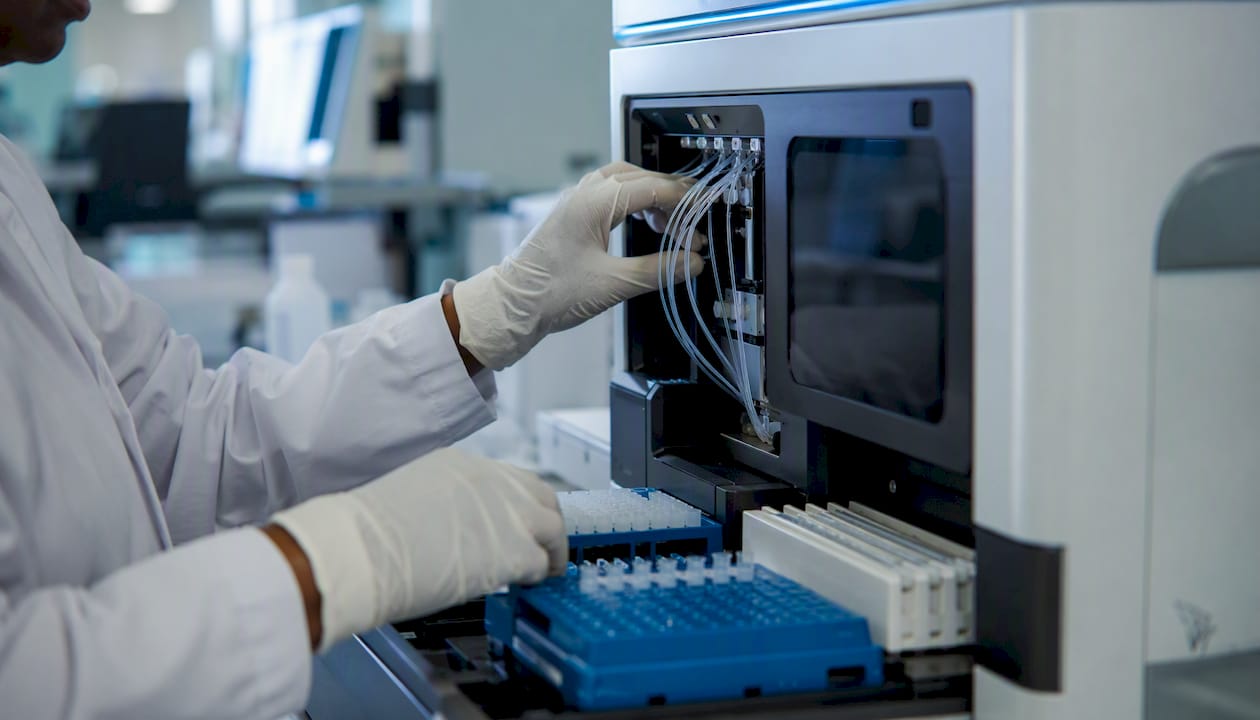
The primary pressure is turnaround time and EHR integration. A molecular lab running respiratory panels, oncology markers, or infectious disease PCR needs accessioning that feeds directly into the EHR order queue, result sign-out that triggers an HL7 ORU message back to the ordering physician, and QC records that satisfy both CLIA and CAP inspection requirements. The decisive LIMS features here are HL7 bidirectional messaging, instrument automation for result import, and configurable QC modules with Levey-Jennings tracking.
PGx and genetic testing labs
The challenge is not sample volume but report complexity. A PGx lab generating pharmacogenomics reports needs configurable report templates that can incorporate CPIC guideline tiers, FDA pharmacogenomic labeling references, and gene-drug interaction annotations. The LIMS must link sample accession to the correct patient and provider, manage the clinical review queue, and deliver the final report securely to both the ordering provider and the patient portal. Chain-of-custody and audit trails matter here for CLIA compliance, but the role of LIMS in genetic report delivery is what separates a functional system from a competitive one.
Clinical trial and CRO lab
Study templates, blinded sample handling, and CDISC exports are non-negotiable. A CRO lab managing Phase II or III specimens needs subject-level accessioning (not patient-level), protocol-driven visit schedules, and the ability to handle amendments without breaking historical records. SDTM-aligned exports reduce the manual reformatting work that otherwise delays database lock. Unified data architecture that reduces reconciliation steps, as documented in Medidata's trial data governance work, reflects the same principle: when your LIMS and your data submission layer share a data model, late-stage submission risk drops substantially.
Feature-to-use-case mapping:
| Feature | Molecular Diagnostics | PGx/Genetic Testing | Clinical Trial/CRO |
|---|---|---|---|
| HL7/FHIR bidirectional messaging | Critical | Important | Important |
| Configurable report templates | Moderate | Critical | Moderate |
| Study templates and subject management | Not required | Moderate | Critical |
| Chain-of-custody and freeze/thaw logging | Important | Important | Critical |
| CDISC/SDTM export | Not required | Not required | Critical |
| Instrument automation | Critical | Important | Important |
| Audit trails and e-signatures | Critical | Critical | Critical |
Why Labrynix is designed for genetic, molecular, and PGx clinical labs
Most clinical LIMS platforms were built for broad hospital or research use and then adapted for molecular and PGx workflows. Labrynix was built the other way around: from real genetic and molecular laboratory experience, with the sample-to-report workflow as the design center.
The Labrynix LIMS platform covers the core capability requirements described throughout this guide: accessioning and barcode management, sample status tracking, workflow queues, role-based access, configurable permissions, and audit logs. Where Labrynix goes further is in the reporting layer. Labrynix Reports generates branded pharmacogenomics and genetic testing reports using customizable templates, AI-assisted summaries, CPIC guideline support, PharmGKB-informed annotations, and FDA pharmacogenomic labeling references, all while keeping clinical review and final approval under laboratory control.
Labrynix Connect supports HL7, FHIR, APIs, webhooks, EMR/EHR connections, billing platforms, and instrument integrations. Labrynix Portal gives providers and patients secure, branded access to orders, statuses, and reports. Labrynix Intelligence adds AI-powered workflow automation, bottleneck detection, and operational analytics.
For compliance, Labrynix is built with HIPAA-conscious workflow principles: role-based access, audit logs, secure report delivery, configurable permissions, and data governance support. The platform is designed to help labs support CLIA/CAP inspection readiness and Part 11-relevant controls, while each laboratory retains responsibility for its own clinical validation, report approval, and regulatory obligations.
Proof points and next steps:
Labrynix can provide sandbox access and sample validation artifacts on request. For genetic testing lab workflows specifically, the platform supports the full accession-to-report cycle that PGx and molecular labs require.
What lab software practitioners actually get wrong
The conventional wisdom in LIMS procurement is to start with a feature checklist. That is the wrong starting point, and it consistently produces implementations that are technically compliant but operationally painful.
The labs that get this right start with their failure modes: where does the current process break, lose data, or create inspection risk? A feature checklist tells you what a vendor sells. A failure-mode analysis tells you what you actually need. Those two lists overlap less than you would expect.
The second mistake is treating validation as a post-go-live task. Validation is a design input. If your QA team is not in the room during requirements and configuration, you will spend the first six months after go-live rewriting test scripts and chasing deviations that were baked in from day one.
Do:
- Require validation artifacts and a sandbox study before you shortlist, not after you select.
- Involve QA and lab operations in requirements, not just IT and procurement.
Don't:
- Accept "we support Part 11" without requesting the specific controls documentation and a gap assessment.
- Underestimate change management: the most technically sound LIMS implementation can fail if staff revert to paper-based workarounds within 90 days of go-live.
Labrynix fits where generic LIMS platforms fall short
Generic LIMS platforms give you sample tracking. What a PGx or molecular diagnostic lab actually needs is sample tracking plus structured PGx reporting, provider and patient portal delivery, HL7/FHIR connectivity, and audit-ready workflows, all in one system that does not require four separate vendors to stitch together.
Labrynix delivers that connected workflow for genetic testing, molecular diagnostics, and precision medicine labs. The platform covers LIMS workflow management, branded PGx report generation, interoperability tools, portal access, billing visibility, and AI-powered operational analytics. Labs that need a focused PGx reporting solution can start there; labs that need a full operating system can deploy the complete platform.
If you are in active vendor evaluation, Labrynix offers sandbox access and sample validation artifacts on request. Visit the Labrynix solutions page to see product fit by lab type, or request a personalized demo to walk through your specific workflow and compliance requirements.
Sources
These are the primary regulatory and standards references to consult when drafting vendor requirements and validation requests:
This article is general information, not a substitute for advice from a qualified doctor. Consult a qualified healthcare professional about your own circumstances before acting on anything here.