
For genetic and molecular labs, the safest starting point is a platform that bundles LIMS workflow management with a vendor-neutral provider portal and native PGx reporting. Before you sign anything, run a one-week technical POC that proves HL7/FHIR connectivity, report template delivery, and provider portal role permissions against your actual test menu.
The provider portal market currently splits into three functional tiers: basic result viewers, multi-payer administrative platforms, and integrated clinical outreach suites with CPOE and real-time result access. Most genetic and molecular labs need the third tier, yet many vendors quote pricing based on the first. That gap is where procurement decisions go wrong.
Your immediate next steps:
- Score at least two vendors against the rubric in Section 2 before scheduling demos
- Require HL7 v2 and FHIR R4 connectivity evidence in writing before the POC
- Confirm PGx annotation sources (CPIC, PharmGKB) and structured variant representation are native, not add-ons
- Request IQ/OQ/PQ templates and a traceability matrix before contract negotiations begin
Table of Contents
- How do you build a scoring rubric for LIMS and provider portal vendors?
- What features should you compare across LIMS and provider portal systems?
- What does LIMS and provider portal implementation actually cost?
- Does your vendor actually support HL7, FHIR, and instrument integration?
- What should you require from reporting engines and provider portals?
- What compliance and security controls must you verify before procurement?
- What service levels and validation support should you expect from vendors?
- How do you run a technical POC to verify vendor claims?
- Why Labrynix meets the rubric for genetic and molecular labs
- How do you assess a vendor's track record in genetics and molecular testing?
- How do maintenance and update policies differ for molecular and genetic testing environments?
- Key Takeaways
- What actually matters when selecting a LIMS and portal for a genetics lab
- Labrynix offers a technical POC built for genetic and molecular labs
- Useful sources and references
How do you build a scoring rubric for LIMS and provider portal vendors?
A scoring rubric turns a subjective vendor comparison into a defensible procurement record. Assign each dimension a weight, score every vendor 1–5, multiply, and total. The dimensions that matter most for genetic and molecular labs are listed below.
Weighted scoring dimensions:
- Best fit for lab type and scale (15%): Does the vendor explicitly support genetic, molecular, or PGx workflows, or is this a generic clinical LIMS with a genetics module bolted on? Enterprise LIMS suits large multisite labs; cloud-native SaaS fits distributed or startup labs; ELN-integrated platforms serve R&D teams. Know which category you are buying before the demo.
- Core features (20%): Sample management, workflow engine, PGx report templates, chain-of-custody, and multi-gene panel result structures. Score on whether these are native or require third-party configuration.
- Integration stack (20%): HL7 v2, FHIR R4, REST APIs, webhooks, instrument interfaces, EMR/EHR connectivity. Deduct points for any protocol that requires a paid add-on.
- Reporting and portal capabilities (20%): Branded provider portal, CPOE support, real-time result access, mobile access, structured report payloads, and PGx annotation sources. This dimension is where buyer reviews consistently separate strong from weak vendors for genetic labs.
- Pricing and licensing model (10%): Subscription SaaS vs. perpetual license, per-test vs. per-seat pricing, and what is included in the base vs. what triggers an upsell.
- Implementation timeline and services (5%): Realistic go-live estimates, dedicated project management, and whether the vendor has completed genetic lab implementations before.
- Compliance and security (5%): HIPAA BAA, SOC 2 Type II, role-based access control, audit logs, encryption at rest and in transit.
- Support, training, and SLA (5%): Uptime commitments, incident response time, validation protocol support, and training formats.
RFP and demo questions to ask every vendor:
- Show us an end-to-end HL7 v2 ORU message mapped to a PGx report template in your system.
- What FHIR resources do you support natively, and which require custom mapping?
- How does your portal handle multi-gene panel results with structured variant/allele data?
- Who owns the data if we terminate the contract, and what is the export format?
- What validation artifacts do you provide, and who signs them?
- What is your median ticket resolution time for P1 incidents?
Red flags to watch for:
- The vendor cannot demonstrate HL7/FHIR connectivity live in a sandbox environment
- PGx reporting templates require a separate professional services engagement to configure
- The portal is a rebranded third-party product with no direct integration to the LIMS
- Validation documentation is described as "available on request" with no standard package
- Implementation timelines are quoted without a discovery phase or scope document
Building your comparison spreadsheet: Create one row per vendor and one column per rubric dimension. Add a raw score column (1–5), a weight column, and a weighted score column. A final column for "deal-breaker flags" keeps disqualifying issues visible regardless of total score.
What features should you compare across LIMS and provider portal systems?
Feature checklists are only useful when tied to actual lab outcomes. The table below maps feature categories to the operational result each one drives for genetic and molecular labs, along with example acceptance criteria.
| Feature Category | What It Enables | High Grade Criteria | Medium Grade | Low Grade |
|---|---|---|---|---|
| Sample management | Chain-of-custody, accessioning, status tracking | Native barcode/RFID, full audit trail, multi-site support | Manual entry with partial audit | No chain-of-custody tracking |
| Workflow engine | Configurable test queues, role-based task routing | Visual workflow builder, conditional logic, no-code config | Scripted workflows requiring IT | Rigid fixed workflows |
| PGx report templates | Branded, structured pharmacogenomics reports | CPIC/PharmGKB native, configurable interpretation rules, AI-assisted drafting | Template editor with manual annotation | Static PDF with no structured data |
| Provider portal | Physician order entry, result access, notifications | CPOE, real-time results, branded access, mobile, role permissions | Web portal with delayed results | Email-only result delivery |
| Integration stack | EMR/EHR, instrument, billing connectivity | HL7 v2 + FHIR R4 + REST API native, webhook support | HL7 v2 only, APIs on request | SFTP flat-file only |
| Security and compliance | HIPAA, audit readiness, data governance | SOC 2 Type II, BAA, RBAC, encryption at rest/in transit | BAA only, partial RBAC | No BAA, shared credentials |
| Support and validation | Regulated lab go-live, ongoing compliance | IQ/OQ/PQ templates, traceability matrix, dedicated CSM | Generic onboarding docs | Self-serve only |
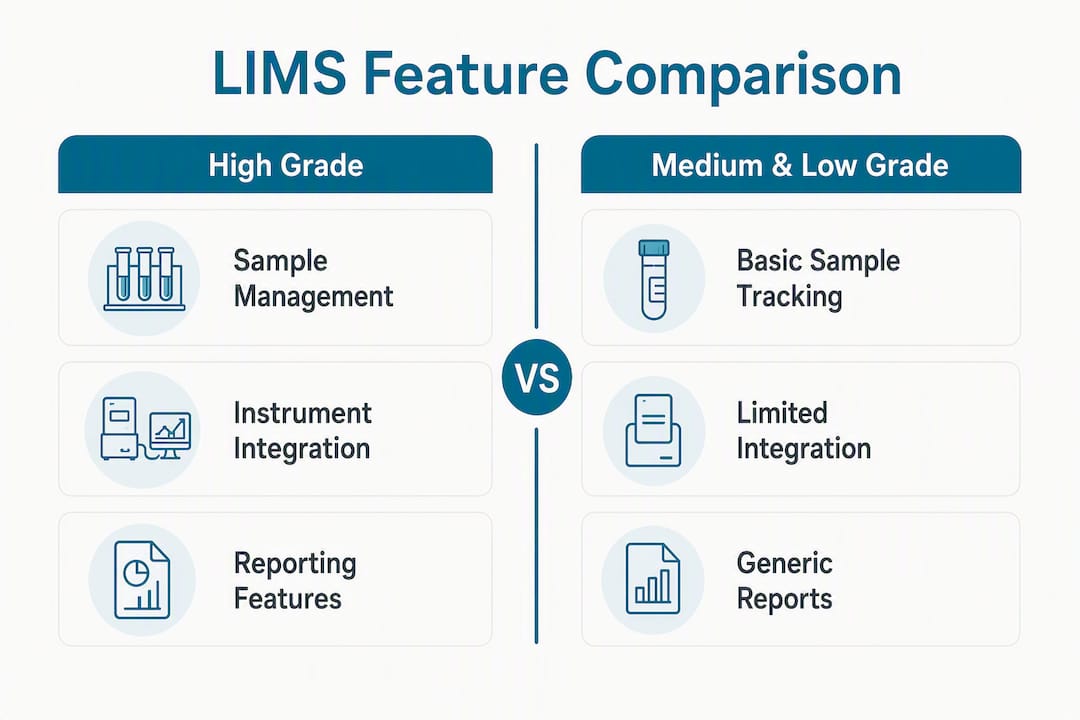
A few points worth expanding. The PGx report template row is where most generic LIMS vendors fall short. Requiring vendors to show support for CPIC guideline sources, PharmGKB-informed annotations, and configurable interpretation rules that preserve lab-approved language is non-negotiable for a precision medicine lab. It is the core deliverable. Similarly, a provider portal that delivers results via email is a tier-one product masquerading as a tier-three solution.
Vendor-neutral hub architectures that connect through a single secure hub to hundreds of EMR vendors reduce per-connection overhead significantly, which matters when your referring network spans multiple health systems. That single architectural decision can determine whether your integration budget is $50,000 or $500,000.
Additional feature checklist items for genetic and molecular labs:
- Structured variant and allele representation in result payloads
- Multi-gene panel result display with gene-drug interaction summaries
- Patient portal with secure report delivery and consent management
- Billing workflow visibility: claim status, invoice tracking, revenue handoffs
- AI-assisted report drafting and bottleneck detection
- Configurable user roles with granular permission sets
What does LIMS and provider portal implementation actually cost?
Implementation cost is the number most vendors obscure until the statement of work. Here is a realistic breakdown.

Typical implementation stages and duration include discovery and scoping, configuration, instrument integration, validation, training, and go-live and hypercare. Implementation durations vary depending on lab complexity and workflow needs.
Genetic and molecular labs with complex PGx report templates and multiple instrument interfaces sit toward the longer end of that range.
Pricing models and hidden costs
Subscription SaaS is now the dominant model for cloud LIMS and portal software. It shifts cost from a large upfront capital expense to a predictable operational line item, and provider portals deployed as web-based subscriptions typically require less implementation hardware and mapping work than traditional EMR integrations.
Perpetual licensing still appears in enterprise LIMS contracts, usually paired with annual maintenance fees of 18–22% of the license cost. For most genetic labs under 500 tests per day, SaaS is the more predictable option.
Common hidden costs to budget for:
- Per-integration fees for each EMR or instrument interface
- Professional services for report template customization beyond a base set
- Validation support billed separately from the software subscription
- Training beyond the initial onboarding package
- Data migration from a legacy LIS or spreadsheet environment
- Annual price escalation clauses (often 3–7% per year in SaaS contracts)
Sample pricing scenarios
Third-party implementation cost reviews report wide ranges for small-to-mid-size labs and enterprise implementations, varying with customization and lab size. These figures cover software and implementation services combined, excluding internal IT labor, validation time, or training costs.
For a multi-year TCO calculation, consider annual subscription fees, estimated support costs, integration maintenance, and re-validation cycles triggered by major platform updates. Labs should plan re-validation periodically according to regulatory guidance.
Pro Tip: Lock the scope of the base configuration in writing before signing. The most common source of cost overruns is "out-of-scope" template customization and integration work that was discussed in demos but never documented. Get a line-item statement of work, not a project description.
Does your vendor actually support HL7, FHIR, and instrument integration?
Integration claims are easy to make in a sales deck and hard to prove without a live test. Here is what to require.
Essential protocols and connectors checklist
- HL7 v2.x: Confirm support for ADT, ORM, ORU, and MDM message types. Ask which segments are configurable and which are hardcoded.
- FHIR R4: Require native FHIR resource support for DiagnosticReport, Observation, Patient, ServiceRequest, and Specimen. Vendor-neutral portals built on FHIR R4 are significantly easier to connect to modern EHR systems.
- REST APIs: Require documented, versioned REST APIs with authentication (OAuth 2.0 or API key), rate limits disclosed, and a sandbox environment available before contract signing.
- Webhooks: Confirm event-driven notifications for order status changes, result availability, and critical value flags.
- SFTP and VPN/TLS: Legacy connectivity for instruments and billing systems that do not support modern APIs. Still necessary for many analyzer interfaces.
- Instrument interfaces: Bidirectional interfaces for your specific analyzers. Ask for a reference list of instruments the vendor has already interfaced, not a general claim of "instrument connectivity."
EMR/EHR integration patterns
Two approaches dominate: direct point-to-point EMR interfaces and vendor-neutral portal hubs. A hybrid deployment that routes low-volume referring practices through a web portal and high-volume hospital systems through direct EMR interfaces minimizes total connectivity spend while maximizing coverage across a referring network.

Hub-and-spoke architectures, where the lab connects once to a central hub that maintains connections to hundreds of EMR vendors, are especially valuable for regional labs scaling outreach. A single hub connection can reach 500+ EMR vendors without building individual point-to-point integrations for each one.
Layering a provider portal over an existing LIS or LIMS avoids replacing working infrastructure and enables rapid deployment without operational downtime. This is the right approach when the internal system is stable but the provider-facing experience needs modernizing.
Integration test cases to run in your POC:
- Send a simulated HL7 v2 ORM order from a test EMR and confirm it appears correctly in the LIMS
- Trigger a result and verify the HL7 v2 ORU message maps accurately to the report template
- Submit a FHIR ServiceRequest and retrieve a FHIR DiagnosticReport with structured variant and allele data
- Test a bidirectional instrument interface: send a worklist, receive a result file, confirm auto-verification rules fire
- Verify webhook delivery for a result-available event to a simulated provider notification endpoint
What should you require from reporting engines and provider portals?
Reporting and portal capabilities are where physician adoption is won or lost. A portal that physicians find slow, confusing, or incomplete will be abandoned within weeks of go-live, regardless of how technically sound the underlying LIMS is.
Provider portal feature checklist:
- CPOE (computerized provider order entry) with test catalog search and order routing
- Real-time result access with configurable notification triggers (email, SMS, in-portal)
- Branded portal with lab logo, color scheme, and custom domain support
- Mobile-responsive design or native mobile app for result review on the go
- Role-based access: ordering provider, covering provider, office staff, and lab admin
- Insurance eligibility check at order entry
- Secure messaging between provider and lab
- Patient portal with consent management and secure report delivery
Reporting capabilities to require:
- Template engine with configurable sections for gene-drug interaction summaries, allele calls, and clinical recommendations
- Structured data output: FHIR DiagnosticReport and HL7 ORU payloads alongside PDF delivery
- PGx annotation sources: CPIC guideline integration, PharmGKB-informed annotations, FDA pharmacogenomic labeling references
- Configurable interpretation rules that preserve lab-approved language and prevent unauthorized edits
- AI-assisted report drafting with human review and final approval workflow
- Export formats: PDF, HL7, FHIR, CSV for downstream analytics
A typical referring physician workflow looks like this: log in, search by patient name or order ID, review the PGx summary panel, download the full PDF, and trigger a notification to the patient. That entire flow should take under two minutes. If your vendor cannot demonstrate it in a live environment, that is a signal worth taking seriously.
Acceptance criteria for report delivery:
- Report available in portal within the agreed turnaround time after lab sign-off
- Structured FHIR payload delivered to EMR within 60 seconds of report release
- Provider notification sent within 5 minutes of result availability
- PDF report matches the structured data payload with no discrepancies
- Audit log captures every access event, download, and notification
What compliance and security controls must you verify before procurement?
U.S. genetic and molecular labs operate under HIPAA, CAP, and CLIA requirements, and the software you buy must support all three without requiring you to build compliance controls from scratch.
Non-negotiable compliance checklist:
- Signed Business Associate Agreement (BAA) before any PHI touches the vendor's environment
- SOC 2 Type II report, current within the last 12 months, available for review
- Role-based access control (RBAC) with granular permission sets, not just admin/user tiers
- Full audit logs: who accessed what, when, from which IP, and what action was taken
- Encryption in transit (TLS 1.2 minimum, TLS 1.3 preferred) and at rest (AES-256 or equivalent)
- Multi-factor authentication for all user accounts, including portal users
- Configurable session timeout and automatic logout
Data governance items to confirm in writing:
- Data retention policy: how long is data stored, and what triggers deletion?
- Data export: can you export all data in a standard format (HL7, FHIR, CSV) at any time?
- Data ownership: the contract must state explicitly that the lab owns its data
- De-identification support: can the vendor de-identify datasets for research or analytics use cases?
- Consent handling: does the platform support patient consent workflows for genetic data?
Audit preparation tips:
Require vendors to supply validation artifacts as part of the implementation package, not as a paid add-on. The minimum set includes IQ/OQ/PQ templates, a traceability matrix linking test scripts to requirements, signed test evidence, and a rollback plan for configuration changes during go-live. Labs that receive these documents at contract signing shorten their internal validation effort considerably.
The role of LIMS in lab compliance extends beyond audit logs. Configurable workflows that enforce review and approval steps, prevent result release without authorized sign-off, and capture every status change are what make a LIMS a compliance asset rather than just a data store.
What service levels and validation support should you expect from vendors?
The gap between what vendors promise in sales and what they deliver post-signature is widest in the services category. Set measurable expectations before you sign.
Service expectations list:
- Dedicated project manager for the implementation period
- Named customer success manager post-go-live, not a shared support queue
- Validation protocol support: vendor provides templates and participates in IQ/OQ/PQ execution
- Training formats: train-the-trainer sessions, recorded virtual training, and on-site options for go-live
- Documentation: user manuals, admin guides, and release notes delivered with every update
Suggested SLA metrics with sample targets:
- System uptime: 99.9% monthly uptime for core LIMS and portal functions
- API latency: 95th percentile response time under 500ms for standard result queries
- P1 incident response: Acknowledgment within 30 minutes, status update every 60 minutes
- P2 incident resolution: Resolution or workaround within 8 business hours
- Ticket resolution (P3/P4): Resolution within 5 business days
- Planned maintenance windows: Advance notice of at least 72 hours, scheduled outside peak lab hours
Validation deliverables vendors should provide:
- Installation Qualification (IQ) template with environment specifications and sign-off fields
- Operational Qualification (OQ) template with test scripts covering all configured workflows
- Performance Qualification (PQ) template with acceptance criteria tied to your specific test menu
- Traceability matrix linking each requirement to at least one test script and one test result
- Signed test evidence package from the vendor's own internal validation
- Rollback procedure document for configuration changes and major updates
How do you run a technical POC to verify vendor claims?
A focused 1–3 week technical POC separates real capability from marketing claims more reliably than any reference call or demo. Here is a blueprint.
POC test plan structure
- Objectives: Verify HL7/FHIR connectivity, PGx report template delivery, portal role permissions, and instrument interface functionality in a sandbox environment using de-identified test data.
- Scope: Limit to three to five test cases per integration type. A POC that tries to test everything tests nothing well.
- Environment: Vendor-provided sandbox with a representative data set. Require the vendor to pre-load at least 20 de-identified patient records and 10 test orders before day one.
- Data sets: Use real test menu items from your lab (de-identified). Generic test data does not reveal edge cases in PGx variant representation or multi-gene panel result structures.
- Success criteria: Define pass/fail thresholds for each test case before the POC begins. Do not let the vendor redefine "success" mid-test.
POC test cases and acceptance criteria
HL7/FHIR connectivity:
- Send an HL7 v2 ORM order; confirm it appears in the LIMS within 60 seconds with all required fields populated. Pass/fail.
- Retrieve a FHIR DiagnosticReport for a completed PGx result; confirm structured allele calls and gene-drug interaction data are present. Pass/fail.
Report template delivery:
- Generate a PGx report using the vendor's template engine; confirm CPIC guideline annotations, PharmGKB references, and lab-approved interpretation language appear correctly. Pass/fail.
- Export the report as PDF and as a FHIR DiagnosticReport; confirm both formats match. Pass/fail.
Portal role permissions:
- Log in as an ordering provider; confirm access to own patients' results only. Pass/fail.
- Log in as a covering provider; confirm access to the practice's results with appropriate scope. Pass/fail.
- Attempt to access a result outside the assigned practice; confirm access is denied and the attempt is logged. Pass/fail.
Provider UX tasks:
- Search for a patient by name, open the PGx report, download the PDF, and trigger a notification. Target: under two minutes. Pass/fail.
Reference-check questions for existing customers
- What was the actual go-live date versus the contracted date, and what caused any delay?
- How does the vendor handle a P1 incident during peak lab hours?
- Has the vendor ever failed a CAP or CLIA inspection related to the software, and how was it resolved?
- What does the annual update process look like, and how much internal re-validation does it require?
- Would you buy this platform again?
Request case studies, support ticket resolution metrics, and uptime logs covering the last 12 months. A vendor that cannot provide these has not been in production long enough to trust with a regulated genetic lab.
Why Labrynix meets the rubric for genetic and molecular labs
Labrynix was built from direct genetic and molecular laboratory experience, not adapted from a generic clinical LIMS. That origin matters when you are evaluating whether a vendor actually understands the operational complexity of PGx reporting, multi-gene panel workflows, and provider portal requirements for precision medicine.
How Labrynix maps to the rubric:
- Best fit: PGx labs, molecular diagnostic labs, hereditary cancer testing programs, reference labs, startup labs, and multi-location lab networks. The genetic testing lab solution covers the full sample-to-report workflow.
- Core features: Labrynix LIMS manages test orders, patient and provider information, accessioning, sample status, workflow queues, user roles, and audit activity natively.
- Integration stack: Labrynix Connect supports HL7, FHIR, REST APIs, webhooks, EMR/EHR, billing platforms, CRM systems, and lab instruments. Integration pathways are part of the platform, not a paid add-on tier.
- Reporting: Labrynix Reports generates branded PGx reports using customizable templates with CPIC guideline support, PharmGKB-informed annotations, FDA pharmacogenomic labeling references, AI-assisted summaries, and lab-approved interpretation rules. The PGx reporting module covers 700+ medications.
- Provider and patient portals: Labrynix Portal gives providers and patients secure, branded access to orders, statuses, reports, and result delivery workflows. Role-based permissions, real-time result access, and secure messaging are included.
- Billing visibility: Labrynix Billing provides claim status, invoice workflows, payment tracking, and revenue handoffs without requiring a separate billing platform integration.
- AI-powered operations: Labrynix Intelligence adds bottleneck detection, review queue management, report drafting assistance, and operational analytics.
- Compliance: HIPAA-conscious workflow design with role-based access, audit logs, secure report delivery, configurable permissions, and data governance support throughout.
Pro Tip: When you request a Labrynix POC, ask the team to demonstrate a live HL7 v2 ORU message mapped to a PGx report template, a FHIR DiagnosticReport export, and a provider portal login with role-restricted result access. Those three tests cover the highest-risk integration and reporting scenarios in a single session.
Labrynix's molecular diagnostics solution is purpose-built for the workflows described throughout this comparison. Labs that have moved from disconnected reporting tools to the Labrynix platform report reduced manual handoffs between LIMS, reporting, and portal functions, and faster provider turnaround on PGx results.
How do you assess a vendor's track record in genetics and molecular testing?
Vendor reputation in a specialized segment like genetics and molecular diagnostics is not the same as general LIMS market share. A vendor with thousands of clinical lab customers may have only a handful of PGx or molecular genetics implementations, and those are the reference accounts that matter.
When evaluating track record, ask for a list of current customers in genetic testing, pharmacogenomics, or molecular diagnostics specifically. Generic "lab" references from environmental or food testing labs do not transfer to the compliance and reporting demands of a CLIA-certified genetic lab.
Published G2 and Capterra reviews for LIMS platforms give a useful signal on general usability and support quality, but they rarely surface genetics-specific implementation experience. Supplement peer reviews with direct reference calls to labs running the same test types you do.
Three questions that reveal depth of genetics experience faster than any demo:
- Has the vendor completed a CAP inspection with a genetic or molecular lab customer, and can they share the outcome?
- Does the vendor have a dedicated implementation team with genetics lab experience, or is it a generalist professional services group?
- How does the vendor handle a CPIC guideline update that requires changes to existing PGx report templates across multiple customer accounts?
The third question is particularly revealing. CPIC publishes guideline updates regularly, and a vendor without a defined update and re-validation process for PGx templates creates ongoing compliance risk for every lab on the platform.
Labrynix was built by a team with direct CLIA genetic lab experience, which means the platform's design reflects real operational constraints rather than theoretical feature requirements. That distinction shows up in the specifics: configurable interpretation rules that preserve lab-approved language, structured variant representation, and a PGx reporting workflow that keeps clinical review and final approval under laboratory control.
How do maintenance and update policies differ for molecular and genetic testing environments?
Software updates in a regulated genetic lab are not a background IT event. Every significant platform update can trigger a re-validation requirement under CLIA and CAP standards, which means the vendor's update policy directly affects your compliance workload and operational continuity.
The key distinction is between minor updates (bug fixes, UI changes, performance improvements) and major updates (new modules, changes to result calculation logic, report template engine changes, or integration protocol upgrades). Minor updates typically require a risk assessment and regression testing. Major updates often require a full OQ/PQ cycle.
What to compare across vendors:
- Update frequency and notification lead time: How far in advance does the vendor notify customers of major updates? Ninety days is a reasonable minimum for a regulated lab to plan re-validation.
- Rollback capability: Can the vendor roll back a major update if validation fails? This should be contractually guaranteed, not just technically possible.
- Validation support for updates: Does the vendor provide updated IQ/OQ/PQ templates and a delta traceability matrix (showing only what changed) with each major release? Labs that receive delta documentation instead of full re-validation packages save significant internal effort.
- Parallel environment: Does the vendor maintain a staging environment where labs can validate updates before they reach production? This is standard practice for regulated environments and should not be an upsell.
- PGx guideline currency: For PGx-specific platforms, how quickly does the vendor incorporate new CPIC and PharmGKB guideline updates, and what is the re-validation process for affected report templates?
A vendor that pushes updates on a continuous deployment model without a defined change control process is incompatible with a regulated genetic lab environment, regardless of how good the features are. Require a written change management policy before procurement, not after.
LIMS customization options for genetic labs also affect update risk. Heavily customized configurations require more re-validation effort after each major release. Platforms that separate lab-configured content (report templates, interpretation rules, workflow logic) from core application code reduce that burden by limiting what changes during a platform update.
Key Takeaways
For genetic and molecular labs, the right LIMS and provider portal combination is one that supports PGx reporting natively, proves HL7/FHIR connectivity in a live POC, and delivers validation artifacts as a standard part of implementation, not an optional add-on.
| Point | Details |
|---|---|
| Score vendors before demos | Apply a weighted rubric across eight dimensions to create a defensible procurement record before any vendor presentation. |
| Run a 1–3 week technical POC | Test HL7/FHIR connectivity, PGx report template delivery, and portal role permissions against your actual test menu before committing. |
| Require validation artifacts upfront | IQ/OQ/PQ templates, a traceability matrix, and a rollback plan should be part of the base implementation package, not a paid add-on. |
| Prioritize portal and reporting depth | Provider portal tier and PGx annotation sources (CPIC, PharmGKB) are the highest-impact differentiators for genetic and molecular lab procurement. |
| Labrynix as the recommended option | Labrynix combines native PGx reporting, HL7/FHIR support, branded portals, and AI-assisted workflows in one platform built for genetic and molecular labs. |
What actually matters when selecting a LIMS and portal for a genetics lab
The conventional wisdom in lab IT procurement is to build the longest possible feature checklist and score vendors against it. That approach sounds rigorous, but it consistently produces the wrong outcome. Labs end up selecting the vendor with the most features on paper rather than the vendor with the deepest experience in their specific test category.
The features that matter most for a genetic or molecular lab are narrow and non-negotiable: structured PGx report output, configurable interpretation rules that stay under lab control, and a provider portal that physicians will actually use. Everything else is secondary. A LIMS with excellent sample management but a weak report engine is a liability for a PGx lab, because the report is the product. The sample management is just the path to get there.
The implementation pitfall most labs do not anticipate is stakeholder misalignment during the selection process. Clinical staff care about report quality and provider experience. Operations cares about workflow efficiency and turnaround time. Finance cares about billing visibility and cost. IT cares about integration complexity and security. Each group will score the same vendor differently, and without a shared rubric, the selection process devolves into internal politics rather than objective evaluation.
The fix is to run the scoring rubric in Section 2 as a group exercise before any vendor demos. Each stakeholder scores independently, then the group reconciles the differences. Disagreements on a specific dimension are usually a sign that the requirement itself is not well-defined, which is better to discover before the demo than after the contract is signed.
One thing to never compromise on: the BAA and SOC 2 Type II report. No BAA means no PHI in the vendor's environment, full stop. A vendor that pushes back on providing a current SOC 2 Type II report is telling you something important about their security posture. Everything else in the procurement is negotiable. Those two are not.
Labrynix offers a technical POC built for genetic and molecular labs
Genetic and molecular labs spend months evaluating LIMS and portal vendors, then discover post-signature that PGx reporting templates require a separate professional services engagement or that HL7 connectivity was never tested against their actual message formats. Labrynix was built to close that gap before the contract, not after.
A Labrynix technical POC demonstrates live HL7/FHIR connectivity, a working PGx report template with CPIC and PharmGKB annotations, and a branded provider portal with role-restricted result access, all against your actual test menu in a sandbox environment. The team provides implementation timelines, a pricing model tailored to your lab's volume and module needs, and a standard validation artifact package including IQ/OQ/PQ templates and a traceability matrix.
Labs evaluating LIMS and portal solutions for molecular diagnostics can request a POC directly through the Labrynix website. Bring your integration inventory, your current report template requirements, and your top three procurement questions. The POC is designed to answer all of them in a single session.
Useful sources and references
The sources below support the claims and frameworks in this article. Use them during vendor evaluation and reference checks.
| Source | What It Supports |
|---|---|
| HL7 International — HL7 v2 and FHIR standards | Integration protocol requirements; HL7 v2 message types and FHIR R4 resource definitions |
| HHS HIPAA Security Rule guidance | HIPAA safeguards, BAA requirements, and security control expectations |
| CPIC — Clinical Pharmacogenomics Implementation Consortium | PGx guideline sources; annotation requirements for PGx report templates |
| PharmGKB — Pharmacogenomics Knowledgebase | Gene-drug interaction annotations and variant-level evidence for PGx reporting |
| G2 LIMS category — highest rated | Peer reviews and buyer sentiment for LIMS platforms across lab types |
| Lifepoint Informatics — provider portal tiers and interoperability | Portal tier definitions, hub-and-spoke architecture, and validation artifact guidance |
| Lifepoint Informatics — provider portal vs. EMR interface | Hybrid connectivity model, cost comparison, and POC methodology |
| Lifepoint Informatics — LIS portal guide | Portal layering over existing LIS/LIMS without operational disruption |
| G2 — best LIMS software | Vendor positioning by lab type and scale; integration and reporting as buyer priorities |
| ITQlick — labPortal review | Implementation cost ranges for small-to-mid and enterprise lab deployments |
| Labrynix PGx reporting | PGx reporting capabilities, CPIC/PharmGKB support, and template configuration evidence |
Additional Labrynix resources for procurement:
- Labrynix platform overview: full component and integration details
- LIMS for genetic and molecular labs: dedicated LIMS product page
- Benefits of LIMS with portal integrations: strategic rationale for integrated portal and LIMS deployments
- LIMS vs. LIS for genetic testing: clarifies terminology and implications for portal selection
This article provides general information for laboratory procurement planning and does not constitute legal, regulatory, or compliance advice. Confirm current HIPAA, CLIA, and CAP requirements with qualified counsel or your accreditation body before finalizing procurement decisions.