
For startup labs, the single most important planning move is to scope a Minimum Viable LIMS (MVL) before touching a single integration, then build outward in governed phases. Most teams that struggle with LIMS integration do so because they tried to replicate every manual workflow in software on day one. A phased, governance-driven approach that starts with data hygiene, instrument connectivity, and clear data ownership gets you to a working go-live faster and with far less rework.
TL;DR for startup LIMS integration planning:
- Scope first: Define your MVL, the smallest set of workflows that makes the lab operational and audit-ready.
- Governance before code: Assign data owners and publish metadata conventions before any integration development starts.
- Realistic timeline: Budget 6–18 months end-to-end; instrument integrations run 2–4 weeks each, HL7/FHIR connections 1–3+ months.
- True cost: Plan for 2–3× the base software license once professional services, validation, and testing are included.
- Standards to know: ASTM/LIS2-A2 for instruments, HL7 v2.x or FHIR for EHR/EMR, REST APIs for enterprise systems.
- Regulatory baseline: IQ/OQ/PQ validation artifacts and audit trails are non-negotiable for regulated U.S. labs (CLIA, CAP, FDA 21 CFR Part 11).
Table of Contents
- What does LIMS integration actually mean for a startup lab?
- Why LIMS integration pays off early for startup labs
- Which integration architecture fits your startup?
- What are the core integration touchpoints in a modern lab?
- How to build a phased LIMS implementation plan
- Which technical standards do you actually need to plan for?
- What does a practical validation checklist look like for a regulated startup?
- How much does LIMS integration actually cost?
- How do you build a governance model that prevents technical debt?
- What are the most common LIMS integration pitfalls, and how do you avoid them?
- How do you select the right LIMS vendor for a startup?
- Real-world benchmarks every startup should use in planning
- Key Takeaways
- What most planning guides get wrong about LIMS integration
- Labrynix supports startup labs through every integration phase
- Primary sources and standards to bookmark during planning
What does LIMS integration actually mean for a startup lab?
LIMS integration is the process of connecting your Laboratory Information Management System to the other software and instruments in your lab so that data flows automatically between them, without manual re-entry. For a startup molecular lab, that typically means linking your analyzers, your EHR or ordering portal, your billing platform, and your reporting module into a single traceable data chain.
A concrete example: a provider submits a pharmacogenomics test order through your portal. That order lands in the LIMS, triggers accessioning, assigns a sample ID, and routes the sample to the correct instrument queue. The analyzer runs the assay and pushes structured results back to the LIMS via an ASTM/LIS2-A2 connection. The LIMS then triggers report generation, notifies the provider portal, and hands a billing record to your revenue cycle system. No one re-keys a result. Every step carries a timestamp and a user ID.
The stakeholders involved span more than just IT:
- Lab technicians and scientists define what data the instruments produce and what the LIMS needs to capture.
- IT and integration engineers build and maintain the connections.
- QA and compliance staff validate that the integrations behave correctly under regulated conditions.
- Lab leadership and product owners set priorities, approve scope, and own the governance model.
Getting all four groups aligned before a single line of integration code is written is what separates projects that go live on time from those that drag on for two years.
Why LIMS integration pays off early for startup labs
The operational case for integration is straightforward: manual data transfer is slow, error-prone, and impossible to audit cleanly. But the business case for a startup is even sharper, because every person on your team is doing three jobs.
Operational benefits:
- Automated result capture eliminates transcription errors and speeds turnaround time.
- Full sample lineage and chain of custody are maintained automatically, which is what auditors actually check.
- Workflow queues replace paper logs and spreadsheets, so bottlenecks become visible before they become crises.
- Audit trails satisfy CLIA, CAP, and FDA 21 CFR Part 11 requirements without manual log maintenance.
Business benefits:
- Billing records generated directly from LIMS data reduce claim errors and denials.
- Faster time-to-report improves provider satisfaction and supports volume growth.
- Structured data in the LIMS feeds analytics dashboards, giving leadership real throughput and quality metrics.
For a startup with a lean team, the highest-impact first integration is almost always instrument connectivity. Getting your primary analyzer talking to the LIMS removes the single biggest manual bottleneck in most molecular labs. New labs that implement LIMS from launch avoid the painful and expensive data migration that comes from trying to retrofit a system onto months of spreadsheet-based records.
Pro Tip: Before you evaluate any vendor, map your top three manual handoffs by time cost. The integration that eliminates the most person-hours per week is your MVL starting point.

Which integration architecture fits your startup?
Four main architectures exist, and the right choice depends on your technical capacity, validation requirements, and how fast you need to move. None of them is universally best.
| Architecture | How it works | Startup pros | Startup cons | Complexity | Typical time to implement | Maintenance burden | Best for |
|---|---|---|---|---|---|---|---|
| REST API (direct) | LIMS exposes or consumes HTTP endpoints; systems call each other directly | Fast to prototype, well-documented, cloud-native | Tight coupling; both sides must version together | Medium | 2–8 weeks per connection | Medium | Cloud-native startups with dev resources |
| Middleware / message bus | HL7 engine or integration platform (e.g., Mirth Connect) routes messages between systems | Decouples systems; handles HL7 v2.x natively; reusable | Adds infrastructure; requires HL7 expertise | High | 1–4 months | High | Labs with multiple EHR/EMR connections |
| File exchange (SFTP/CSV) | Systems drop and pick up flat files on a schedule | Simple to implement; no API needed | Latency; brittle; hard to audit in real time | Low | 1–3 weeks | Low | Low-volume or legacy instrument connections |
| Direct DB | Integration reads/writes directly to the LIMS database | No API needed | Breaks on upgrades; vendor-unsupported; validation nightmare | Very high | 1–2 weeks to build, months to fix | Very high | Avoid for new builds |
Decision rules: Start with REST APIs for any cloud-native LIMS and modern instruments. Use a middleware layer (Mirth Connect is the most common open-source HL7 engine in U.S. labs) when you need to connect multiple EHR systems or handle HL7 v2.x message routing. File exchange is acceptable for a legacy instrument with no API, but plan to replace it. Direct database integration is a last resort and creates validation debt that compounds quickly. You can find technical API documentation and HL7/FHIR examples to evaluate what a vendor's integration surface actually looks like before you commit.
What are the core integration touchpoints in a modern lab?
Every lab has a slightly different stack, but the touchpoints below appear in nearly every molecular or genetic testing operation. Understanding what data each one exchanges with the LIMS shapes your integration scope and your validation plan.
- Analytical instruments: Push structured result data (numeric values, flags, QC status) to the LIMS via ASTM/LIS2-A2 or vendor-proprietary APIs. Instrument integration means automated capture and transmission of result data, not just a file dump. Typical data: sample ID, test code, result value, units, reference range, run timestamp.
- EHR/EMR systems: Exchange orders (inbound) and results (outbound) using HL7 v2.x ADT, ORM, and ORU message types, or FHIR R4 resources for newer platforms. This is where most of the integration complexity lives for clinical labs.
- Electronic Lab Notebooks (ELN): Share experiment metadata, reagent lot numbers, and method parameters with the LIMS for traceability. Critical for research-adjacent startup labs that need to link bench work to reported results.
- ERP systems: Receive inventory consumption data from the LIMS (reagents, consumables) and push purchase order status back. Relevant once volume justifies automated inventory management.
- Billing platforms: Receive structured billing records from the LIMS including CPT codes, patient demographics, insurance information, and order details. Errors here directly affect revenue.
- Provider and patient portals: Pull order status and completed reports from the LIMS in real time. For PGx labs, this is the primary delivery mechanism for clinical reports.
- Data lakes and analytics pipelines: Receive de-identified or aggregated LIMS data for operational analytics, quality metrics, and research. Usually implemented after core integrations are stable.
Sample lineage and chain of custody run through all of these touchpoints. Every handoff between systems needs a traceable sample identifier, a timestamp, and a responsible user or system actor. Without that, your audit trail has gaps that regulators will find.
How to build a phased LIMS implementation plan
A realistic implementation plan for a startup lab has eight phases. Skipping or compressing the early ones is the most common reason projects fail.

Phase 1: Discovery (weeks 1–4) Map current workflows, identify integration touchpoints, and define MVL scope. Assign a project owner, a lab subject matter expert (SME), and an IT lead. Document what "done" looks like with measurable outcomes (e.g., reduce accessioning time by 40%, eliminate manual result transcription).
Phase 2: Design and MVL scoping (weeks 3–8) Finalize integration architecture, data models, and metadata conventions. Produce a functional specification for each integration. This is also when you audit and standardize historical data before any migration begins. Trying to clean data during migration is one of the most common root causes of project failure.
Phase 3: Integration development (weeks 6–16) Build connections in priority order: instruments first, then EHR/EMR, then billing and portals. Budget 2–4 weeks per instrument for initial connectivity including driver setup, field mapping, and test cases. HL7/FHIR connections to EHR systems typically run 1–3+ months.
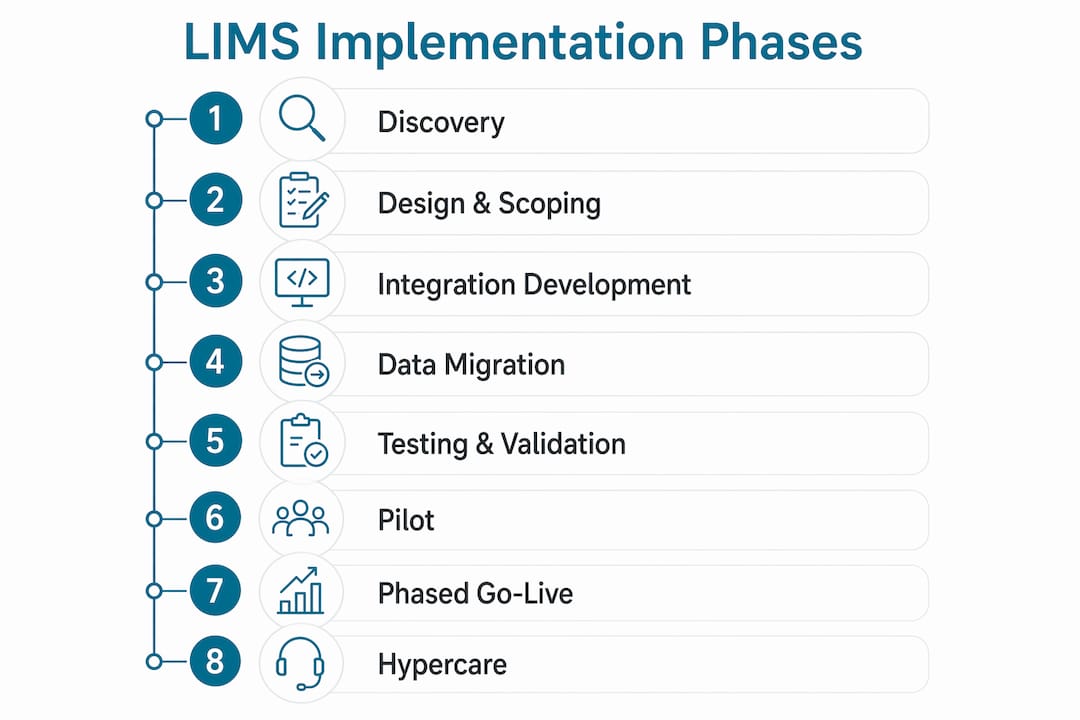
Phase 4: Data migration (weeks 12–18) Migrate historical records using the standardized data model from Phase 2. Run parallel processing for at least two weeks to catch mapping errors before cutover.
Phase 5: Testing and validation (weeks 14–22) Execute unit tests, integration tests, UAT, performance tests, and security tests. For regulated labs, produce IQ/OQ/PQ artifacts and a traceability matrix. See the validation section below for the full checklist.
Phase 6: Pilot (weeks 20–26) Run a limited go-live with one workflow or one instrument type. Capture issues in a structured log. Do not expand scope until pilot acceptance criteria are met.
Phase 7: Phased go-live (weeks 24–36+) Roll out remaining integrations in priority order. Use the go-live preparation checklist to confirm readiness at each phase gate.
Phase 8: Hypercare (weeks 36–52) Dedicated support period post-launch. Monitor error queues, integration logs, and user feedback. Resolve edge cases (cancelled orders, result corrections, instrument downtime scenarios) before transitioning to steady-state support.
Role matrix:
| Role | Responsibilities |
|---|---|
| Project owner (lab leadership) | Scope decisions, budget, escalation |
| Project manager | Timeline, risk log, meeting cadence |
| Lab SME (scientist/tech) | Workflow requirements, UAT, acceptance sign-off |
| IT integrator | Architecture, development, infrastructure |
| QA/Validation lead | IQ/OQ/PQ artifacts, traceability matrix, change control |
| LIMS vendor | Configuration, API support, release management |
| External consultant (optional) | HL7/FHIR expertise, validation templates |
Total duration for a startup lab running a focused MVL: 6–18 months is realistic. Pre-built workflow templates can reduce configuration time meaningfully; some platforms report roughly 30% reductions in setup time using domain-specific pre-configured templates.
Pro Tip: Build a two-week buffer into every phase gate. Integration edge cases (cancelled orders, instrument firmware updates, HL7 message variants) always surface during testing and always take longer to resolve than estimated.
Which technical standards do you actually need to plan for?
The standards landscape for lab integration looks complex, but most startup labs only need to plan for three or four of them. Here is what each one covers and where it applies.
- ASTM E1394 / LIS2-A2: The dominant standard for instrument-to-LIS/LIMS communication. Defines the message structure for transmitting patient demographics, test requests, and results between analyzers and laboratory systems. If your instruments support it, use it. If they use a proprietary protocol, ask the vendor for an ASTM wrapper or a documented API.
- HL7 v2.x: The most widely deployed standard for clinical messaging in U.S. healthcare. ADT messages carry patient demographics, ORM carries orders, and ORU carries results. Most U.S. EHR systems still speak HL7 v2.x natively. Plan for v2.5.1 as the baseline; some older hospital systems run v2.3 or v2.4.
- FHIR R4: The modern REST-based standard for healthcare data exchange, mandated by CMS and ONC for patient access and interoperability under the 21st Century Cures Act. Newer EHR platforms (Epic, Cerner/Oracle Health) expose FHIR APIs. If you are connecting to a health system, ask which version they support before scoping your integration.
- REST APIs (JSON/HTTP): The standard for connecting cloud-native LIMS platforms to modern enterprise systems, billing platforms, and portals. Well-documented, easy to test, and straightforward to validate. Prefer REST over SOAP for any new integration.
- File formats (CSV, XML, HL7 flat files): Used for legacy instrument connections and batch data transfers. Acceptable as a short-term solution; plan to replace with API or ASTM connections as volume grows.
A practical note on versioning: HL7 v2.x messages vary by implementation. Two systems that both claim HL7 v2.5.1 support can still fail to interoperate because of custom Z-segments or non-standard field usage. Always request sample message payloads from both sides and test against real data before signing off on an integration spec.
Standards callout: The integration hierarchy for U.S. labs follows a clear pattern: ASTM/LIS2-A2 for instruments, HL7 v2.x or FHIR for EHR/EMR connectivity, and REST APIs or middleware for enterprise systems. Planning your architecture around this hierarchy prevents scope creep and keeps validation manageable.
What does a practical validation checklist look like for a regulated startup?
Validation in a regulated lab is not optional, but it does not have to be a six-month documentation exercise either. The IQ/OQ/PQ framework scales down to MVL scope without losing audit defensibility.
Validation deliverables by phase:
| Deliverable | Phase | Purpose |
|---|---|---|
| Installation Qualification (IQ) | Post-install | Confirms system is installed per vendor specs; documents software version, server config, network setup |
| Operational Qualification (OQ) | Pre-UAT | Verifies each function works as designed; covers integration message flows, error handling, field mapping |
| Performance Qualification (PQ) | Pilot/go-live | Confirms system performs correctly under real lab conditions with real data volumes |
| Traceability matrix | Throughout | Maps each requirement to a test case and a test result; the document auditors ask for first |
| Change control log | Ongoing | Records every configuration change post-validation with justification and re-test evidence |
| UAT sign-off | Pre-go-live | Lab SME confirms workflows meet operational requirements |
Testing checklist:
- Unit tests for each integration endpoint (does the message parse correctly? do all required fields map?)
- Integration tests with real instrument output files and real HL7 message samples
- Negative testing: what happens when a sample ID is missing, a result is out of range, or a message is malformed?
- Performance testing: can the system handle peak volume (e.g., 200 samples per day) without latency?
- Security testing: role-based access controls, audit log integrity, encrypted data in transit (TLS 1.2+)
- Rollback plan: documented steps to revert to the previous state if go-live fails
- Acceptance criteria: specific, measurable pass/fail thresholds for each test category
Data validation steps for new labs should include a full historical data audit before migration. Auditing and standardizing legacy records before mapping them into the LIMS is one of the most reliable ways to prevent migration failures. Trying to clean data mid-migration is a common root cause of project delays.
For HIPAA compliance, your validation documentation should also confirm that PHI is handled correctly at every integration point: encrypted in transit, access-controlled, and logged. If your lab handles genetic data subject to GINA or state-level genetic privacy laws, document those controls separately.
How much does LIMS integration actually cost?
The number most startup labs get wrong is the total cost of ownership. The software license is the visible line item. Everything else tends to surprise people.
Cost components:
- Software license or subscription: The base SaaS fee. For a startup lab, this typically runs on a per-module or per-volume model. Get a three-year total cost projection, not just year one.
- Professional services (implementation): Configuration, integration development, data migration, and go-live support. This is where the 2–3× multiplier comes from. A $50,000 annual license can easily carry $100,000–$150,000 in implementation services.
- Integration development: Custom API work, HL7 engine setup, instrument driver configuration. Budget separately from general implementation if your vendor quotes them together.
- Validation and testing: IQ/OQ/PQ documentation, UAT facilitation, and any external validation consultant fees. For a regulated lab, this is not optional and is frequently underestimated.
- Data migration: Auditing, cleaning, mapping, and loading historical data. Scope this based on record volume and data quality, not on optimism.
- Training: Initial training for lab staff, IT, and QA. Budget for re-training when staff turns over.
- Ongoing maintenance: Annual support fees, integration monitoring, version upgrades, and re-validation after significant changes.
A typical LIMS implementation costs 2–3× the base license when all of these components are included. That benchmark is well-established across the industry and should anchor your budget planning from day one.
Hidden costs to watch for:
- Per-instrument connector fees (some vendors charge separately for each instrument integration)
- HL7 engine licensing (Mirth Connect is open-source, but commercial HL7 engines carry annual fees)
- Re-validation costs after vendor-initiated software updates
- Data egress fees if your LIMS is cloud-hosted and you need to export data at scale
- Consultant fees for HL7/FHIR expertise your internal team does not have
Pro Tip: When negotiating integration work, push for fixed-scope statements of work with defined deliverables and acceptance criteria. Time-and-materials contracts for integration development have a way of expanding when edge cases surface during testing.
How do you build a governance model that prevents technical debt?
Governance is the part of LIMS integration planning that most startup teams skip because it feels like overhead. It is actually the thing that determines whether your integrations are still maintainable in year three. Integration is primarily a governance challenge: cross-functional ownership of data standards and metadata is what prevents brittle connections and accumulating technical debt.
Governance roles:
- Data owner per domain: One named person owns the data model for each integration domain (patient demographics, sample records, results, billing). They approve schema changes and resolve conflicts.
- Integration steward (IT): Maintains API contracts, monitors integration health, and manages versioning.
- QA/compliance liaison: Reviews changes for validation impact before they go to production.
Metadata conventions to standardize before integration:
- Sample ID format and uniqueness rules
- Test code vocabulary (map to LOINC codes where applicable)
- Date/time format (ISO 8601 across all systems)
- Patient identifier type (MRN, accession number, requisition ID) and how they map across systems
- Result status codes and their meanings
Rules to prevent technical debt:
- API contract-first: write the interface specification before building either side of an integration.
- Semantic versioning for all internal APIs: breaking changes require a new major version, not a silent update.
- Integration monitoring: log every message, alert on failures, and review error queues daily during the first 90 days post-go-live.
- Change control: any modification to an integration that touches PHI or validated workflows requires documented review and re-test evidence.
Patient data management in a LIMS context also means documenting data retention policies, access controls, and breach notification procedures as part of your governance framework, not as an afterthought.
Pro Tip: Publish your metadata conventions in a shared document that every team member can find. The single biggest source of integration bugs in startup labs is two developers independently inventing different formats for the same field.
What are the most common LIMS integration pitfalls, and how do you avoid them?
Most integration failures are predictable. The patterns repeat across labs of every size, and they are almost always avoidable with the right checkpoints.
Top pitfalls:
- Mirroring broken workflows in software. The most common root cause of LIMS failure is forcing the system to replicate unoptimized manual processes rather than redesigning workflows around what the system does well. Fix the workflow on paper before you configure the software.
- Skipping data hygiene. Migrating dirty data into a new LIMS produces a new LIMS with dirty data. Audit and standardize historical records before migration, not during.
- Under-testing integrations. Unit tests alone are not enough. Integration tests with real message samples, negative test cases, and performance tests under realistic volume are all required. A result that looks correct in a test environment can fail silently in production when a field is slightly different.
- Unclear ownership. When no one is accountable for an integration's health, it degrades quietly. Assign a named owner for every integration endpoint before go-live.
- Scope creep during development. Every stakeholder has a "while we're at it" request. Scope changes mid-development extend timelines and inflate costs. Use a formal change request process from day one.
- Ignoring edge cases. Cancelled orders, amended results, instrument downtime, and duplicate sample IDs are not rare events. They happen weekly in a production lab. Test for them explicitly.
Red flags during vendor selection:
- The vendor cannot provide sample HL7 message payloads or API documentation before contract signing.
- Integration support is described as "available" but not included in the base contract.
- The vendor has no documented validation support or IQ/OQ/PQ templates.
- Reference customers are all large enterprise labs with no startup or early-stage examples.
- The contract includes data egress restrictions or fees that make it expensive to leave.
Actionable mitigations:
- Run a workflow redesign workshop before scoping the LIMS configuration.
- Complete a data audit report as a formal project deliverable before Phase 3 begins.
- Require the vendor to provide a test environment with sample data before UAT.
- Add integration ownership assignments to your project charter, not just your RACI matrix.
How do you select the right LIMS vendor for a startup?
Vendor selection for a startup lab is not a feature checklist exercise. Architecture fit and integration model predict long-term success far better than a count of supported modules. Here is a structured approach.
Vendor questions to ask before signing:
- What integration architectures do you support (REST API, HL7, FHIR, file exchange)? Provide sample API documentation and message payloads.
- Which instruments do you have pre-built connectors for, and what is the process for instruments not on that list?
- How do you handle LIMS software updates? Are integrations re-validated after updates, and who is responsible?
- What validation support do you provide? Do you supply IQ/OQ/PQ templates, a validation guide, or a professional services validation package?
- What are your data export and egress policies? Can we export all data in a standard format at any time, at no additional cost?
- What are your support SLAs for integration issues in production? What is the escalation path for a critical integration failure?
- Can you provide three reference customers at a similar scale (startup or early-stage lab) who have completed integration? What were their year-three experiences?
Decision matrix:
| Criterion | Weight | What to evaluate |
|---|---|---|
| Architecture and integration model | 30% | API surface, HL7/FHIR support, instrument connector library |
| Validation footprint | — | IQ/OQ/PQ templates, change control support, audit trail completeness |
| Vendor operating model | 20% | Release cadence, support SLAs, professional services quality |
| Functional fit | — | Workflow coverage for your specific test menu and reporting needs |
| Total cost of ownership (3-year) | — | License + services + integration + validation + maintenance |
Weight these criteria based on your regulatory environment. A CLIA-certified lab doing clinical genetic testing should weight validation footprint higher. A research-adjacent startup with lighter regulatory requirements might weight functional fit and TCO more heavily.
For reference checks, ask specifically about year-three experience: how many integrations required re-work after the initial go-live? How did the vendor handle a major software update that broke an existing integration? Those answers tell you more than any demo.
Real-world benchmarks every startup should use in planning
These figures come from published implementation guides and practitioner sources. Use them to anchor your project plan and budget presentations.
| Benchmark | Typical range | Source basis |
|---|---|---|
| Total implementation timeline | 6–18 months | Industry implementation guides |
| Total cost vs. base license | 2–3× license fee | Professional services + validation + testing |
| Instrument integration (per instrument) | 2–4 weeks | Driver, mapping, and test cases |
| HL7/FHIR EHR integration | 1–3+ months | Message design, testing, edge cases |
| Configuration time reduction (pre-built templates) | ~30% | Vendor-cited example cases |
| Data migration (after pre-audit) | 2–6 weeks | Depends on record volume and data quality |
Planning callout: The 6–18 month timeline and 2–3× cost multiplier are the two figures most startup labs underestimate. Build both into your board-level budget and timeline presentations from the start. Revising them upward mid-project is far more damaging than setting realistic expectations early.
The instrument integration timeline of 2–4 weeks per instrument assumes a standard ASTM or vendor API connection with good documentation. Proprietary interfaces, older instruments, or instruments with no documented protocol can easily double that estimate. Build a per-instrument assessment into your discovery phase before committing to a go-live date.
For HL7/FHIR connections, the 1–3+ month range reflects the reality that EHR systems vary widely in their HL7 implementation. A connection to a well-documented Epic FHIR R4 endpoint is a different project than a connection to a legacy hospital system running HL7 v2.3 with custom Z-segments. Scope each EHR connection individually.
Key Takeaways
Successful startup LIMS integration requires a governance-first, phased approach: define your MVL, assign data owners, budget 2–3× the license fee, and plan 6–18 months for a complete implementation.
| Point | Details |
|---|---|
| Start with MVL scoping | Define the smallest working LIMS configuration before planning any integration to avoid scope overrun. |
| Budget for true total cost | Plan for 2–3× the base license fee to cover professional services, validation, and integration development. |
| Timeline is longer than expected | A complete startup LIMS integration realistically takes 6–18 months; instrument connections alone run 2–4 weeks each. |
| Governance prevents technical debt | Assign named data owners and publish metadata conventions before any integration code is written. |
| Labrynix for startup labs | Labrynix Connect supports HL7, FHIR, REST APIs, and instrument integrations in a platform built for molecular and genetic testing labs. |
What most planning guides get wrong about LIMS integration
The conventional advice on LIMS integration tends to focus on feature checklists and vendor comparisons. After working through the actual planning challenges that startup labs face, the more useful observation is this: the projects that fail almost never fail because of a missing feature. They fail because the team treated integration as a technical task rather than an organizational one.
The governance piece is consistently underweighted. A startup lab can have excellent developers and a well-documented API, and still end up with unmaintainable integrations two years later because no one owns the data model. When the lab scientist who defined the sample ID format leaves, and the billing system starts rejecting records because the format changed, the cost of that missing governance decision becomes very concrete.
The other thing most guides understate is the edge case problem. The main workflow is easy to test. Cancelled orders, amended results, instrument downtime, and duplicate accession numbers are the scenarios that break integrations in production. They are also the scenarios that auditors look for. Building explicit test cases for failure modes, not just happy paths, is what separates a validated integration from one that happens to work most of the time.
One more thing worth saying plainly: the MVL concept is not a compromise. It is a strategy. Launching with a focused, well-validated set of integrations and expanding from a stable base is faster and cheaper than trying to build everything at once. The labs that treat their LIMS implementation like a product launch, with defined outcomes and iterative releases, consistently outperform the ones that try to go from zero to fully integrated in a single project.
Labrynix supports startup labs through every integration phase
Startup labs evaluating LIMS platforms need more than a feature list. They need a system that was built around the actual workflows of molecular and genetic testing, with integration support that does not require a separate consulting engagement to activate.
Labrynix Connect handles HL7, FHIR, REST APIs, webhooks, instrument connections, EHR/EMR integrations, billing platforms, and provider and patient portals in one connected system. The platform includes documented APIs, pre-built integration pathways for common lab instruments and EHR systems, and workflow templates that reduce configuration time. Labrynix is built with HIPAA-conscious principles including role-based access, audit logs, and configurable permissions, which means your validation documentation starts from a defensible baseline rather than a blank page.
For startup labs in molecular diagnostics, pharmacogenomics, or genetic testing, the Labrynix platform for genetic testing labs covers the full sample-to-report workflow: LIMS, PGx reporting, provider and patient portals, billing visibility, and AI-powered operational analytics. If you are at the planning stage and want to understand how Labrynix fits your integration architecture, the Labrynix LIMS product overview is the right starting point. Schedule a consultation to walk through your specific integration scope and get a realistic implementation estimate.
Primary sources and standards to bookmark during planning
These references belong in your procurement folder and your validation binder. Each one serves a specific planning purpose.
- LIMS implementation guide (Gistia): The source for the 6–18 month timeline and 2–3× cost multiplier benchmarks. Use it to anchor budget and timeline presentations.
- LIMS integration guide (Gistia): Covers the instrument integration timeline (2–4 weeks per instrument) and HL7/FHIR integration duration (1–3+ months). Reference it when scoping individual integration workstreams.
- LIMS for biotech startups (Codephusion): Practical framing of the MVL concept and the risk of mirroring broken workflows. Useful for stakeholder alignment conversations.
- LIMS integration governance (Software Mind): The governance-first argument for cross-functional data ownership. Reference it when building your governance model and metadata conventions.
- LIMS selection beyond features (Sakara Digital): Architecture fit and vendor operating model as the primary selection criteria. Use it to structure your vendor evaluation scorecard.
- LIMS implementation guide (Scispot): Covers IQ/OQ/PQ validation approach and the pre-built template setup time reduction example. Reference it for validation planning and template sourcing.
- Instrument integration knowledge base (IDBS): Technical definition of instrument integration and ASTM/vendor API flows. Useful for scoping instrument connectivity requirements with vendors.
- HL7 International: The primary standards body for HL7 v2.x and FHIR. Download the FHIR R4 specification and the HL7 v2.5.1 implementation guide directly from this source for your validation documentation.
- ASTM International: Publisher of the LIS2-A2 (formerly E1394) standard for instrument-to-LIS communication. Required reference for any instrument integration validation package.
- ONC 21st Century Cures Act interoperability rules: The regulatory basis for FHIR R4 mandates in U.S. clinical settings. Reference when scoping EHR/EMR integration compliance requirements.
- Labrynix API documentation: Technical reference for HL7, FHIR, and REST API integration with the Labrynix platform. Use during vendor evaluation and integration design phases.
Save these links before your first vendor meeting. Having the primary standards documents in hand during a vendor demo changes the quality of the conversation considerably.
This article provides general planning guidance for informational purposes. Each laboratory is responsible for confirming that its specific integration design, validation approach, and compliance obligations meet applicable regulatory requirements, including CLIA, CAP, FDA 21 CFR Part 11, and HIPAA, for its own operations.