
A LIMS quality control module is a dedicated software component within a Laboratory Information Management System that manages, automates, and documents QC workflows from sample routing through final reporting. For genetic and molecular labs operating under FDA 21 CFR Part 11 or ISO 17025, this module is the operational backbone of data integrity and audit readiness. Understanding what a LIMS quality control module does, which features matter most, and how it compares to manual alternatives gives lab managers and QA professionals a clear foundation for evaluating their current systems.
What is a LIMS quality control module?
A LIMS quality control module is the functional layer within a LIMS that handles QC testing workflows, including sample routing, data capture, results comparison against specifications, and automated reporting with full traceability. The term "QC module" is the common shorthand, but the recognized industry term is quality management module or QC management component, and both refer to the same set of capabilities. The module sits at the intersection of sample tracking and compliance documentation, making it distinct from general LIMS workflow tools.
The core purpose is to replace manual, error-prone QC steps with rule-based automation. When a sample enters a QC workflow, the module routes it to the correct test queue, captures instrument data, compares results against predefined limits, and flags failures automatically. That automation removes the judgment calls that create inconsistency in manual systems.

Key features of a LIMS QC module
LIMS quality control features fall into six functional categories that every lab manager should evaluate before selecting or upgrading a system:
- Sample and test tracking with chain of custody. Every sample movement is logged with a timestamp and operator ID, creating an unbroken record from accessioning to result release.
- Automated specification comparison with pass/fail determination. The module compares numeric results against configured upper and lower limits and assigns a pass, fail, or review status without manual intervention.
- Workflow routing and approval automation. Failed or flagged results route automatically to the designated reviewer, removing the need for manual handoffs between bench staff and QA leads.
- Electronic audit trails. Every data entry, edit, and approval is captured with the operator identity, timestamp, original value, new value, and reason for change.
- Deviation and nonconformance management. Out-of-specification results trigger a structured investigation workflow, linking the deviation record directly to the affected sample and test.
- Automated QC reporting. The module generates certificates of analysis, QC summary reports, and batch release documents from captured data without manual reformatting.
Pro Tip: Configure your specification limits at the assay level, not the test level. Genetic and molecular assays often have matrix-specific performance ranges, and a single global limit will generate false failures that slow batch release.
The functions of a LIMS quality module extend beyond data capture. Instrument integration, data normalization, and report generation together create a defensible, auditable record that supports both internal review and external inspection.
How does LIMS quality work for regulatory compliance?
Regulatory compliance is where QC module design separates adequate systems from audit-ready ones. FDA 21 CFR Part 11 requires secure, computer-generated audit trails that log operator actions with timestamps and prevent alteration or deletion. That requirement effectively mandates a QC module with immutable record history. A spreadsheet or a basic status log does not meet this standard.
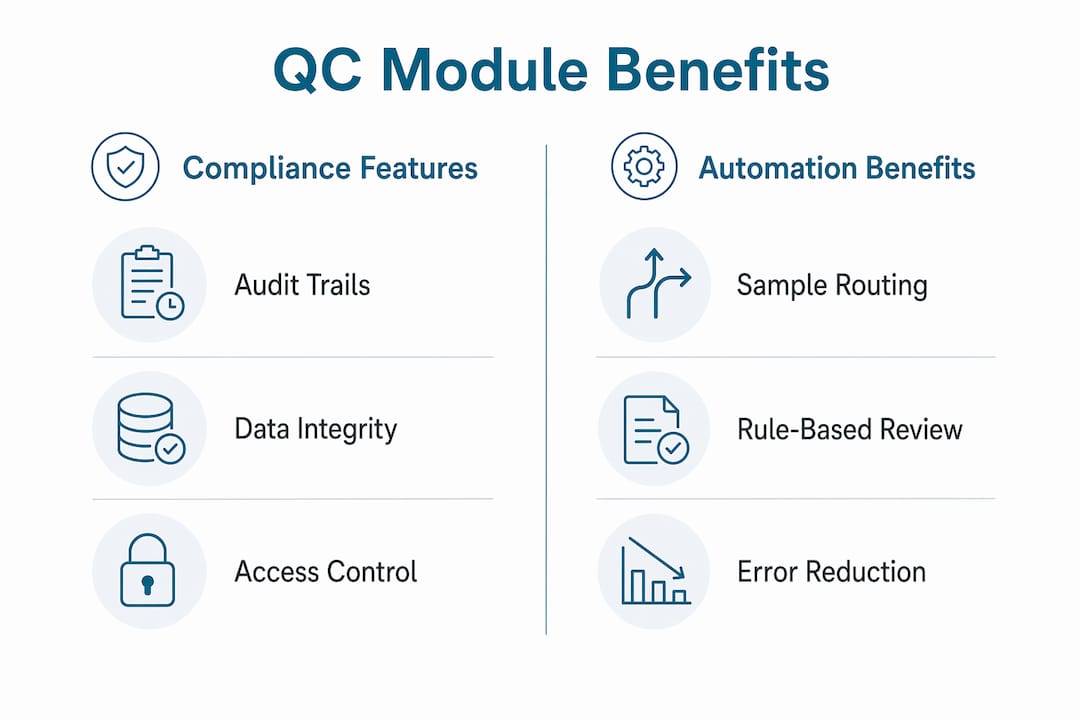
ISO 17025 adds a documentation layer. ISO 17025-aligned LIMS support controlled document workflows with versioning, approvals, acknowledgments, and audit trail linkage so auditors can trace every amendment back to its source. For molecular diagnostic labs running accredited testing, that traceability is not optional.
The compliance benefits of a properly configured QC module are concrete:
- Audit trail completeness. Every field-level change is logged with justification, satisfying the "who, what, when, and why" standard that regulatory auditors apply.
- Version-controlled procedures. SOPs and test specifications are linked to the active version in use at the time of each result, preventing retroactive changes from affecting historical records.
- Electronic approval chains. Review and release steps are captured as electronic signatures, meeting 21 CFR Part 11 requirements for controlled access and non-repudiation.
- Traceable amendments. Any correction to a result or record carries the original value, the corrected value, the operator, and the reason, satisfying ISO 17025 amendment documentation requirements.
- Inspection-ready exports. Audit packages can be generated on demand, reducing the time required to respond to FDA Form 483 observations or ISO assessments.
"Audit trails are often the compliance bottleneck. Their integrity and completeness determine whether a QC module is fit for regulated environments." — Valkit, 21 CFR Part 11 Audit Trail Guide
Audit trails must log field-level changes with detailed justification to meet regulatory audit expectations. Logs that capture only status changes, such as "approved" or "rejected," are insufficient. Auditors test for the full edit history at the data field level, and systems that cannot produce it create findings.
LIMS QC module vs. spreadsheets and standalone tools
The comparison between a LIMS QC module and spreadsheet-based QC management is not close. Spreadsheets lack integrated sample tracking, rule-based approvals, audit trails, and consistent review workflows. That gap is not a minor inconvenience. It is a structural compliance risk.
| Capability | LIMS QC module | Spreadsheet or standalone tool |
|---|---|---|
| Sample tracking with chain of custody | Automated, timestamped, linked to test records | Manual entry, no enforced chain of custody |
| Specification comparison | Rule-based, automatic pass/fail | Manual calculation, formula errors possible |
| Audit trail depth | Field-level logs with operator, timestamp, and reason | File-level version history at best |
| Workflow routing | Automated routing to reviewers on failure | Manual notification via email or verbal handoff |
| Nonconformance management | Structured investigation linked to sample record | Separate document or no formal process |
| Regulatory readiness | Designed for 21 CFR Part 11 and ISO 17025 | Requires significant supplemental validation |
Standalone QC tools that are not integrated with the LIMS create a different problem. Data must be transferred between systems, introducing transcription errors and breaking the chain of custody. A molecular diagnostic LIMS with a native QC module eliminates that transfer step entirely. The sample record, test result, QC decision, and audit trail all live in one system.
The operational efficiency difference is also significant. Integrated LIMS QC modules improve lab efficiency by automating routing, approvals, and test execution, reducing errors compared to manual systems. That reduction in manual steps directly lowers the risk of out-of-specification investigations caused by transcription errors rather than actual assay failures.
Practical applications in genetic and molecular labs
Genetic and molecular labs have QC requirements that generic LIMS platforms often underserve. Pharmacogenomics assays, next-generation sequencing panels, and hereditary cancer tests each carry specific QC acceptance criteria tied to run controls, coverage thresholds, and allele frequency cutoffs. A QC module built for these workflows handles that complexity without requiring workarounds.
Typical QC workflows automated by a well-configured module include:
- Run control verification. Positive and negative controls are tracked per run, compared against historical performance ranges, and flagged if they fall outside the accepted window.
- Instrument data normalization. Raw instrument outputs are captured directly via integration, normalized to the configured unit, and compared against the specification without manual transcription.
- Batch release routing. When all QC criteria pass, the batch moves automatically to the release queue. When any criterion fails, the batch routes to the QA reviewer with the failure detail attached.
- Certificate of analysis generation. Release documents are generated from the verified result record, not from a separate template, so the document always reflects the actual data.
QC modules facilitate faster batch release cycles by automating data management, review by exception, and providing a single source of truth for QC data. That speed matters in clinical genetic testing, where turnaround time directly affects patient care decisions.
Integration with external systems extends the value further. A LIMS that supports HL7, FHIR, and direct instrument connections, as Labrynix does through Labrynix Connect, allows QC data to flow between the lab system, the instrument, and the ordering provider without manual intervention. That connectivity supports the sample-to-report workflow that genetic labs depend on for both speed and accuracy.
Pro Tip: When evaluating QC modules for a growing molecular lab, test the configuration interface for specification management. Labs that can update QC limits and routing rules without vendor involvement respond faster to assay changes and avoid costly change-control delays.
Selecting a QC module for lab growth requires looking beyond current test volume. The module should support multiple assay types, configurable review tiers, and role-based access so that as the lab adds tests or staff, the QC framework scales without a system rebuild. LIMS workflow design that accounts for QC scalability from the start prevents the expensive re-implementation projects that many labs face at the two-year mark.
Key Takeaways
A LIMS quality control module is the single most important compliance and efficiency tool a genetic or molecular lab can configure correctly from day one.
| Point | Details |
|---|---|
| Core definition | A QC module automates sample routing, specification comparison, and audit documentation within a LIMS. |
| Compliance requirement | FDA 21 CFR Part 11 and ISO 17025 both require field-level audit trails that spreadsheets cannot produce. |
| Audit trail depth | Logs must capture who changed what, when, and why at the field level, not just status changes. |
| Integration advantage | A native QC module eliminates data transfer between systems, removing transcription errors and chain-of-custody gaps. |
| Scalability factor | Choose a module with configurable specification management so QC rules can be updated without vendor involvement. |
What I've learned about QC modules that most guides skip
Labs consistently underinvest in audit trail configuration and then discover the gap during their first external inspection. The audit trail is not a background feature. It is the primary evidence that your QC process is controlled. I have seen labs with well-designed bench workflows fail ISO 17025 assessments because their LIMS logged status changes but not field-level edits. The auditor asked for the original value of a corrected result, and the system could not produce it.
The second pattern I see is over-reliance on vendor validation documentation. A vendor's validation package covers the software as delivered. It does not cover your configuration. If you add a custom specification rule or modify a routing workflow, that change requires your own validation evidence. Labs that treat vendor IQ/OQ/PQ as a substitute for their own configuration validation create a compliance gap that is invisible until an audit.
My advice for molecular and genetic labs evaluating QC modules: test the audit trail before you test anything else. Create a result, edit it, and ask the system to show you the full field-level history with the reason for change. If the system cannot show you that in two clicks, it will not satisfy a 21 CFR Part 11 auditor. Everything else, including reporting, routing, and integration, can be configured. Audit trail architecture is structural and cannot be retrofitted.
The evolution of LIMS capabilities in molecular diagnostics is moving toward AI-assisted review queues and automated anomaly detection. Those features add value, but they do not replace the need for a sound QC module foundation. Build the foundation first.
— Tarek
Labrynix LIMS for genetic and molecular lab QC
Labrynix is built specifically for genetic testing, molecular diagnostics, and pharmacogenomics labs that need QC management aligned with real clinical workflows, not adapted from generic laboratory software.

The Labrynix LIMS platform supports sample tracking, workflow queues, role-based access, audit activity, and operational visibility across the complete testing cycle. Labrynix Connect handles HL7, FHIR, and direct instrument integrations, so QC data moves between systems without manual transcription. For labs ready to move beyond spreadsheets and disconnected tools, Labrynix LIMS solutions cover genetic testing, molecular diagnostics, and reference lab environments with QC workflows designed for compliance from the ground up. Labs focused on molecular diagnostics can also review the molecular diagnostics LIMS offering for a closer look at QC and reporting capabilities built for that environment.
FAQ
What does a quality control module do in a LIMS?
A LIMS quality control module automates sample routing, compares test results against configured specifications, generates pass/fail determinations, and creates electronic audit trails. It replaces manual QC steps with rule-based workflows that support regulatory compliance and faster batch release.
How does a LIMS QC module support FDA 21 CFR Part 11?
FDA 21 CFR Part 11 requires secure, computer-generated, time-stamped audit trails that log operator actions and prevent record alteration. A compliant QC module captures field-level changes with operator identity, timestamp, and justification, producing the immutable record history the regulation requires.
Why are spreadsheets insufficient for laboratory QC management?
Spreadsheets lack integrated sample tracking, rule-based approvals, and field-level audit trails. They cannot produce the attributable, time-stamped change history that FDA and ISO 17025 auditors require, making them a structural compliance risk in regulated genetic and molecular labs.
What is the difference between a status-only log and a field-level audit trail?
A status-only log records that a record moved from "pending" to "approved." A field-level audit trail records the original value, the new value, the operator who made the change, the timestamp, and the reason. Regulatory auditors require field-level detail, and systems that only log status changes fail that standard.
Can a LIMS QC module integrate with lab instruments directly?
Yes. Modern LIMS platforms with native instrument integration capture raw instrument outputs directly, normalize them to the configured unit, and compare them against QC specifications without manual data entry. That direct connection removes transcription errors and maintains an unbroken chain of custody from instrument to result record.