
Startup genetic, molecular, and pharmacogenomics labs need reporting tools because manual processes cannot maintain the audit trail depth, sample-to-report traceability, or decision speed that GxP, CLIA, and HIPAA compliance demands at any meaningful scale. The three outcomes that matter most:
- Enforceable audit trails that log every data access, interpretation change, and report approval automatically
- Sample-to-report chain of custody so every result is traceable from accession to final delivery
- Decision velocity — near-real-time operational data instead of weekly spreadsheet exports that are stale before anyone reads them
- TAT visibility that flags bottlenecks before they become billing or clinical problems
Labrynix is built specifically for these needs, combining LIMS workflow management, PGx reporting, and compliance-grade data governance in one connected platform.
Table of Contents
- Why do startup labs need reporting tools for compliance and speed?
- What do PGx and genetic labs specifically need from reporting tools?
- Which integrations does a startup lab's reporting stack actually need?
- How should a startup lab implement reporting tools step by step?
- How do reporting tools strengthen regulatory compliance and data security?
- How do you measure ROI from reporting tools in a startup lab?
- How does Labrynix address these needs for startup genetic and PGx labs?
- Key Takeaways
- The gap most startup labs don't see until it's too late
- Ready to see what purpose-built reporting looks like for your lab?
- Useful sources
Why do startup labs need reporting tools for compliance and speed?
The practical upside of automated reporting goes well beyond dashboards. When leadership can see real-time operational data instead of waiting for a Monday-morning spreadsheet, decisions that used to take days happen in hours. That gap matters when a turnaround time spike is costing you provider relationships.
Compliance benefits are equally concrete. Automating audit trails is critical to maintaining laboratory certification and reducing risk during regulatory reviews. A manual process simply cannot produce the timestamped, tamper-evident access logs that a CLIA inspector or HIPAA auditor expects. Automated reporting closes that gap without adding headcount.
Operationally, the shift from manual to automated reporting reduces re-run rates, cuts report production time, and gives billing teams visibility into claim stages before revenue slips through the cracks. Automated scheduled reports free staff from manual refreshes and distribute consistent views to every stakeholder simultaneously.
Industry guidance shows payback periods for labs moving off manual reporting processes — with formula errors, stale exports, and hidden reconciliation costs as the primary drivers of that cost.
Pro Tip: Align your metric definitions before you automate anything. Faster reports built on inconsistent definitions just accelerate misinformation. A metric dictionary (definition, formula, source system, owner) is the highest-ROI step you can take before buying software.
| Reporting approach | Audit trail | TAT visibility | Scalability | PGx annotation support |
|---|---|---|---|---|
| Manual spreadsheets | None | Delayed | Poor | None |
| Generic BI tools | Partial | Near-real-time | Moderate | Requires custom build |
| Purpose-built lab reporting | Automated, immutable | Real-time | High | Native |
What do PGx and genetic labs specifically need from reporting tools?
Generic BI platforms were not designed for nested assay outputs, variant-to-medication mappings, or interpretation rule versioning. Purpose-built LIMS-integrated reporting reduces maintenance overhead because the platform understands these data structures natively. When your assay panel changes, a generic tool requires engineering work; a purpose-built platform handles it through configuration.
A complete PGx report must include:
- Genotype and phenotype summary per gene
- Medication guidance tied to CPIC guidelines and FDA pharmacogenomic labeling
- PharmGKB annotations with evidence levels
- Lab-approved interpretation rules with version stamps
- Actionable variant flags linked to guideline sources
Provider-facing and patient-facing reports have different formatting needs. Providers need a concise clinical summary with medication tables and prescribing guidance. Patients need plain-language explanations. Both formats should be brandable, deliverable via secure portal, and available as PDF. Keeping both under the same template engine is what prevents version drift between what the provider sees and what the patient receives.
Interpretation rules evolve as genetic knowledge advances. Your reporting tool must version-stamp every rule change, log who approved the update, and maintain a full audit history of which rule set generated each report. Without that, you cannot defend a historical result during a regulatory review.

Pro Tip: Build your interpretation rule engine so that a clinical scientist can update medication guidance without touching code. If every CPIC update requires a developer, your lab will always be running behind current guidelines.
Which integrations does a startup lab's reporting stack actually need?
The foundation of reliable reporting is clean, integrated data with automated refreshes and a central semantic layer. For a genetic or molecular lab, that means connecting the right systems from day one.
Essential integration points:
- LIMS/LIS for sample status, accession records, and workflow queue data
- Lab instruments and middleware for result ingestion
- EHR/EMR via HL7 or FHIR for order receipt and result delivery
- Billing platforms for claim stage visibility and revenue reconciliation
- APIs and webhooks for real-time event triggers and external notifications
The most common failure point is disconnected core operational systems with inconsistent metric definitions. Identity mapping is where this breaks: if your LIMS uses one patient identifier and your billing system uses another, every cross-system report requires manual reconciliation. Unified patient and order identifiers, consistent accession date formats, and standardized status codes are prerequisites, not nice-to-haves.
Integration evaluation checklist:
- Does the platform support HL7 v2 and FHIR R4 natively?
- Are instrument connectors pre-built or custom-developed?
- Does the platform offer real-time event triggers or only batch refresh?
- Where does data reside, and does that satisfy your HIPAA obligations?
- What is the connector maintenance model when instrument firmware updates?
For a deeper look at molecular diagnostic LIMS architecture and how it fits into the reporting stack, the fundamentals are worth reviewing before scoping integrations.
How should a startup lab implement reporting tools step by step?
A phased rollout reduces risk and gives your team time to validate before going live with clinical data.
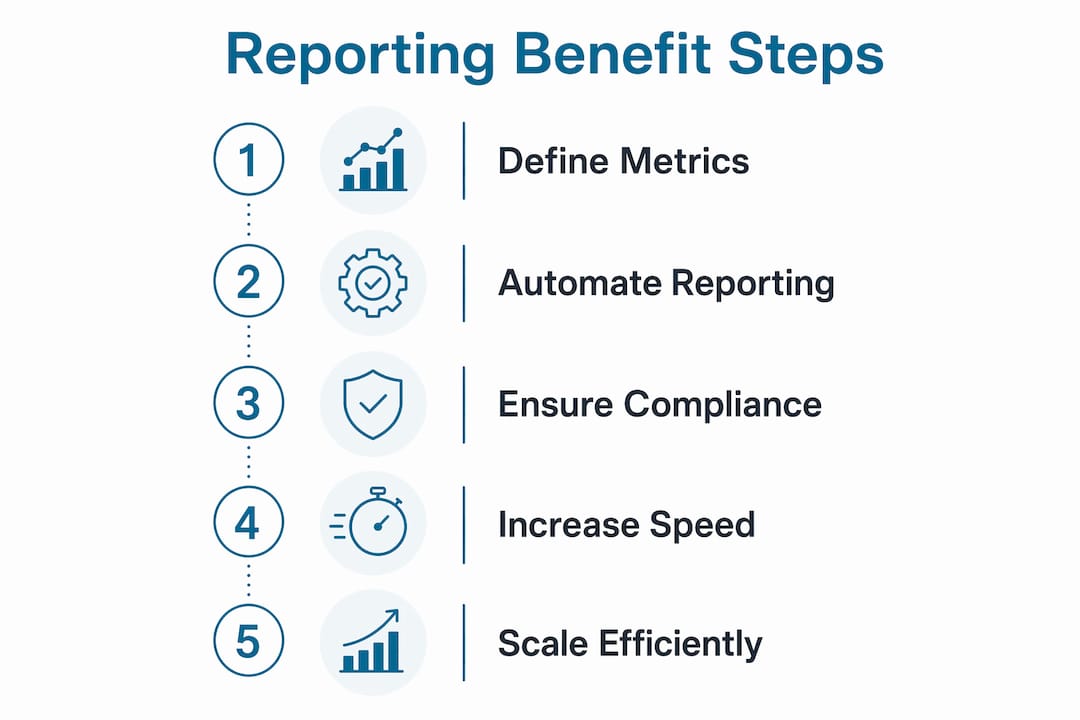
- Define your metric dictionary. Document every KPI: its formula, source system, owner, and update frequency. This is the governance foundation.
- Identify your minimum viable report set. What does leadership need on day one? TAT by test type, sample status by queue, and billing claim stages cover most startup needs.
- Connect sources and validate identity mapping. Confirm that patient and order identifiers are consistent across LIMS, EHR, and billing before any report is generated.
- Validate the sample-to-report chain of custody. Trace five to ten samples end-to-end and confirm every status transition is logged with a timestamp and user ID.
- Test audit trails and role-based access. Verify that access logs capture every view and export, and that permission tiers restrict data correctly.
- Run parallel reporting. Generate reports from both the new system and your old process for two to four weeks and reconcile the numbers.
- Phased user onboarding. Train power users first, then extend access with documented workflows and a named support contact.
Timeline: most startup labs complete the integration and validation phases in six to twelve weeks, depending on the number of source systems and the complexity of instrument connectors. Cost buckets to plan for: implementation services, connector licensing, and user training.
Common failure points: poor data quality in source systems, shifting metric definitions mid-project, and underinvesting in training. The last one is consistently underestimated.
Pro Tip: Run your proof-of-concept against real operational data, not sanitized test sets. Performance and reconciliation issues only surface under true data volume and complexity. A clean POC that fails on live data is a costly surprise.
How do reporting tools strengthen regulatory compliance and data security?
Required compliance capabilities for any regulated genetic lab:
- Immutable audit trails with user ID, timestamp, and action type
- Role-based access control with configurable permission tiers
- Signed electronic records for report approvals
- Configurable data retention policies aligned to CLIA and HIPAA requirements
Traceability goes beyond sample tracking. Your reporting tool must log who changed an interpretation rule, when, and what the previous version contained. That version history is what you present during a CAP inspection or HIPAA audit to demonstrate that every historical report reflects the rule set that was active at the time of generation.
Security basics that should be non-negotiable:
- Encryption at rest and in transit for all PHI
- Secure report delivery through provider and patient portals, not unencrypted email
- Configurable permissions that prevent unauthorized data exports
- Backup and recovery verification with documented retention schedules
Regulatory checkpoints to test before go-live: audit-log completeness review, validation evidence package, and retention/backup verification against your CLIA certificate requirements. The sample-to-report workflow documentation is a useful reference for structuring that validation evidence.
Reporting tools that automate audit trails are critical to maintaining laboratory certification — manual methods cannot reliably produce the tamper-evident, timestamped records that GxP and CLIA reviews require at scale.
How do you measure ROI from reporting tools in a startup lab?
KPIs to track from day one:
- Report production hours saved per week
- TAT improvement by test type (baseline vs. post-implementation)
- Re-run rate reduction
- Billing realization rate and days-to-claim submission
- Closed-loop reconciliation time between LIMS and billing
Industry guidance places payback periods for moving off manual reporting at 12–18 months, driven primarily by recovered analyst hours and reduced reconciliation labor. At several hours of weekly reporting labor per staff member across a small team, that is a significant amount of time per year spent assembling data instead of analyzing it.
Qualitative ROI is harder to quantify but equally real: lower audit risk, faster clinical decision cycles, and reduced staff turnover from eliminating repetitive manual work.
| KPI | Baseline source | Target signal |
|---|---|---|
| Report production time | Current weekly hours logged | Reduction after automation |
| TAT by test type | LIMS accession-to-report timestamps | Trend improvement over 90 days |
| Billing realization rate | Billing platform claim data | Increase in clean claims submitted |
- Collect your baseline numbers before implementation, not after.
- Set a 90-day review cadence to track trend lines, not just point-in-time snapshots.
- Include qualitative signals (audit readiness, staff feedback) in your ROI report to leadership.
Most startup labs complete implementation and validation phases in 12–18 months, depending on source system complexity and instrument connectors. Cost buckets to plan for: implementation services, connector licensing, and user training.
Common failure points: poor data quality in source systems, shifting metric definitions mid-project, and underinvesting in training. The last one is consistently underestimated.
Pro Tip: Run your proof-of-concept against real operational data, not sanitized test sets. Performance and reconciliation issues only surface under true data volume and complexity. A clean POC that fails on live data is a costly surprise.
How does Labrynix address these needs for startup genetic and PGx labs?
Labrynix maps directly to the requirements above. The platform covers the full sample-to-report workflow: LIMS order management, accessioning, sample tracking, and workflow queues connect directly to report generation without manual handoffs.
Feature highlights:
- PGx reporting with CPIC guideline support, FDA pharmacogenomic labeling references, and PharmGKB-informed annotations
- Configurable interpretation rules with version stamps and approval workflows
- HL7, FHIR, and API connectivity through Labrynix Connect for EHR, billing, and instrument integrations
- Provider and patient portals for secure, branded report delivery
- Billing visibility across claim stages, invoice workflows, and revenue handoffs
- Role-based access and immutable audit logs built into the core workflow
Trust signals worth noting: Labrynix was built from real genetic and molecular laboratory experience, not adapted from a generic clinical platform. That distinction shows up in the details — the platform understands nested assay outputs, variant-to-medication mappings, and the difference between a provider summary and a patient-facing explanation. Branded PGx reports with CPIC, PharmGKB, and FDA references are configurable without engineering involvement.
Implementation typically begins with a discovery call covering integration scope, connector availability, and validation planning. Most startup labs are operational within 12–18 months. Pro Tip: Ask any vendor to walk you through how their platform handles an interpretation rule update — specifically, how it versions the change, who approves it, and how historical reports are preserved. That single question separates purpose-built lab platforms from adapted BI tools.
For a full feature comparison, the genetic testing lab solution page maps platform capabilities to lab-specific needs.
Key Takeaways
Startup genetic, molecular, and PGx labs need reporting tools because compliance-grade audit trails, sample-to-report traceability, and real-time decision visibility cannot be maintained reliably with manual processes at any meaningful scale.
| Point | Details |
|---|---|
| Align metrics before automating | Define every KPI's formula, source, and owner before building any report or dashboard. |
| Prioritize LIMS and EHR integration | Unified patient identifiers across LIMS, EHR, and billing are the prerequisite for trustworthy cross-system reports. |
| Validate with live data | Run your proof-of-concept against real operational data to surface performance and reconciliation issues before full go-live. |
| Payback timeline | Industry guidance places payback at 12–18 months when moving off manual reporting, driven by recovered analyst hours and audit risk reduction. |
| Labrynix for startup labs | Labrynix connects LIMS workflow, PGx reporting with CPIC/PharmGKB/FDA references, portals, and billing visibility in one platform built for genetic and molecular labs. |
The gap most startup labs don't see until it's too late
The conventional wisdom is that reporting tools are a "scale" problem — something you address after you've proven the science and grown the team. That framing is wrong, and it costs labs real money.
Audit trail requirements don't become easier to retrofit. When a lab builds its first six months of operations on spreadsheets and disconnected tools, the work of reconstructing a defensible chain of custody for those samples is significant. The labs that build reporting infrastructure early don't just pass audits more cleanly — they make better clinical and operational decisions from month one, because the data is there when they need it.
The other mistake is treating generic BI tools as a neutral starting point. They aren't. A generic dashboard platform that doesn't understand PGx interpretation rules, variant-to-medication mappings, or CLIA audit requirements will require constant engineering to stay current. Every CPIC update becomes a development ticket. That maintenance burden compounds quickly in a startup environment where engineering time is scarce.
Start small, govern your metrics from day one, and validate with real data. Those three habits separate labs that scale cleanly from labs that spend their Series A budget on data cleanup.
Ready to see what purpose-built reporting looks like for your lab?
Startup labs running genetic, molecular, or PGx testing don't need another generic dashboard — they need a platform that understands the sample-to-report workflow, speaks CPIC and FHIR natively, and keeps compliance evidence built in from the start. That's exactly what Labrynix delivers.

Download the genetic lab buyer's guide to evaluate reporting and LIMS features against your lab's specific requirements, or request a demo to walk through integration scope and connector availability with the Labrynix team.
- In a demo: expect a review of your current source systems, integration connectors, PGx report templates, and a validation planning discussion tailored to your lab's test menu.
- Implementation ballpark: most startup labs are fully operational within six to twelve weeks, depending on integration complexity.
Explore the full PGx reporting capabilities or the molecular diagnostics solution page to see how the platform maps to your workflow before the first conversation.
Useful sources
- CPIC — Clinical Pharmacogenomics Implementation Consortium: The primary source for evidence-based PGx prescribing guidelines; use to validate medication guidance tiers in your reports.
- PharmGKB: Curated pharmacogenomics knowledge base providing variant annotations and evidence levels referenced in clinical PGx reports.
- FDA Pharmacogenomics Guidance: Official FDA table of PGx biomarkers in drug labeling; the authoritative reference for FDA-label-based medication guidance.
- Business reporting in 2026 — Bold Reports: Industry analysis on real-time reporting, automated delivery, and decision velocity for modern organizations.
- Reporting tool vs. Excel — GlowReports Blog: Practical comparison of manual vs. automated reporting with payback period guidance.
- Guide to BI reporting — Databricks Blog: Technical reference on ETL pipelines, semantic layers, and proof-of-concept methodology for reporting infrastructure.
- Why BI is a must-have for modern labs — MedHealthOutlook: Lab-specific analysis of audit trail requirements and the maintenance burden of generic BI tools for genetic data.
- Labrynix platform and PGx reporting features: Platform-specific compliance features, PGx report capabilities, and integration details for genetic and molecular labs.