
Molecular diagnostics reporting software is defined as a specialized platform that connects sample accessioning, sequencing data management, clinical interpretation, and billing compliance into a single observable workflow. Labs that rely on spreadsheets, disconnected modules, or generic LIMS platforms face a compounding problem: 60–70% of data and AI initiatives in clinical labs fail due to governance gaps and disconnected tools, not analytic failure. That statistic tells you the bottleneck is operational, not scientific. Platforms like Labrynix, LabWare, and Thermo Fisher's enterprise LIMS have demonstrated that integrating workflow automation, interpretation support, and billing compliance into one system is the only architecture that scales with the demands of modern molecular testing.
Why molecular diagnostics need reporting software: the core case
Without purpose-built reporting software, molecular diagnostic labs face a set of operational challenges that compound quickly as test volume grows. The problems are not isolated. They form a chain where each gap creates the next failure.
- Multi-step workflow fragmentation. Next-generation sequencing, pharmacogenomics, and liquid biopsy workflows each involve dozens of discrete steps from order intake to final report delivery. Without a connected system, each handoff between steps is a manual touchpoint and a potential error source.
- Data silos and disconnected tools. Software failures arise mostly from fragmented systems and governance gaps, not algorithm accuracy. When your LIMS, bioinformatics pipeline, and reporting module do not share data in real time, you are managing three separate sources of truth.
- Manual CPT coding errors. Labs that manually assign CPT codes to molecular test claims face 40–60% revenue loss from automated payer denials when codes are misaligned with updated policies. That is not a billing department problem. It originates at the reporting stage.
- Audit-readiness gaps. Regulatory inspections under CAP, CLIA, and CMS require complete, reproducible documentation of every result. Manual tracking in spreadsheets cannot produce the timestamped, role-attributed audit trails that inspectors require.
- Governance and reproducibility failures. When interpretation logic lives in a scientist's head or an unlocked Excel file, reproducibility is impossible to demonstrate. This is the governance gap that causes labs to fail audits and lose accreditation.
Molecular labs historically relied on spreadsheets and manual tracking, but these methods become unsustainable as test volumes grow and complexity increases. Cleveland Clinic's transition to custom LIMS and bioinformatics integration is a documented example of what happens when a high-volume lab outgrows manual systems and invests in connected infrastructure.
Pro Tip: Before evaluating any reporting software, map every manual handoff in your current sample-to-report workflow. Each handoff is a risk point. The number of handoffs you count will tell you exactly how much operational risk you are currently carrying.
How specialized reporting software improves lab workflow efficiency
The value of integrated molecular diagnostics reporting tools is not theoretical. It is measurable at each stage of the workflow.
Sample accessioning through final report as one system
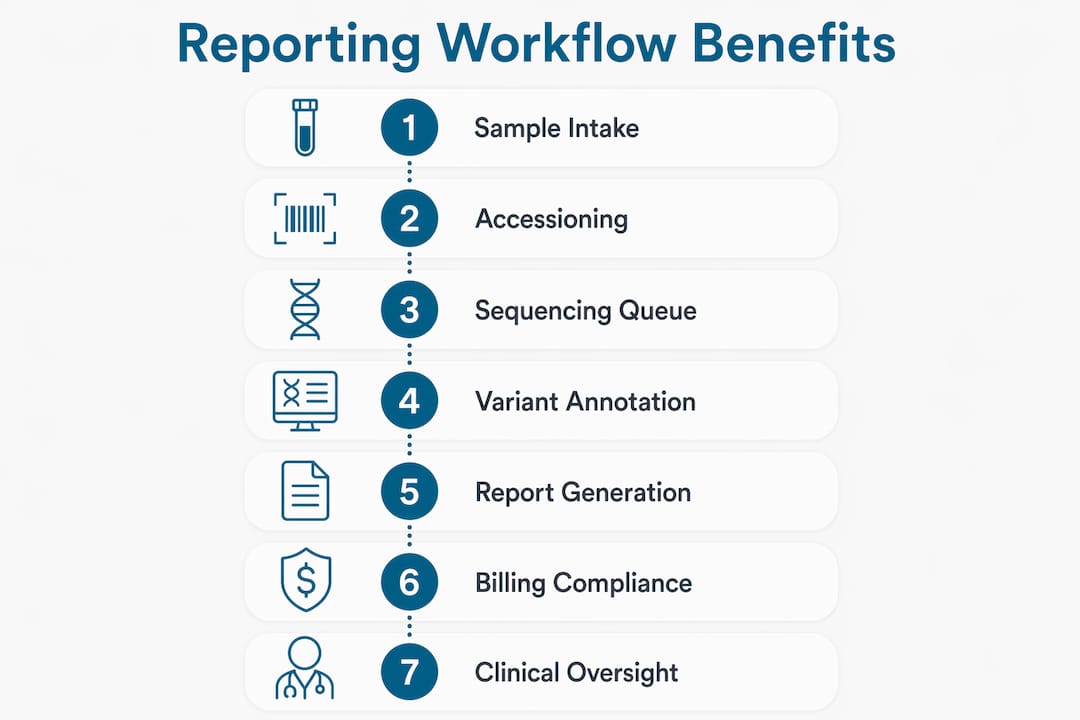
Modern platforms connect order intake, accessioning, sequencing queue management, variant annotation, clinical interpretation, and report generation without requiring manual data transfer between systems. Orchestrating as a single observable system reduces cloud costs, maintenance overhead, and improves reliability across the entire workflow. When a sample moves from accessioning to sequencing, the reporting module already knows it exists, who ordered it, and what turnaround time applies.

Automated CPT code embedding and DEX Z-Code compliance
Embedding billing identifiers at the report generation stage reduces claim denials and eliminates the manual follow-up that consumes billing staff time. DEX Z-Codes, which are supplemental identifiers required by MolDX-administered payers, must accompany specific molecular CPT codes on claims. Software that embeds these codes at the point of report finalization removes a critical failure point from the revenue cycle.
Clinical interpretation oversight with structured evidence
Clinical interpretation must remain human-led. Software supports structured evidence management and explainability without automating diagnosis. The distinction matters for FDA compliance and for the defensibility of your reports. Platforms that provide CPIC guideline references, PharmGKB annotations, and lab-approved interpretation rules give your clinical team a structured framework without removing their judgment from the process.
Comparison: manual and modular approaches versus integrated platforms
| Capability | Manual or modular approach | Integrated reporting platform |
|---|---|---|
| Sample tracking | Spreadsheet or standalone LIMS | Real-time status across full workflow |
| CPT code assignment | Manual lookup and entry | Automated embedding at report generation |
| DEX Z-Code compliance | Manual addition post-report | Embedded at finalization |
| Audit trail | Partial, manually maintained | Complete, timestamped, role-attributed |
| Clinical interpretation support | Unstructured, analyst-dependent | Structured evidence with guideline references |
| Report delivery | Email or manual portal upload | Secure provider and patient portal |
Pro Tip: When comparing molecular diagnostics report approval software, ask each vendor specifically how DEX Z-Codes are embedded in the report workflow. If the answer involves a manual step after report generation, that is a billing risk that will cost you money every month.
What are the compliance and billing impacts in 2026?
The 2026 CPT code update introduced nearly 70 new genomic and molecular codes, and correct coding can increase lab revenue by 25–50%. That range reflects the difference between labs that have automated coding validation built into their reporting workflow and labs that are still relying on manual code lookup tables. The financial gap is not marginal.
Payer enforcement has also shifted. Labs relying on unlisted CPT codes face increasing automated denials, because 2026 payer systems now flag missing or incorrect molecular-specific codes without human review. A denial that previously required a human reviewer to catch now happens at the clearinghouse level before the claim reaches a payer. That acceleration means labs without automated coding validation are losing revenue faster than they were two years ago.
| Compliance risk | Consequence without software | Software mitigation |
|---|---|---|
| Missing DEX Z-Codes | Automated denial at clearinghouse | Embedded at report finalization |
| Incorrect CPT code assignment | 40–60% revenue loss from denials | Automated code validation against 2026 updates |
| Unlisted code usage | Systematic payer rejection | Code-specific mapping to current CPT catalog |
| Missing MolDX policy alignment | Audit exposure and recoupment | MolDX policy integration in coding logic |
| Incomplete audit documentation | CAP/CLIA inspection failure | Timestamped, role-attributed audit trails |
The compliance picture in 2026 is not just about avoiding penalties. It is about recognizing that accurate code usage tied to LCDs and MolDX policies is now the baseline requirement for claim success, not an advanced capability. Labs that treat billing compliance as a back-office function separate from reporting are structurally exposed.
What factors matter when selecting molecular testing software?
Selecting reporting software for a molecular diagnostic lab is a decision that affects every operational function, from sample intake to revenue collection. These are the criteria that separate a good fit from a costly mistake.
-
Workflow compatibility. The software must connect to your existing LIMS or replace it with equivalent functionality. A reporting module that requires manual data export from your LIMS adds a handoff, not removes one. Review LIMS workflow design principles before committing to any architecture.
-
Clinical interpretation controls. The platform must support human-led review with structured evidence, not automate interpretation. Verify that the software provides configurable interpretation rules, guideline references, and a clear approval workflow that keeps a credentialed reviewer in the chain.
-
Billing code updating capability. CPT and DEX Z-Code catalogs update annually. Your software vendor must demonstrate a clear process for pushing those updates into the platform before the effective date. Ask for their 2026 update timeline as a reference check.
-
Scalability and governance features. Role-based access controls, audit logs, configurable permissions, and data governance support are not optional features. They are the infrastructure that makes your lab defensible during inspections and scalable during growth.
-
Integration pathways. Evaluate support for HL7, FHIR, API connections, and EMR/EHR integration. A platform that cannot exchange data with your ordering providers or billing system creates new silos while claiming to eliminate them.
-
Phased rollout and training support. Labs that attempt full-system cutover in a single go-live event consistently report higher error rates and staff resistance. A phased rollout, starting with accessioning and report generation before adding billing integration, reduces operational disruption. Confirm that your vendor provides structured onboarding, not just documentation.
Enterprise LIMS platforms that support advanced reporting automation and regulatory adherence demonstrate that the technology exists to meet all six criteria. The question for your lab is whether the platform you select was built for molecular diagnostics specifically or adapted from a broader clinical laboratory context.
Key takeaways
Molecular diagnostics reporting software is the operational infrastructure that connects sample tracking, clinical interpretation, billing compliance, and audit readiness into one defensible workflow.
| Point | Details |
|---|---|
| Governance gaps cause most failures | 60–70% of lab data initiatives fail due to disconnected tools, not analytic quality. |
| Billing compliance starts at reporting | DEX Z-Codes and CPT codes must be embedded at report generation to prevent automated denials. |
| 2026 coding changes are material | Nearly 70 new molecular CPT codes require automated validation to capture 25–50% revenue potential. |
| Human oversight is non-negotiable | Clinical interpretation must remain human-led; software structures evidence but does not replace judgment. |
| Integration depth determines ROI | Platforms that connect LIMS, reporting, and billing in one system outperform modular bolt-on approaches. |
The part most labs get wrong
The labs I see struggling most with reporting software are not struggling because they chose the wrong analytics engine. They are struggling because they underestimated how much of their problem was operational, not scientific. The sequencing is fine. The variant calling is fine. The failure point is the twelve manual steps between a finalized variant call and a billable, defensible, provider-ready report.
The coding-billing-reporting triad is where I see the most expensive blind spots. Lab directors who are deeply invested in the science often delegate billing integration to a vendor implementation team and assume it will work. It frequently does not, because the billing logic has to be embedded in the report template itself, not bolted on afterward. When a DEX Z-Code is missing from a claim, the fix is not in the billing department. It is in the report generation workflow, and that requires software that was designed with billing in mind from the start.
The other thing I would push back on is the assumption that AI-assisted interpretation reduces the need for human oversight. It does the opposite. As AI tools surface more variant candidates and generate more draft interpretations, the clinical reviewer's role becomes more important, not less. The software should make that review faster and more structured. It should never make it optional. Labs that treat AI-generated interpretation as a final output are taking on liability that no platform can absorb on their behalf.
My honest recommendation: before you evaluate any platform, migrate away from spreadsheets first and document your actual workflow. The gaps you find in that exercise will tell you exactly what your reporting software needs to solve.
— Tarek
See how Labrynix handles this for molecular labs

Labrynix is built specifically for the workflows described in this article. The platform connects LIMS workflow management, PGx and genetic testing report generation, automated CPT and DEX Z-Code embedding, clinical interpretation controls, and provider and patient portals into one system. Labrynix Intelligence adds AI-assisted report drafting and bottleneck detection, while keeping every clinical approval under laboratory control. Labrynix Billing provides real-time visibility into claim stages and revenue handoffs, so your team knows where every report stands in the revenue cycle. If your lab is ready to move beyond disconnected tools and manual coding workflows, explore Labrynix to see the full platform.
FAQ
Why do molecular diagnostics need specialized reporting software?
Molecular diagnostics generate multi-step, high-volume data that manual tools cannot track, code, or document reliably. Specialized reporting software connects sample accessioning, clinical interpretation, and billing compliance into one auditable workflow.
What is molecular diagnostic reporting compliance?
Molecular diagnostic reporting compliance refers to meeting CAP, CLIA, CMS, and payer requirements for documentation, CPT coding, DEX Z-Code usage, and audit trail completeness. Failure to comply results in automated claim denials and inspection risk.
How do DEX Z-Codes affect molecular lab billing?
DEX Z-Codes are supplemental identifiers required by MolDX-administered payers alongside specific molecular CPT codes. Labs that omit them face automated denials at the clearinghouse level before a claim reaches a human reviewer.
What should labs look for in a molecular diagnostics report approval workflow?
Labs should confirm that the software requires a credentialed reviewer to approve every report before finalization, with a timestamped audit trail. Automated interpretation without human sign-off creates both clinical and regulatory liability.
How does reporting software reduce claim denials in molecular labs?
Reporting software reduces denials by embedding CPT codes and DEX Z-Codes directly into the report at finalization, validating them against current payer policies before the claim is submitted. This removes the manual coding step where most errors originate.