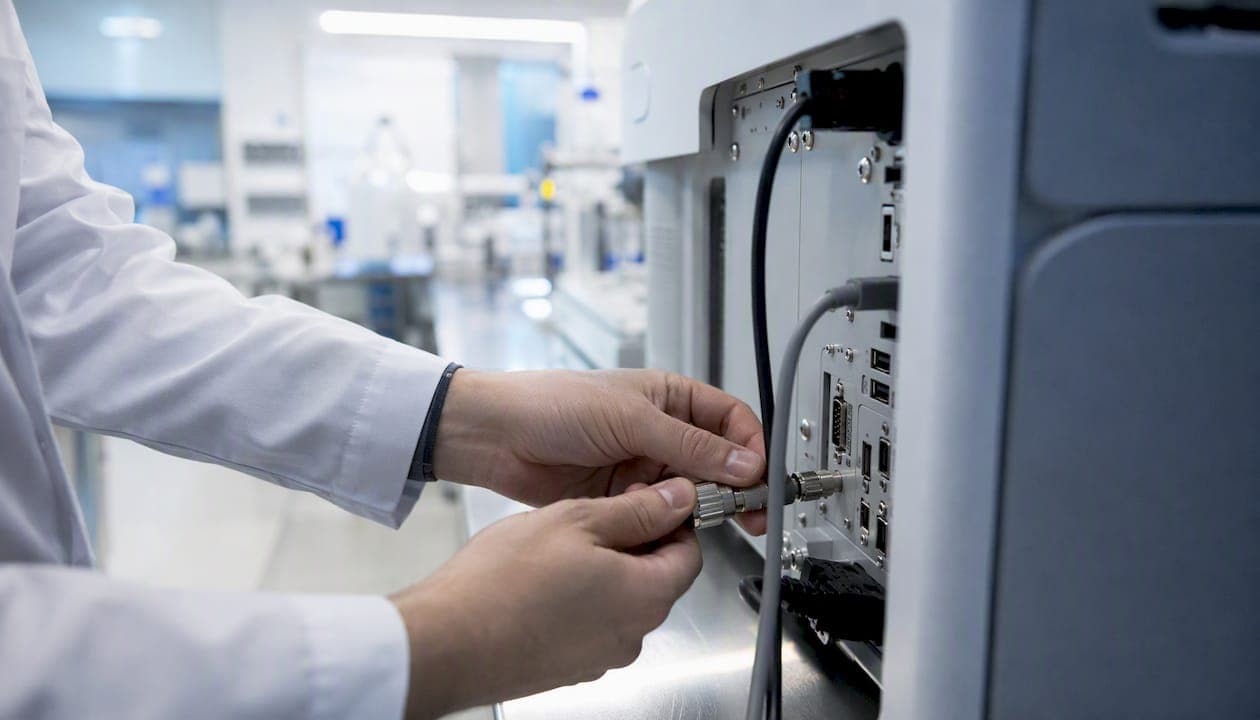
A LIMS is the operational backbone for QC in a modern lab because it centralizes sample data, enforces QC rules automatically, and keeps a defensible audit trail without extra clerical work. If your lab still tracks controls on spreadsheets or paper worksheets, that gap becomes the first thing an auditor finds. LIMS QC refers to the quality control functions built into a laboratory information management system: runsheets, rules engines, control charts, and the release logic that stops a bad result before it reaches a report.
Three things matter most once you start evaluating whether your lab needs this:
- Traceability. Every sample, reagent lot, and analyst action gets logged with an immutable audit trail and, where required, an electronic signature.
- Automation. QC rules run against every result in real time, flagging out-of-range values and blocking release until someone signs off.
- Compliance readiness. The system maps directly to frameworks like ISO/IEC 17025 and 21 CFR Part 11, so audit prep stops being a fire drill.
A full LIMS QC module earns its cost in a regulated environment or any lab running high sample volumes with multiple analysts. A two-person research lab running a handful of assays a week can often get by with a disciplined spreadsheet and a lot of manual double-checking. Once you add shift handoffs, multiple instruments, or a certifying body looking over your shoulder, that manual approach starts breaking down fast.
Key Takeaways
A LIMS functions as the QC backbone in a modern lab because it enforces rules automatically, preserves audit trails, and keeps release decisions defensible under inspection.
| Point | Details |
|---|---|
| LIMS QC role | Centralizes sample data, blocks out-of-range results automatically, and preserves an audit trail for every decision. |
| Core modules to evaluate | Prioritize runsheets, a shared QC rules engine, control charting, and role-based electronic signatures. |
| Implementation priority | Treat validation as a parallel workstream and run at least one full parallel QC cycle before cutover. |
| Next step | Map three core QC workflows and evaluate a platform like Labrynix against those specific processes. |
Table of Contents
- What LIMS QC Modules Actually Include
- How Does a LIMS Automate a QC Workflow?
- What Controls Keep LIMS QC Data Audit-Ready?
- How Instrument Integration Improves QC Accuracy
- What Does a LIMS Implementation Actually Take?
- Does a LIMS Replace a QMS, or Work Alongside One?
- LIMS QC Checklist: From Go-Live to Daily Operations
- When Is a LIMS the Right QC Tool for Your Lab?
- Backup, Disaster Recovery, and Archiving QC Data
- Training Analysts and Managing Change Around QC Modules
- Reviewing and Refining QC Configurations Over Time
- What Drives LIMS Implementation Cost and Timeline
- What I've Learned Watching LIMS QC Rollouts Go Right and Wrong
- How Labrynix Supports LIMS-Driven QC for Genetic and Molecular Labs
- Frequently Asked Questions
- Sources
What LIMS QC Modules Actually Include
Vendors describe their platforms differently, but the functional building blocks of QC in a laboratory information management system are fairly consistent across genetic, molecular, environmental, and manufacturing labs. Here's what to expect and evaluate:
- Runsheet/worksheet module — the digital workspace where analysts log samples, controls, and results for a batch or run.
- QC rules engine — the logic layer that checks each result against control limits, method-specific rules, or statistical thresholds automatically.
- Control charting and statistics — Shewhart charts, CUSUM tracking, and precision/accuracy metrics that surface drift before it becomes a failure, a common feature set in dedicated QC management platforms.
- Sample and batch management — tracking of accessioning, chain of custody, and batch grouping through the entire lifecycle.
- Inventory, lot, and expiry handling — linking reagent and control lots directly to results so an expired CRM never silently invalidates a run.
- Audit trails, roles, and electronic signatures — the compliance layer that records who did what, when, and why.
- Reporting templates — configurable output formats that pull QC status directly into the final report.
A well-built runsheet captures more than a raw number. A typical layout includes sample ID, QC type (blank, duplicate, spike, CRM), lot number, analyst initials, raw instrument result, any corrected value, an automated QC flag (pass, fail, warning), and a comment field for justification. That comment field matters more than people expect. It's often the first thing an auditor reads when a flagged result eventually got released anyway.
Pro Tip: Build QC rules as a shared rule library rather than burying them inside individual test methods. A central library lets you update a control limit once and apply it everywhere it belongs, and it gives your QA team one place to audit instead of forty scattered method configurations.
How Does a LIMS Automate a QC Workflow?
The mechanics of day-to-day QC in a LIMS follow a fairly predictable sequence, though the details shift depending on lab type and instrument mix.
- Sample receipt and accessioning create the record and assign it to a workflow queue.
- The system generates a runsheet and assigns QC sample types (blanks, duplicates, spikes, CRMs) alongside patient or client samples.
- Data enters the system either manually or through an instrument import.
- The QC rules engine checks every result against the applicable limits the instant it lands.
- A supervisor reviews flagged results, and the system either releases the batch or holds it pending investigation.
That fourth step is where the real value shows up. Picture a molecular lab running a batch of 40 samples with a positive control and negative control on either end of the plate. The positive control comes back below the acceptable range. Here's what typically happens next:
- System action: the LIMS automatically flags the entire batch and blocks the approval button for every sample tied to that run.
- Analyst action: the analyst reviews the instrument trace, checks reagent lot history, and documents a probable cause, such as a degraded reagent or a pipetting error.
- Supervisor action: a supervisor reviews the documented justification, decides whether to rerun the batch or accept a documented exception, and signs off electronically.
Without that automated block, a rushed analyst could release results from a failed control run and nobody would catch it until a client complaint or an audit surfaces the gap. A rules engine takes that judgment call out of a single person's hands and forces documentation before anything moves forward.
What Controls Keep LIMS QC Data Audit-Ready?
Data integrity in a LIMS rests on a handful of specific, checkable controls, not a vague promise of "compliance." The controls that actually matter are immutable audit trails, field-level change logging, role-based access, electronic signatures, version control on methods and rules, and a traceable release lifecycle that moves a result through defined states like Pending, Ready, Approved, and Published.
For labs operating under ISO/IEC 17025 or GxP frameworks, a LIMS provides the primary infrastructure for data integrity through these exact mechanisms: immutable audit trails, electronic signature support, and permission-based access controls. Under 21 CFR Part 11, an electronic record only counts as trustworthy if you can prove who touched it and when, and if the system prevents unauthorized edits after the fact. GAMP 5 adds the validation lens on top: it defines how much formal computer system validation (CSV) a given software category requires based on risk.
Quick figure check: a 2026 discovery phase that skips a real risk assessment is one of the most common reasons labs end up doing CSV twice, once informally and once for real, after an auditor rejects the first pass.
A short checklist worth running against any LIMS you're evaluating or validating:
- Does every field change generate a timestamped, attributable log entry?
- Can you restrict result approval to specific roles, separate from data entry roles?
- Are electronic signatures tied to a unique credential, not a shared login?
- Is there a documented, testable release lifecycle from raw result to published report?
- Does the vendor provide validation documentation templates for IQ/OQ/PQ?
How Instrument Integration Improves QC Accuracy
Manual transcription is still one of the largest sources of QC error in labs that haven't automated data capture. Common integration approaches include direct instrument drivers, middleware platforms that sit between instruments and the LIMS, standardized flat-file exports (CSV), and message standards like HL7 or FHIR where a lab needs to exchange results with clinical systems. Genetic and molecular labs often lean on a mix of direct drivers for high-volume analyzers and structured exports for lower-volume or legacy instruments, a pattern covered in more depth in Labrynix's guide to LIMS instrument integration.
The payoff for QC specifically comes down to three things: transcription errors disappear because nobody retypes a number, turnaround shortens because results post automatically, and QC checks run in real time instead of during a batch review hours later.
Pro Tip: Log the raw instrument value and the corrected value as two separate fields, never one overwritten number. When an auditor or a client asks how a result changed, you want a documented trail, not a memory of what happened three months ago.
A few integration details trip up more labs than you'd expect. Sample identifiers need to match exactly between the instrument's export and the LIMS accessioning record, including leading zeros and barcode formats. Unit and precision mismatches (an instrument reporting three decimal places when your method spec wants two) can silently shift a result across a control limit. And nonstandard exports from older instruments often need a middleware translation layer rather than a native driver, which adds a line item to your integration budget most labs don't budget for on the first pass.
What Does a LIMS Implementation Actually Take?
LIMS implementation is a distinct project with its own phases, roles, and failure points, not a simple software install. It spans discovery, configuration, data migration, instrument integration, testing and validation, training, and go-live, with timelines ranging from a few weeks for a narrow cloud deployment to well over a year for a multi-site regulated rollout.
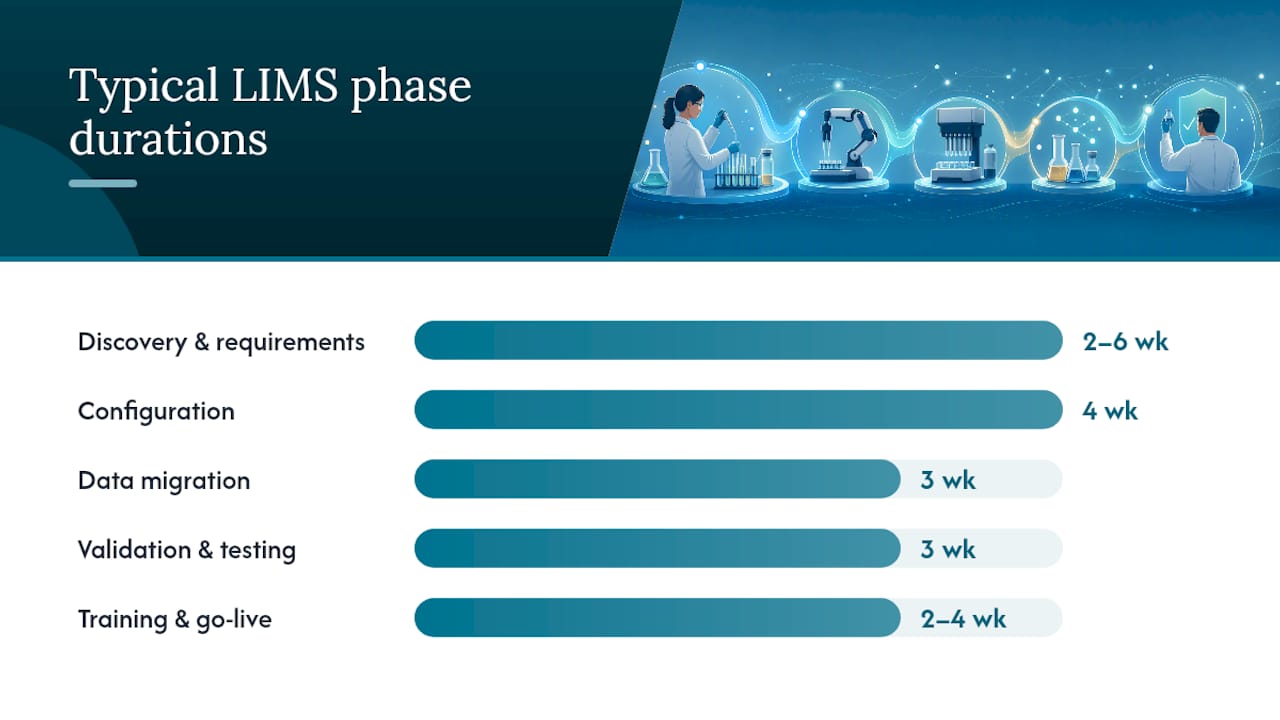
| Phase | Typical duration | Major driver |
|---|---|---|
| Discovery and requirements | 2 to 6 weeks | How well existing workflows are documented |
| Configuration | 4 weeks | Number of test methods and QC rule complexity |
| Data migration | 3 weeks | Legacy data quality and field mapping effort |
| Instrument integration | 2 weeks | Number and diversity of connected instruments |
| Validation and testing | 3 weeks | Regulatory tier and CSV scope required |
| Training and go-live | 2 to 4 weeks | Staff turnover and superuser readiness |
Broader industry estimates put total implementation at six to eighteen months for most labs, with implementation services frequently costing a multiple of the software license cost. That cost driver surprises labs that budget only for the subscription and forget the configuration, migration, and training labor behind it.
Staffing the project matters as much as the timeline. You need a project sponsor with budget authority, a lab lead who owns workflow decisions, a regulatory or QA representative embedded from day one, an IT or integration lead for instrument connections, a vendor implementation lead, and two or three superusers who will train the rest of the staff after go-live. Including compliance officers and QA in requirements and testing from day one matters because gaps caught late in a regulated rollout are far more expensive to fix than gaps caught during discovery.
For regulated labs, validation is not a phase you bolt on at the end. Treating validation as a parallel workstream that progresses alongside configuration and integration, rather than a final gate before go-live, tends to catch defects while they're still cheap to fix. A practical CSV approach covers Installation Qualification (does the system install and run as specified), Operational Qualification (does each function behave correctly under test conditions), and Performance Qualification (does the system perform correctly under real operating conditions with real users). Add user acceptance testing and a retained set of test evidence, because an auditor will eventually ask to see it.
- Confirm IQ: installation matches the vendor specification.
- Run OQ: test every QC rule, workflow state, and user role against documented test scripts.
- Execute PQ: run production-like data through the system with actual lab staff.
- Retain signed test evidence and traceability matrices for audit purposes.
Pro Tip: A a roughly three-month implementation window is realistic for a narrowly scoped cloud deployment, but only if you run the old and new systems in parallel for at least a full QC batch cycle. That parallel run is what catches data migration discrepancies before they become a client-facing problem, and it's a much easier conversation to have during testing than after go-live. Labrynix's go-live checklist for molecular labs walks through exactly this kind of staged cutover.
Does a LIMS Replace a QMS, or Work Alongside One?
A LIMS and a Quality Management System solve different problems, and confusing the two is one of the more common planning mistakes labs make during vendor selection. A LIMS owns the transactional layer: sample tracking, QC rule enforcement, result release, and instrument data. A QMS owns document control, CAPA (corrective and preventive action), training records, and the broader quality system that governs how the lab operates as an organization.
- LIMS alone is enough for labs whose primary QC need is transactional: catching out-of-range results, tracking lots, and generating audit trails on sample data.
- You need both once corrective actions, formal document revisions, or training compliance tracking become part of your regulatory obligation, which is nearly universal in accredited clinical and molecular labs.
- Integration matters more than duplication. The strongest setups link a LIMS QC failure directly to a CAPA record in the QMS, so a control failure automatically opens a corrective action rather than living only as a comment field.
For genetic and molecular labs specifically, the practical path is to prioritize LIMS for transactional QC, since that's where the daily volume and audit risk concentrate, then integrate to a QMS for the corrective action and document control layer rather than trying to force one system to do both jobs.
LIMS QC Checklist: From Go-Live to Daily Operations
Go-live readiness depends on working through a defined sequence rather than flipping a switch on launch day:
- Configure sample types, test methods, and QC rule sets before touching real data.
- Import and reconcile legacy data, since data migration is the single most common source of implementation friction and deserves independent verification, not a single spot check.
- Validate every instrument interface with live test samples, not just sample files.
- Run a parallel testing cycle covering a complete QC batch cycle.
- Train superusers first, then cascade training to the broader analyst team.
- Schedule a post-go-live audit within 30 to 60 days to catch configuration drift early.
Once live, a daily or per-shift checklist keeps the system doing its job instead of becoming shelfware:
- Confirm sample login matches the physical accessioning log.
- Verify the runsheet pulled the correct QC sample types and lot numbers for the batch.
- Confirm instrument imports completed without transcription gaps.
- Review every flagged QC result before end-of-shift handoff.
- Document any exception with a specific cause, not a generic "retest" note.
Labrynix's genetic lab data migration guide covers the field-mapping specifics that matter most for step two above, and it's worth a look before you touch a single legacy record.
When Is a LIMS the Right QC Tool for Your Lab?
A LIMS earns its place in a lab's operations once QC volume, staff count, or regulatory obligation exceeds what a spreadsheet and human vigilance can reliably catch. The next concrete step isn't buying software. It's mapping three of your highest-risk workflows (usually control sample tracking, batch release, and instrument data capture) and testing each candidate system against those specific processes rather than a generic feature list.
- If you're running a single accredited method with modest volume, a lightweight configuration may cover you.
- If you're running multiple methods, multiple instruments, or multiple sites under a shared accreditation, plan for a full LIMS QC module from the start.
- Either way, involve QA and a regulatory representative in that workflow-mapping exercise before you request a single vendor demo.
Backup, Disaster Recovery, and Archiving QC Data
QC data has a longer shelf life than most lab staff assume, since regulatory retention requirements and audit lookback periods can stretch years past the original test date. A production LIMS deployment needs three layers of protection: routine automated backups (daily at minimum, with off-site or cloud redundancy), a documented disaster recovery plan with a defined recovery time objective, and a long-term archival strategy that keeps historical QC records searchable rather than locked in an unreadable format after a system upgrade. Cloud-hosted LIMS platforms typically handle backup infrastructure as part of the subscription, but that doesn't remove the lab's responsibility to test restoration periodically and confirm archived records remain retrievable in their original context, including linked audit trails and electronic signatures, not just as flattened export files.
Training Analysts and Managing Change Around QC Modules
The QC rules engine and runsheet workflow are usually where new LIMS users struggle most, because the system is enforcing discipline that manual processes never required. Effective training separates data-entry training from QC-review training, since analysts and supervisors interact with the flagging and release logic differently. Superusers trained during implementation should run hands-on sessions using real (not demo) sample types, because abstract training data rarely surfaces the edge cases that trip up a new analyst three weeks into production use. Labrynix's onboarding process guide for genetic and molecular labs lays out a training sequence that separates these roles explicitly, which matters more in QC contexts than in general lab training because a confused analyst facing a blocked release will otherwise just call IT instead of following the documented exception process.

Reviewing and Refining QC Configurations Over Time
QC rules and control limits are not a set-it-and-forget-it configuration. Method performance drifts, new reagent lots behave differently than validated ones, and instruments age. A periodic review cadence, quarterly is common in regulated labs, should reassess control limits against recent run data, retire rules that generate more false flags than true catches, and confirm that role permissions still match current staffing. Skipping this review is how labs end up with QC rules that were accurate three years ago and now generate so many nuisance flags that analysts start treating every alert as noise, which defeats the entire purpose of automated QC enforcement.
What Drives LIMS Implementation Cost and Timeline
Cost and timeline overruns on LIMS projects rarely come from the software license itself. They come from data migration complexity, the number of distinct test methods requiring individual QC rule configuration, the diversity of instruments needing integration, and the depth of validation required by your regulatory tier. A single-method lab with one instrument and clean legacy data can move through implementation in a matter of weeks. A multi-site molecular lab running a dozen assays across different instrument platforms, migrating a decade of legacy records, and validating under a full GxP framework should expect a year or more and budget accordingly, with implementation services often running two to three times the license cost itself as noted earlier.
What I've Learned Watching LIMS QC Rollouts Go Right and Wrong
The labs that get the most value out of a LIMS QC module aren't the ones with the biggest budgets. They're the ones that treat discovery as a real diagnostic exercise instead of a checkbox before configuration starts. A discovery phase that maps actual, messy workflows rather than the idealized version in the standard operating procedure is the single best predictor I've seen of whether a rollout finishes on schedule or drags into a second budget cycle.
Three things consistently separate smooth implementations from painful ones. First, run a real parallel cycle before cutover, not a token one. A single QC batch run through both the old and new systems side by side exposes mapping errors that no amount of documentation review catches. Second, treat validation as work that happens alongside configuration, not after it. Waiting until the end to validate means every configuration mistake gets discovered at the worst possible time. Third, get QA and a regulatory representative in the room from the first discovery meeting, not the testing phase. Compliance gaps found in week two cost an afternoon to fix. Compliance gaps found during an inspection cost a lot more than that.
None of this requires exotic project management. It requires discipline about sequencing and a willingness to slow down during discovery so you don't pay for it twice during validation.
How Labrynix Supports LIMS-Driven QC for Genetic and Molecular Labs
Everything covered above, runsheets, QC rules, instrument integration, audit trails, and validation planning, maps directly onto how Labrynix's LIMS platform is built for genetic testing, molecular diagnostics, and precision medicine labs. Instead of retrofitting a generic clinical LIMS to handle pharmacogenomics workflows, Labrynix connects sample tracking, QC rule enforcement, and audit-ready role permissions to the specific reporting demands of PGx labs, including branded report generation and provider-facing delivery.
For labs weighing a full platform against a narrower reporting tool, Labrynix supports both a connected LIMS and QC workflow and a standalone PGx reporting module built around CPIC and PharmGKB-informed interpretation rules, so you can scope the engagement to what your lab actually needs right now. If you're mapping your own three core QC workflows as a next step, request a workflow review or explore the genetic testing lab software page to see how the modules discussed here fit together in practice.
Frequently Asked Questions
What does LIMS QC mean in a laboratory setting? LIMS QC refers to the quality control functions built into a laboratory information management system, including runsheets, automated QC rule enforcement, control charting, and audit trail generation that keep results defensible under inspection.
Is a LIMS required for ISO/IEC 17025 accreditation? No single software is mandated, but a LIMS makes meeting the traceability, record-keeping, and data integrity requirements of ISO/IEC 17025 substantially easier than manual or spreadsheet-based tracking.
How long does a LIMS QC module take to implement?
Can a small lab skip LIMS and use spreadsheets for QC instead? A lightweight approach can work for low-volume, single-method labs without regulatory oversight, but it becomes risky once volume, staff count, or accreditation requirements increase.
Does a LIMS replace a Quality Management System? No. A LIMS handles transactional QC like sample tracking and result release, while a QMS manages document control, CAPA, and training records. Most regulated labs need both, integrated together.
This article provides general information about LIMS QC capabilities and implementation practices. It is not a substitute for professional regulatory or compliance advice specific to your lab's accreditation status and jurisdiction.
Sources
- LIMS Implementation: Step-by-Step Guide — CASRAI
- Data integrity and LIMS compliance | Bassetti Group