
The LIMS result verification process is the systematic method laboratories use to confirm that test results managed within a Laboratory Information Management System are accurate, valid, and compliant with regulatory standards. In regulated environments, this process sits at the intersection of data integrity, patient safety, and audit readiness. Labs that treat result verification as a checkbox activity rather than a structured workflow expose themselves to compliance gaps, reporting errors, and failed audits. Understanding the full scope of LIMS data verification, from automated checks to manual review triggers to system validation, gives quality assurance teams the foundation to build a defensible, efficient operation.
What is the LIMS result verification process?
The LIMS result verification process is the structured sequence of checks a laboratory applies to confirm that every test result is accurate, complete, and fit for release. The industry term for the automated component is autoverification, and it refers to rule-based logic that evaluates results against predefined criteria without requiring manual intervention. When a result passes all criteria, the system releases it automatically. When it fails, the system flags it for human review.
A well-designed verification workflow covers three core checkpoints:
- Reference range checks: The result is compared against established normal ranges for the patient population. Results outside the range trigger a manual review queue.
- Instrument flags: Analyzer-generated flags, such as interference warnings or QC failures, are evaluated before release. Any active flag blocks autoverification.
- Delta checks: The current result is compared against the patient's previous result for the same analyte. A change exceeding the defined threshold routes the result to a technologist.
Autoverification performance is well-documented in clinical settings. A study of 246,579 test results found that approximately 80.66% were autoverified against standard criteria, with a false-positive rate of just 0.02%. That means the vast majority of results can move through the workflow without manual handling, while the system reliably catches the small fraction that needs expert eyes.
The practical implication is significant. Labs that configure autoverification correctly reduce technologist workload on routine results and concentrate manual review on the cases that genuinely need it. The key word is "correctly." Poorly tuned rules create either excessive manual review or, worse, missed errors.

Pro Tip: Start autoverification rules with broad, conservative thresholds. Collect performance data for 60–90 days, then tighten the rules based on real false-negative and false-positive rates from your specific test menu and patient population.
How does LIMS validation support the reliability of result verification?
LIMS validation and result verification are related but distinct. Result verification confirms that individual test results are accurate. System validation confirms that the LIMS itself performs reliably enough to be trusted with that task. Without a validated system, the verification rules you configure have no documented basis for trust.
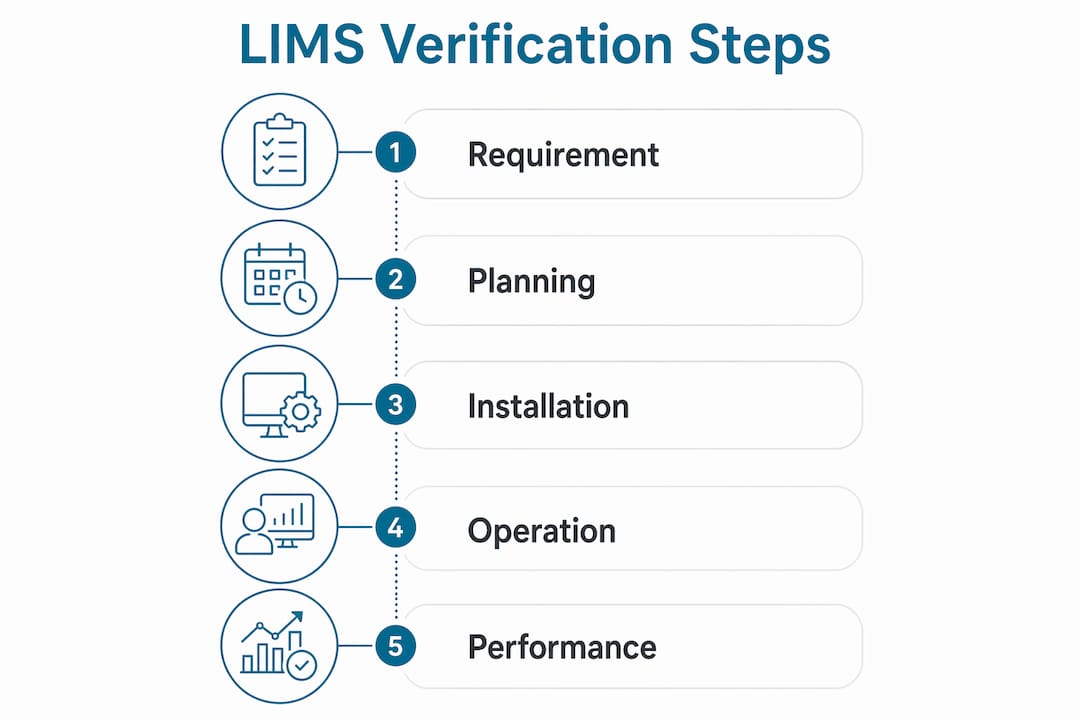
LIMS validation follows the GAMP 5 lifecycle, which structures documented evidence across six phases:
- User Requirements Specification (URS): Define what the system must do from the laboratory's perspective.
- Functional Requirements Specification (FRS): Translate user needs into specific system functions.
- Design Qualification (DQ): Confirm the system design meets the functional requirements.
- Installation Qualification (IQ): Verify the system is installed correctly in the intended environment.
- Operational Qualification (OQ): Test that the system operates as specified under normal conditions.
- Performance Qualification (PQ): Confirm the system performs consistently under real-world laboratory conditions.
Each phase requires scripted test protocols, defined acceptance criteria, and signed documentation. Incomplete validation documentation is one of the most common triggers for audit observations and findings. A full validation package includes validation plans, requirement specifications, risk assessments, test protocols, traceability matrices, and summary reports.
The IQ, OQ, and PQ phases deserve particular attention for result verification workflows. OQ testing should specifically exercise the autoverification rule engine, confirming that each rule fires correctly under the conditions it was designed for. PQ testing should run the system under actual production volumes to confirm performance holds.
A risk-based validation approach aligned with FDA Computer Software Assurance principles focuses validation effort on high-risk functionalities: data capture, audit trails, and reporting. Lower-risk features receive proportionally less testing. This approach reduces validation burden without sacrificing compliance quality.
Pro Tip: Map every autoverification rule back to a documented requirement in your URS or FRS. If a rule cannot be traced to a requirement, it should not be in production. Traceability matrices make this audit-ready from day one.
What are common challenges in managing LIMS verification workflows?
Managing LIMS result verification at scale introduces operational complexity that goes beyond initial configuration. Labs face three recurring categories of challenge: rule drift, software change management, and cross-functional alignment.
Rule drift happens when autoverification thresholds are set at implementation and never revisited. Patient populations shift, test menus expand, and analyzer models change. Rules that were accurate at go-live may generate more false negatives or false positives over time. Delta checks and median patient values are common sources of false negatives in autoverification, which is why practitioners recommend ongoing performance monitoring and periodic rule tuning.
The table below compares manual verification and autoverification across key operational dimensions:
| Dimension | Manual verification | Autoverification |
|---|---|---|
| Speed | Slower; depends on technologist availability | Near-instant for results meeting all criteria |
| Consistency | Variable; subject to individual judgment | Consistent; rule-based and repeatable |
| Error risk | Higher for high-volume, routine results | Lower for routine results; requires well-tuned rules |
| Audit trail | Requires manual documentation | Automatically logged by the LIMS |
| Scalability | Limited by staffing | Scales with test volume without added labor |
| Best use case | Complex, flagged, or ambiguous results | High-volume, routine, criteria-passing results |
Software updates present a second challenge. Any change to the LIMS, whether a vendor patch, a configuration update, or a new interface, can affect how verification rules execute. Effective LIMS verification requires cross-functional collaboration between lab directors, IT teams, and clinicians to evaluate the impact of every change before it reaches production. Labs that treat software updates as purely an IT task routinely discover verification failures after the fact.
The third challenge is alignment. Verification is not purely technical. It requires that the business needs of clinicians and laboratory specialists are accurately reflected in the LIMS technical implementation. A rule that makes sense to a software engineer may not reflect clinical reality. Closing that gap requires structured communication between the people who define clinical requirements and the people who configure the system.
Practical steps to address these challenges include:
- Schedule quarterly reviews of autoverification rule performance using production data.
- Require impact assessments for all LIMS changes before deployment.
- Assign a named owner for each verification rule, responsible for its ongoing accuracy.
- Document all rule changes in the LIMS change control log with clinical justification.
How is result verification integrated into quality assurance and compliance?
Result verification does not operate in isolation. It sits inside a broader quality system governed by standards including ISO 15189, ISO 17025, and CLIA. Each standard imposes specific documentation and performance requirements that verification workflows must satisfy.
ISO 17025 requires documented validation that software used for data collection, processing, and reporting performs as intended for the specific laboratory use. This means your LIMS verification configuration must be validated, not just installed. The standard does not accept vendor documentation as a substitute for laboratory-specific validation evidence.
Routine audit review of LIMS verification documentation and change control records is necessary to maintain compliance and system reliability. Auditors from accreditation bodies and regulatory agencies will examine whether your verification rules are documented, whether changes are controlled, and whether performance is monitored. Labs that maintain living documentation rather than static binders consistently perform better in these reviews.
Practical steps for maintaining compliance over time include:
- Conduct an internal audit of verification records at least annually, before external inspections.
- Review and revalidate autoverification rules after any significant change to the test menu, patient population, or analyzer platform.
- Maintain a change control log that links every LIMS configuration change to a risk assessment and approval record.
- Train staff on verification procedures at onboarding and after any rule change, with documented competency records.
- Use the LIMS reporting dashboard to monitor verification rates and flag any unexpected shifts in autoverification pass rates.
Periodic revalidation is not optional. It is the mechanism that keeps your validation status current as the system and its environment evolve. Labs that skip revalidation after software updates or workflow changes accumulate compliance debt that surfaces at the worst possible time.
Key Takeaways
The LIMS result verification process requires a validated system, well-tuned autoverification rules, cross-functional ownership, and continuous monitoring to maintain accuracy and compliance.
| Point | Details |
|---|---|
| Autoverification drives efficiency | Approximately 80.66% of clinical results can be autoverified, freeing technologists for complex cases. |
| GAMP 5 validation underpins trust | IQ, OQ, and PQ phases must specifically test the verification rule engine, not just general system function. |
| Rule drift is a real risk | Autoverification thresholds require periodic review using production performance data, not just initial setup. |
| Cross-functional alignment is required | Lab directors, IT, and clinicians must jointly own verification rule design and change management. |
| Compliance standards demand documentation | ISO 17025, ISO 15189, and CLIA all require validated, auditable evidence of verification system performance. |
What I've learned about verification that most labs get wrong
Labs invest heavily in configuring autoverification at go-live, then treat it as a solved problem. That is the single most common oversight I see. The rules that worked at implementation reflect the patient population, test menu, and analyzer configuration at that moment in time. Six months later, after a new analyzer interface, a formulary change, or a shift in referral patterns, those same rules may be quietly generating errors that no one is catching.
The fix is not complicated. It requires treating autoverification rule performance as an ongoing quality indicator, the same way you treat QC data. Pull the false-negative and false-positive rates monthly. Assign someone to own the numbers. When the data shifts, investigate before it becomes a compliance finding.
The second thing I consistently see underestimated is the human side of validation. Successful labs treat validation planning as foundational, tying every software rule to a clinical or laboratory requirement. That discipline forces the conversation between the people who understand the clinical intent and the people who configure the system. When that conversation does not happen, you end up with technically correct rules that are clinically wrong.
Regulations are also moving. FDA's Computer Software Assurance framework shifts the emphasis from exhaustive documentation to risk-based evidence. Labs that build their verification and validation programs around risk prioritization now will be better positioned as that framework continues to influence accreditation expectations. The labs I see thriving are the ones that treat verification as a living program, not a one-time project.
— Tarek
How Labrynix supports LIMS result verification and compliance
Labrynix is built around the complete sample-to-report workflow, which means result verification is not an afterthought. The Labrynix LIMS platform supports role-based access, audit logs, configurable workflow queues, and user permissions designed to keep verification processes documented and defensible. For molecular diagnostic and genetic testing labs, where result accuracy directly affects patient care decisions, that infrastructure matters.

Labrynix Intelligence adds AI-powered review queue management and operational analytics, giving quality teams visibility into verification bottlenecks before they become compliance issues. Labs working toward ISO 15189, ISO 17025, or CLIA compliance can explore LIMS solutions by lab type to see how Labrynix supports audit-ready verification workflows across genetic testing, molecular diagnostics, and reference lab environments.
FAQ
What is autoverification in a LIMS?
Autoverification is a rule-based process within a LIMS that automatically releases test results meeting all predefined criteria, such as reference ranges, delta checks, and instrument flags, without requiring manual technologist review.
How do GAMP 5 phases apply to LIMS result verification?
GAMP 5 structures the validation lifecycle through phases including IQ, OQ, and PQ. OQ testing must specifically confirm that autoverification rules execute correctly, and PQ must validate performance under real production conditions.
What standards govern LIMS result verification?
ISO 15189, ISO 17025, and CLIA all require documented evidence that LIMS software used for data collection, processing, and reporting performs as intended for the specific laboratory use.
How often should autoverification rules be reviewed?
Autoverification rules should be reviewed at least quarterly using production performance data, and revalidated after any significant change to the test menu, analyzer platform, or patient population.
What triggers a manual review in LIMS result verification?
A result routes to manual review when it fails any autoverification criterion, including an out-of-range value, an active instrument flag, a delta check exceedance, or a QC failure associated with the analytical run.