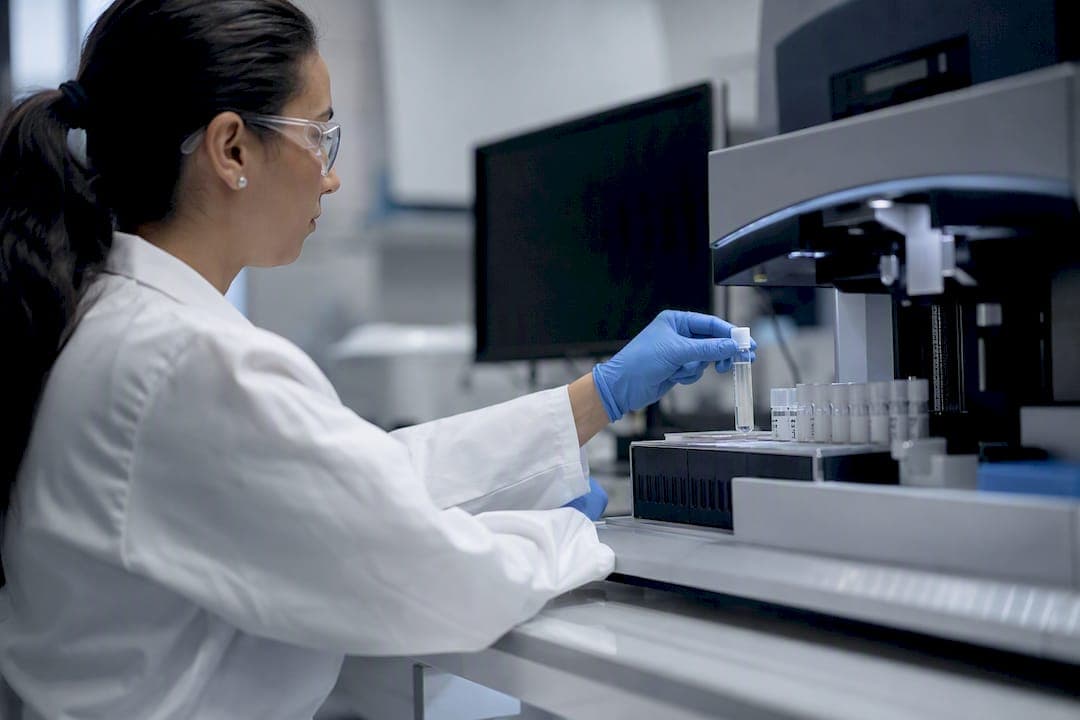
In modern genetic and molecular labs, webhooks push validated, schema-checked LIMS events, results, sample-state changes, billing triggers, into downstream systems in near real time. That's the whole point of lab webhook use cases: replace batch exports and polling scripts with event notifications that fire the moment something changes. The guiding principle behind every reliable implementation is the same: publish validated events to a shared event backbone rather than wiring one-off point-to-point hooks between every pair of systems.
The highest-value uses cluster around five areas:
- Result delivery to EHR/EMR systems and provider portals the instant a report finalizes.
- Sample status updates for accessioning, QC flags, and instrument-run completion
- Billing triggers that kick off claims the moment an order closes
- Instrument orchestration that tells robots and analyzers when a sample is ready
- Analytics feeds streaming operational events into dashboards and models
None of this works without three non-negotiables: signed, encrypted delivery; idempotent handling so duplicate events don't duplicate actions; and a retry/dead-letter/reconciliation loop that catches what falls through. Event-driven integration architectures consistently cut propagation latency compared with batch approaches, which is the entire business case for making the switch.
TL;DR:
- Implement schema validation using JSON Schema or Avro to ensure consistent interpretation of event data across all systems.
- Prioritize reliable delivery of sample status and result notifications before expanding to instrument coordination or analytics workflows.
- Enforce security through HTTPS, HMAC signatures, and role-based access control to prevent data breaches and ensure audit readiness.
- Establish a nightly reconciliation process to identify and correct missed or failed webhook deliveries, maintaining data integrity.
- Use a platform like Labrynix Connect that provides built-in support for HL7, FHIR, webhooks, and audit logging to accelerate deployment and compliance.
Table of Contents
- Lab Webhook Use Cases From LIMS to EHR, Instruments, and Billing
- Which Architecture Pattern Actually Holds Up: Schema Registry, Event Bus, or FHIR Subscriptions?
- A Practical Checklist for Building Production Lab Webhooks
- Monitoring, Auditing, and Governance for Webhook-Driven Labs
- How Webhook Usage Differs Across Clinical, Research, and Diagnostic Labs
- What Most Labs Get Wrong About Webhooks
- Labrynix Connect Turns These Use Cases Into a Working Integration Layer
- Key Takeaways
- Sources
Lab Webhook Use Cases From LIMS to EHR, Instruments, and Billing
Every webhook event in a lab environment maps to a moment when one system needs to tell another system something changed. The trick isn't the trigger, it's deciding what the payload carries and what the receiver does with it.
1. Result delivery events. A final result, an amended result, and a critical-value alert are three different event types, not one. Critical alerts and complex pathogenic calls often need distinct delivery paths and confirmations compared with routine negative screens. PGx reports carry structured payloads: gene, phenotype, drug interaction flags, and a link to the full report attachment rather than the whole document embedded in the webhook body. Labrynix's genetic report delivery workflows follow this pattern, keeping the event lightweight and pointing the receiving portal at a secure read endpoint for the full record.
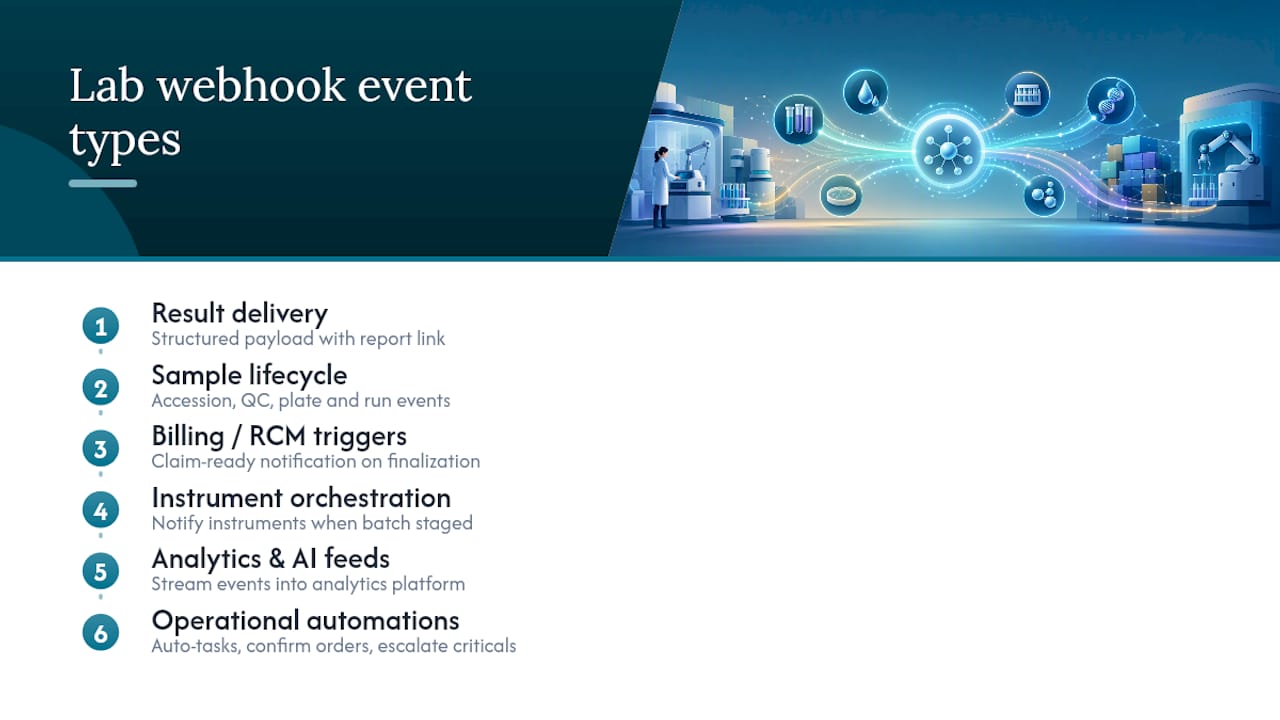
2. Sample lifecycle events. Accessioning confirmation, collection receipt, QC flag raised, aliquot created, plate loaded, instrument run completed. Each is its own event type with its own consumer. A portal cares about accessioning and final status. An instrument controller cares about plate-level events almost exclusively.
3. Billing and RCM triggers. When an order closes or a result finalizes, that event should fire a claim-ready notification to the billing system automatically, not on a nightly batch job that leaves revenue sitting for a day. This is one of the more overlooked lab billing coordination opportunities, since RCM delays often trace back to a missed handoff rather than a coding error.
4. Instrument orchestration. Webhooks can notify a sequencer or liquid handler that a batch is staged and ready, coordinating plate-level automation across multiple instruments without a human checking a queue every twenty minutes.
5. Analytics and AI pipeline feeds. Streaming sample and turnaround events into an analytics platform lets operations leads watch bottlenecks form in real time instead of reconstructing them from a report the next morning.
6. Operational automations. A flagged QC result can auto-create a review task. An ambiguous PGx call can trigger a confirmation test order. A critical result can escalate to an on-call pathologist. These automations only work because the underlying event, not a polling script, fires the moment the state changes.
Which Architecture Pattern Actually Holds Up: Schema Registry, Event Bus, or FHIR Subscriptions?
The pattern that survives contact with a real lab environment is the one where nothing gets published without a contract. A canonical schema, defined in JSON Schema or Avro and enforced through a schema registry, stops the slow rot where five downstream teams each interpret a result_status field differently until nobody trusts the data anymore.
Three components make this practical:
- A webhook gateway that receives inbound events, validates them against the registered schema, enriches them with canonical IDs, and republishes to a broker rather than fanning out directly to every consumer
- A broker like Apache Kafka (or an equivalent cloud event bus) sitting behind the gateway, giving you replay, consumer isolation, and the ability to add a new subscriber without touching the producer
- FHIR Subscriptions for clinical-facing notifications, especially where you're bridging legacy HL7 v2 feeds into a modern event model, while custom LIMS event types handle purely operational flows like plate loading
An event-driven architecture using Kafka and microservices has already been shown to support reproducible, scalable genomic diagnostic workflows, which matters because reproducibility is exactly what auditors and CAP inspectors ask about. FHIR subscription and gateway patterns are particularly suited to critical clinical alerts and to integrating older HL7 systems without ripping them out.
The mistake most integration teams make is treating webhooks as at-most-once, fire-and-forget notifications. They're not. Delivery is at-least-once by design, which means your consumer has to be idempotent or you will eventually process the same result twice and double-bill a patient or double-fire a critical alert.
Idempotency in practice means every event carries a unique delivery ID, and the consumer checks that ID against what it has already processed before acting. It's a small design decision that prevents a genuinely bad day. For a deeper comparison of the messaging standards underneath all this, see this plain-English guide to HL7 and FHIR.
A Practical Checklist for Building Production Lab Webhooks
Getting from "we have a webhook" to "we have a webhook we can trust in a CAP audit" takes discipline, not cleverness. Here's the runbook integration engineers actually need.
- Define a minimal canonical payload. Every event needs
sample_id,event_type,schema_id,timestamp,actor_id, andcorrelation_idat minimum. Keep the body thin and point consumers at a documented read endpoint for the full record, the same pattern used in result-push APIs that favor small payloads over embedded data. - Lock down security. HTTPS everywhere, HMAC signatures in an
X-Signatureheader so receivers can verify the sender, short-lived tokens or mTLS for machine-to-machine clients, and role-based access on any endpoint that returns patient data. - Set your delivery policy. Retries with exponential backoff, a unique delivery ID on every attempt for de-duplication, and a dead-letter queue with manual replay tooling for anything that fails after the retry budget runs out. This mirrors how production LIMS webhook systems handle signed deliveries and failed-delivery replay.
- Test before you trust it. Build a sandbox that sends signed test deliveries, and run end-to-end tests covering the full path from order creation through result finalization through delivery confirmation.
- Reconcile nightly. Run a job that compares LIMS state against downstream system state and flags mismatches for triage. This is the safety net that catches the webhook that silently failed three days ago.
Pro Tip: Build the dead-letter replay tool before you launch, not after your first outage. Teams that skip this step end up hand-crafting SQL fixes at 2 a.m. instead of clicking "replay" on a queue.
Monitoring, Auditing, and Governance for Webhook-Driven Labs
Delivery success rate, average latency, dead-letter queue depth, and consumer lag are the four numbers that tell you whether your webhook ecosystem is healthy. Set alert thresholds on all four, not just uptime.
Every event should land in an append-only store carrying actor, timestamp, and a checksum, queryable later for audits. Event streams built this way improve reproducibility in genomic workflows because you can reconstruct exactly what happened and when, rather than reconciling logs across five systems after the fact.
Governance means someone owns the schema version policy: who mints canonical IDs, who approves a breaking schema change, and what the SOP says about backward compatibility. Without that ownership, schema drift creeps in quietly. And plan for graceful degradation: if the billing system is offline, events should queue rather than get dropped, with a clear SOP for how long they queue before someone gets paged.
How Webhook Usage Differs Across Clinical, Research, and Diagnostic Labs
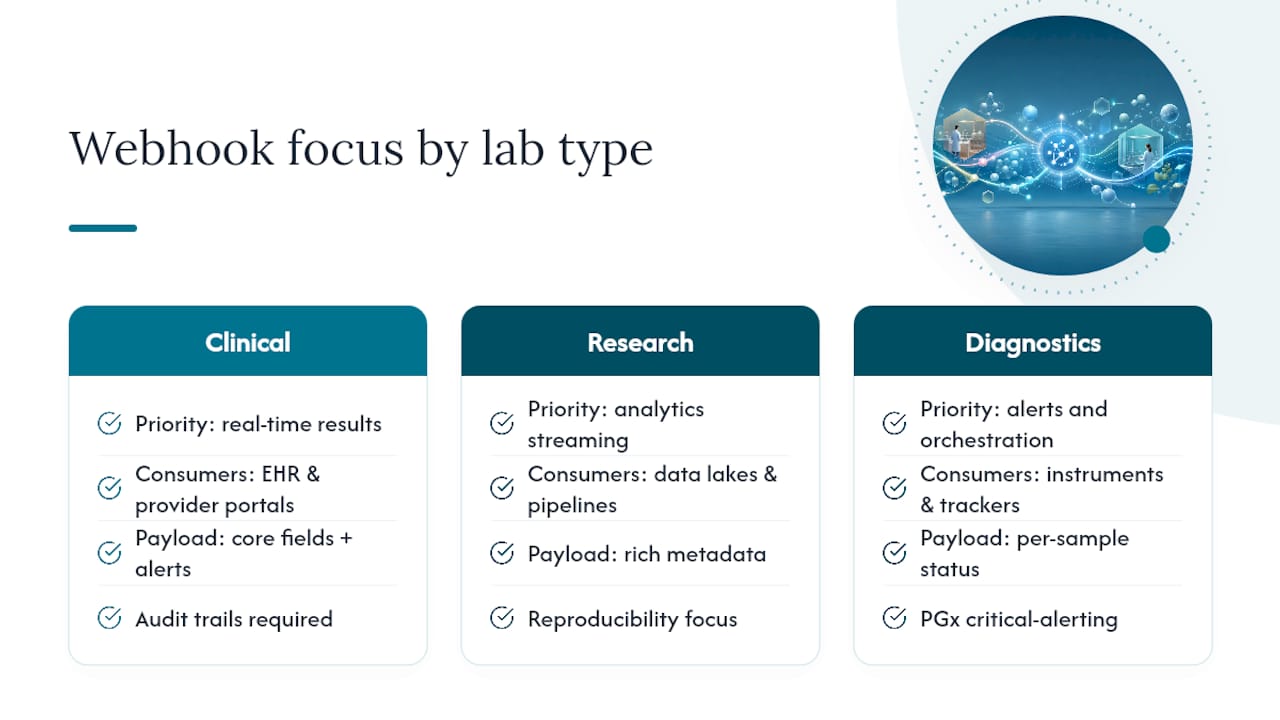
A hospital-based clinical lab, a genomics research lab, and a standalone diagnostics lab don't reach for webhooks the same way, because their downstream consumers and regulatory pressure differ.
Clinical labs lean hardest on real-time result delivery and critical-value alerting, because a delayed potassium result has a patient-safety consequence. Their webhook priorities skew toward EHR integration, provider portal notifications, and billing triggers tied to CPT-coded finalized results. Audit trails matter as much for regulatory defense as for troubleshooting.
Research labs care less about instant delivery to a single provider and more about streaming events into analytics pipelines and data lakes for cohort-level analysis. Their webhook payloads often carry richer metadata (batch IDs, protocol versions, instrument calibration state) because reproducibility across an entire study matters more than turnaround time on any one sample.
Diagnostic and PGx-focused labs sit somewhere between the two: they need the alerting rigor of clinical labs for critical pharmacogenomic findings, but also need instrument orchestration events firing constantly across high sample volumes, since a single sequencing run touches hundreds of samples that each need independent status tracking.
The practical implication: a lab running all three functions under one roof needs a schema registry flexible enough to support multiple event "dialects" without losing the canonical core fields every consumer relies on.
What Most Labs Get Wrong About Webhooks
The conventional advice treats webhooks as a plumbing decision, something the integration engineer solves quietly and nobody else needs to think about. That's backward. The riskiest failures I've seen reasoned through in webhook architecture aren't technical, they're organizational: nobody owns the schema, nobody tests the dead-letter queue until it's full, and the reconciliation job exists in a ticket backlog instead of in production.
The overrated fix is "just add more retries." Retries paper over transient failures, but they don't catch a downstream system that's been silently rejecting a malformed payload for a week. Only nightly reconciliation that treats LIMS state as the source of truth catches that kind of quiet drift.
What labs should prioritize first isn't the flashiest use case, it's the boring one: get sample-status and result-delivery events schema-validated and idempotent before you build instrument orchestration or analytics feeds on top. A shaky foundation under a critical-alert workflow is how a lab ends up explaining a missed delivery to an accrediting body.
— Tarek
Labrynix Connect Turns These Use Cases Into a Working Integration Layer
Building the architecture described above from scratch, schema registry, gateway, broker, reconciliation jobs, takes months most integration teams don't have to spare. Labrynix Connect ships these building blocks already wired into the platform, so a lab evaluating event-driven integrations gets a working system instead of a six-month infrastructure project.
Labrynix Connect handles HL7, FHIR, APIs, and webhooks natively, with schema-validated events, append-only audit logs, and role-based access controls built into the same platform that runs your PGx reporting and provider portals. Labrynix Reports and Labrynix Portal deliver finalized results and pharmacogenomic reports through the same secure channel, and Labrynix Billing gives you visibility into claim status the moment a result finalizes, closing the gap between result delivery and revenue. For labs comparing this against a patchwork of custom scripts, the molecular diagnostics LIMS built around this workflow is worth a look, as is the full lab API documentation covering every webhook endpoint and event type available today. Request an integration walkthrough to see how your current LIMS events map onto Labrynix Connect's schema.
Key Takeaways
Reliable lab webhook integrations succeed when validated, idempotent events flow through a schema-governed broker instead of brittle point-to-point connections between systems.
| Point | Details |
|---|---|
| Start with results and status | Pilot sample-status and result-delivery events before building instrument or analytics feeds. |
| Enforce a schema registry | Require JSON Schema or Avro validation on every event to prevent silent payload drift. |
| Secure every endpoint | Use HMAC signatures, HTTPS, and mTLS or short-lived tokens for machine clients. |
| Build reconciliation early | Run nightly jobs comparing LIMS and downstream state to catch missed deliveries. |
| Choose a platform with native support | Labrynix Connect ships HL7, FHIR, and webhook connectivity with audit logging built in. |
This article is general information, not a substitute for advice from a qualified doctor. Consult a qualified healthcare professional about your own circumstances before acting on anything here.
Sources
- GenomicInsights: event-driven architecture for genomic diagnostics (MDPI, 2023)
- Event-driven healthcare integration study (IJLRP, 2022)