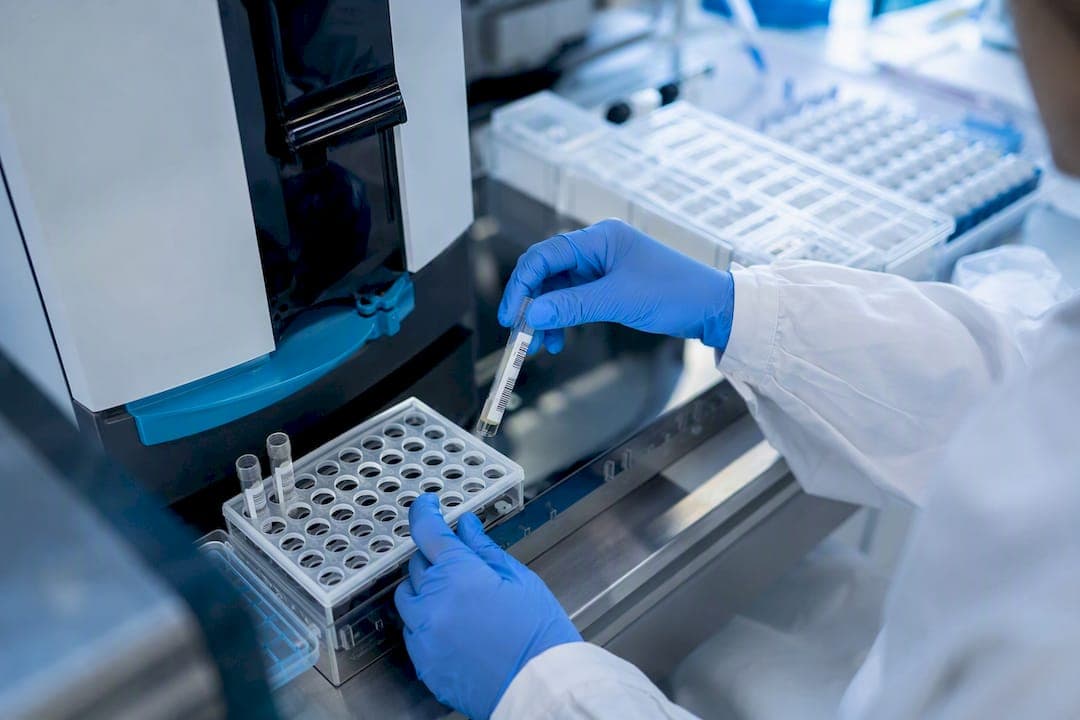
Software-driven laboratory automation, meaning connected LIMS workflows, HL7/FHIR integrations, and AI-assisted reporting, cuts turnaround time and manual error by automating the full sample-to-report lifecycle. This is not about robotic arms or pipetting hardware. It is the software layer that moves a sample from accessioning through bioinformatics to a finished, delivered report, using platforms like Labrynix alongside standards like HL7 and FHIR under HIPAA-conscious controls.
- Core capabilities: workflow automation, HL7/FHIR integrations, AI-assisted reporting
- Top impact: shorter turnaround time, fewer transcription errors, higher throughput
- Next step: run a focused 30 to 90 day pilot before a full rollout
Key Takeaways
Software-driven laboratory automation succeeds when LIMS workflow engines, HL7/FHIR integrations, and validated AI assistance work together across the full sample-to-report lifecycle.
| Point | Details |
|---|---|
| Define scope early | Software automation covers LIMS, integrations, and AI reporting, not robotics or TLA hardware. |
| Prioritize interoperability | HL7/FHIR and API-first S2S communication should outrank UI polish in vendor decisions. |
| Pilot before scaling | Run a 30 to 90 day pilot with real data before a phased, multi-assay rollout. |
| Validate like a clinical instrument | Build audit trails, RBAC, and concordance testing into the system from day one. |
| Labrynix fits the sample-to-report model | Labrynix combines LIMS workflows, PGx reporting, and FHIR integrations built specifically for genetic and molecular labs. |
Table of Contents
- What Does Laboratory Automation Mean for Software Systems?
- What Are the Benefits of Automating Lab Workflows?
- Why Do HL7 and FHIR Matter for Lab Integrations?
- How Do You Choose the Right Lab Automation Software?
- How Long Does a Lab Automation Implementation Take?
- What Belongs on a Validation and Compliance Checklist?
- Where Does AI Actually Help Lab Reporting Today?
- What Does Lab Automation Software Cost, and What's the ROI?
- Why We Built Around the Sample-to-Report Workflow
- How Labrynix Supports Your Lab's Automation Goals
- Frequently Asked Questions
- Sources
What Does Laboratory Automation Mean for Software Systems?
When lab directors search for laboratory automation, they usually mean two very different things, and mixing them up wastes budget. This guide covers the software side only: LIMS workflow engines, bioinformatics pipeline orchestration, interpretation and reporting tools, integration layers, and portals. It does not cover robotic arms, conveyor-based total lab automation (TLA) hardware, or pipetting robots. Those are physical instrumentation systems with a separate vendor market and a separate buying process entirely.
The software stack this article treats includes:
- Accessioning and order intake within the LIMS
- Workflow queues and status tracking across the sample lifecycle
- Bioinformatics pipeline orchestration and interpretation logic
- Report generation, including PGx-specific templates and clinical annotations
- HL7/FHIR and API integrations with EHRs, billing systems, and instruments
- Provider and patient portals for secure result delivery
- Security, audit logging, and role-based access controls
What Are the Benefits of Automating Lab Workflows?
Genetic and molecular labs that automate the software layer see measurable gains, not just smoother-looking dashboards. Automation in molecular laboratories shortens turnaround time and lets labs absorb new contracts without proportionally adding staff, while shifting technologists toward higher-value review work instead of manual data entry.
The gains break down by stakeholder:
- Lab directors get consistent PGx and genetic report formatting, better auditability, and higher effective capacity without new hires.
- Operations managers see fewer transcription and routing errors, since data moves between systems instead of being retyped.
- IT and diagnostics leaders get standardized integration points instead of one-off scripts that break with every EHR update.
Modular NGS library-prep automation alone has let labs scale from 4 to 384 samples per run depending on the platform, which is the kind of throughput swing that makes or breaks a growth quarter.
Why Do HL7 and FHIR Matter for Lab Integrations?
Interoperability is the backbone of reproducible sample-to-report automation, and that mostly comes down to HL7 and FHIR standards. The hard part isn't connecting an instrument anymore. It's building reliable software-to-software (S2S) communication between your LIMS, bioinformatics pipeline, and the EHRs and portals waiting on results.
Before go-live, plan and test these interfaces:
- Inbound orders from EHR or referring providers
- Instrument and batch status updates into the LIMS
- Pipeline orchestration callbacks (job start, completion, failure)
- Outbound DiagnosticReport delivery via FHIR
- Billing system handoffs
- Partner and referring-physician portal access
Test each interface for connectivity, payload validation, and performance under realistic load, not just a clean demo dataset. Then run error replay tests: kill the connection mid-transfer and confirm the system recovers without silently dropping a result.
Pro Tip: Build a fallback queue for every inbound and outbound interface. When an EHR goes down for maintenance, orders and results should queue and retry automatically instead of vanishing into a support ticket.
How Do You Choose the Right Lab Automation Software?
Prioritize workflow fit and integration depth over interface polish. A clean-looking dashboard that can't handle your accessioning-to-bioinformatics handoff will cost you more in workarounds than it saves in training time.
Run every vendor through this checklist:
- Full workflow coverage from accessioning through bioinformatics to reporting
- Native HL7/FHIR and API support, not bolt-on middleware
- PGx-specific reporting, including CPIC and PharmGKB-informed annotation support
- Compliance scaffolding for audit trails and role-based access
- A named migration and validation assistance process
- Documented training programs and support SLAs
- Proven scalability as sample volume or assay menu grows
Ask vendors directly:
- How do you migrate historical sample and patient data, and who owns that project?
- What validation artifacts do you provide for CLIA-adjacent sign-off?
- Which EHR, billing, and instrument integrations do you already support in production?
- How deep is your PGx reporting logic, and does it reference current CPIC guidelines?
Red flags: no S2S API, no audit log export, or a vendor who won't share validation documentation before contract signature.
How Long Does a Lab Automation Implementation Take?
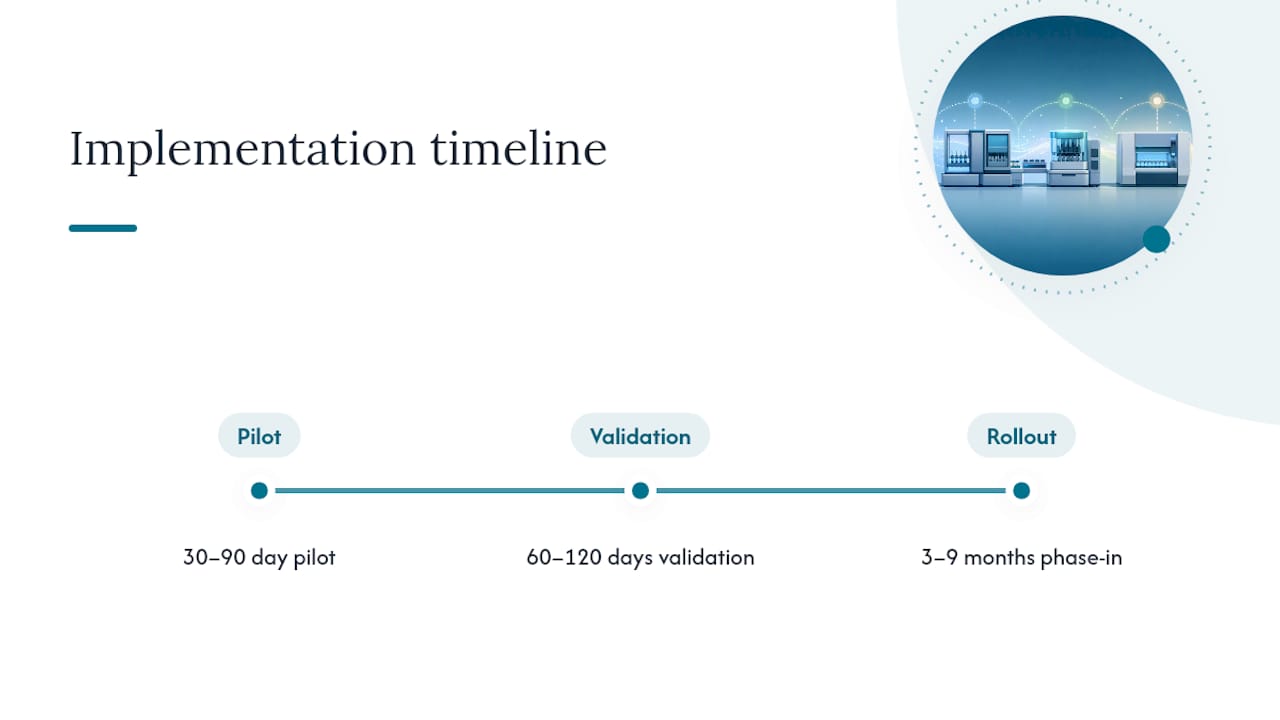
The short version: pilot with production-like data, validate integrations and reporting accuracy, then scale in phased waves. Do not attempt a single-weekend cutover across every assay.
- Pilot (30 to 90 days): one assay or workflow, real (de-identified) sample data, core integrations live.
- Validation and parallel running (60 to 120 days): run old and new systems side by side, compare report concordance, stress-test integrations.
- Phased go-live (3 to 9 months): roll additional assays and locations in waves, monitoring each before the next.
Pilot success means:
- Sample throughput matches or beats baseline
- Report accuracy holds against manual QC review
- Integrations stay stable under real order volume
- Lab staff actually adopt the new workflow instead of routing around it
Bring in clinical champions, IT, QA, and operations leads from day one. A rollout designed without the technologists who'll use it daily tends to stall at the training stage.
What Belongs on a Validation and Compliance Checklist?
Treat the software system as a validated clinical instrument from the first pilot day, not an IT project you validate afterward. That mindset shift avoids the scramble that happens when an auditor asks for traceability records six months post-launch.
Your checklist needs:
- Documented test plans with traceable sample runs
- Result concordance testing against your prior system or manual process
- Performance testing under realistic (not idealized) load
- Audit log verification and change control sign-off
Security controls that pair with it: role-based access control, encryption in transit and at rest, immutable audit logs, and privileged access monitoring for anyone touching PHI or genetic data.
Pro Tip: Run one sample through the full pipeline weekly during validation, from accessioning to final report, and confirm every timestamp and user action lands correctly in the audit log. That single recurring test catches more integration drift than a one-time validation sprint.
Where Does AI Actually Help Lab Reporting Today?
AI augments decision workflows. It flags QC anomalies, drafts report summaries, and aggregates variant evidence, but it does not replace clinical sign-off. Every output still needs a human review gate before it reaches a provider or patient.
Realistic use-cases right now:
- Automated summarization of report narratives for reviewer speed
- Variant evidence aggregation pulled from annotation databases
- QC anomaly detection across instrument and batch data
- Bottleneck prediction across workflow queues
Adoption is still early. A minority of surveyed diagnostic organizations report already using AI-integrated software for data-driven lab tasks, though most expect to adopt it as genomics volume and complexity grow. Guardrails matter more than the models: validation datasets, drift monitoring, mandatory human review, and full auditability of every AI-assisted output.
What Does Lab Automation Software Cost, and What's the ROI?
Budget across six categories: licensing, integration and API work, validation and QA, training and change management, hosting, and ongoing support. ROI comes from labor hours saved, fewer repeat tests, and faster billable turnaround.
| Cost Category | What It Covers |
|---|---|
| Licensing & subscription | Core LIMS and reporting module fees |
| Integration & API work | HL7/FHIR builds, EHR and billing connections |
| Validation & QA | Test plans, concordance testing, sign-off |
| Training & change management | Staff onboarding, workflow redesign |
| Hosting & infrastructure | Cloud or on-prem system hosting |
| Ongoing support | Vendor SLAs, updates, troubleshooting |
A simple ROI formula: (labor hours saved + reduced repeat-test costs + faster billable throughput) minus total implementation cost, measured over the first 12 months.
- Estimate current manual hours per report cycle.
- Multiply by fully loaded technologist cost.
- Subtract projected automation cost to find monthly payback.
Why We Built Around the Sample-to-Report Workflow
Genetic and molecular labs don't fail on science. They stall on handoffs between accessioning, bioinformatics, and reporting. That's why Labrynix was built around the sample-to-report workflow itself, not as a generic clinical LIMS retrofitted for genomics.
How Labrynix Supports Your Lab's Automation Goals
Labrynix delivers LIMS workflow automation, PGx-specific reporting, HL7/FHIR and API integrations, and AI-powered operational analytics, built for genetic, molecular, and pharmacogenomics labs rather than adapted from generic clinical software.
The platform covers what this guide's vendor checklist demands directly:
- Sample-to-report workflow management from accessioning through result delivery
- DiagnosticReport-ready FHIR delivery for EHR and provider integration
- PGx reporting modules with CPIC and PharmGKB-informed annotation support
- Validation support and migration assistance during rollout
- Provider and patient portals with role-based, audit-logged access
If your lab is evaluating a platform for genetic testing workflows, the practical next step is a pilot: bring a real assay, real (de-identified) sample volume, and test the integrations that matter to your operation before committing to a full rollout. Labs weighing standalone reporting versus a full operating system can start with a conversation about PGx reporting capabilities and scope from there.
Frequently Asked Questions
What is lab automation in the software sense, as opposed to robotics? It refers to LIMS workflow engines, integrations, and AI-assisted reporting that move samples through accessioning, bioinformatics, and reporting. It's distinct from physical automation like pipetting robots or conveyor-based TLA systems.
How long does a typical lab automation software implementation take? Expect a 30 to 90 day pilot, followed by 60 to 120 days of validation and parallel running, then 3 to 9 months to phase in additional assays across a full rollout.
Do HL7 and FHIR both matter, or just one? Both. HL7 still handles many legacy interfaces, while FHIR is increasingly the standard for modern DiagnosticReport delivery and API-first integrations. A capable platform supports both.
Can AI replace manual review in genetic and PGx reporting? No. AI can draft summaries, flag QC anomalies, and aggregate variant evidence, but human review and sign-off remain required before any report reaches a provider or patient.
What's the biggest implementation risk labs underestimate? Data migration and stakeholder buy-in. Labs that skip clinical champion involvement or rush historical data migration tend to see adoption stall well after go-live.
This article is general information, not a substitute for advice from a qualified doctor. Consult a qualified healthcare professional about your own circumstances before acting on anything here.
Sources
- Implementing laboratory automation for next-generation sequencing: benefits and challenges for library preparation (PMC)