
For genetic and PGx labs, the strongest reporting-first choice is a purpose-built platform that combines structured variant data, CPIC guideline support, and branded report delivery. Labrynix leads that category. For broader clinical and reference labs, enterprise LIMS platforms and cloud-native solutions each serve distinct needs depending on scale, integration requirements, and regulatory burden.
Three quick filters before you go further:
- Lab type and volume: A startup PGx lab and a high-throughput reference lab have fundamentally different reporting demands. Match the platform to your actual test menu and report complexity, not just sample volume.
- Integration depth: If you deliver results to EHR systems or provider portals, HL7 and FHIR support are non-negotiable. Labs without those pathways today will need them within 12–18 months.
- Regulatory burden: CLIA regulations set documentation and reporting obligations that affect every U.S. lab. Any platform you evaluate must support audit-ready logs, role-based access, and traceable report approvals.
Shortlist candidates fall into three categories: enterprise LIMS platforms (LabVantage, LabWare, Thermo Fisher SampleManager, STARLIMS), cloud-native LIMS built for throughput and templated reporting (QBench, Benchling), and PGx-specialized reporting modules (Labrynix). Each category suits a different lab profile.
Table of Contents
- Reporting profiles: what each solution actually does well
- How we evaluated these laboratory reporting tools
- How to choose a reporting-capable LIMS or LIS for your lab
- Why genetic and PGx labs need specialized reporting tools
- Key Takeaways
- The reporting gap most lab managers don't see until it's too late
- Labrynix is built for labs where the report is the product
- Useful sources and further reading
Reporting profiles: what each solution actually does well
Enterprise LIMS platforms (LabVantage, LabWare, STARLIMS, Thermo Fisher SampleManager)
Enterprise platforms are the workhorses of large-scale lab reporting. Their reporting modules typically cover CoA generation, scheduled batch reports, compliance documentation, and graphical dashboards for KPI monitoring. G2 reviews for Thermo Fisher SampleManager specifically call out pre-configured dashboards and analytics as differentiators, which matters when lab directors need real-time visibility without building reports from scratch.
The trade-off is implementation complexity. These platforms are highly configurable, but that configurability comes with long validation timelines, typically 6–18 months for full deployment, and a dependency on internal IT or a dedicated implementation partner. Template customization often requires vendor-side professional services, which adds cost and slows iteration.
Pros: Deep compliance documentation, broad instrument integrations, enterprise-grade audit trails, multi-site scalability.
Cons: Lengthy implementation cycles, significant upfront costs, template changes often require IT involvement, and limited native PGx-specific reporting logic.
Implementation note: Budget an extended period and a dedicated validation team. Labs that underestimate the qualification phase consistently overshoot timelines.
Cloud-native LIMS (QBench, Benchling)
QBench and Benchling occupy different ends of the cloud-native space. QBench is built for throughput: its bulk reporting templates and reusable report formats help clinical, environmental, and food-safety labs process similar tests efficiently. Standard reporting features like one-click CoA generation, CSV and PDF export, and audit-ready logs are table stakes here, and QBench delivers them without the enterprise overhead.
Benchling skews toward research. Its strength is connecting experiment data directly to reports, valuable for biotech R&D teams though less suited to clinical reporting workflows requiring structured HL7 delivery or patient-facing summaries. HL7 support varies, so labs with EHR integration needs should verify connectors before committing.
Pros: Fast deployment, lower upfront cost, modern UI, and strong template libraries.
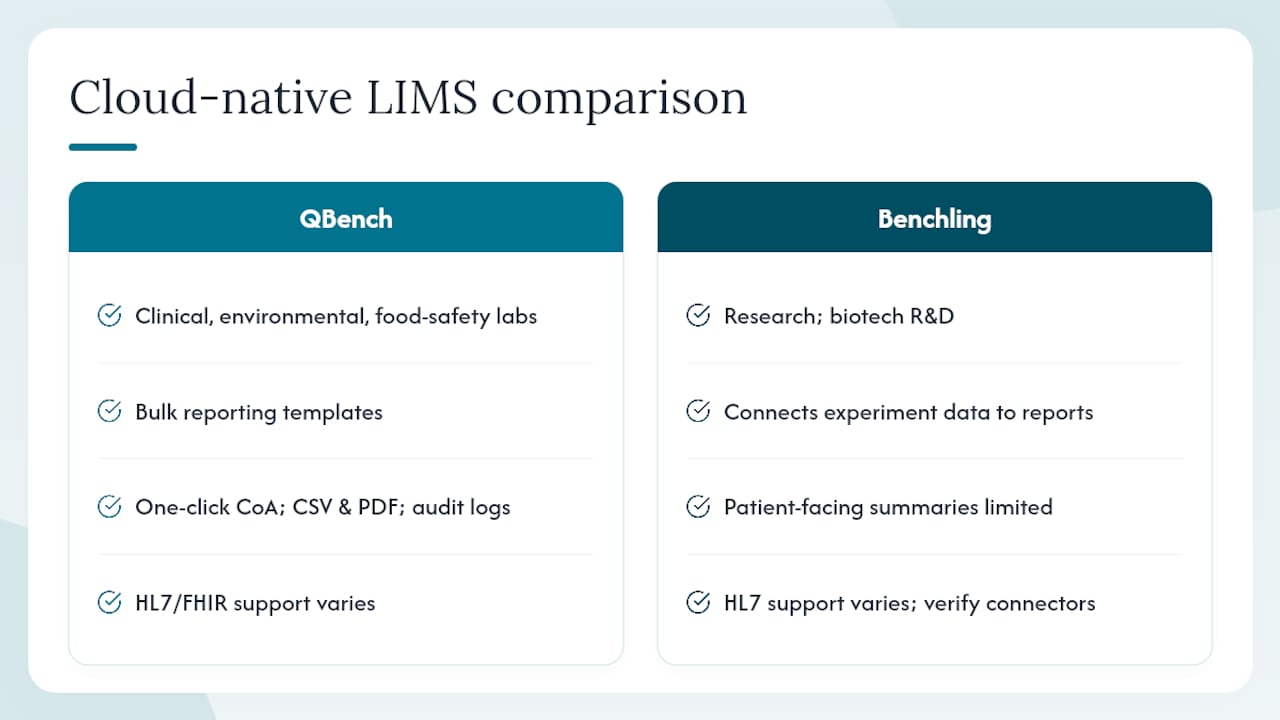
Cons: Limited native PGx reporting logic, HL7/FHIR support varies by configuration, less suited to complex clinical genetics workflows.
Pro Tip: Before signing a cloud-native LIMS contract, export a sample report in every format you need (PDF, CSV, HL7) and deliver it to a test EHR endpoint. What the demo shows and what the production environment delivers are not always identical.
PGx-specialized reporting (Labrynix)
Labrynix occupies a category the enterprise platforms and cloud-native LIMS do not fully address: reporting built specifically for pharmacogenomics and genetic testing. The platform's PGx reporting module generates branded reports with CPIC guideline support, PharmGKB-informed annotations, FDA pharmacogenomic labeling references, and AI-assisted summaries. Provider-facing and patient-facing views are configurable separately, which means a clinician gets a structured interpretation summary while a patient receives a plain-language version of the same result.
The clinical review workflow is a structural feature, not an add-on. Interpretation text passes through a configurable review queue before any report reaches a provider or patient. That separation of layout templates from clinical copy is exactly what genetics labs need to maintain defensible, auditable report approval chains.
Deployment is cloud-native SaaS, and the implementation timeline to first report is measured in weeks rather than months. Labs that need to stand up a PGx reporting workflow quickly, without a multi-month IT project, find that meaningful.
Pros: Purpose-built PGx and genetic reporting, CPIC/PharmGKB integration, AI-assisted summaries, branded provider and patient views, fast time-to-first-report, HL7/FHIR delivery, HIPAA-conscious audit trails.
Cons: Focused on genetic and molecular diagnostics; labs with broad industrial or environmental testing needs may require additional modules or a separate LIMS.
Research-focused ELN + LIMS platforms
Integrated ELN and LIMS platforms serve research labs that need experiment documentation alongside inventory and reporting. The reporting in these platforms tends to be data-export-oriented rather than clinician-delivery-oriented: researchers get structured data exports and visualization tools, but the output is not designed for HL7 delivery to an EHR or patient portal. For academic and early-stage biotech labs, that trade-off is acceptable. For labs moving toward clinical reporting, it becomes a gap.
Pros: Strong experiment-to-report traceability, good for research documentation, lower cost for small teams.
Cons: Not designed for clinical report delivery, limited HL7/FHIR support, not suited to PGx interpretation workflows.
How we evaluated these laboratory reporting tools
Reporting capability was the primary filter. A LIMS with excellent sample tracking but a weak reporting module does not serve a lab whose primary deliverable is a clinical or PGx report. The evaluation weighted dimensions in this order:
- Reporting features (highest weight): Ad hoc and scheduled reports, CoA generation, PGx-specific sections, graphical dashboards, and export formats (PDF, CSV, HL7, FHIR). Labs that can export structured data and deliver via HL7/FHIR reduce vendor lock-in and accelerate BI adoption, per Zageno's evaluation framework.
- User experience: — Intuitive report builder UI, training requirements, and the learning curve for lab staff who are not software engineers.
Evidence sources included G2 category ratings and user reviews, vendor product documentation, compliance documentation from CDC CLIA, Zageno's lab management guide, and vendor case studies. Vendor-level feature claims were generalized into category profiles to avoid amplifying marketing language. Labrynix's PGx reporting capabilities were validated against the platform's published product documentation and feature descriptions.
Labs procuring through government channels should note that some enterprise LIMS platforms are available via GSA contract vehicles, which simplifies public-sector purchasing and compliance documentation requirements.
How to choose a reporting-capable LIMS or LIS for your lab
Prioritize PGx and genetic reporting templates, interoperability, and compliance features when reporting is your primary deliverable. Everything else is secondary.
Step 1: Define your must-have reporting features. Build your non-negotiable list before you talk to any vendor. A LIMS reporting module should cover:
- Ad hoc report generation (query any data field, export on demand)
- Scheduled and batched reports (automated delivery to providers or internal dashboards)
- CoA and CoC generation with configurable templates
- PGx-specific report sections: variant annotation, phenotype assignment, medication guidance, CPIC/PharmGKB references, evidence levels
- Graphical dashboards for lab KPIs (turnaround time, test volume, result status)
- Export formats: PDF, CSV, Excel, XML, HL7, FHIR
- Audit trail on every report: who created it, who reviewed it, when it was released
- Role-based access: separate permissions for report creation, clinical review, and final release
Step 2: Prepare your demo script. Ask every vendor these questions directly:
- How do you manage CPIC guideline updates when new evidence changes interpretation recommendations?
- Can I export raw data in CSV or XML without vendor involvement?
- How do you deliver reports to providers and patients — HL7 message, FHIR API, portal, or PDF email?
- What audit logs exist for report creation, review, and release? Can I export them for CLIA inspection?
- How long does template customization take, and who does it — your team or ours?
- What happens to my data if I terminate the contract?
Step 3: Watch for red flags.
- No audit trail on report release
- Proprietary data formats with no export option
- HL7/FHIR listed as "available" but only through a third-party connector at additional cost
- Template changes require a vendor ticket and a two-week turnaround
- No separation between layout templates and clinical interpretation text
Step 4: Run a structured pilot. Shortlist three vendors. Run scripted demos using your actual test types and report formats. Pilot with de-identified test data before committing to a full implementation. Finalize with a written scope, validation plan, and go-live timeline.
The workflow software reporting module features list from Labrynix provides a detailed checklist that maps directly to these evaluation steps and is worth reviewing before your first vendor call.
For labs evaluating turnaround expectations alongside reporting capabilities, clinical lab result delivery benchmarks from EIV Diagnostics offer useful market context on what providers and patients expect from modern lab reporting workflows.
Why genetic and PGx labs need specialized reporting tools
Generic LIMS reporting modules were not designed for pharmacogenomics. They handle CoA generation and scheduled reports well, but they do not know what a CYP2D6 phenotype assignment means, how to reference CPIC guidelines by evidence level, or how to present a medication interaction summary in a format a clinician can act on in under 60 seconds.
A PGx report engine needs to combine four things: structured variant data, guideline-driven interpretations from CPIC, PharmGKB-informed annotations, and a clinician-friendly summary that a provider can read without a genetics degree. Labrynix's PGx reporting platform is built around exactly that structure, covering more than 700 medications with CPIC and PharmGKB annotation support.
PGx report checklist for genetics labs:
- Variant annotation with gene, variant, and zygosity fields
- Phenotype assignment (e.g., poor metabolizer, ultrarapid metabolizer) per gene
- Medication guidance sections with actionable clinical recommendations
- References to CPIC guidelines and PharmGKB evidence levels
- FDA pharmacogenomic labeling references where applicable
- Reviewer signoff fields with timestamp and credentials
- Separate provider-facing and patient-facing report views
- Audit trail from report creation through clinical review to final release
Interoperability matters as much as report design. A beautifully formatted PGx report that cannot be delivered via HL7 to an EHR, or via FHIR API to a provider portal, creates a manual delivery step that slows turnaround and introduces transcription risk. Labrynix Connect supports HL7, FHIR, APIs, and webhooks, which means reports can be pushed directly to EHR systems or pulled by provider portals without manual intervention. For labs that also feed data into BI pipelines, structured data export keeps analytics current without a separate extraction process.
The operational payoff is measurable in practice: faster clinician turnaround, fewer interpretation queries back to the lab, and a defensible audit trail that holds up under CLIA inspection. LIMS reporting functions that support CLIA and HIPAA compliance are not optional for U.S. clinical genetics labs — they are the baseline expectation.
Pro Tip: Keep templating and clinical copy in separate controlled environments. Design your report layout in the template builder, but route all clinical interpretation text through a formal review workflow before it reaches any provider or patient. Mixing layout changes with interpretation updates is how unvetted clinical language slips into production reports.
Key Takeaways
For genetic and PGx labs, a purpose-built reporting platform with CPIC/PharmGKB support, HL7/FHIR delivery, and a clinical review workflow is the only reporting architecture that holds up under real clinical and regulatory scrutiny.
| Point | Details |
|---|---|
| Reporting capability is the primary filter | Evaluate LIMS platforms on report templates, PGx support, and export formats before anything else. |
| HL7/FHIR interoperability is non-negotiable | Labs delivering results to EHRs or provider portals need native HL7/FHIR support, not a third-party add-on. |
| Enterprise vs. cloud-native trade-off | Enterprise LIMS offer deep configurability but typically require long implementation timelines; cloud-native platforms deploy much faster with narrower customization. |
| Run a scripted pilot before committing | Demo with your actual test types, export a real report to a test EHR endpoint, and validate the audit trail before signing. |
| Labrynix for PGx and genetic labs | Labrynix delivers purpose-built PGx reporting with CPIC/PharmGKB annotations, branded templates, and HL7/FHIR delivery for genetic and molecular labs. |
The reporting gap most lab managers don't see until it's too late
The conventional wisdom in LIMS selection is to evaluate workflow first and reporting second. The logic sounds reasonable: if the sample doesn't move correctly through the lab, the report doesn't matter. But that framing gets the priority order backwards for genetic and PGx labs, where the report is the product.
A lab that processes samples flawlessly and then generates a PGx report that a clinician cannot interpret, cannot receive via their EHR, or cannot trace back through a clear audit chain has failed at its core deliverable. The sample workflow is infrastructure. The report is what the provider ordered and what the patient's care depends on.
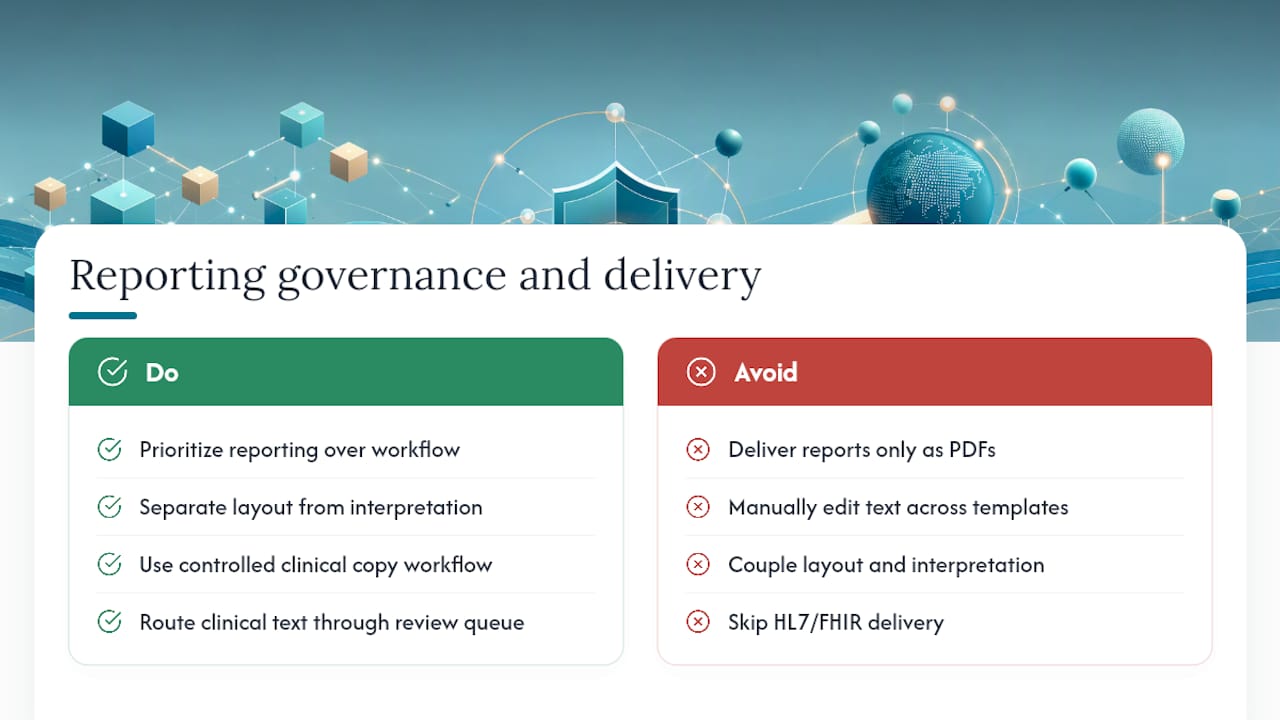
What most managers underestimate is how much of the reporting problem is actually a template governance problem. Labs spend months configuring a report layout, then discover that every time CPIC publishes updated guidelines, someone has to manually edit interpretation text across dozens of template variants. Without a controlled clinical copy workflow, that process is both slow and risky. The labs that handle this well separate the layout layer from the interpretation layer from day one, and they route clinical text through a formal review queue every time it changes.
The other underestimated factor is delivery. A report that exists as a PDF in a portal is not the same as a report delivered as a structured HL7 message to an EHR. Providers working inside Epic or Cerner don't want to log into a separate portal. They want the result in their workflow. Labs that cannot deliver via HL7 or FHIR are creating friction that erodes provider satisfaction and, eventually, test order volume.
The tools that solve both problems, template governance and structured delivery, are the ones worth shortlisting. Everything else is a workaround.
Labrynix is built for labs where the report is the product
If your lab's primary deliverable is a PGx or genetic testing report, and you need that report to be clinically defensible, provider-ready, and delivered via HL7 or FHIR, Labrynix is the platform built for that workflow. Unlike enterprise LIMS that treat reporting as one module among many, Labrynix was designed from the ground up around the sample-to-report journey for genetic and molecular labs.

The Labrynix LIMS and PGx reporting platform covers the full workflow: order intake, accessioning, sample tracking, PGx report generation with CPIC and PharmGKB annotations, provider and patient portal delivery, HL7/FHIR integration, audit trails, and AI-assisted report drafting. Labs can start with the PGx reporting module and expand to full LIMS operations as they scale.
When you request a demo, ask to see: a PGx report template walkthrough with CPIC guideline references, live HL7/FHIR delivery to a test EHR endpoint, the audit trail from report creation through clinical review to release, and the sample migration and validation plan. Request a pilot with de-identified test data before committing to full implementation. Contact Labrynix to schedule a demo and see the reporting workflow your lab actually needs.
Useful sources and further reading
| Source | What it covers | Why it's useful |
|---|---|---|
| CDC CLIA Law and Regulations | Federal requirements for lab testing, documentation, and reporting | Baseline compliance reference for all U.S. clinical labs |
| G2 LIMS Category — Highest Rated | User ratings and review themes for LIMS platforms | Marketplace signal for reporting and dashboard buyer priorities |
| G2 — Thermo Fisher SampleManager Reviews | User reviews highlighting dashboards and analytics | Evidence for enterprise reporting strengths |
| G2 — QBench Reviews | User reviews on bulk reporting templates and reusable formats | Evidence for cloud-native templated reporting capabilities |
| Zageno — Top Lab Management Tools 2026 | Evaluation criteria: workflow compatibility, scalability, integration, compliance | Framework for LIMS selection and scoring |
| LabHQ — LIMS Reporting System | CoA generation, custom templates, CSV export, audit logs | Feature reference for standard reporting capabilities |
| GSA Procurement — Lab Software | Government contract pathways for lab software procurement | Relevant for public-sector and government lab buyers |
| Labrynix PGx Reporting | CPIC/PharmGKB annotations, branded templates, clinical review workflows | Primary reference for PGx-specific reporting capabilities |
| Labrynix — Molecular Diagnostics Solutions | How Labrynix integrates with lab workflows and EHRs | Relevant to molecular and genetic lab reporting and integration needs |
| Labrynix — LIMS Reporting Module Guide | Explainer on reporting module roles for lab managers | Practical reference for building your evaluation checklist |