
A laboratory information management system (LIMS) is defined as the primary technical control for patient data security in clinical and molecular labs. The role of LIMS in patient data security goes beyond simple record-keeping. A well-configured LIMS enforces role-based access, generates tamper-evident audit trails, encrypts data at rest and in transit, and supports compliance with HIPAA, ISO 27001, and emerging 2026 regulations. For laboratory managers and compliance officers, understanding how these controls work together is the difference between a defensible security posture and a regulatory liability.
What are the core security functions LIMS provides to protect patient data?
A LIMS protects patient data through five interlocking security controls, each addressing a distinct attack surface. These controls work together rather than independently, which is why a disconnected set of tools rarely achieves the same protection level as an integrated platform.
The core security functions a LIMS delivers include:
- Role-based access control (RBAC). Every staff member sees only the data their role requires. A phlebotomist has no reason to view genetic interpretation notes, and a billing coordinator has no reason to access raw sequencing results. RBAC enforces that boundary automatically.
- Audit trails. Every read, write, edit, and export action is logged with a timestamp and user identity. These logs are the primary evidence in a regulatory audit and the first tool investigators use after a breach.
- Encryption. Patient records must be encrypted at rest and during transmission. The HIPAA Security Rule mandates administrative, physical, and technical safeguards that include encryption as a core technical control.
- Multi-factor authentication (MFA). Passwords alone are not sufficient for systems holding protected health information. MFA adds a second verification step before granting access to sensitive records.
- Automated compliance logging. A LIMS captures the data regulators need without requiring manual effort from staff. This reduces both human error and the time required to respond to audit requests.
These controls are not optional enhancements. The HIPAA Security Rule treats risk analysis, encryption, and workforce training as required safeguards for any lab handling electronic protected health information.
Pro Tip: Configure your LIMS to generate automated access reports on a monthly schedule. Reviewing who accessed what data, and when, catches privilege creep before it becomes a compliance finding.

How do 2026 healthcare data regulations influence LIMS security requirements?
Regulatory requirements for labs are tightening across multiple jurisdictions in 2026, and LIMS configurations must reflect those changes. The table below maps the most relevant frameworks to their specific LIMS implications.
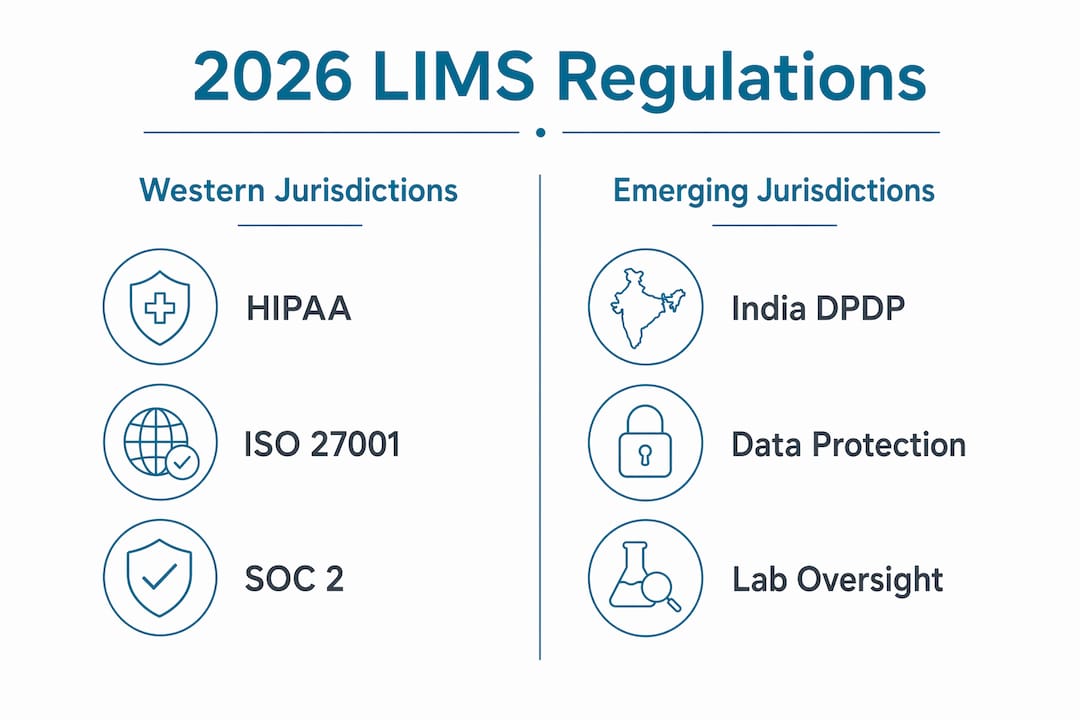
| Regulation | Key Requirement | LIMS Implication |
|---|---|---|
| HIPAA Privacy Rule | 30-day patient record access | LIMS must support secure, auditable data export on request |
| HIPAA Security Rule | Encryption, MFA, risk analysis | Technical controls embedded in LIMS configuration |
| India's DPDP Act | Granular consent management and accountability | LIMS must log consent status per patient and data use |
| ISO 27001 | Information security management system | LIMS audit trails and access reviews support certification |
| SOC 2 Type II | Continuous monitoring and availability | Cloud LIMS with automated logging satisfies SOC 2 controls |
HIPAA requires healthcare providers to give patients copies of their electronic health records within 30 days. That means your LIMS must be able to locate, compile, and export a complete patient record quickly and securely, not as an afterthought but as a built-in workflow.
India's DPDP Act, effective june 2026 under Data Protection Board oversight, adds a layer most Western labs overlook. Labs serving Indian patients or operating internationally must capture granular consent at the point of data collection and maintain a traceable record of how that consent was used. A LIMS without structured consent fields and consent audit logs cannot satisfy this requirement.
ISO 27001 and SOC 2 are not legal mandates for most labs, but they function as the practical benchmark for what "good" security looks like. Payers, hospital partners, and enterprise clients increasingly require one or both certifications before signing contracts. A LIMS that generates continuous access logs and supports formal access reviews makes both certifications significantly easier to achieve. Labs looking for a deeper overview of LIMS compliance requirements will find the regulatory landscape has shifted considerably since 2024.
What are modern security challenges for labs and how must LIMS adapt?
The threat model for clinical labs has changed. Perimeter defenses alone no longer protect patient data, and LIMS platforms that were designed only to keep outsiders out are now structurally inadequate.
The most pressing modern threats include:
- Internal curiosity breaches. The UK's Information Commissioner's Office states that internal breaches cause lasting harm and must be actively prevented. Staff accessing records out of personal interest, not clinical need, is one of the most common sources of patient data compromise. Audit trails and anomaly detection are the primary controls.
- Legacy instrument vulnerabilities. Many lab analyzers run operating systems that cannot be patched. These instruments must be isolated from the main network using segmentation and LIMS middleware that sanitizes data traffic before it reaches the core system.
- Ransomware. Labs are high-value targets because operational downtime directly affects patient care. A LIMS with automated backups, real-time monitoring, and isolated data stores limits the blast radius of a ransomware event.
"Healthcare security now extends across the entire health data life cycle, requiring integrated technical and organizational controls beyond perimeter defenses. Zero Trust models focusing on continuous validation and monitoring are no longer optional. They are the baseline expectation for any system handling sensitive health data."
The Zero Trust model assumes no user or device is trusted by default, even inside the network. Every access request is validated against current permissions, device health, and behavioral patterns. For a LIMS, this means session timeouts, continuous re-authentication for sensitive actions, and real-time alerts when access patterns deviate from a user's normal behavior. Labs must also transition to automated threat detection integrated directly into their LIMS rather than relying on periodic manual reviews.
How can laboratories optimize LIMS configurations for maximum patient data protection?
Configuring a LIMS for security is not a one-time project. It requires a set of ongoing practices that keep controls aligned with evolving threats and regulatory expectations.
-
Implement attribute-based access control. RBAC sets broad permissions by job title. Attribute-based access control goes further by restricting access based on the specific data element, the patient's care team membership, and the purpose of the access. This prevents incidental disclosures that RBAC alone cannot stop.
-
Enforce just-in-time vendor access. Cloud LIMS vendors often require remote access for maintenance. Standing privileged access for vendors is a significant attack surface. Just-in-time protocols grant temporary, scoped access only when a specific maintenance task is approved, then revoke it automatically.
-
Conduct formal risk analyses at least annually. HIPAA requires documented risk analysis, but most labs treat it as a checkbox exercise. A genuine risk analysis maps every data flow, identifies where patient data is stored and transmitted, and tests whether current controls address each identified risk.
-
Run quarterly access reviews. Staff roles change. People leave. Permissions accumulate. A quarterly review of who has access to what, cross-referenced against current job functions, catches privilege creep before a regulator does. Pair this with a review of your LIMS audit logs to identify any anomalous access patterns.
-
Train staff on role-specific data responsibilities. Generic security awareness training does not change behavior in a lab context. Staff need to understand exactly which data they are authorized to access, what constitutes a breach in their specific role, and how to report a suspected incident. Organizational culture and targeted training are key to preventing insider breaches.
-
Leverage cloud LIMS security advantages. Cloud-based platforms typically provide dedicated security teams, automated patching, and redundant disaster recovery that most labs cannot replicate on-premise. The security advantage is real, provided vendor access is tightly controlled.
Pro Tip: When evaluating cloud LIMS vendors, ask specifically for their SOC 2 Type II report and their vendor access policy. A vendor that cannot produce both documents on request is not ready to hold your patient data.
Key takeaways
A LIMS is the most effective technical control available to labs for protecting patient data, provided it is configured and managed as a living security system rather than a static software deployment.
| Point | Details |
|---|---|
| RBAC and attribute-based access | Limit data visibility to the minimum necessary for each role and each specific task. |
| Audit trails are non-negotiable | Every access event must be logged and reviewed regularly to detect internal and external threats. |
| Regulatory requirements are expanding | HIPAA, India's DPDP Act, ISO 27001, and SOC 2 each impose specific LIMS configuration requirements in 2026. |
| Zero Trust replaces perimeter defense | Continuous validation of every access request is now the baseline expectation for clinical lab security. |
| Cloud LIMS requires vendor access controls | Just-in-time vendor access protocols prevent standing privileged access from becoming an attack vector. |
Why labs underestimate the human side of LIMS security
Most compliance conversations I have with lab managers focus on software features: encryption, MFA, audit logs. Those controls matter. But the security failures I see most often come from the human layer, not the technical one.
A LIMS can log every access event perfectly and still fail to protect patient data if no one reviews those logs. Attribute-based access control is only as good as the access review process that keeps permissions current. The technology creates the capability. The lab's culture and processes determine whether that capability is actually used.
The labs that handle this well treat security as a clinical discipline, not an IT function. They assign a named person to review access logs. They include data protection responsibilities in job descriptions, not just onboarding training. They run tabletop exercises to test their incident response before a real event forces the issue.
The future of LIMS security will involve more automation, AI-assisted anomaly detection, and tighter integration between security monitoring and workflow management. Platforms like Labrynix are already building in these capabilities. But automation does not replace accountability. It amplifies it. A lab with a strong security culture will use automated alerts to act faster. A lab without that culture will ignore them.
— Tarek
Labrynix LIMS and patient data security for molecular labs
Genetic and molecular labs face a higher standard of data protection than most clinical settings. Genomic data is permanent, deeply personal, and increasingly targeted. Labrynix is built with HIPAA-conscious and GDPR-conscious workflow principles, including role-based access, audit logs, configurable permissions, and secure report delivery through the Labrynix Portal.

Labs working in pharmacogenomics, hereditary cancer testing, and molecular diagnostics can explore Labrynix LIMS solutions designed specifically for the security and compliance demands of precision medicine. The platform's security architecture covers HIPAA, SOC 2, and ISO 27001 aligned controls in one connected system. If you are evaluating lab software with data protection as a primary requirement, the lab software buyer's guide is a practical starting point.
FAQ
What is the role of LIMS in patient data security?
A LIMS protects patient data by enforcing role-based access control, generating tamper-evident audit trails, encrypting records at rest and in transit, and supporting compliance with HIPAA, ISO 27001, and other regulatory frameworks. It acts as the central security control layer for all lab data operations.
How does LIMS support HIPAA compliance for labs?
HIPAA requires labs to implement administrative, physical, and technical safeguards including encryption, multi-factor authentication, risk analysis, and audit controls. A LIMS automates most of these requirements and generates the documentation needed to demonstrate compliance during an audit.
What is the biggest internal security threat in a lab setting?
Unauthorized access by staff acting out of curiosity rather than clinical need is one of the most common sources of patient data compromise. The UK's ICO identifies internal breaches as a leading cause of lasting harm, making audit log reviews and strict role-based access policies critical controls.
How does Zero Trust apply to LIMS security?
Zero Trust requires continuous validation of every access request, regardless of whether the user is inside or outside the network. For a LIMS, this means session timeouts, behavioral monitoring, and real-time alerts when access patterns deviate from a user's established baseline.
Are cloud-based LIMS platforms more secure than on-premise systems?
Cloud LIMS platforms typically provide stronger security through dedicated security teams, automated patching, and redundant disaster recovery. The key condition is that vendor remote access must be controlled through just-in-time protocols that prevent standing privileged access to patient data.