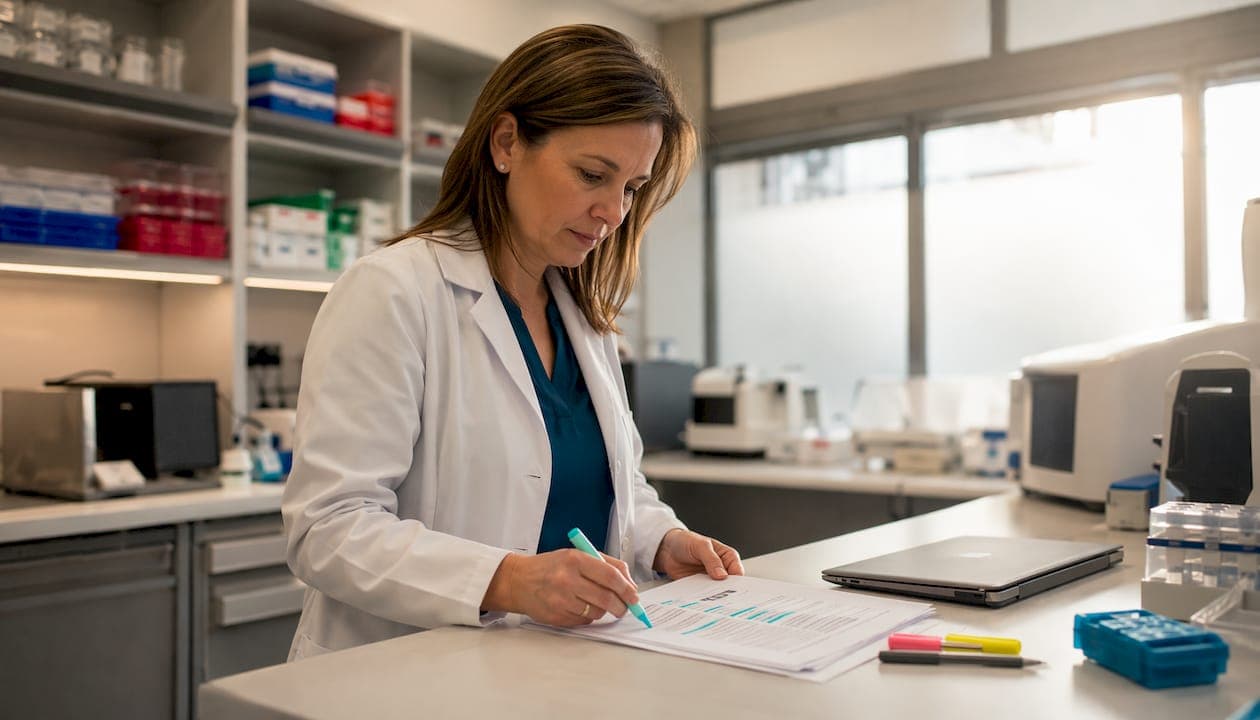
How a LIMS supports CAP readiness in new clinical labs
A laboratory information management system is the operational backbone that makes CAP accreditation achievable for a new clinical lab, not just a documentation exercise. From the moment a sample enters your facility, a properly configured LIMS captures every action, timestamps every decision, and stores every result in a format that survives an inspector's scrutiny. Without that foundation, labs default to spreadsheets and paper logs, which create compliance gaps that auditors consistently flag.
The core value is straightforward: a LIMS replaces manual, error-prone record-keeping with automated, attributable data flows. CAP inspectors want to see complete, time-stamped batch records that trace every result back to an instrument, a method, and an operator. A LIMS delivers exactly that, on demand, without a four-hour scramble through filing cabinets.

For a new lab, the role of LIMS in CAP readiness goes beyond convenience. It defines whether your compliance posture is built into daily operations or bolted on before each inspection cycle.
Key functions a LIMS provides for CAP readiness:
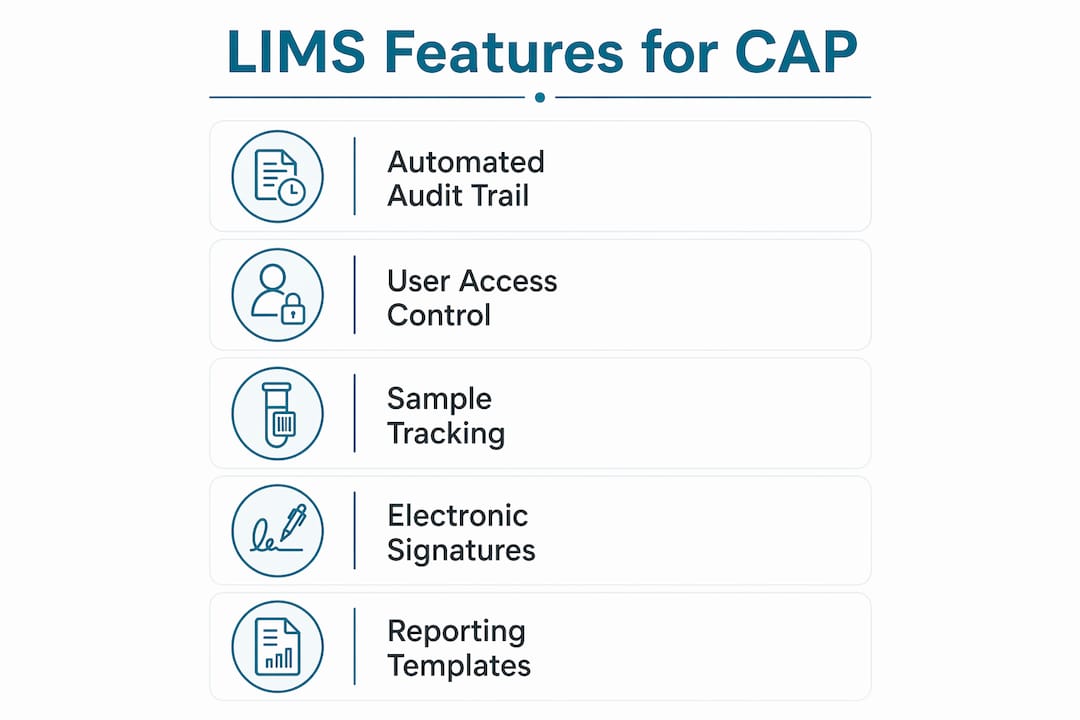
- Automated audit trails: Every data entry, modification, and approval is logged with a timestamp and user attribution, satisfying CAP's data integrity requirements.
- Standardized data capture: Structured fields and mandatory inputs prevent the inconsistent recording that derails accreditation reviews.
- Centralized electronic records: All sample data, QC results, and reports live in one searchable system, enabling rapid retrieval during inspections.
- SOP and document control: Current procedure versions are enforced at the point of work, with version history preserved.
- Instrument and system integration: Automated data flows from analyzers and EMR systems eliminate transcription errors and keep the audit trail complete.
- Role-based access control: Permissions are tied to job function, limiting who can view, enter, or approve data in line with CAP requirements.
- Training and competency tracking: Staff qualification records are stored and retrievable, supporting CAP's personnel documentation mandates.
Table of Contents
- What LIMS features directly address CAP and CLIA requirements?
- What does CAP require specifically for molecular and NGS labs?
- How do you maintain continuous CAP compliance, not just inspection-cycle readiness?
- How Labrynix supports CAP readiness for genetic and molecular labs
- Labrynix gives new molecular labs a compliance-ready foundation
- Key Takeaways
What LIMS features directly address CAP and CLIA requirements?
CAP and CLIA share a common foundation: documented, controlled, and traceable laboratory operations. A laboratory information management system built for clinical compliance addresses each requirement category with specific functionality, not generic data storage.
- Sample lifecycle management: From accessioning through result release, every sample state change is recorded with operator identity and timestamp, satisfying CAP's chain-of-custody requirements.
- Electronic SOP management with e-signatures: Procedures are version-controlled, and staff acknowledgment is captured electronically, replacing paper sign-off logs.
- QC modules: Levey-Jennings charts, Westgard rules, and out-of-control flagging are built into the workflow, with every QC event stored for audit trail completeness.
- Data traceability: Results are linked to the instrument that generated them, the reagent lot used, and the analyst who reviewed them.
- User access control: Role-based permissions restrict data modification to authorized personnel, a direct CAP and HIPAA requirement.
- Change management workflows: Deviations, corrective actions, and procedure changes follow a documented approval path, with the full history preserved.
- Inspection-ready reporting: Compliance reports, QC summaries, and audit logs can be generated on demand rather than assembled manually before each inspection.
| LIMS Feature | CAP/CLIA Requirement Addressed |
|---|---|
| Automated audit trail | Data integrity, CFR Part 11 |
| Electronic SOP with e-signature | Document control, personnel records |
| QC module with Westgard rules | Analytical quality management |
| Role-based access control | Data security, HIPAA compliance |
| Sample lifecycle tracking | Chain of custody, traceability |
| Deviation and CAPA workflows | Corrective action documentation |
| On-demand compliance reports | Inspection readiness, CAP checklist |
Pro Tip: Map your CAP checklist items to specific LIMS configuration settings before go-live. Labs that do this during implementation avoid the costly remediation of retrofitting compliance controls after the system is already in production.
What does CAP require specifically for molecular and NGS labs?
Molecular and next-generation sequencing labs face a more demanding CAP checklist than general clinical labs. The CAP molecular pathology requirements add specificity around bioinformatics, variant reporting, and pipeline reproducibility that generic LIMS platforms often handle poorly.
Building to CAP standards is the right ceiling for molecular labs. CLIA compliance follows automatically when CAP requirements are met, but the reverse is not true. That means your LIMS and bioinformatics infrastructure need to satisfy the more detailed CAP framework from the start.
- Variant classification documentation: Every variant reported must have a documented classification rationale, tied to the specific database version and guideline used at the time of reporting.
- Database and pipeline version control: Reference databases, alignment tools, and variant callers must be version-locked per run, with a change-control log for all updates. Workflow engines like Nextflow or Snakemake support this kind of pipeline-as-code documentation.
- Analytical method validation: Sensitivity, specificity, and limit of detection must be characterized for all variant classes, with the validation data stored and retrievable.
- SOP coverage for every workflow step: CAP requires written procedures for sequencing, bioinformatics, variant review, result amendment, and fail-over scenarios, all with documented staff training.
- Competency assessment records: Time-stamped evidence of staff training and competency verification for each procedure is a CAP inspection item, not a suggestion.
- Proficiency testing participation: Enrollment and performance records for CAP PT programs must be maintained and accessible.
- Automated QC enforcement: Pass/fail thresholds for Q-scores, coverage depth, duplicate rates, and on-target percentages must be defined and enforced automatically, not left to operator judgment.
A LIMS that supports NGS lab compliance connects these requirements into a single traceable record. When a CAP inspector asks to see the bioinformatics pipeline version used for a specific patient report from eight months ago, your answer should take seconds, not hours.
How do you maintain continuous CAP compliance, not just inspection-cycle readiness?
The most common mistake new labs make is treating CAP readiness as a periodic event rather than a permanent state. Continuous inspection readiness means your LIMS can reconstruct a complete, attributed batch record from electronic sources at any moment, without reference to paper backups or manual assembly.
That capability depends on decisions made during LIMS design, not after go-live. Defining audit trail configuration, access controls, and electronic signature workflows upfront lowers both validation effort and the risk of finding gaps under regulatory scrutiny. Retrofitting these controls after implementation is consistently more expensive and disruptive than building them in from the start.
Treating LIMS implementation as a quality and compliance initiative, rather than an IT deployment, changes who is involved and what gets prioritized. QA, regulatory affairs, and lab operations teams need seats at the table from day one, not just IT and the vendor.
- Design data integrity controls upfront: Audit trails, access restrictions, and e-signature workflows must be configured and validated before the system goes live.
- Validate all integration data flows: Connections between the LIMS, instruments, and EMR must be bidirectional, validated, and documented to satisfy CAP's data integrity expectations.
- Use deviation tracking proactively: Corrective and preventive action workflows in the LIMS should capture every out-of-specification event, not just the ones that reach a formal investigation.
- Conduct mock inspections using LIMS data: Periodically test your ability to reconstruct a complete sample record on demand. If retrieval takes more than a few minutes, the configuration needs attention.
- Involve cross-functional teams in system governance: Ongoing LIMS administration should include QA input, not just IT, to keep compliance controls current as workflows evolve.
Pro Tip: Schedule a quarterly "inspection simulation" where your QA team requests a complete batch record for a randomly selected sample from 90 days prior. The retrieval time and completeness of that record tells you more about your actual compliance posture than any checklist.
How Labrynix supports CAP readiness for genetic and molecular labs
Labrynix was built specifically for genetic testing, molecular diagnostics, and pharmacogenomics labs, not adapted from a generic clinical platform. That distinction matters when your CAP checklist includes variant classification documentation, bioinformatics pipeline version control, and PGx report traceability alongside the standard sample tracking and QC requirements.
The Labrynix LIMS platform manages the complete sample-to-report workflow: test orders, accessioning, sample status, workflow queues, user roles, and audit activity. Role-based access control and configurable permissions are built into the platform's architecture, supporting HIPAA-conscious and GDPR-conscious operations. Every data action generates a time-stamped, user-attributed audit log that satisfies CAP's electronic records requirements.
For molecular and NGS labs, Labrynix Reports connects result data to customizable reporting templates with FDA pharmacogenomic labeling references, CPIC guideline support, and PharmGKB-informed annotations. Reports are generated under laboratory control, with clinical review, interpretation, and final approval tracked in the system. That traceability is exactly what CAP inspectors look for in a precision medicine lab.
Labrynix Intelligence adds AI-powered workflow automation to the compliance picture, supporting bottleneck detection, review queue management, and operational analytics. Labrynix Connect handles integration with EMR, EHR, billing platforms, lab instruments, and external systems via HL7, FHIR, and APIs, eliminating the manual data transcription that creates audit trail gaps.
Key Labrynix capabilities for CAP-ready new labs:
- Audit-ready sample tracking: Complete chain-of-custody records from accessioning through result release, with full traceability to operators and instruments.
- SOP and document management: Version-controlled procedures with electronic acknowledgment, enforced at the point of work.
- QC management: Structured QC workflows with stored results and deviation flagging, supporting CAP's analytical quality requirements.
- Secure, role-based access: Configurable permissions and audit logs aligned with HIPAA and CAP data security requirements.
- PGx and genetic reporting: Branded, provider-ready reports with guideline-based annotations and lab-controlled approval workflows.
- System integration: Validated connections to instruments, EMR, and billing systems that keep data flows automated and the audit trail complete.
- AI-powered insights: Operational analytics and workflow automation that surface compliance risks before they become inspection findings.
For a new lab building its compliance foundation, Labrynix provides the infrastructure to support CAP accreditation readiness from day one, not as an add-on after the lab is already running.
Labrynix gives new molecular labs a compliance-ready foundation
New genetic and molecular labs face a specific challenge: they need to be CAP-ready before they have years of operational history to draw on. Labrynix was designed for exactly that situation, giving labs a platform where compliance controls, audit trails, and reporting workflows are built into the system from the start, not assembled from disconnected tools.
The platform covers the full operational scope a new lab needs: LIMS workflow management, PGx and genetic testing reports, provider and patient portals, billing visibility, instrument and EMR integrations, and AI-powered operational insights. Labs that need a focused reporting solution can start there. Labs building a complete compliance infrastructure can deploy the full platform. Either way, the CAP-relevant controls, role-based access, audit logging, and document management are present from day one.
If you're standing up a new molecular or genetic testing lab and want a LIMS that was built for your workflow rather than adapted from a generic clinical platform, explore Labrynix for genetic labs or review the full Labrynix platform to see how it maps to your CAP readiness requirements.
Key Takeaways
A properly configured LIMS is the single most consequential infrastructure decision a new clinical lab makes for CAP accreditation readiness, because it determines whether compliance is built into daily operations or assembled before each inspection.
| Point | Details |
|---|---|
| LIMS as compliance foundation | Automated audit trails and standardized data capture replace manual records and eliminate the gaps CAP inspectors flag. |
| Design controls upfront | Audit trail configuration, access controls, and e-signature workflows must be defined during LIMS design, not retrofitted after go-live. |
| Molecular labs face stricter requirements | CAP mandates variant classification documentation, pipeline version control, and validated bioinformatics, all requiring LIMS support. |
| Continuous readiness over periodic prep | A LIMS must enable on-demand reconstruction of complete batch records, making inspection readiness a permanent state, not a cycle. |
| Labrynix for new molecular labs | Labrynix provides audit-ready sample tracking, SOP management, role-based access, and PGx reporting built for CAP-compliant genetic lab operations. |