
A LIMS is your lab's scientific engine — it owns sample tracking, instrument data, chain-of-custody, and regulatory compliance. An ERP is your enterprise backbone — finance, procurement, inventory, and production scheduling. Most modern labs need both, connected. When a LIMS and ERP system are properly integrated, test results flow directly into business systems, orders pre-populate the LIMS before samples arrive, and inventory reconciles automatically. The standards that make this work in U.S. clinical and genetic labs are FDA 21 CFR Part 11, HL7/FHIR messaging, and RESTful APIs — and vendors like Labrynix are built with those requirements in mind.
Table of Contents
- What does a LIMS actually do for your lab?
- What does an ERP do, and why can't it replace a LIMS?
- LIMS vs ERP: a side-by-side comparison
- Why should you integrate your LIMS and ERP?
- What data actually moves between a LIMS and ERP?
- What are your technical options for connecting LIMS and ERP?
- How do you choose the right LIMS and ERP for your lab?
- How Labrynix addresses LIMS and ERP integration needs
- Key Takeaways
- The integration problem most labs underestimate
- Labrynix is built for labs that need more than a generic LIMS
- Useful sources and further reading
What does a LIMS actually do for your lab?
A Laboratory Information Management System (LIMS) is purpose-built software that manages the complete lifecycle of a sample — from registration through analysis, reporting, and archival. It is the system of record for scientific data, not business data.
Core capabilities that matter in genetic and molecular labs:
- Sample registration and accessioning: Captures patient, provider, and specimen metadata at intake; assigns unique accession numbers; enforces chain-of-custody at every transfer.
- Workflow automation: Routes samples through configurable queues, enforces SOP steps, and flags exceptions before they become errors.
- Instrument integration: Connects directly to sequencers, analyzers, and other instruments to ingest result files without manual re-entry, reducing transcription errors and improving traceability.
- Structured data capture: Supports metadata modeling for panels, variants, gene-drug pairs, and other scientific constructs that generic business software cannot represent.
- Audit trails and reporting: Logs every action, timestamp, and user change to support FDA 21 CFR Part 11, GLP, and CLIA compliance requirements.
- PGx and genetic reporting support: Generates structured, clinician-ready pharmacogenomics reports with interpretation rules, CPIC guideline references, and lab-approved annotations.
LIMS platforms are purpose-built for laboratory workflows in ways that ERP modules simply are not. An ERP has no concept of sample lineage, no instrument connector layer, and no mechanism for enforcing SOP sequences at the bench level.
Pro Tip: When evaluating any LIMS, ask specifically how you configure metadata models and workflow templates without vendor engineering involvement. Configurable LIMS platforms that let your team define fields, validation rules, and routing logic without code changes will serve you far longer as your test menu evolves.
What does an ERP do, and why can't it replace a LIMS?
An Enterprise Resource Planning system is software that manages the financial and operational processes of a business — purchasing, accounting, inventory, production scheduling, human resources, and order-to-cash workflows. It is the system of record for money, materials, and business transactions.
Primary ERP functional blocks relevant to labs:
- Finance and accounting: General ledger, accounts payable/receivable, cost center tracking, and financial reporting.
- Procurement: Purchase orders, vendor management, and contract tracking for reagents, consumables, and capital equipment.
- Inventory and materials management: Stock levels, lot tracking, and replenishment triggers for lab supplies.
- Production planning and work orders: Scheduling of production runs or testing batches, often the source of job creation that flows into the LIMS.
- Order-to-cash and billing: Customer invoicing, chargeback processing, and revenue recognition.
SAP is one of the most widely deployed ERP systems in large laboratory and manufacturing environments. It handles these business functions well. What it cannot do is manage sample lineage, enforce scientific workflows, connect to a sequencer, or produce a compliant audit trail for a clinical test result. As SCC Soft Computer notes, an ERP like SAP is not a LIMS and should not be positioned as one — the two systems are complementary, not interchangeable.
LIMS vs ERP: a side-by-side comparison

The clearest way to decide which system owns a given function is to ask: is this a scientific decision or a business decision? Scientific decisions live in the LIMS. Business decisions live in the ERP.
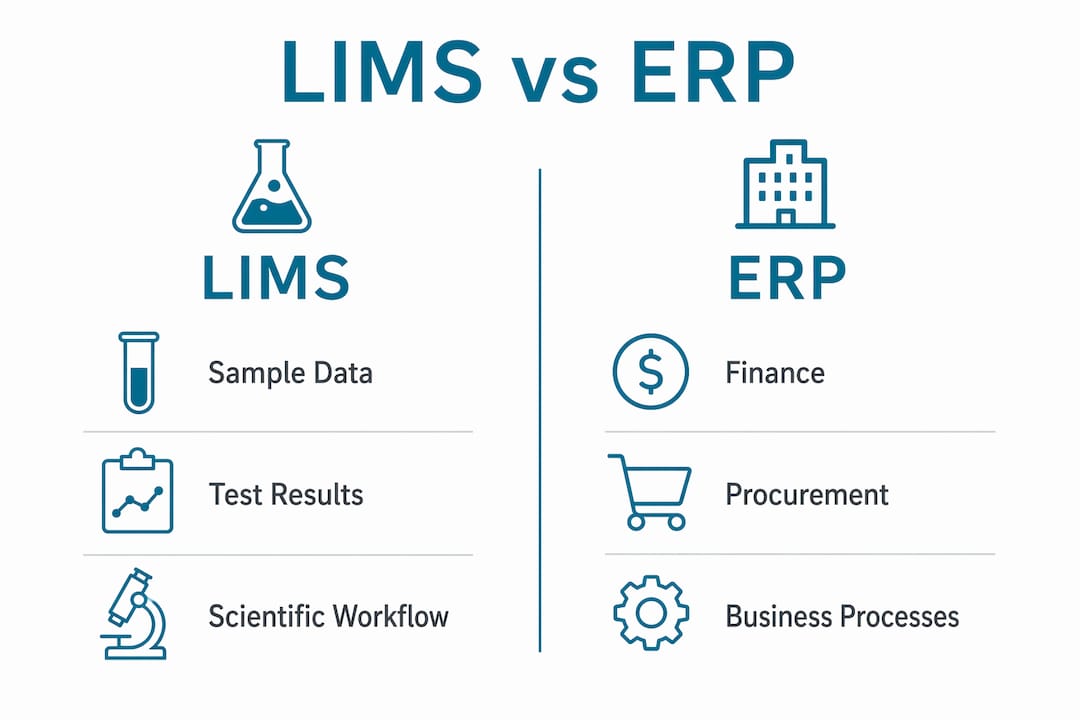
| Dimension | LIMS | ERP |
|---|---|---|
| Primary focus | Scientific workflows, sample data, regulatory compliance | Finance, procurement, inventory, enterprise operations |
| Key features | Sample tracking, instrument integration, audit trails, SOP enforcement, PGx/genetic reporting | GL/AP/AR, purchase orders, inventory management, production scheduling, HR |
| Regulatory support | FDA 21 CFR Part 11, GLP, CLIA, HIPAA-conscious data handling | SOX, financial audit standards, industry-specific ERP compliance modules |
| Integration capabilities | REST APIs, HL7/FHIR, webhooks, instrument connectors, middleware | REST/SOAP APIs, EDI, ERP-native connectors, middleware/ESB |
| Scale and deployment | Single lab to multi-site networks; cloud or on-premise | Enterprise-wide, often multi-site and multi-entity; cloud or on-premise |
| Typical buyers | Lab directors, lab managers, informatics leads, compliance officers | CFOs, IT directors, operations managers, procurement teams |
| Implementation shape | 3–18 months depending on complexity; subscription or perpetual license | 6–24+ months for enterprise rollouts; significant professional services cost |
Data ownership by artifact:
- Sample metadata and accession numbers: LIMS is authoritative.
- Test results and variant calls: LIMS is authoritative.
- Purchase orders and reagent inventory balances: ERP is authoritative.
- Customer master data and billing records: ERP is authoritative.
- Work order IDs that trigger sample login: ERP creates; LIMS consumes.
Real-world mapping examples: a QC lab in pharmaceutical manufacturing uses the ERP for batch production scheduling and the LIMS for in-process and release testing. A clinical genetic lab uses the ERP for billing and reagent procurement while the LIMS manages accessioning, sequencing workflows, and PGx report generation. A high-volume reference lab uses the ERP for chargeback and inventory reconciliation while the LIMS handles sample routing and result delivery to providers.
Why should you integrate your LIMS and ERP?
Integrating LIMS and ERP eliminates duplicate data entry, accelerates time-to-release, and gives business teams real-time visibility into lab status without requiring them to log into the LIMS. That last point matters more than most labs expect — operations managers and finance teams make decisions based on lab throughput, and manual status updates are always late.
Key operational benefits:
- Order pre-login: ERP work orders automatically create jobs in the LIMS before samples arrive, so accessioning staff are not re-keying order details.
- Accuracy: Eliminating manual transcription of results into the ERP removes a common source of billing and inventory errors.
- Single master data: Customer records, part numbers, and order IDs maintained in one authoritative system prevent the "which version is correct?" problem.
- Forward visibility: Sample receipt acknowledgements and retest flags flow back to the ERP so production schedulers know when to expect results.
- Billing automation: Final test results trigger invoice line items or chargeback records in the ERP without a manual handoff.
Common high-value integration use cases: automated job creation from ERP production orders; sample receipt acknowledgements back to ERP; final test results publishing to ERP to trigger production release decisions; reagent and consumable inventory reconciliation; and billing or chargeback automation for clinical reference labs.
Pro Tip: Start with the smallest viable set of exchanged fields: order IDs, sample accession numbers, and result status flags. Get those flows stable and auditable before adding payload fields like full result sets or inventory detail. Scope creep in integration projects is the most common reason timelines double.
What data actually moves between a LIMS and ERP?
The table below maps the core data entities, their direction of flow, and which system should be the authoritative master.
| Data Entity | Direction | Authoritative Master | Notes |
|---|---|---|---|
| Work/order IDs | ERP → LIMS | ERP | ERP creates; LIMS references for job pre-login |
| Sample accession numbers | LIMS → ERP | LIMS | Assigned at intake; used as correlation key |
| Sample receipt status | LIMS → ERP | LIMS | Confirms physical receipt; triggers scheduling |
| Final test results | LIMS → ERP | LIMS | Triggers production release or billing |
| Retest/resample flags | LIMS → ERP | LIMS | Alerts production to delay or re-run |
| Reagent/consumable inventory | ERP → LIMS | ERP | Stock levels and lot data for traceability |
| Billing/invoice line items | LIMS → ERP | ERP | Result completion triggers invoice creation |
| Customer/patient master data | ERP ↔ LIMS | ERP (typically) | Synced at onboarding; ERP usually owns master |
Before building any integration, lock down these governance decisions:
- Which system owns each field (no shared ownership — pick one).
- What unique identifiers link records across systems (order ID, accession number, patient MRN).
- How frequently data syncs and what the acceptable latency is (real-time vs. batch).
- How errors and mismatches are detected, logged, and resolved.
- Who is responsible for reconciliation when systems diverge.
What are your technical options for connecting LIMS and ERP?
HL7 and FHIR are the clinical messaging standards most relevant when your lab exchanges results with EHRs, billing platforms, or public health systems. Beyond those, you have several practical integration architectures to choose from.

RESTful APIs and webhooks are the most common modern approach. They offer low latency, straightforward authentication (OAuth 2.0, token-based), and good maintainability when both systems expose well-documented endpoints. Webhooks are particularly useful for event-driven flows like "sample received" or "result finalized." The trade-off: both systems need stable, versioned APIs, and you need a strategy for handling failures and retries.
HL7/FHIR messaging is the right choice when your lab must share results with EHRs, hospital systems, or public health reporting infrastructure. HL7 v2 is still the dominant standard in U.S. clinical labs; FHIR R4 is gaining ground for newer integrations. If your LIMS vendor cannot demonstrate tested HL7/FHIR connectors, that is a gap worth probing hard in demos. For labs doing LIMS-to-EHR data exchange, this is non-negotiable.
Middleware and ESB (Enterprise Service Bus) approaches add a transformation and routing layer between systems. This is the right call when you have multiple source and target systems, complex data transformation requirements, or a need for centralized monitoring and error handling. The cost is higher upfront complexity and an additional system to maintain.
Secure file exchange (CSV/XML) is the lowest-tech option and still common in smaller labs or for batch processes like nightly inventory reconciliation. It works, but it introduces latency, requires robust error detection, and is harder to audit in real time.
SOAP/web services appear in older ERP integrations, particularly with legacy SAP environments. They are functional but less flexible than REST and harder to test.
Implementation notes that matter regardless of method: use mutual TLS or token-based auth for all connections; log every transaction with timestamps and correlation IDs; build a test environment that mirrors production data structures before go-live; and document your transformation rules in a data mapping specification that both the LIMS and ERP teams sign off on.
For most genetic and molecular labs, the recommended architecture is: LIMS ↔ REST API or HL7/FHIR ↔ middleware (optional, for complex routing) ↔ ERP, with instrument data feeding the LIMS via native connectors or file watchers. See your LIMS instrument integration options for the instrument layer specifically.
How do you choose the right LIMS and ERP for your lab?
Start with one rule: prioritize configurability, instrument support, regulatory features, and integration API maturity over marketing feature lists. A vendor demo that shows you a polished UI is not evidence of a working HL7 connector.
Evaluation checklist
- Configurability and metadata modeling: Can your team define custom fields, workflow steps, and validation rules without vendor engineering? How does the system handle new test types or panel expansions?
- Instrument and middleware support: Which instruments does the LIMS connect to natively? Does it support file watchers, transformation scripts, or bidirectional instrument communication?
- API and HL7/FHIR maturity: Is there a documented, versioned REST API? Has the vendor demonstrated HL7 v2 or FHIR R4 integrations in production environments similar to yours?
- Deployment options: Cloud-first, on-premise, or hybrid? What are the data residency implications for HIPAA-covered data?
- Security and compliance: Does the system support FDA 21 CFR Part 11 electronic records and signatures? Role-based access controls? Immutable audit logs?
- Backup and disaster recovery: What are the RPO and RTO commitments? Where are backups stored, and how is recovery tested?
- Vendor support SLA: What is the response time for critical issues? Is there a dedicated implementation team or a ticket queue?
- Total cost of ownership: License or subscription fees, implementation professional services, integration development, validation effort, training, and ongoing maintenance. Integration complexity raises cost nonlinearly — a simple file exchange costs far less than a bidirectional HL7/FHIR integration with real-time error handling.
Realistic timeline expectations
A small lab pilot with a focused scope typically runs 3–6 months from contract to go-live. An enterprise multi-site deployment with ERP integration, instrument connectors, and full validation can run 9–18 months. Phased migration approaches — pilot, migration, validation, cutover — are the standard for preserving sample lineage and audit trails during transition.
Questions to ask vendors in demos
- How do you handle data migration from our current system, and what does the validation package include?
- Show me a working HL7 or FHIR integration in a production environment. What was the implementation timeline?
- What integration patterns do you support natively, and what requires custom development?
- How do you support 21 CFR Part 11 validation — do you provide IQ/OQ/PQ documentation?
- What does change management and end-user training look like, and is it included or billed separately?
- Can we have a dedicated test environment that mirrors production?
- What is your process when a new instrument model needs to be connected?
- How do you handle breaking API changes, and what is your versioning policy?
- What does your support escalation path look like for a critical production issue at 2 AM?
- Who owns the integration after go-live — your team, ours, or a third party?
Pro Tip: Before signing any contract, request a short integration proof-of-concept using your actual sample identifiers and order IDs. A vendor who can demonstrate a working data flow in a sandbox environment in two to four weeks is a vendor whose integration claims are real.
For a deeper LIMS evaluation checklist tailored to genetic labs, that resource covers additional criteria specific to PGx and molecular workflows.
How Labrynix addresses LIMS and ERP integration needs
Labrynix is built specifically for genetic testing, molecular diagnostics, and pharmacogenomics laboratories — not adapted from a generic clinical or manufacturing LIMS. That distinction shows up in the capabilities that matter most when you are evaluating against the checklist above.
Platform capabilities relevant to the selection criteria:
- Configurable LIMS workflows for order intake, accessioning, sample tracking, and workflow queue management — without requiring vendor engineering for each change.
- PGx reporting and interpretation support, including customizable templates, AI-assisted summaries, CPIC guideline references, PharmGKB-informed annotations, and FDA pharmacogenomic labeling references.
- HL7, FHIR, and API integration pathways via Labrynix Connect, supporting EHR, ERP, billing platform, CRM, and instrument connections.
- Role-based access controls and immutable audit logs designed with HIPAA-conscious and GDPR-conscious workflow principles.
- Provider and patient portals (Labrynix Portal) for secure, branded result delivery and order status visibility.
- Billing workflow visibility (Labrynix Billing) covering claim stages, invoice workflows, and revenue handoffs — the layer that connects lab results to ERP billing processes.
- AI-powered operational analytics (Labrynix Intelligence) for bottleneck detection, review queue management, and lab performance visibility.
On integration specifically: Labrynix Connect supports webhooks, REST APIs, HL7/FHIR messaging, and instrument connectors, giving labs the flexibility to integrate with existing ERP systems without replacing them. The LIMS acts as the scientific engine; the ERP remains the financial and procurement backbone. Synchronization happens through the integration layer, not through manual handoffs.
Labrynix was built from direct genetic and molecular laboratory experience, which means the platform's workflow design, metadata model, and reporting architecture reflect the actual operational challenges precision medicine labs face — not a generic adaptation of clinical or manufacturing software. For labs evaluating LIMS solutions with serious ERP integration requirements, that domain specificity reduces implementation risk and shortens the time to a working, validated system.
Deployment is cloud-first with enterprise-grade controls. Implementation support, professional services for integration configuration, and training are available — ask during your demo for specifics on what is included versus scoped separately.
Key Takeaways
Most labs need both a LIMS and an ERP, connected via APIs or HL7/FHIR, with clear data ownership rules established before integration begins.
| Point | Details |
|---|---|
| LIMS vs ERP ownership | LIMS owns sample data and results; ERP owns finance, procurement, and inventory — never overlap these. |
| Integration scope first | Start with order IDs, accession numbers, and result status; add payload fields only after core flows are stable. |
| Top selection priorities | Configurability, instrument support, API/HL7/FHIR maturity, and 21 CFR Part 11 compliance outweigh feature lists. |
| Timeline expectations | Small lab pilots run 3–6 months; enterprise multi-site deployments with ERP integration run 9–18 months. |
| Labrynix for molecular labs | Labrynix provides configurable LIMS workflows, PGx reporting, HL7/FHIR and API integration, and HIPAA-conscious controls for genetic and molecular labs. |
The integration problem most labs underestimate
The hardest part of a LIMS and ERP project is not the technology. It is the data governance conversation that nobody wants to have before the project starts.
Every integration I have seen run over budget and over schedule had the same root cause: two teams, each convinced their system was the authoritative master for a shared field. Order IDs, customer records, patient identifiers — when ownership is ambiguous, every data mismatch becomes a political negotiation instead of a technical fix. The fix is not a better API. It is a governance document, signed before the first line of integration code is written, that names the authoritative system for every exchanged field.
The second lesson is about scope. Labs consistently underestimate how much effort goes into data mapping — not the mapping itself, but the discovery that your current data is inconsistent, partially duplicated, or structured differently than you thought. A phased approach, starting with a minimal viable integration covering order creation, sample receipt, and result status, gives you a working system fast and surfaces data quality problems in a controlled way. Trying to sync everything at once is how projects stall at month seven with nothing in production.
Change management is the third piece most teams skip. Power users who understand both the LIMS and the ERP workflows are worth identifying early. They become the internal experts who train colleagues, catch edge cases during UAT, and keep the integration governance forum alive after go-live. Without that forum, integrations drift — fields get renamed, workflows change, and nobody notices until a billing discrepancy surfaces six months later.
Labrynix is built for labs that need more than a generic LIMS
Genetic and molecular labs evaluating their LIMS and ERP options face a specific problem: most LIMS platforms were designed for clinical or manufacturing contexts, then adapted for molecular diagnostics. The metadata models, reporting modules, and integration patterns reflect that origin.
Labrynix was built the other way around — starting from the workflows of genetic testing and pharmacogenomics labs, then building the integration and reporting infrastructure those labs actually need. For a lab that needs configurable LIMS workflows, production-ready HL7/FHIR and API connections to ERP and EHR systems, and branded PGx reporting with CPIC and PharmGKB support, Labrynix covers that stack in one platform. HIPAA-conscious controls, role-based access, and audit logs are built in, not bolted on.
The clearest next step is a demo focused on your specific integration scenario. Bring your ERP vendor's API documentation and your current sample identifier format, and ask Labrynix to demonstrate the data flow. Explore Labrynix for genetic testing labs or review the core LIMS platform to see how the capabilities map to your selection checklist before you schedule time.
Useful sources and further reading
- ERP to LIMS Interfacing (Wavefront Software) — Practical reference for integration points: job creation, sample receipt acknowledgements, retest flags, and result publishing. Useful for architects planning the data exchange layer.
- LIMS Software vs ERP Systems: Key Differences (SwissDiData) — Clear boundary definition between LIMS and ERP capabilities; useful for procurement teams building the business case for both systems.
- Is SAP a LIMS System? (SCC Soft Computer) — Authoritative explanation of why ERP systems cannot substitute for a LIMS in laboratory contexts; useful for stakeholders who question whether an existing SAP deployment covers lab needs.
- LIMS Software Overview (LabKey) — Covers configurability, metadata modeling, and workflow design; useful for selection criteria and understanding what "configurable" actually means in practice.
- LIMS vs ERP: Which System Should You Pick? (1LIMS) — Covers phased migration approaches and data mapping considerations; useful for IT teams planning cutover and validation.
- LIS/LIMS Software for Genetic and Molecular Labs (Labrynix) — Primary product page covering Labrynix platform capabilities, integration pathways, compliance features, and deployment options; useful for procurement teams building a vendor shortlist.
- LIMS Evaluation Criteria for Genetic Labs (Labrynix Blog) — Detailed evaluation checklist tailored to genetic and molecular lab requirements; useful for lab managers building RFP criteria.
This article is general informational guidance, not legal, regulatory, or compliance advice. Confirm current FDA, HIPAA, and applicable regulatory requirements with your compliance officer or a qualified professional for your specific laboratory situation.