
A properly configured LIMS consent management setup for genetic testing is not a checkbox feature. It is the lab's authoritative record that captures, enforces, and audits every patient consent decision from order intake through report release. Get the architecture right from day one: a versioned consent registry, specimen ID linkage, role-based access control (RBAC), immutable audit logs, and validated SOPs. Without all five, you have documentation, not enforcement.
Must-have items to capture in every consent record:
- Consent type: broad (biobanking/research) vs. test-specific (clinical diagnostic)
- Version ID: tied to the exact consent form version the patient signed
- Effective and expiry dates: including date-limited flags for time-restricted authorizations
- Specimen ID linkage: the accession event that ties this consent to a physical sample
- Secondary use and research opt-in: explicit yes/no flags, not free-text notes
- Recontact preference: whether the patient wants to be contacted about incidental findings or reanalysis
- Authorized viewers: which roles and systems may access this consent record and the linked specimen data
- Capture metadata: who entered the consent, when, and what evidence of discussion exists (e-signature, Record of Discussion, or witnessed paper form)
Go/no-go sanity checks before you build or buy:
- Can the system export a complete, tamper-evident audit trail filtered by specimen ID or consent version?
- Does every specimen record display the consent version that was active at the time of accession?
- Are consent flags enforced at the API and query layer, not just the UI, so a direct database call cannot bypass them?
If any answer is no, the system is not ready for a CLIA or CAP inspection. A LIMS built for genetic labs should pass all three checks before you write a single SOP.
Table of Contents
- What do U.S. regulators require for informed consent in genetic testing?
- How do you design consent capture and enforcement inside the LIMS?
- What technical controls enforce consent and protect genomic PHI?
- How should consent travel between your LIMS, EHR, and patient portals?
- What validation plan and SOPs do you need for CLIA/CAP readiness?
- How do you handle consent changes, withdrawals, and recontact day to day?
- What does a realistic implementation timeline and budget look like?
- How does Labrynix implement consent management for genetic testing labs?
- Key Takeaways
- The part of consent management most labs get wrong
- Labrynix supports your consent-management implementation from day one
- Useful sources
What do U.S. regulators require for informed consent in genetic testing?
The binding framework for genetic testing consent in the United States sits at the intersection of HIPAA, CLIA, CAP accreditation standards, and the Common Rule (45 CFR 46) for research contexts. Each layer adds requirements your LIMS data model must reflect.
Core elements of valid informed consent
MedlinePlus Genetics identifies the foundational elements: the purpose and scope of the test, the sample collection method, what results mean (including uncertain ones), specimen disposition, and where required, a signature with witness or a Record of Discussion (RoD). The ClinGen/CADRe consensus workgroup distilled these further into a prioritized core suitable for pretest discussions by non-genetics providers: voluntariness, why the test is recommended, what results will be returned and to whom, other possible results and options, test limitations, family impact, and risk of genetic discrimination.
Two elements that many labs underweight: variants of uncertain significance (VUS) and incidental findings. Patients must be told upfront that a result may be ambiguous, that it could have implications for relatives who have not been tested, and that the lab's policy on recontact and reanalysis applies to them. Capturing whether that conversation happened, and what the patient decided, is as important as capturing the signature.
HIPAA and PHI boundaries for genomic data
Under HIPAA, genetic information is protected health information (PHI). The HIPAA Privacy Rule generally permits use and disclosure for treatment, payment, and healthcare operations without additional authorization, but secondary use for research requires either a valid authorization or a waiver from an IRB or Privacy Board. Labs running biobanking consent management programs or contributing to research registries must track which specimens carry a research authorization and which do not, at the individual record level.
Genomic files (VCF, BAM, FASTQ) are a particular PHI boundary risk. Raw sequence data can re-identify individuals even after standard de-identification. Your LIMS must treat these files as PHI, store them with the same access controls as structured clinical records, and never expose them in observability stacks, logging pipelines, or non-production environments without explicit de-identification.
State law adds another layer. Several states, including California (CMIA), Texas, and Illinois, have genetic privacy statutes that impose requirements beyond HIPAA, including separate written authorizations for certain disclosures. Your consent metadata schema should include a state-law flag field so the system can apply the correct rule set based on the ordering provider's jurisdiction.
What CLIA and CAP inspectors look for
CLIA requires that laboratories maintain records sufficient to demonstrate the accuracy and reliability of their testing processes. CAP inspection checklists go further: inspectors want to see consent records tied to specific specimen IDs, evidence that the correct consent version was active at the time of testing, and a change log showing any amendments. They will ask for an audit export on the spot. If your LIMS cannot produce a consent-to-specimen linkage report within minutes, that is a finding.
How do you design consent capture and enforcement inside the LIMS?
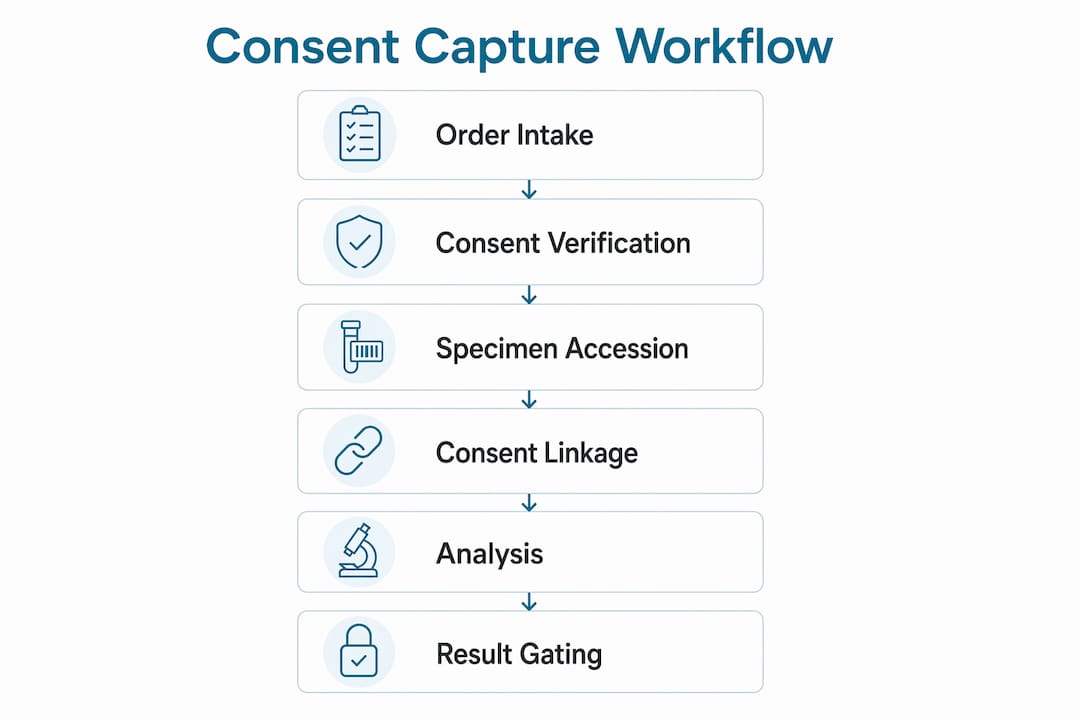
The workflow has six stages, each with a decision gate where consent status either permits or blocks the next action.

Order intake → Consent capture/verification → Specimen accession → Consent linkage → Analysis → Result gating/report release
At order intake, the provider enters or confirms consent status. If consent is missing or expired, the order is flagged and held. Accession cannot proceed until a valid consent record exists. At analysis, the pipeline checks consent flags (research opt-in, recontact preference, secondary use allowance) before routing the specimen. At report release, the system confirms the consent version linked to the specimen is still active and that the report type is permitted under that consent.
Recommended consent data model
| Field | Type | Notes |
|---|---|---|
| consent_id | UUID | Primary key; immutable once created |
| consent_type | Enum | broad, test-specific, research-only |
| version_id | String | Ties to the exact form version signed |
| signer_id / relationship | String | Patient or legally authorized representative |
| effective_date | Date | When consent becomes valid |
| expiry_date / date-limited flag | Date / Boolean | Null for open-ended; set for time-limited authorizations |
| permitted_uses | JSON array | clinical, research, secondary-analysis, data-sharing |
| research_opt_in | Boolean | Explicit flag; never inferred |
| recontact_preference | Enum | yes, no, results-only, incidental-only |
| linked_specimen_ids | Array of UUIDs | Every accession event this consent covers |
| linked_order_ids | Array of UUIDs | Orders placed under this consent |
| captured_by | User ID | Who entered the consent record |
| capture_method | Enum | e-signature, paper-scan, RoD, verbal-witnessed |
| discussion_metadata | JSON | Structured notes: topics covered, counselor ID, timestamp |
The linked_specimen_ids field is the most critical column in this table. Without it, you cannot prove at inspection that the specimen processed on a given date was covered by the consent version active on that date.
Consent versioning and artifact storage
Store two things for every consent version: the human-readable PDF (or scanned paper form) as an immutable artifact, and the structured metadata above as a database record. Never allow the PDF to be overwritten. When a patient amends consent, create a new consent record with a new version_id and a new effective_date. The old record stays in place, marked superseded, with a pointer to the new version. This gives you a complete chain of custody that an auditor can follow without asking you to reconstruct it manually.
Practical workflow examples
For provider-entered consent at order entry, the ordering provider completes a structured consent form in the provider portal. The LIMS creates the consent record, generates a consent_id, and holds the order in a "pending accession" state until the record is confirmed complete. For patient portal capture with e-signature, the patient receives a secure link, reviews the consent document, and signs electronically. The e-signature timestamp and IP address are stored as capture metadata, and the consent record is linked to the pending order automatically. For WGS tests requiring a Record of Discussion, the genetic counselor completes a structured RoD form in the LIMS, documenting which topics were covered and the patient's decisions on each. The RoD is stored as a PDF artifact and linked to the specimen accession event.
Pro Tip: Store both the human-readable consent PDF and the structured metadata fields. Inspectors want to read the form; your pipeline needs the flags. Centralizing consent logic in a single consent registry, rather than duplicating flags across order, specimen, and report tables, is the single most important architectural decision you will make.
What technical controls enforce consent and protect genomic PHI?
Consent enforcement only works if the controls live at the right layer. UI-level checks are necessary but not sufficient. A user with direct database access or API credentials can bypass them entirely.
RBAC patterns for genetic PHI:
- Define least-privilege roles: variant curators read VCF data but cannot view raw FASTQ files or export consent records; report signatories can approve reports but cannot modify consent flags; compliance officers can export audit logs but cannot alter specimen records.
- Separate duties between variant curation and report sign-off. The same user should not be able to both interpret a variant and release the report without a second reviewer.
- Implement temporary elevated access workflows for urgent cases: time-limited role grants with automatic expiry and a mandatory audit entry explaining the business reason.
- Review role assignments quarterly. Access creep in genetic labs is common, especially when staff cover multiple functions during ramp-up.
Audit logging requirements:
- Capture every consent lifecycle event: created, updated, withdrawn, amended, and expired.
- Log every specimen-access event: who accessed the record, from which system, and at what time.
- Log report-view and report-export events, including downloads from the patient portal.
- Make logs immutable: write-once storage, no delete permissions for any role including administrators.
- Retain logs for the period required by CLIA (generally two years for test records, longer for some genetic tests) and your state's rules.
- Export logs in a structured format (JSON or CSV) that an inspector can open without specialized software.
Encryption and key management:
Encrypt genomic files at rest using AES-256 or equivalent. Encrypt structured consent metadata with the same standard. Use TLS 1.2 or higher for all data in transit, including internal service-to-service calls. Manage encryption keys separately from the data they protect; a key management service that rotates keys on a defined schedule reduces the blast radius of a credential compromise. Never allow patient identifiers or consent flags to appear in application logs, metrics dashboards, or error traces. This is where compliance-by-design matters most: push data-minimization rules into the API and query layers so PHI cannot leak into observability pipelines regardless of how a developer writes a query.

Consent enforcement at the API layer:
Every API endpoint that returns specimen data, genomic files, or reports should evaluate the consent flags for the linked consent record before returning data. A policy engine pattern works well here: the API calls a consent service, passes the specimen ID and the requested action (view, export, research-use), and receives a permit or deny decision. Deny decisions are logged automatically. Tokenized access for patient and provider portals ensures that portal sessions cannot be used to access records outside the patient's own consent scope.
How should consent travel between your LIMS, EHR, and patient portals?
The LIMS consent registry is the single source of truth. Every other system, including the EHR, the patient portal, and any research registry, reads consent status from the LIMS rather than maintaining its own copy. Duplicating consent state across systems creates version conflicts that are nearly impossible to resolve during an inspection.
FHIR and HL7 mapping
FHIR R4 provides a Consent resource designed for exactly this use case. Map your consent_id to the Consent.identifier field, consent_type to Consent.category, and permitted_uses to Consent.provision.type. Attach the consent version ID to DiagnosticReport and ServiceRequest resources using the Consent resource reference or a Provenance resource that links the report to the consent artifact. Common pitfall: labs that embed consent status as a free-text note in the ServiceRequest narrative rather than as a structured reference. That approach breaks automated enforcement and makes audit reconstruction manual.
For HL7 v2 environments, the ZCO or ZDS custom segment is the conventional place to carry consent metadata. Document your segment definitions in your interface specification and include them in your validation test cases.
Pro Tip: Pass the consent version_id with every order and result message, not just the consent_id. During an inspection, you need to prove which version of the consent form was active when the specimen was processed, not just that consent existed.
Portal integration patterns
When a patient signs consent through the portal, the e-signature event triggers a webhook that creates or updates the consent record in the LIMS in real time. The LIMS responds with the consent_id, which the portal stores as a reference. If the sample has already been collected before consent is finalized (a common scenario in urgent clinical situations), the LIMS holds the specimen in a "pending consent" queue and blocks analysis until the consent record is linked. This is preferable to retroactive consent documentation, which creates audit gaps.
For automated genomic reanalysis workflows, the reanalysis pipeline must check the recontact_preference flag before initiating a new analysis cycle. If the patient opted out of recontact, the reanalysis result is held for clinician review rather than automatically released.
Partner and research registry integrations
When sharing data with a research registry or biobank, use scoped tokens that carry the permitted_uses flags from the consent record. The receiving system should enforce those flags independently. Document the permitted uses in a data use agreement (DUA) that references the specific consent version IDs in scope. Attribute-based access control (ABAC) at the API layer, where access decisions are made based on consent attributes rather than static role assignments, is the right model for research pipelines where data use permissions vary by specimen.
What validation plan and SOPs do you need for CLIA/CAP readiness?
Validation for consent-management features follows the same IQ/OQ/PQ structure as any other LIMS module. The difference is that consent controls are safety-critical: a failure does not just produce a wrong result, it exposes PHI or processes a specimen without authorization.
- Requirements traceability matrix (RTM): List every consent requirement (regulatory, clinical, and operational) and map each to a specific system feature and a test case. The RTM is the document an inspector will ask for first. If a requirement has no test case, it is not validated.
- Installation qualification (IQ): Confirm the consent module is installed with the correct version, configuration settings match the approved specification, and all dependent services (consent registry, audit log, encryption service) are running.
- Operational qualification (OQ) test cases:
- Create consent version A; confirm the specimen accession record associates the correct version_id.
- Withdraw consent; confirm the analysis pipeline blocks further processing and the report release gate denies output.
- Attempt an export from a role without export permissions; confirm denial and verify the audit log captures the attempt with the correct user ID and timestamp.
- Amend consent to add research opt-in; confirm the research pipeline now routes the specimen correctly.
- Performance qualification (PQ): Run the OQ test cases under production-representative load and data volumes. Confirm audit log entries are created within the required time window and that consent flag evaluation at the API layer does not introduce unacceptable latency.
- Audit export test: Reproduce the consent version history for a specific specimen in the audit export. Confirm the export matches the database records and is formatted for inspector review.
SOPs to draft before go-live:
- Consent capture SOP: step-by-step for provider-entered, patient portal, and RoD capture methods
- Consent version management SOP: how to create, supersede, and archive consent versions
- Consent withdrawal and amendment SOP: who can authorize changes, required documentation, and downstream actions
- Recontact SOP: triggers, responsible roles, documentation requirements, and turnaround expectations
- Data retention and destruction SOP: retention periods by data type, destruction methods, and documentation
- Consent breach incident response SOP: detection, containment, notification, and post-incident review
Evidence artifacts for inspectors: sample audit exports (pre-generated, not produced on demand), consent-to-specimen linkage reports, SOP signoff records with dates and reviewer names, training completion records for all staff who touch consent workflows, and PQ test logs with pass/fail results and reviewer signatures.
A go-live readiness checklist that maps each SOP to its validation evidence is the fastest way to demonstrate inspection readiness without scrambling.
How do you handle consent changes, withdrawals, and recontact day to day?
Consent is not static. Patients change their minds, results prompt new questions, and VUS classifications evolve. Your operational policies need to handle all three without creating audit gaps.
Withdrawal and partial withdrawal
When a patient withdraws consent, the LIMS should immediately flag all linked specimens as "consent withdrawn" and block any further analysis or report release. For specimens where analysis is already complete, the withdrawal applies to future use only. The lab cannot un-run a test, but it can stop secondary analysis, research use, and data sharing. Document this distinction explicitly in your consent withdrawal SOP so staff do not incorrectly treat a withdrawal as a retroactive invalidation of completed clinical results.
Partial withdrawals are common in genetic testing. A patient may allow clinical reporting but withdraw consent for research use. The LIMS must support granular flag updates: changing research_opt_in from true to false without altering the clinical permitted_use flag. This is why a JSON array for permitted_uses is preferable to a single boolean consent field.
Consent withdrawal in genetic testing is rarely all-or-nothing. Patients often want to stop research participation while keeping their clinical results accessible to their care team. A LIMS that treats withdrawal as a binary on/off creates operational problems and may lead labs to over-restrict access to completed clinical reports, which is itself a patient safety issue.
VUS and incidental findings workflows
When a variant is reclassified from VUS to pathogenic, the lab needs to determine whether the original consent covered recontact for updated results. Check the recontact_preference flag. If the patient opted in, the recontact SOP triggers: the ordering provider is notified, an amended report is generated, and the recontact event is logged with a timestamp and the responsible staff member's ID. If the patient opted out, the reclassification is documented internally and the result is held for clinician review without direct patient outreach.
Amended reports must reference the original report version and the consent version active at the time of amendment. The audit trail should show the chain: original consent → original report → reclassification event → amended consent check → amended report.
Pro Tip: Standardize scripted counseling prompts that capture the quality of the consent conversation as structured metadata: which topics were covered, what questions the patient asked, and what decisions they made. A free-text note that says "patient consented" tells an inspector nothing. A structured RoD with topic checkboxes and a counselor ID tells them everything.
What does a realistic implementation timeline and budget look like?
LIMS modernization for genomics labs typically spans several months to over a year, depending on lab size, integration complexity, and the state of existing consent documentation. Consent-management features add scope to every phase.
| Phase | Typical Duration | Key Activities | Primary Cost Driver |
|---|---|---|---|
| Planning and requirements | 4–8 weeks | Map current consent artifacts; define metadata schema; identify integration endpoints | Internal staff time; workflow design consulting |
| Pilot and parallel run | 6 weeks | Deploy consent registry for one test type; run parallel with existing process; validate linkage | Vendor professional services; validation QA effort |
| Expand pipelines and integrations | 8 weeks | EHR/EMR HL7/FHIR connectors; patient portal e-consent; research registry scoped tokens | Custom integration development; portal UX build |
| Validation and go-live | 4–8 weeks | IQ/OQ/PQ execution; SOP signoffs; training; audit export testing | QA/validation staff; compliance review |
| Legacy decommission | 2–6 weeks | Archive legacy consent records; migrate to new registry; confirm linkage completeness | Data migration effort; staff time |
Primary cost drivers
Custom EHR and portal integrations are consistently the largest line item. A bidirectional HL7/FHIR integration with a major EHR platform requires specification, development, testing, and ongoing maintenance. Patient portal e-consent UX adds design and security review costs. Audit log retention for genomic files is a storage cost that scales with sequencing volume. Validation and QA effort is often underestimated: plan for at least one dedicated QA resource for the duration of the OQ and PQ phases.
For budgeting conversations with leadership, frame the ask around three numbers: the cost of the implementation, the cost of a failed inspection (remediation, re-inspection fees, potential CLIA suspension), and the time saved annually by automated consent gating versus manual consent checks. Automated gating typically eliminates a category of pre-analysis hold that otherwise requires a coordinator to manually verify consent status for every specimen.
Phase 1 priority: Deploy a minimal viable consent registry with structured metadata, specimen linkage, and audit logging. Defer advanced reanalysis automation and research pipeline integrations to Phase 2. Getting the core registry right is worth more than a partially built end-to-end system.
How does Labrynix implement consent management for genetic testing labs?
Labrynix was built around the workflows genetic testing labs actually run, not a generic clinical lab model adapted after the fact. Consent management in Labrynix is a first-class feature, not a configuration workaround.
Core consent features in Labrynix LIMS:
- Versioned consent registry with immutable artifact storage (PDF + structured metadata)
- Specimen linkage at accession: every accession event captures the active consent_id and version_id
- Configurable consent flags: research opt-in, recontact preference, secondary use, data-sharing permissions
- RBAC controls with least-privilege role definitions and separation of duties between curation and sign-off
- Immutable audit logs covering consent lifecycle events, specimen access, report views, and export attempts
- FHIR R4 Consent resource mapping and HL7 v2 custom segment support via Labrynix Connect
Worked example workflow in Labrynix:
A provider submits an order through the Labrynix provider portal and completes the structured consent form. Labrynix creates a consent record, assigns a consent_id and version_id, and stores the signed PDF as an immutable artifact. The order moves to accession only after the consent record is confirmed complete. At accession, the LIMS links the consent_id to the specimen accession record. When the analysis pipeline runs, it queries the consent service for the permitted_uses flags. If research_opt_in is false, the specimen is excluded from the research queue automatically. At report release, the report delivery workflow checks that the consent version linked to the specimen is still active and that the report type is permitted. The audit log captures every step.
Validation support Labrynix provides:
- Sample RTM entries for consent-management requirements, ready to extend with lab-specific requirements
- PQ test scripts for consent capture, withdrawal, enforcement, and audit export scenarios
- Example audit-export reports formatted for CAP and CLIA inspection packages
- Onboarding playbook covering consent workflow design, SOP templates, and training resources
For labs migrating from spreadsheets or legacy systems, Labrynix professional services supports consent artifact migration, historical linkage reconstruction, and parallel-run validation to confirm that no consent records are lost in transition.
Key Takeaways
A LIMS consent management setup for genetic testing requires a versioned consent registry linked to specimen IDs, enforced through RBAC and API-level policy gates, and validated with documented SOPs and immutable audit logs before any CLIA or CAP inspection.
| Point | Details |
|---|---|
| Versioned registry is non-negotiable | Every specimen must link to the exact consent version active at accession; missing this link is a CAP inspection finding. |
| API-layer enforcement beats UI checks | Consent flags must be evaluated at the API and query layer so no direct database call can bypass them. |
| Validation requires an RTM and PQ scripts | Map every consent requirement to a test case; inspectors will ask for the RTM and audit export on the spot. |
| Phase 1 scope: registry and audit logs | Deploy the minimal viable consent registry with structured metadata and immutable logs before building portal or research integrations. |
| Labrynix ships consent-ready | Labrynix provides a versioned consent registry, specimen linkage, RBAC, immutable audit logs, and sample PQ scripts for inspection packages. |
The part of consent management most labs get wrong
Most labs treat consent as a documentation problem. They focus on getting the form signed and filed, and they stop there. The operational gap shows up later: during an inspection, when an auditor asks which consent version was active when specimen ACC-2024-00847 was processed, and no one can answer without manually cross-referencing a spreadsheet and a PDF folder.
The real problem is not the form. It is the linkage. A signed consent form that is not tied to a specific specimen accession event, with a version ID that can be reproduced in an audit export, is not enforceable. It is a paper record that proves intent but not execution. Labs that build consent management as a foundational, automated component of their LIMS, rather than a documentation step bolted on at the end, avoid this entirely. The consent record becomes part of the specimen's chain of custody from the moment of accession, not something reconstructed after the fact.
There is also a clinical dimension that gets underweighted. Consent for genetic testing is not a one-time event. VUS reclassifications, incidental findings, and reanalysis requests mean that the consent conversation continues long after the sample is processed. A LIMS that treats consent as a static signed form cannot support the recontact workflows, amended report processes, and partial withdrawal scenarios that genetic testing actually generates. The architecture has to be built for consent as a living record, not a closed transaction.
Labs that get this right tend to have one thing in common: they designed the consent registry before they designed the reporting workflow, not after.
Labrynix supports your consent-management implementation from day one
Genetic testing labs that need more than software, they need a partner who understands what a CAP inspector will ask for and has the artifacts ready, find that Labrynix closes the gap between a compliant design and a compliant operation.
Labrynix genetic testing lab software includes implementation and workflow design services, HL7/FHIR integration support, validation templates and PQ test scripts, staff training and change management resources, and ongoing support for consent workflow updates as regulations evolve. The platform's HIPAA-conscious, CLIA/CAP-aware controls mean the compliance architecture is already in place; your team configures it to your specific test menu and consent policies.
To get the most from a discovery call, bring your current consent SOPs (or a description of your current process), the test types you need to cover in Phase 1, your EHR and portal integration endpoints, and an estimate of monthly specimen volume. Labrynix will map those inputs to a phased implementation plan and provide example inspection artifacts so you can see exactly what your audit package will look like before you go live.
Useful sources
-
What is informed consent? — MedlinePlus Genetics: Covers the foundational elements of informed consent for genetic testing, including test purpose, result meanings, specimen disposition, and signature requirements. Use this to ground consent metadata field definitions.
-
Defining the Critical Components of Informed Consent for Genetic Testing — PMC/ClinGen: ClinGen/CADRe expert consensus on the prioritized core consent elements for clinical genetic testing. Useful for determining which fields are required versus optional in your LIMS schema.
-
Required Elements of the Consent Form — NIH National Human Genome Research Institute: Covers Common Rule (45 CFR 46) required elements for genomics research consent, including biospecimen use, WGS disclosure, withdrawal rights, and data-sharing statements. Essential for research-context consent flags.
-
The consent conversation for genomic testing — Genomics Education Programme: UK-based guidance (non-U.S., for additional context) on RoD best practices, VUS and incidental findings disclosure, and reanalysis consent. Practical for SOP design and RoD metadata structure.
-
LIMS Modernization 2026: A Complete Step-by-Step Guide for Genomics and Clinical Labs: Covers phased LIMS implementation, compliance-by-design controls, interoperability planning, and cost drivers. Use for timeline and technical architecture sections.
-
LIS/LIMS Software for Genetic and Molecular Labs — Labrynix: Labrynix product documentation covering LIMS capabilities, RBAC, audit logs, and HL7/FHIR connectors relevant to consent enforcement.
-
LIMS Data Migration Best Practices for Labs in 2026 — Labrynix blog: Practical migration guidance including parallel runs, validation checklists, and change management steps applicable to consent registry migration and go-live planning.