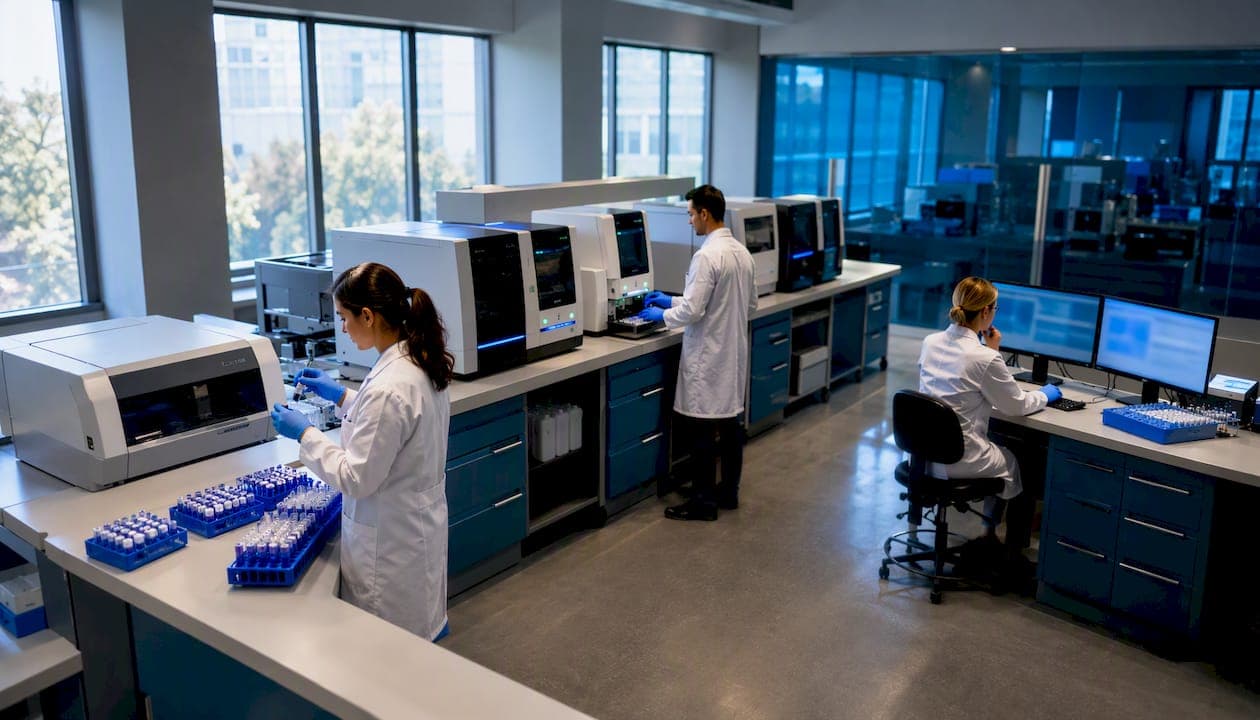
Managing workflow across a genetic or molecular lab network comes down to three moves: centralize your SOPs and governance, run a unified LIMS or connected data platform with HL7/FHIR integrations, and roll out changes in validated phases rather than all at once. Done right, this produces consistent quality across sites, tighter turnaround time (TAT) variance, and operations that actually scale instead of multiplying your headaches with every new location. The rest of this guide walks through exactly how to build it.
TL;DR:
- Successful multi-site lab network management requires centralized SOPs, unified data platforms, and phased implementation to ensure consistent quality and scalable operations.
- Governance must include documented clinical oversight at each site, clear decision ownership, and standardized incident reporting, audits, and change control processes.
- Technology choices should prioritize HL7/FHIR API integration, role-based access, full audit trails, and automation features like sample routing and result validation.
- Regular KPI monitoring of turnaround times, concordance rates, and sample errors is essential, with increased focus on daily dashboards and root-cause analysis after deployment.
- Overcoming human resistance and master-data issues are the main challenges, while PGx reporting and provider portals significantly improve site consistency and communication.
Table of Contents
- Why Formal Lab Network Workflow Management Matters
- Core Components: Governance, Process, Technology, Logistics
- How Do You Roll Out Multi-Site Lab Workflow Standardization?
- Staying Auditable: Governance and Clinical Oversight Across Sites
- What Should You Require From a Lab Network Technology Platform?
- Measuring Success After Rollout
- What Genetic Lab Networks Get Wrong About Workflow Harmonization
- Bringing It Together With Labrynix
- Sources
Why Formal Lab Network Workflow Management Matters
When each site in a lab network runs its own version of an SOP, its own spreadsheet, and its own instrument calibration schedule, quality drifts without anyone noticing until a result gets challenged. TAT becomes unpredictable from one site to the next, and billing errors creep in because nobody has one clean view of order status across the network.
Standardizing the pre-analytical, analytical, and post-analytical phases is the foundation that fixes this. Unified SOPs and instrument validation give every site the same starting conditions, and a single point of visibility makes training, QA, and procurement dramatically simpler because you're managing one system instead of five variations of the same idea. The metrics worth tracking from day one: TAT by site and assay, assay failure rate, inter-site concordance, and sample loss or mislabel rate. Everything in this playbook exists to move those four numbers in the right direction.
Core Components: Governance, Process, Technology, Logistics
Lab network workflow management breaks into four pillars. Skip one, and the other three eventually strain under the weight of what's missing.
- Governance: a master SOP library, a cross-site quality committee that meets on a set cadence, and documented clinical advisory roles at each location, not just at headquarters.
- Processes: harmonized pre-analytical, analytical, and post-analytical workflows, plus instrument validation and preventive maintenance schedules that follow the same calendar everywhere.
- Technology: either a single LIMS instance or a tightly integrated platform, connected through HL7, FHIR, and REST APIs, with role-based access and full audit trails baked in.
- Logistics and procurement: validated sample transport with documented chain of custody, centralized inventory tracking, and vendor contracts negotiated once for the whole network instead of site by site.
The governance pillar is the one labs underinvest in most often, mainly because it produces no immediate operational lift. It's also the pillar accreditors check first. A centralized LIS instance gives leadership real-time visibility into performance trends, but that visibility is only trustworthy if the governance layer defines who owns what decision and who signs off on which result. Technology without governance just gives you faster access to inconsistent data.
How Do You Roll Out Multi-Site Lab Workflow Standardization?
Trying to harmonize five sites in one quarter is how harmonization projects die. A phased rollout, with acceptance checks built into each stage, protects both quality and staff sanity.
- Phase 0, discovery. Inventory every system, instrument, and SOP variant in use across the network. Map current sample routes end to end. This phase alone often reveals more inconsistency than leadership expected.
- Phase 1, standardize. Build the master method library and pick two or three priority assays to harmonize first, ideally your highest-volume tests. Don't attempt full standardization across the whole test menu at once.
- Phase 2, choose your architecture. Decide between a single LIMS tenant serving all sites or a federated integration model connecting existing systems. Pilot the choice at one or two sites and validate inter-site concordance before expanding.
- Phase 3, staged rollout. Bring remaining sites online in waves, with training, formal change control, instrument validation, and transport validation completed before each site goes live.
- Phase 4, steady state. Shift to ongoing KPI monitoring, cross-site audits, regular QA cycles, and a fixed governance meeting cadence that doesn't lapse once the "project" feels done.
Pro Tip: Run Phase 2's pilot on your two most different sites, not your two most similar ones. If concordance holds between your best-equipped flagship lab and your leanest satellite site, it will hold everywhere in between.
Master data cleanup, unifying patient IDs, provider IDs, and instrument mappings across sites, is usually the most time-consuming part of Phase 0, often taking weeks and sometimes months depending on how many legacy systems you're untangling. Budget for that reality up front instead of discovering it mid-project.
Staying Auditable: Governance and Clinical Oversight Across Sites
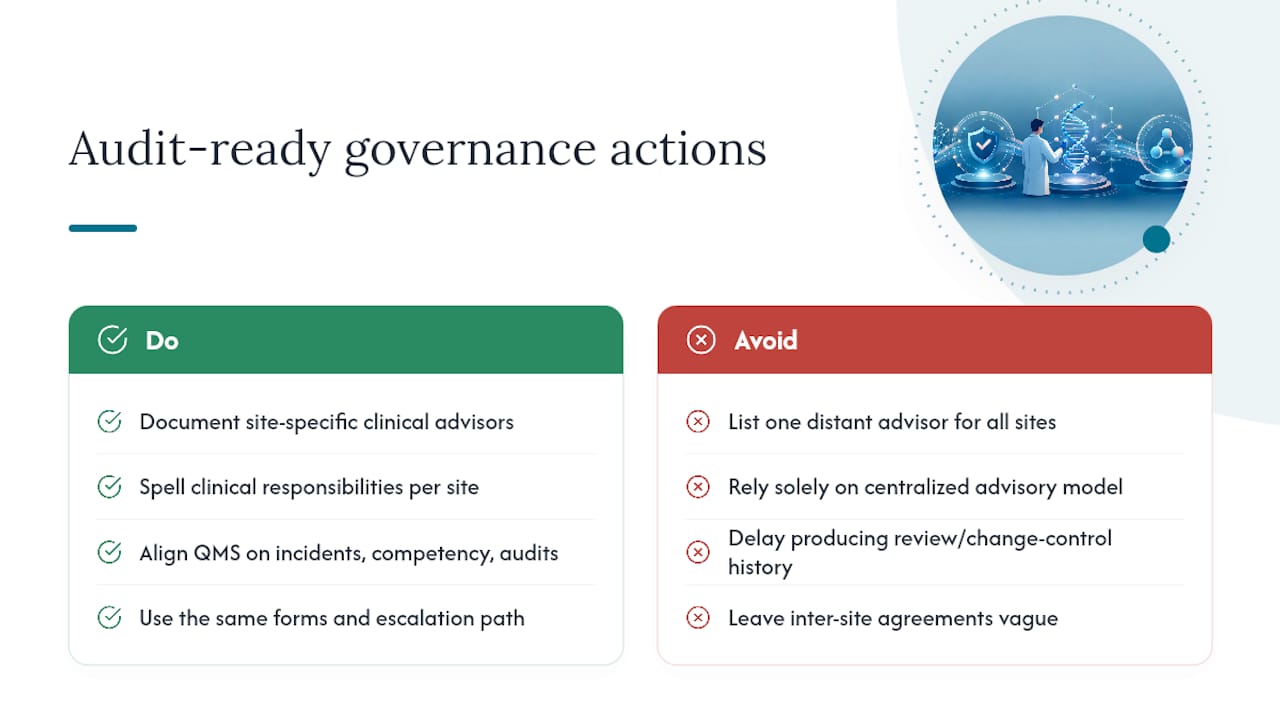
Accreditors don't just want to see that your sites use the same SOP. They want documented proof that clinical oversight is genuinely happening at each location, not rubber-stamped from a central office. UKAS guidance on multi-site laboratory networks is explicit that regulators expect clear documentation of how sites interact and meaningful, location-specific clinical advisory engagement, not a single distant advisor listed on paper for every site.
That means every inter-site agreement needs to spell out who holds clinical advisory responsibility at each location and who has reporting access to what. Your QMS needs to align across the network on incident reporting, competency assessment, internal audits, and corrective action documentation, all using the same forms and the same escalation path. When an assessor asks who reviewed and approved a given result, or wants to see the change-control history behind a method update, you need to produce it in minutes, not days. A purely centralized advisory model with no local engagement is a known accreditation failure point, so build local presence into the governance structure from the start, not as an afterthought.
What Should You Require From a Lab Network Technology Platform?
Vendors and internal IT teams both need to meet the same bar before you commit to a platform for network-wide workflow management.
- Insist on real interface documentation and sandbox testing for HL7, FHIR, and REST APIs, not a sales deck that says "we integrate with everything."
- Require a unified master data model: shared patient and provider IDs, an instrument registry, a shared method library, and clear mapping rules between legacy systems.
- Confirm role-based access, full audit trails, encrypted transport, and a documented backup and disaster-recovery plan.
- Ask specifically about automation: auto-routing of samples, rule-based result validation, and AI-assisted drafting for PGx reports where your lab produces them.
Multi-branch LIMS platforms increasingly advertise real-time sync and cross-site dashboards as standard features, which tells you the market has already accepted this as table stakes, not a premium add-on. For labs running heavy automation, more advanced orchestration frameworks use manager-worker architectures and resource reservation to coordinate instruments and prevent scheduling conflicts across a network. That level of complexity makes sense once you're running high sample volumes through shared automated equipment; it's overkill for a two-site network still standardizing basic SOPs.
Measuring Success After Rollout
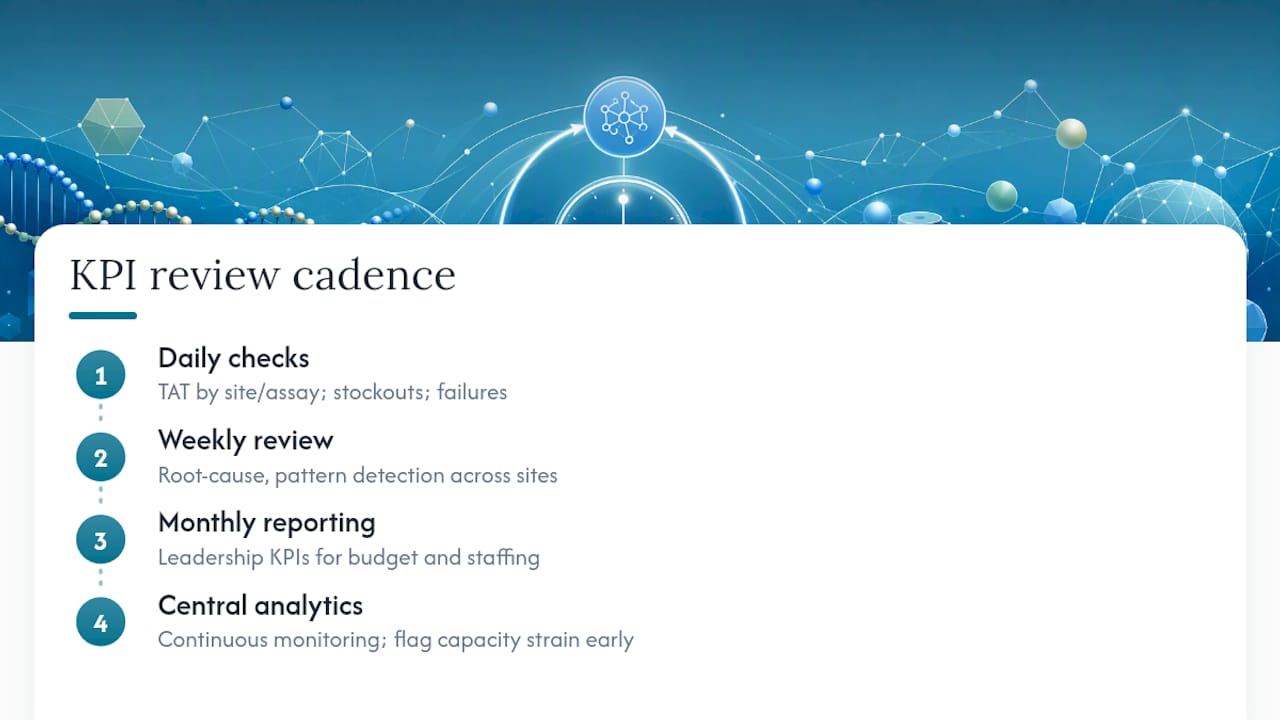
The KPIs that matter don't change much once you're live: TAT by site and assay, inter-site concordance, sample loss or mislabel rate, inventory stockouts, and assay failure rates. What changes is the cadence you check them on.
Daily operational dashboards catch same-day problems, like a site's TAT spiking because an instrument went down. Weekly reviews are where root-cause conversations happen, separating a one-off blip from a pattern worth escalating. Monthly leadership reporting rolls everything up into the KPIs that justify budget and staffing decisions. Central analytics, watched consistently, will flag capacity strain before it becomes a crisis, giving you the lead time to rebalance volume to another site or temporarily outsource overflow rather than letting one location's backlog become the whole network's problem.
What Genetic Lab Networks Get Wrong About Workflow Harmonization
Most labs treat lab network workflow management as a software purchase. It isn't.
The pitfall I see most often is underestimating the master-data problem. Teams assume linking systems is a weekend integration job, then discover mismatched patient identifiers and three versions of the same assay method have been quietly coexisting for years. Staff resistance to new SOPs is the second-biggest killer, and it's rarely about competence. It's about a tech who's run a process one way for a decade being told their method is now "non-standard." Human factors, not software gaps, are usually the real barrier to multi-site consistency, and no platform fixes that without deliberate change management alongside it.
Where the technology genuinely earns its keep is in PGx reporting and provider communication. A specialized reporting layer with CPIC and PharmGKB-informed logic removes hours of manual formatting per report and gives every site the same report quality without a central bottleneck. Integrated provider and patient portals cut down the phone tag that eats up staff time across a network far more than any dashboard redesign does.
— Tarek
Bringing It Together With Labrynix
Everything in this playbook, the unified data platform, the HL7/FHIR integrations, the audit trails, the harmonized PGx reporting, is exactly what Labrynix's LIMS was built to run for genetic and molecular lab networks.

Labrynix connects order intake, accessioning, and workflow queues across every site into one system, so your team stops reconciling five spreadsheets to answer a simple TAT question. PGx report generation carries built-in CPIC and PharmGKB-informed logic, which means every site produces the same report quality without your reviewers reformatting someone else's template. Labrynix Connect handles the HL7, FHIR, and API integration work your IT team would otherwise build from scratch, and role-based access with full audit logging gives accreditors the exact documentation trail this guide describes. Provider and patient portals cut the manual back-and-forth that eats hours at every site, every week.
If you're planning a network rollout or trying to bring accreditation evidence up to standard across multiple locations, start with Labrynix's solutions for lab networks and request a walkthrough of how the platform maps to your specific sites and assay mix.
Sources
- Managing multisite clinical diagnostic networks | Lab Manager
- Guidance for medical laboratory services provided as part of a network or multi-site organisation | UKAS
- AlabOS — workflow management for autonomous labs (arXiv)