
A diagnostic reporting workflow is the end-to-end process that transforms analyzed specimen data into an interpreted, delivered, and auditable clinical report. For genetic, molecular, and pharmacogenomics labs, that means every step from order receipt through variant interpretation, report assembly, clinical sign-off, and verified delivery to the ordering provider and patient. A workflow is performing well when it meets these criteria:
- Reports are delivered on time with documented turnaround time (TAT)
- Hand-offs between systems and roles are tracked, not assumed
- Structured outputs conform to HL7/FHIR DiagnosticReport and Observation resources
- Clinical sign-off is logged with a tamper-evident audit trail
- CPIC, PharmGKB, and FDA pharmacogenomic labeling are cited where applicable
- Role-based access controls and validation records are in place
The sections below cover each component, the operational steps, interoperability standards, compliance controls, and the KPIs that tell you whether the workflow is actually closing the diagnostic loop.
Table of Contents
- What makes up a diagnostic reporting workflow?
- How the operational flow runs from order to delivery
- How to combine structured data with formatted reports
- How to minimize fragile hand-offs and keep the diagnostic cycle intact
- What compliance and audit controls your reporting workflow needs
- How to design PGx and genetic reports that clinicians actually use
- How to plan a reporting workflow implementation
- How Labrynix maps to a modern reporting workflow
- Key Takeaways
- Where labs should focus first
- Labrynix gives labs the infrastructure to close the diagnostic loop
- Useful sources for designing and validating reporting workflows
What makes up a diagnostic reporting workflow?
Every reporting workflow rests on a set of system components and human roles. Missing one creates a gap that manual workarounds will eventually fail to cover.
| Component | Function | Primary Role |
|---|---|---|
| Order intake / CPOE interface | Receives and validates test orders | Ordering clinician, lab intake staff |
| Accessioning / specimen management | Assigns accession numbers, tracks specimen status | Lab technician |
| LIMS / LIS | Central workflow engine: queues, status, audit | Lab informatician, IT |
| Analysis engine / NGS pipeline | Runs analytical processing, variant calling | Bioinformatician |
| Interpretation workspace | Variant curation, genotype/phenotype mapping | Clinical scientist |
| Report assembly | Template selection, content population | Lab scientist, reporting module |
| Clinical review and sign-off | Final authorization before release | Pathologist, clinical director |
| Delivery channels | Provider portal, patient portal, HL7/FHIR output | IT, portal administrator |
IHE Reporting Workflow profiles describe the interactions between scheduling systems, report management systems, and reporting workstations as a set of defined transactions, not ad hoc handshakes. Auditability lives in the LIMS: every status change, role action, and sign-off event should generate a timestamped log entry. The role of LIMS in genetic report delivery is precisely this: a single system of record that tracks every hand-off.
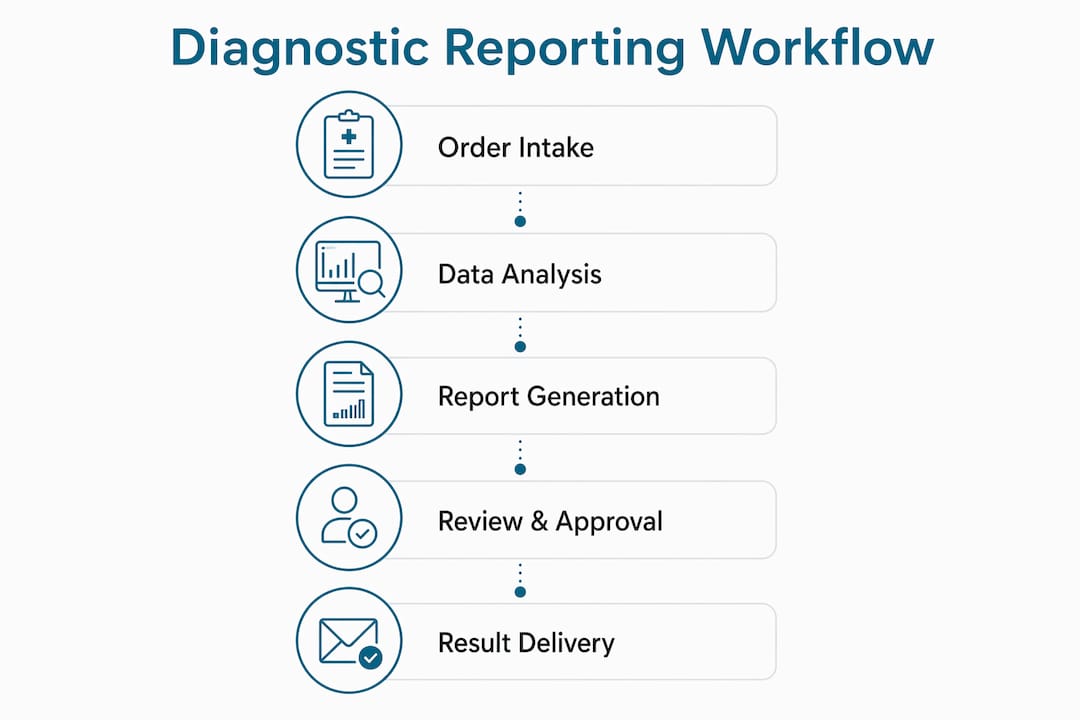
How the operational flow runs from order to delivery
The sample-to-report process follows a defined sequence. Each step has metadata to capture and a readiness signal to emit before the next step begins.
- Order receipt and validation. Confirm patient demographics, test code, and ordering provider. Flag missing priors or incomplete requisitions before accessioning.
- Accessioning. Assign accession number, record specimen condition, set initial workflow status.
- Analytical processing. Instruments or NGS pipelines execute. Input readiness flags confirm all required inputs are present before reporting begins. DICOM UPS push/pull/watch patterns apply here: a "ready-to-read" signal fires only when post-processing outputs are complete.
- Variant calling and interpretation. Curate variants, assign classifications, map genotype to phenotype for PGx tests.
- Report assembly. Select the correct template, populate structured fields, attach CPIC/PharmGKB citations and FDA labeling references.
- Clinical review and sign-off. Authorized clinician reviews, approves, and signs. The LIMS logs the action with timestamp and user identity.
- Report generation. Produce both a structured FHIR/HL7 output and a formatted PDF or HTML for provider and patient delivery.
- Delivery and acknowledgment. Push to provider portal and patient portal; log confirmed receipt or flag unacknowledged results for follow-up.
Pro Tip: Use a pull worklist for routine daily reporting to balance queue depth, and reserve push notifications for critical or unexpected results. Hybrid pull/push implementations consistently reduce TAT without overwhelming reviewers.
How to combine structured data with formatted reports

Modern reporting workflows must publish two outputs simultaneously: structured, machine-readable observations and provider-friendly formatted documents. Neither alone is sufficient.
FHIR DiagnosticReport and Observation resources carry the machine-readable layer: LOINC-coded results, genotype assertions, phenotype classifications, and references to formatted report documents. HL7 v2 messaging remains common in U.S. labs for order and result routing where EHR systems have not yet migrated to FHIR. LOINC codes on every test result allow EHR clinical decision support (CDS) engines to act on results without parsing free text. IHE Reporting Workflow and DICOM UPS patterns add the coordination layer: push, pull, and watch SOP classes schedule, claim, and track work items across systems.
Structured laboratory results enable EHR-based result reporting and tracking functions that directly support safety and clinical decision support — the SAFER Test Results Reporting guide identifies this as a foundational requirement for safe follow-up workflows.
Pro Tip: Map your consumers before you build: EHR CDS engines and registries need structured FHIR/HL7 data; ordering providers and patients need formatted PDFs or HTML. Implement both with consistent accession numbers and patient identifiers so every consumer can correlate the two outputs.
How to minimize fragile hand-offs and keep the diagnostic cycle intact
Post-analytical errors — failures in communication and hand-off rather than analytic mistakes — are where the diagnostic cycle most often breaks down. The highest-risk moment is after the report is generated: an unacknowledged result sitting in a queue is a patient safety event waiting to happen.
Controls that close the loop:
- Readiness signals: fire a "ready-to-read" event only when all required inputs are confirmed present
- Watch/event notifications: alert the next role automatically rather than relying on manual checks
- Claimed worklist items: require a user to explicitly claim a task before working it, preventing duplicate or dropped work
- Back-up recipient routing: if the primary recipient does not acknowledge within a defined window, escalate to a secondary contact
- Acknowledgment logging: record every confirmed receipt with timestamp and user identity
KPIs to track: hand-off failure rate, time-to-acknowledgment, percentage of results with documented follow-up, and review-backlog depth. The SAFER Test Results Reporting guide recommends structured self-assessment checklists specifically to surface these gaps before they cause harm.
Pro Tip: Include clinical context snippets and prior-result references in the report metadata. Reviewers who can see the previous PGx result alongside the current one spend less time reconstructing context and make fewer interpretation errors.
What compliance and audit controls your reporting workflow needs
Reporting workflows must produce tamper-evident audit trails, enforce role-based access, and maintain documented validation records for every report template and interpretation rule. These are not optional for labs operating under CLIA, CAP, or state licensure.
A reporting workflow without version-controlled templates and signed-off interpretation rules is not auditable — and an unauditable workflow cannot demonstrate that the right rule was applied to the right patient at the right time.
Required controls:
- Audit logs capturing every sign-off, amendment, and release event with user identity and timestamp
- Role-based access control (RBAC) with least-privilege assignment
- Secure transport (TLS) and encrypted storage for report data
- Validation and verification records for new or modified templates
- Documented SOPs for clinical review, amendment, and critical-value notification
Pro Tip: Store signed-off interpretation rules and example validation artifacts directly within the report history record. When an inspector asks why a specific genotype was classified a certain way, the answer should be one click away, not a manual search through a separate document repository.
How to design PGx and genetic reports that clinicians actually use
Effective pharmacogenomics and genetic reports balance a clear clinical interpretation, guideline citations, and structured result fields for EHR consumption. A report that is scientifically correct but clinically unreadable fails the ordering provider and the patient.
Essential template elements:
- Summary interpretation: one concise paragraph stating the clinical bottom line
- Genotype/phenotype mapping: explicit table linking gene, diplotype, and predicted metabolizer status
- Medication impact table: drug name, interaction classification, recommended action, evidence level
- Guideline citations: CPIC, PharmGKB, and FDA pharmacogenomic labeling references with evidence grades
- Variant details and limitations: analytical validity, assay limitations, and variants not detected
- Patient-facing summary: plain-language explanation of what the results mean for the patient
CPIC guidelines and PharmGKB annotations provide the evidence backbone for drug-gene interaction classifications. FDA pharmacogenomic labeling adds regulatory context for specific drug-gene pairs. Every coded result should carry a LOINC code so the EHR can consume it as structured data, not just a PDF attachment.
Pro Tip: Include both a machine-readable genotype/phenotype assertion in the structured FHIR output and a short plain-language patient summary in the formatted report. Providers and patients are reading the same result through very different lenses.
How to plan a reporting workflow implementation
Implementations follow a predictable arc: discovery, configuration and integration, validation, go-live, and optimization. The timeline and cost vary with integration complexity and validation scope, not with the size of the lab.
| Phase | Key Activities | Primary Cost Driver |
|---|---|---|
| Discovery | Stakeholder mapping, current-state gap analysis, data mapping (LOINC, identifiers) | Staff time |
| Configuration / integration | Interface development (HL7/FHIR, APIs), template creation, portal setup | Interface count |
| Validation | Test case execution, clinical sign-off on templates, change-control documentation | Regulatory scope |
| Go-live | Cutover planning, training, parallel run | Training volume |
| Optimization | KPI review, bottleneck detection, template refinement | Ongoing |
KPIs to track post-deployment: TAT by test type, review backlog size, hand-off failure rate, percentage of structured FHIR reports delivered, and clinician satisfaction scores. Dashboard configuration examples show how these metrics surface in a LIMS reporting view.
Pro Tip: Lock template version control and change-control documentation before go-live, not after. Retroactively reconstructing which template version was active on a given date is one of the most common inspection headaches labs face.
How Labrynix maps to a modern reporting workflow
Labrynix is built around the complete sample-to-report workflow, with each platform module addressing a specific workflow layer.
- Labrynix LIMS: worklist management, accessioning, status tracking, role-based access, and audit logs
- Labrynix Reports: configurable PGx and genetic report templates with CPIC guideline support, PharmGKB-informed annotations, FDA pharmacogenomic labeling references, and AI-assisted interpretation summaries
- Labrynix Connect: HL7 and FHIR integration pathways, APIs, webhooks, and EHR/EMR interfaces for structured output delivery
- Labrynix Portal: provider and patient portals for secure report access, order status, and result delivery
- Labrynix Intelligence: AI-powered bottleneck detection, review queue management, and operational analytics
A genetic lab that implements integrated worklists, automated "ready-to-read" signals, and structured PGx outputs gains measurable control over TAT and hand-off gaps — the two variables that most directly affect both patient safety and provider satisfaction.
The molecular diagnostics solution page maps these features to specific lab types, including PGx labs, hereditary cancer programs, and reference labs.
Key Takeaways
A diagnostic reporting workflow succeeds when it tracks every hand-off, publishes structured and formatted outputs, enforces clinical sign-off, and maintains auditable records at every step.
| Point | Details |
|---|---|
| Definition and goal | A diagnostic reporting workflow converts analyzed data into an interpreted, delivered, and auditable clinical report. |
| Highest-risk phase | Post-analytical hand-offs cause more errors than analytic mistakes; acknowledgment logging and readiness signals close the gap. |
| Dual output requirement | Every workflow must publish both structured FHIR/HL7 observations and formatted provider/patient reports with consistent identifiers. |
| Compliance baseline | Tamper-evident audit logs, RBAC, validated templates, and version-controlled interpretation rules are required for CLIA/CAP compliance. |
| Labrynix | Labrynix combines LIMS, PGx reporting templates with CPIC/PharmGKB support, HL7/FHIR integrations, and audit-ready controls in one platform. |
Where labs should focus first
The labs that modernize most successfully do not try to fix everything at once. Start with continuity controls: map every hand-off point in your current workflow, identify which ones rely on manual checks or email, and replace those with event notifications and claimed worklist items. Structured FHIR output should be the second priority, piloted on one high-volume test type before expanding. Lock template version control and change-control documentation early. TAT and hand-off failure rate are the two metrics worth measuring from day one. Everything else, including AI-assisted summaries and advanced analytics, builds on that foundation. Without it, you are automating a fragile process rather than fixing one.
Labrynix gives labs the infrastructure to close the diagnostic loop
Labs that have outgrown disconnected templates, manual hand-offs, and generic reporting modules now have a purpose-built alternative. Labrynix delivers integrated genetic testing lab software that connects LIMS workflow management, PGx reporting, and interoperability tools in one platform built specifically for molecular and precision medicine labs.

Key capabilities for labs evaluating a reporting workflow upgrade:
- Structured HL7/FHIR output alongside formatted provider and patient reports
- Configurable templates with CPIC, PharmGKB, and FDA labeling support
- Tamper-evident audit logs and role-based sign-off controls
- Provider and patient portals for secure, branded result delivery
For labs focused specifically on pharmacogenomics, the PGx reporting module covers 700+ medications with guideline-aligned annotations. Request a demo at labrynix.com to see how the platform maps to your current workflow.
Useful sources for designing and validating reporting workflows
These canonical references are worth consulting directly when designing interfaces, validating templates, or assessing workflow safety:
- HL7 FHIR DiagnosticReport: Resource model for structured diagnostic report exchange; use for interface design and structured output modeling.
- IHE Reporting Workflow: Defines worklist transactions, status tracking, and system interactions for reporting environments.
- IHE Reporting Workflow Revision Proposal: Covers multi-source input coordination, readiness signals, and push/pull/watch patterns.
- DICOM UPS workflow overview: Push, pull, and watch SOP classes for scheduling and tracking reporting work items.
- SAFER Test Results Reporting and Follow-Up Guide (ONC): Self-assessment checklists for safe result reporting and follow-up; directly applicable to hand-off controls and KPI design.
- CPIC (Clinical Pharmacogenetics Implementation Consortium): Evidence-based guidelines for drug-gene pairs; cite in PGx report templates and interpretation rules.
- PharmGKB: Curated pharmacogenomics knowledge base for variant annotations and drug-gene relationships.
- FDA pharmacogenomics labeling guidance: Regulatory context for specific drug-gene pairs; required reference for FDA-labeled interactions in PGx reports.