
For US genetic and molecular labs, "GMP compliant software" does not mean manufacturing quality management. It means a CLIA/CAP/HIPAA-focused LIMS and PGx reporting platform that can prove auditability, enforce least-privilege access, and generate guideline-referenced genetic reports. Three things to verify before any other demo conversation:
- Exportable, tamper-evident audit trails and training logs — ask the vendor to export one live during the demo, showing old values, new values, user IDs, timestamps, and reason fields for every amendment
- Granular RBAC with least-privilege enforcement — request a live configuration walkthrough showing role-level permission controls, not just user-group toggles
- PGx/genetic report templates with CPIC and PharmGKB references — ask to generate a sample report that includes a CPIC guideline citation and an FDA pharmacogenomic label reference
Your immediate action: before scheduling a demo, email the vendor and request their most recent CAP or ISO audit artifacts, a signed Business Associate Agreement template, and a sample validation package. Vendors who cannot produce these documents before the demo are telling you something important.
Table of Contents
- How do you evaluate a LIMS for CLIA/CAP/HIPAA compliance?
- What technical features must a compliant LIMS actually include?
- What does implementation and validation actually cost and take?
- What should your vendor RFP and demo script include?
- How does Labrynix map to these compliance requirements?
- Key Takeaways
- What procurement mistakes do labs actually make?
- Labrynix gives genetic labs audit-ready compliance from day one
- Authoritative sources for your vendor negotiations
How do you evaluate a LIMS for CLIA/CAP/HIPAA compliance?
Evaluation works best when you map each technical check to a specific regulatory outcome rather than running a generic feature review. Five pillars cover the territory inspectors actually care about.
Auditability maps directly to CAP checklist requirements: every result entry, amendment, and deletion must have an automated, tamper-proof audit trail that links the action to a named user with a timestamp. If a CAP inspector asks "who changed this result and why," your LIMS answer must be a one-click export, not a manual log search.

Access control connects to HIPAA's minimum necessary standard. RBAC granularity is frequently missed: a technician running a PCR panel should not see billing data or another provider's patient list. During the demo, ask the vendor to create a restricted role live and show you exactly which data elements that role can and cannot access.
Data integrity means ALCOA+ compliance: data must be Attributable, Legible, Contemporaneous, Original, Accurate, plus Complete, Consistent, Enduring, and Available. Ask vendors how the platform prevents backdating entries and whether it enforces electronic signatures on result approvals.
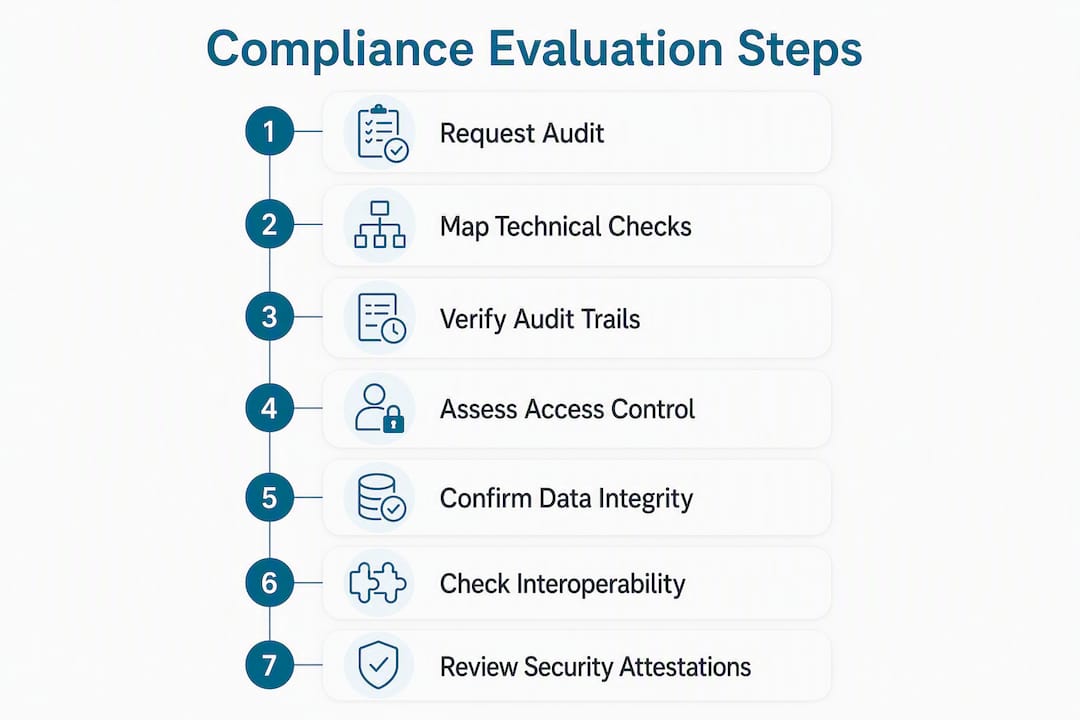
Interoperability determines whether the platform fits your existing infrastructure. A clinical LIMS must support bidirectional HL7 v2.x interfaces and FHIR R4 for EMR connectivity. Ask specifically about HL7 ORU and ORM message support and FHIR DiagnosticReport resources.
Security attestations are the vendor's proof, not their promise. Request a SOC 2 Type II report, and if the vendor claims CAP or ISO certification for the platform itself, ask for the actual audit artifact with findings, not a marketing badge.
Pro Tip: Build a one-page procurement scorecard with pass/fail grades for each pillar before the demo. Share it with the vendor in advance so they know exactly what you will test. Vendors who object to a structured demo agenda are a red flag.
What technical features must a compliant LIMS actually include?
The checklist below covers the features that generate audit deficiencies when absent. Use it in your RFP and during acceptance testing.
- Tamper-evident audit trail capturing user ID, timestamp, old value, new value, and reason for every result change
- Electronic signatures linked to individual user accounts (not shared credentials)
- Exportable audit trail in a readable format (PDF or CSV) without vendor assistance
- Training log with completion dates, version numbers, and user acknowledgments, exportable on demand
- Granular RBAC with role-level permissions, not just department-level groups
- Unique user IDs with no shared accounts; automatic session timeout after inactivity
- Encryption in transit (TLS 1.2 or higher) and at rest
- Emergency access procedure with its own audit trail
- Automated QC rules (Westgard multi-rules) that block result release on QC failures
- Bidirectional HL7 v2.x and FHIR R4 support
- PGx report templates with CPIC guideline citations, PharmGKB annotations, and FDA label references
- IQ/OQ/PQ validation templates supplied by the vendor
For ALCOA+ data integrity specifically, verify that the platform prevents backdated entries and enforces contemporaneous documentation at the point of action.
| Feature | Acceptance Test |
|---|---|
| Tamper-evident audit trail | Amend a result; export the trail and confirm old value, new value, user ID, timestamp, and reason field are all present |
| Electronic signatures | Approve a result; confirm the signature links to a named user account, not a shared login |
| Exportable training log | Export training records for one user; confirm version number and completion date appear |
| RBAC granularity | Create a restricted technician role; confirm it cannot access billing or another provider's patient records |
| HL7/FHIR interface | Send a test ORU message; confirm the receiving EMR displays the result correctly |
| PGx report with CPIC citation | Generate a sample PGx report; confirm a CPIC guideline URL or reference appears in the provider-facing output |
| Automated QC block | Fail a QC run deliberately; confirm the platform blocks result release and logs the event |
Pro Tip: For PGx-specific acceptance testing, verify that report templates include CPIC guideline citations and PharmGKB annotations in the provider-facing output and that FDA pharmacogenomic label references can be included where applicable.
What does implementation and validation actually cost and take?
Validation work typically runs 4–8 weeks for IQ/OQ/PQ cycles with dedicated lab staff. That estimate assumes the vendor supplies validation templates and actively supports the process. Without vendor-supplied artifacts, add two to four weeks.
| Phase | Typical Duration | Vendor Responsibility | Lab Responsibility |
|---|---|---|---|
| Discovery and configuration | Weeks 1–3 | Configure workflows, roles, and templates | Define test menu, user roles, and data fields |
| Instrument interfacing | Weeks 2–5 | Build HL7 interfaces; test message flow | Provide instrument specs; validate results |
| IQ/OQ/PQ validation | Weeks 4–8 | Supply templates; support test execution | Execute tests; document evidence; sign off |
| Training | Weeks 4–8 | Deliver training sessions; provide materials | Complete training; log completion records |
| Go-live and hypercare | Weeks 4–8 | Monitor system; resolve issues | Run parallel operations; confirm data integrity |
Cost drivers that most labs underestimate:
- Integration count: each bidirectional HL7 interface typically adds cost and time; budget separately for each instrument and EMR connection
- Custom report templates: PGx reports with branded layouts and custom interpretation rules require configuration hours beyond standard templates
- Concurrent user seats: seat-based pricing scales with lab size; clarify whether read-only portal users count toward the seat limit
- Validation support hours: some vendors bundle IQ/OQ/PQ support; others bill it separately at consulting rates
The most common timeline risk is instrument interface delays. Instrument manufacturers sometimes take weeks to provide interface specifications. Start that conversation before contract signature, not after.
What should your vendor RFP and demo script include?
RFP paragraph template:
"The vendor must provide: (1) the most recent CAP or ISO audit report for the platform; (2) a SOC 2 Type II report dated within the past 12 months; (3) a signed Business Associate Agreement template; (4) IQ/OQ/PQ validation templates used in prior clinical lab deployments; and (5) a live demonstration of audit trail export, RBAC configuration, and PGx report generation with CPIC guideline references."
Demo script (run in this order):
- Create a test patient result in the system
- Amend the result and add a reason for the change
- Export the audit trail for that result; confirm old value, new value, user ID, timestamp, and reason field
- Show RBAC configuration: create a restricted technician role and demonstrate what it cannot access
- Export a training log for one user showing version number and completion date
- Generate a PGx report with a CPIC guideline citation and an FDA label reference visible in the output
- Show HL7 interface configuration for one instrument or EMR connection
- Demonstrate automatic session timeout and unique user ID enforcement
Sample vendor email:
Subject: Pre-Demo Document Request — [Lab Name] LIMS Evaluation
"Before our scheduled demo on [date], please provide: your most recent CAP or ISO platform audit report, a SOC 2 Type II report, a BAA template, and one sample IQ/OQ/PQ validation package from a prior clinical lab deployment. During the demo, we will ask you to export a live audit trail, configure an RBAC role, and generate a PGx report with CPIC citations. Please confirm you can demonstrate each of these live."
Pro Tip: Run acceptance tests in parallel with instrument interfacing, not sequentially. Labs that wait until interfaces are complete before starting PQ testing routinely add four to six weeks to their go-live date.
How does Labrynix map to these compliance requirements?
Labrynix was built specifically for genetic testing, molecular diagnostics, and PGx labs — not adapted from a generic clinical platform. That distinction shows up in the compliance architecture.
On auditability, Labrynix LIMS logs every result entry, amendment, and deletion with user ID, timestamp, and reason fields, and those logs are exportable in auditor-ready formats. LIMS audit trails and patient data security are built into the platform's core workflow, not added as an afterthought.
On access control, Labrynix supports granular RBAC with configurable role-level permissions, unique user IDs, and session controls. During a Labrynix demo, ask the team to create a restricted technician role live and show you the exact data elements that role cannot reach.
On PGx reporting, Labrynix Reports generates branded, provider-facing and patient-facing pharmacogenomics reports with CPIC guideline support, PharmGKB-informed annotations, and FDA pharmacogenomic label references. PGx reporting for molecular diagnostics is a core capability, not a module bolted onto a generic LIMS.
On interoperability, Labrynix Connect supports HL7, FHIR, APIs, webhooks, and direct EMR/EHR integrations. On security, the platform is built with HIPAA-conscious workflow principles including encryption, audit logging, and configurable data governance.
Labrynix serves PGx labs, genetic testing laboratories, molecular diagnostic labs, hereditary cancer programs, reference labs, hospital labs, startup labs, and multi-site lab networks.
Pro Tip: During procurement, request Labrynix's most recent SOC 2 report or CAP/ISO platform audit artifacts, a BAA template, and a sample IQ/OQ/PQ validation package. These documents should be available before contract signature.
Key Takeaways
For US genetic and molecular labs, compliant LIMS and PGx reporting software must prove auditability, granular access control, and guideline-referenced reporting before any other evaluation criterion.
| Point | Details |
|---|---|
| Define the term correctly | "GMP compliant software" for genetic labs means CLIA/CAP/HIPAA-focused LIMS with PGx reporting, not manufacturing quality management. |
| Three priority checks | Verify exportable audit trails, granular RBAC, and CPIC/PharmGKB-referenced PGx templates during the first demo. |
| Demand vendor artifacts | Request CAP/ISO audit reports, SOC 2, a BAA template, and IQ/OQ/PQ validation packages before contract signature. |
| Budget 4–8 weeks for validation | IQ/OQ/PQ cycles with vendor support typically run 4–8 weeks; instrument interface delays are the most common timeline risk. |
| Labrynix for genetic labs | Labrynix provides auditor-ready exports, granular RBAC, CPIC/PharmGKB PGx reporting, and HL7/FHIR interoperability built for molecular and PGx labs. |
What procurement mistakes do labs actually make?
The most common error is accepting a vendor's compliance narrative without testing it live. A lab director once described approving a LIMS based on a feature checklist the vendor completed in writing, only to discover during a CAP inspection that the audit trail could not be exported without vendor intervention. The finding cost the lab a corrective action plan and a re-inspection fee. The fix was straightforward: require a live export during the demo. The mistake was not requiring it.
Shared accounts are the second most frequent problem. Labs under time pressure during go-live sometimes allow technicians to share credentials "temporarily." That temporary arrangement becomes permanent, and when an inspector asks who approved a result, the answer is a shared login with no individual accountability. HIPAA requires unique user identification as a technical safeguard, and CAP checklists treat shared accounts as a deficiency finding.
A practical tip on demo structure: run the audit trail export and RBAC configuration tests in the first 30 minutes, before the vendor moves to feature slides. Vendors who lead with slides and defer live testing to "a follow-up session" are usually buying time to prepare a workaround. The features that matter most should work on the first try, unscripted.
On HIPAA's addressable controls: treat them as effectively required unless you document a risk-based alternative. Labs that treat "addressable" as "optional" routinely receive audit citations for undocumented risk decisions. The conservative approach is to implement the control and document it.
Labrynix gives genetic labs audit-ready compliance from day one
Genetic and PGx labs evaluating LIMS and reporting software need a platform that proves compliance during the demo, not after contract signature. Labrynix delivers exactly that: auditor-ready audit trail exports, training log exports, granular RBAC configuration, and PGx report generation with CPIC guideline citations and PharmGKB annotations, all in one platform built for molecular and genetic lab workflows.
Three things Labrynix will show you in a demo:
- Auditor-ready exports: export a live audit trail with amendment history, user IDs, timestamps, and reason fields; export training logs with version numbers and completion dates
- PGx reports with guideline references: generate a branded provider-facing report with CPIC citations, PharmGKB annotations, and FDA pharmacogenomic label references
- HL7/FHIR interoperability and validation support: show interface configuration and provide IQ/OQ/PQ validation templates from prior clinical lab deployments
Schedule a Labrynix demo for your genetic testing lab and request an audit trail export, a sample PGx report with guideline citations, and a validation template during the session. If you want to review PGx reporting capabilities specifically, the Labrynix PGx reporting platform covers over 700 medications with CPIC and PharmGKB support.
Authoritative sources for your vendor negotiations
These are the primary standards and agencies your procurement team should cite when evaluating vendors and negotiating compliance requirements.
- CLIA/CMS: The Clinical Laboratory Improvement Amendments govern all US labs testing human specimens; your LIMS must support documentation of QC, result authorization, and personnel records required under 42 CFR Part 493.
- CAP Laboratory Accreditation Program: CAP checklists specify requirements for audit trails, QC documentation, and LIS validation; request vendor documentation mapped to specific CAP checklist items.
- HHS/HIPAA: Technical safeguards require unique user IDs, tamper-evident audit logs, encryption, and automatic logoff; require a signed BAA from any SaaS vendor processing PHI.
- FDA 21 CFR Part 11: Applies when electronic records and signatures replace paper records in regulated submissions; verify with your regulatory counsel whether your lab's reporting workflows trigger Part 11 requirements.
- CPIC and PharmGKB: The Clinical Pharmacogenomics Implementation Consortium and PharmGKB are the primary sources for PGx guideline citations in provider-facing reports; verify that your reporting platform references current CPIC levels and PharmGKB annotations.
- SOC 2 Type II / ISO 27001: Vendor trust signals for security controls; request the full report with findings, not a summary badge, and confirm the audit period covers the current year.