The provenance of data is the recorded history of where a piece of data came from, what happened to it, and who or what touched it along the way. That record answers three questions: who created or changed it, what process produced it, and what inputs fed that process. Standards bodies including W3C and OASIS formalize this record so systems like Labrynix can capture it automatically rather than reconstruct it after the fact.
Three things break without it:
- Trust and QA — you can't judge whether a dataset is fit for use if you can't see where it came from.
- Reproducibility and debugging — retracing a bad result to its source requires a record of every transformation applied.
- Auditability and compliance — regulators and internal reviewers need a verifiable chain, not a verbal explanation.
Key Takeaways
Provenance succeeds when the Entity-Activity-Agent record is captured automatically at the moment data is created, not reconstructed afterward from memory or logs.
| Point | Details |
|---|---|
| Define before you build | A provenance record must answer who, what process, and what inputs, per the W3C PROV model. |
| Match granularity to risk | Use attribute-level detail for high-stakes entities and dataset-level summaries for low-stakes ones. |
| Choose lineage or provenance deliberately | Lineage answers flow questions; full provenance answers accountability questions. |
| Automate capture, don't log manually | Manual provenance logging fails exactly when workloads peak and gaps matter most. |
| Labrynix supports lab-specific provenance | It links LIMS sample workflows, audit logs, and guideline references directly to PGx report versions. |
Table of Contents
- What Does Data Provenance Actually Cover?
- What Are the Formal Types of Data Provenance?
- Is Data Provenance the Same as Data Lineage?
- Why Does Provenance Matter for Trust and Compliance?
- Where Is Data Provenance Most Critical?
- What Standards and Tools Support Data Provenance?
- How Do You Capture and Govern Provenance in Practice?
- What Trade-Offs Come With Provenance at Scale?
- How Do Genomics and Precision-Medicine Labs Handle Provenance?
- What Legal and Ethical Issues Surround Data Provenance?
- How Do You Audit and Verify Provenance Records?
- How Should Provenance Fit Into Governance Frameworks?
- How Do You Design a Provenance Strategy for Your Project?
- What Do Real Provenance Use Cases Look Like in AI and Healthcare?
- What Should Teams Prioritize When Operationalizing Provenance?
- A Practical Next Step for Labs Managing Provenance
- Frequently Asked Questions
- Sources
What Does Data Provenance Actually Cover?
A provenance record isn't one field. It's a small cluster of facts that, together, let someone reconstruct how a piece of data came to exist in its current form.
The core elements, borrowed from the PROV Data Model, are:
- Entity — the thing being described (a file, a table, a lab result).
- Activity — the process that generated or transformed it.
- Agent — the person, instrument, or software responsible.
- Derivation — the link showing one entity came from another.
- Timestamp — when the activity happened.
- Inputs/outputs — what went in, what came out.
- Bundle — provenance about the provenance record itself, useful when the record is later revised.
Granularity matters here. A single reported lab value might carry provenance down to the instrument serial number and calibration date. A curated dataset of ten thousand rows usually gets dataset-level provenance instead: one record describing the collection method, the processing script, and the release version, rather than ten thousand individual histories. Most teams mix both, tracking detail where errors are costly and summarizing where they aren't.
What Are the Formal Types of Data Provenance?
Database research split provenance into three precise categories decades ago, and the distinction still shapes how modern systems are built.
- Why-provenance answers why a piece of data appears in a query result, pointing to the source tuples that justify it.
- Where-provenance answers where a specific value physically came from, tracing it to its exact origin location.
- How-provenance answers how the result was computed, capturing the full derivation, not just the sources.
These categories come from formal database research on provenance types, which also introduced semiring provenance, a mathematical framework that lets a system compute not just where data came from but a score, weight, or confidence value alongside it. Provenance query languages, like the academic ProQL project, build on this to let engineers ask "why is this row here?" the same way they'd ask any other database query. None of this is academic trivia. It's the theory that makes tools like OpenLineage and Apache Atlas queryable rather than just descriptive logs.
Is Data Provenance the Same as Data Lineage?
No, though the two get used interchangeably more often than they should. Provenance is the broader concept: origin, derivation, and the agents responsible, all in one record. Lineage is narrower. It describes the path data took through a pipeline, system to system, useful mainly for tracing flow and diagnosing where a job broke.
Lineage is often a subset of provenance. A lineage graph might tell you data moved from Table A through Job B into Dashboard C. Full provenance tells you that plus who ran Job B, what code version it used, and why the transformation logic changed last quarter.
If your question is "which downstream reports break if I change this column," lineage tracking is enough. If your question is "can I trust this number, and who's accountable if it's wrong," you need full provenance. Regulated environments, healthcare and pharma especially, almost always need the latter.
Why Does Provenance Matter for Trust and Compliance?
Provenance pays off in ways that are easy to underestimate until something goes wrong. It supports source trust assessment, reproducibility of results, root-cause debugging, and regulatory auditability, and it's become central to AI governance and model risk management as regulators start asking hard questions about training data.
Here's a scenario that shows the value concretely: a machine learning team notices a model's accuracy has quietly degraded. With provenance tracking in place, they trace the drop back to a mislabeled batch of training inputs, identify the specific labeling agent and timestamp that introduced the error, and retrain on a corrected subset instead of starting over. Without provenance, that same investigation could take weeks of manual log-diving, or never resolve at all.
Provenance also shows up in operational metrics: shorter incident time-to-resolution, and research results other teams can actually reproduce instead of taking on faith.
Pro Tip: Log provenance events at the moment data is created or transformed, not after the fact. Retroactive provenance reconstruction is almost always incomplete, because the context that mattered at creation time rarely survives in anyone's memory or a Slack thread.
Where Is Data Provenance Most Critical?
Some domains can't function without it. A few stand out.
- AI and ML training data — provenance lets teams audit which examples shaped a model, catch labeling bias, and reproduce a model's training conditions for a compliance review.
- Healthcare and clinical research — provenance links a sample's chain of custody to the interpretation rules and clinical guidelines that shaped a reported result, which is essential for reproducibility and regulatory reporting.
- Pharma and supply chain — provenance traces raw materials and certifications back to their source, verifying authenticity before a batch ships.
- Debugging and forensics — provenance lets an engineer replay the exact inputs that produced a bug, isolate the transformation that introduced it, and reprocess only the affected records instead of the whole pipeline.
Each of these shares the same underlying need: a verifiable record that survives longer than anyone's memory of what happened.
What Standards and Tools Support Data Provenance?
Interoperability is where good intentions usually die, unless you're using a shared vocabulary. A handful of standards and open tools have become the practical backbone of provenance work.
On the standards side: W3C PROV (with its PROV-DM model, PROV-O ontology, and PROV-N notation) is the closest thing to a universal grammar for provenance. OASIS Data Provenance Metadata segments provenance into Source, Provenance, and Use categories, built for enterprise and regulatory contexts. RO-Crate packages provenance alongside the dataset itself using JSON-LD, so the record travels with the data instead of living in a separate system that gets lost.
On the tooling side: OpenLineage captures job and run metadata across pipeline tools in a standardized event format. Apache Atlas provides metadata governance and lineage classification, popular in Hadoop-era enterprise stacks. DataHub offers a searchable metadata catalog with lineage graphs built in. Commercial platforms like IBM's data governance suite and Snowflake's native lineage tracking extend similar capability into managed cloud environments.
When evaluating any of these, check for automated capture (not manual entry), machine-readable output, queryability, and governance hooks like access controls and retention policies.
How Do You Capture and Govern Provenance in Practice?
Good provenance capture is mostly discipline, not technology. A short checklist:
- Embed capture directly into workflows rather than relying on someone remembering to log it afterward.
- Record the Entity, Activity, and Agent triple for every meaningful transformation.
- Log inputs, parameter values, and software versions alongside outputs.
- Assign persistent identifiers to entities so records stay linkable across systems and years.
- Timestamp every event and record custody transfers explicitly.
- Package provenance with the data itself, using RO-Crate or PROV-O encodings rather than a separate document nobody opens.
Governance matters just as much as capture. Role-based access control keeps sensitive provenance metadata visible only to those who need it. Tamper-evident logs prevent quiet edits to the historical record. Retention policies should minimize what's kept long-term, aligned with whatever legal or ethical obligations apply to the data.
Pro Tip: Generate a cryptographic checksum at the moment of creation and tie it directly to the provenance event, not as a separate step. Automate the fixity check into your retention schedule so a corrupted or altered file gets flagged before anyone relies on it.
What Trade-Offs Come With Provenance at Scale?
Provenance isn't free, and pretending otherwise leads to abandoned projects. Storage and indexing costs climb fast if you're logging every transformation indiscriminately. Query performance can suffer under provenance-heavy joins. Verbose telemetry buries the decisions that actually matter under noise nobody reads. Sensitive metadata, like an agent's identity or a patient sample's origin, can itself become a privacy exposure.
The fix is selective capture, not blanket logging. Tier your retention so operational detail ages out while decision-relevant records persist. Segment provenance into Source, Provenance, and Use categories so you're not treating every field with the same sensitivity. Assign a provenance steward, someone accountable for the policy, and write provenance requirements into data management plans and SOPs before the system goes live, not after an audit flags the gap.
How Do Genomics and Precision-Medicine Labs Handle Provenance?
Molecular and precision-medicine labs face a harder version of this problem: they need both why-provenance and where-provenance simultaneously. A reported pharmacogenomic result has to trace back to the physical sample's chain of custody and to the clinical rule set, like CPIC guidance, that shaped its interpretation. Healthcare provenance research treats this dual requirement as central to reproducibility and patient safety, not a nice-to-have.
A practical checklist for lab teams:
- Sample identifiers with a documented chain of custody from intake to result.
- Analysis code, pipeline version, and parameters captured at run time.
- Explicit guideline references, CPIC and PharmGKB versions among them, tied to each interpretation.
- Report-level provenance showing which rules and data fed the final document a provider sees.
Labrynix supports this by connecting LIMS workflow data directly to PGx report generation, maintaining audit logs across the sample-to-report pipeline, and linking guideline references like CPIC updates to the specific report version they informed. Secure delivery through provider and patient portals keeps that chain intact through final handoff.
What Legal and Ethical Issues Surround Data Provenance?
Provenance records are themselves data, and that creates a second layer of obligation most teams overlook until a regulator or a patient asks a hard question.
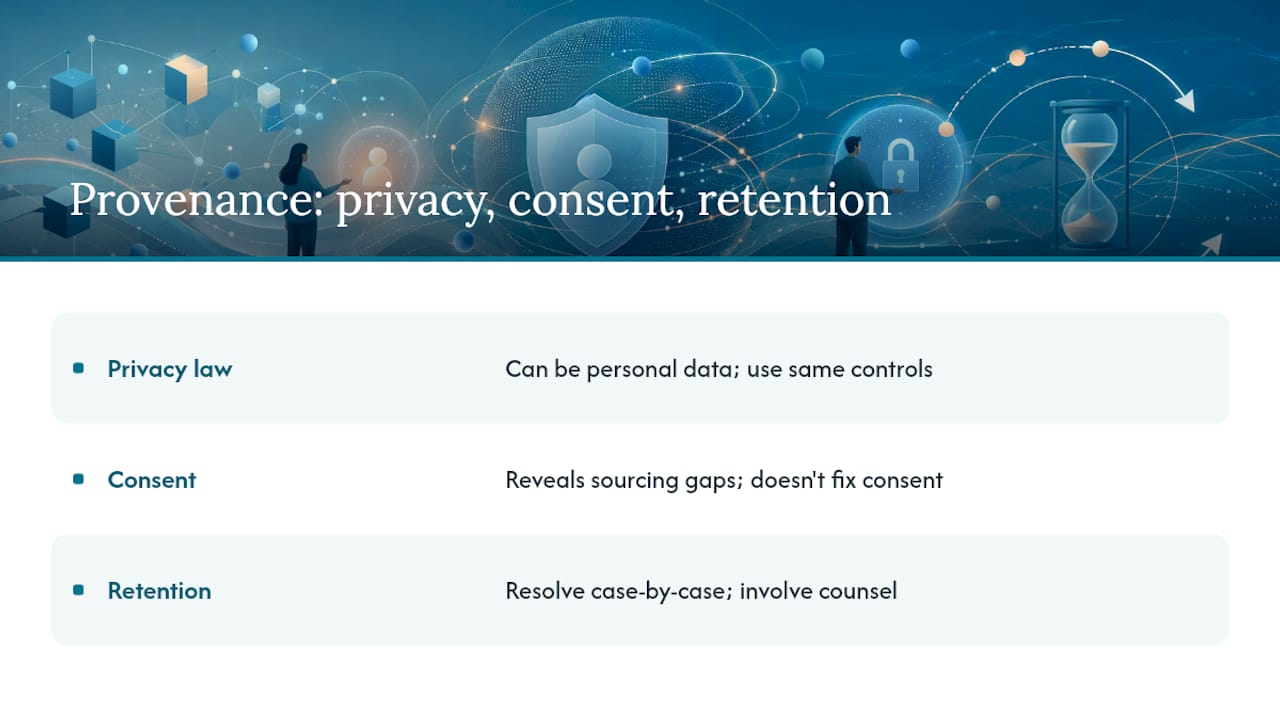
Privacy law is the sharpest edge. A provenance record that names the specific technician who ran an assay, or logs the exact device that generated a health measurement, is personal data under regulations like HIPAA in clinical contexts and GDPR wherever European subjects are involved. That means the provenance trail meant to prove trustworthiness can become a liability if it's stored without the same access controls applied to the underlying data. Minimization matters here: log what's needed to answer the who/what/when question, not everything technically possible.
Consent is the second issue, particularly in AI training contexts. If a dataset's provenance record shows it was assembled from sources without clear rights to reuse, that provenance record becomes evidence of the problem rather than proof of clean sourcing. Provenance doesn't fix a consent gap. It just makes the gap visible, which is often uncomfortable but always better than not knowing.
Retention creates tension too. Compliance regimes frequently want long retention for auditability, while privacy principles push toward deletion once a purpose is served. Resolving that tension case by case, rather than defaulting to "keep everything forever," is safer than it looks, since indefinite retention itself carries regulatory risk. Any organization handling health, financial, or biometric data should treat provenance retention policy as a legal question, not just an engineering one, and involve counsel before finalizing it rather than after an incident forces the conversation.
How Do You Audit and Verify Provenance Records?
A provenance record is only as trustworthy as the checks applied to it. Auditing provenance isn't a one-time task; it's a recurring discipline with a few concrete methods.
Start with completeness checks: does every entity in the system have an Entity, Activity, and Agent triple, or are there silent gaps where a transformation happened off the record? Automated scans that flag entities missing required provenance fields catch this faster than manual review ever will.
Fixity verification comes next. Cryptographic checksums generated at creation time should still match on audit day. A mismatch means either corruption or tampering, and either way, that entity's downstream provenance chain needs re-examination before anyone trusts results derived from it.
Chain integrity review traces a sample record end to end, checking that every derivation link points to a real, still-accessible predecessor. Broken links, an input entity that was deleted or a bundle reference that no longer resolves, are the most common failure mode in provenance systems built without governance hooks from the start.
Cross-referencing against independent logs helps too. If your LIMS records a sample's custody transfer at 2:14 PM and your instrument log shows the same assay starting at 1:50 PM, that fourteen-minute mismatch is worth investigating before it's worth explaining to a regulator. Healthcare compliance audit trails rely heavily on this kind of cross-system reconciliation, since a single log source is rarely sufficient proof on its own.
Tamper-evident logging, where each entry is cryptographically linked to the one before it, makes retroactive edits detectable rather than invisible. Building that in from day one costs far less than adding it after an auditor asks why a log entry looks edited.
How Should Provenance Fit Into Governance Frameworks?
Provenance data is only useful if it plugs into the policies an organization already runs on, rather than living in a parallel system nobody consults during a real decision.
The starting point is treating provenance as a governed asset, not exhaust. OASIS positions provenance metadata as something enterprises should manage with the same rigor as the data it describes, which means it needs an owner, a classification scheme, and a place in the access control model, not just a log file somewhere.
Concretely, that looks like a few things working together. Data governance committees should review provenance requirements alongside data quality and security requirements, not as a separate afterthought item on the agenda. Retention schedules for provenance records need to match retention schedules for the underlying data, since a provenance trail that outlives (or disappears before) the data it describes is functionally useless either way. Role-based access controls, the kind detailed in frameworks around security and compliance for regulated data, should extend to provenance metadata itself, since a chain-of-custody record is often as sensitive as the record it documents.
Organizational policy should also name who's accountable when provenance is incomplete. Without a named steward, gaps get discovered during an audit rather than during normal operations, which is the worst possible time to find them. Building provenance review into existing SOPs, rather than creating a separate provenance-specific audit cycle, keeps the practice alive instead of becoming a compliance exercise everyone quietly resents.
How Do You Design a Provenance Strategy for Your Project?
There's no universal provenance template, because the right level of detail depends entirely on what question you'll eventually need the record to answer.
Start by identifying the specific accountability questions your project needs to answer under pressure: Who approved this result? What training data shaped this model's decision? Which instrument produced this measurement? Write those questions down before building anything, since they determine what fields actually matter.
From there, map granularity to risk. High-stakes entities, a clinical result, a training dataset feeding a deployed model, warrant detailed, attribute-level provenance. Low-stakes intermediate artifacts can get dataset-level summaries instead. Trying to capture everything at maximum detail is how provenance projects collapse under their own storage costs within a year.
Pick your encoding early rather than retrofitting it. Standards like PROV-DM or packaging formats like RO-Crate exist precisely so you're not inventing a schema from scratch, and switching formats midstream is expensive.
Finally, build capture into the workflow itself, whether that's a LIMS, an ML pipeline orchestrator, or a document management system, rather than asking humans to log it manually after the fact. Manual provenance logging has a predictable failure rate: it gets skipped exactly when things are busiest, which is usually when it matters most.
What Do Real Provenance Use Cases Look Like in AI and Healthcare?
Abstract principles land differently once you see them applied. Two scenarios illustrate the pattern.
In an AI context, a model deployed for clinical decision support starts producing inconsistent recommendations for a specific patient subgroup. Because the training pipeline logged provenance for every training example, the team traces the inconsistency to a data source added six months earlier that used a different labeling protocol than the rest of the dataset. They isolate that subset, relabel it against the current protocol, and retrain, resolving the issue in days instead of restarting the entire data collection effort. That's why-provenance and how-provenance working together: knowing which examples justified the output, and knowing how the labeling process differed.
In a healthcare context, a molecular lab reports a pharmacogenomic result flagging a drug interaction risk. Months later, a provider asks which guideline version informed that specific recommendation, since CPIC guidance updates periodically and the answer matters for a follow-up prescribing decision. Because the report generation process recorded the exact guideline version, the interpretation rule applied, and the analyst who reviewed it, the lab answers within minutes instead of reconstructing the process from memory or old emails. That's where-provenance and agent tracking doing the work a verbal explanation never could.
Both cases share the same lesson: provenance only pays off when it was captured at the moment the decision was made, not reconstructed afterward under pressure.
What Should Teams Prioritize When Operationalizing Provenance?
Most teams treat provenance as a documentation exercise, something you write up after a project ships. That's backwards, and it's the single biggest reason provenance initiatives stall. The record has to be generated by the system doing the work, at the moment the work happens, or it simply won't exist when someone needs it.
The formal models, why-provenance, where-provenance, semiring scoring, matter less than whether your workflow actually produces an Entity-Activity-Agent triple every time something meaningful happens. Labs and AI teams that get this right build capture into the pipeline itself rather than bolting logging on as a compliance checkbox. That's the practical lesson underneath the standards.
Anyone designing a system for regulated data, genomic, clinical, or otherwise, should write provenance requirements into the data management plan before the architecture is finalized, not after the first audit request arrives.
A Practical Next Step for Labs Managing Provenance
If your lab is trying to solve this with spreadsheets and disconnected instrument logs, the gap between what regulators expect and what you can actually produce on demand only grows. Labrynix connects sample intake, accessioning, and workflow status directly to PGx report generation, so the chain from raw sample to final clinical report stays intact and auditable in one system rather than scattered across tools that don't talk to each other.
The platform maintains audit logs across that full workflow, links guideline references directly to the report versions they informed, and delivers results through secure provider and patient portals, so provenance isn't something you reconstruct after the fact. It's captured as the work happens. For labs evaluating what this looks like against their current setup, the genetic testing lab software page walks through the specific workflow and reporting features involved. If you're ready to see it applied to your own sample-to-report pipeline, request a walkthrough of Labrynix's solutions to start the conversation.
Frequently Asked Questions
What is the provenance of data in simple terms? It's the documented history of a piece of data: who created it, what process produced or changed it, and what inputs fed that process, structured so anyone can verify it later.
Is data provenance required by law? Not universally, but regulated sectors like healthcare (HIPAA) and any organization handling EU personal data (GDPR) face requirements that make provenance records practically necessary for audit and consent verification.
What's the difference between data provenance and data lineage? Lineage tracks the path data took through a pipeline. Provenance is broader, covering origin, derivation, and the specific agents responsible, which supports accountability questions lineage alone can't answer.
Which tools capture data provenance automatically? Open projects like OpenLineage, Apache Atlas, and DataHub capture pipeline and dataset metadata automatically; commercial platforms including IBM's governance suite and Snowflake's native lineage tools extend similar capability in managed environments.
How do labs track provenance for pharmacogenomic reports? By linking sample chain-of-custody records to the specific clinical guideline version, like CPIC, and analysis parameters that shaped the final interpretation, ideally captured automatically within the LIMS and reporting workflow rather than logged manually after sign-out.
This article is general information, not a substitute for advice from a qualified doctor. Consult a qualified healthcare professional about your own circumstances before acting on anything here.
Sources
- PROV-DM: The PROV Data Model
- Data Provenance Metadata Version 1.0 — OASIS DPS
- Data provenance in healthcare: approaches, challenges, and future directions (PMC article)
- Provenance types (why/where/how) in database research (2009 DOI)