
For a new lab launch, the right move is a compliance-first LIMS with immutable audit trails, electronic signatures, role-based access, document control, and encryption baked in from day one — then validate it to FDA 21 CFR Part 11 and ISO 17025 standards before your first sample runs. Retrofitting compliance after go-live costs far more in time and rework than scoping it correctly upfront.
Here is your immediate action plan:
- Define your CSV scope in the first week: list every regulated workflow the LIMS will touch and document it in a User Requirements Specification (URS).
- Map your data flows and identify where protected health information (PHI) moves between instruments, the LIMS, and external systems (EHR, billing, reporting).
- Confirm instrument connectivity with your shortlisted vendors before signing — driver availability is a common late-stage blocker.
- Select an integration-capable vendor that supports HL7, FHIR, and open APIs, and can supply validation deliverables (IQ/OQ/PQ scripts, traceability matrix).
- Schedule your UAT window before go-live, not after, and assign a dedicated validation lead.
For genetic and molecular lab launches, Labrynix is worth evaluating early; it covers LIMS workflow management, HL7/FHIR integrations, role-based access, audit logging, and PGx reporting controls in one connected platform built specifically for this lab type.
Pro Tip: Don't wait until vendor selection to write your URS. A draft URS written before demos forces vendors to respond to your compliance requirements, not their own marketing checklist.
Key Takeaways
A compliance-first LIMS with immutable audit trails, electronic signatures, role-based access, and validated integrations is the foundation every new molecular or genetic lab needs before its first sample runs. The specific requirements for each lab may be shaped by FDA, ISO 17025, CLIA, or HIPAA regulations; consult the relevant regulatory source for your use case.
| Point | Details |
|---|---|
| Start with a URS | Write your User Requirements Specification before configuration begins — it shapes every validation decision. |
| Require CSV deliverables in the contract | IQ/OQ/PQ scripts, a traceability matrix, and a final validation report must be contractual deliverables, not verbal commitments. |
| Validate integrations separately | Instrument connectivity and EHR order exchange are validated components and need their own test scripts and acceptance criteria. |
| Track four post-launch KPIs | Audit trail completeness, mean time to resolve CAPA, system uptime, and instrument connectivity rate keep compliance visible after go-live. |
| Labrynix for genetic and molecular labs | Labrynix covers LIMS, PGx reporting, HL7/FHIR integrations, and audit logging in one platform built for this lab type. |
Table of Contents
- What LIMS compliance tools does a new lab launch actually need?
- How should you phase a compliant LIMS rollout for a new lab?
- How do you evaluate LIMS vendors for compliance capability?
- What CSV deliverables and regulatory documentation does your LIMS need?
- How do you migrate data and connect instruments and EHR systems safely?
- How do you run UAT and prepare your team for go-live?
- What does post-launch compliance operations actually look like?
- How does Labrynix support a compliance-first new lab launch?
- What most lab launch teams get wrong about compliance sequencing
- Labrynix is built for labs that need compliance from day one
- Sources
What LIMS compliance tools does a new lab launch actually need?
Every compliance gap in a LIMS eventually shows up in one place: the audit. The features below are not optional add-ons — they are the minimum a new lab needs to pass FDA, ISO 17025, CLIA, or HIPAA review from day one. Use this list as your non-negotiable RFP checklist.
Core features mapped to regulatory requirements
- Immutable audit trail. Every record creation, edit, deletion, and access event must be logged with a time-synchronized timestamp (UTC-traceable), the user ID, and the reason for change. FDA 21 CFR Part 11 requires that audit trails be computer-generated and protected from modification.
- Electronic signatures (21 CFR Part 11 alignment). Signatures must be unique to the individual, require a second authentication step at the point of signing, and be permanently linked to the signed record. A checkbox is not a compliant e-signature.
- Document control and versioning. SOPs, test methods, and forms need version history, effective dates, and a controlled distribution workflow. ISO 17025 and CLIA both require documented procedures that staff can demonstrate they have read and understood.
- Role-based access control (RBAC). Access to data, workflows, and configuration settings must be tied to defined roles, not individual permissions granted ad hoc. Least-privilege access is the baseline expectation under HIPAA security rules.
- Secure user authentication. Multi-factor authentication (MFA) for remote access and strong password policies are expected under HIPAA and align with FDA cGMP guidance for computerized systems.
- Encryption at rest and in transit. PHI and genetic data are typically encrypted using current standards such as AES-256 at rest and TLS 1.2 or higher in transit. This is a HIPAA Security Rule requirement and a practical necessity for any cloud-hosted LIMS.
- Automated instrument data capture. Manual transcription of instrument results is a data integrity risk. Direct bidirectional instrument interfaces eliminate transcription errors and create a traceable data chain.
- CAPA and incident tracking. Corrective and preventive action workflows must be built into the LIMS or tightly integrated with a quality module. Open CAPAs with no closure dates are commonly reported findings during CAP and ISO 17025 inspections.
- Calibration and equipment logs. Equipment records, calibration schedules, and maintenance history need to live in the system, not a spreadsheet. ISO standards for laboratory quality require traceable equipment records.
- SOP read-confirmation. Staff must be able to acknowledge they have read and understood current SOPs within the system, with a logged timestamp. This is one of the most commonly omitted features in entry-level LIMS products.
Two small features that vendors frequently omit and auditors frequently check: time-synchronized audit timestamps (not just server time) and tamper-evident export formats for audit log downloads. Ask for both in your demo.
How should you phase a compliant LIMS rollout for a new lab?
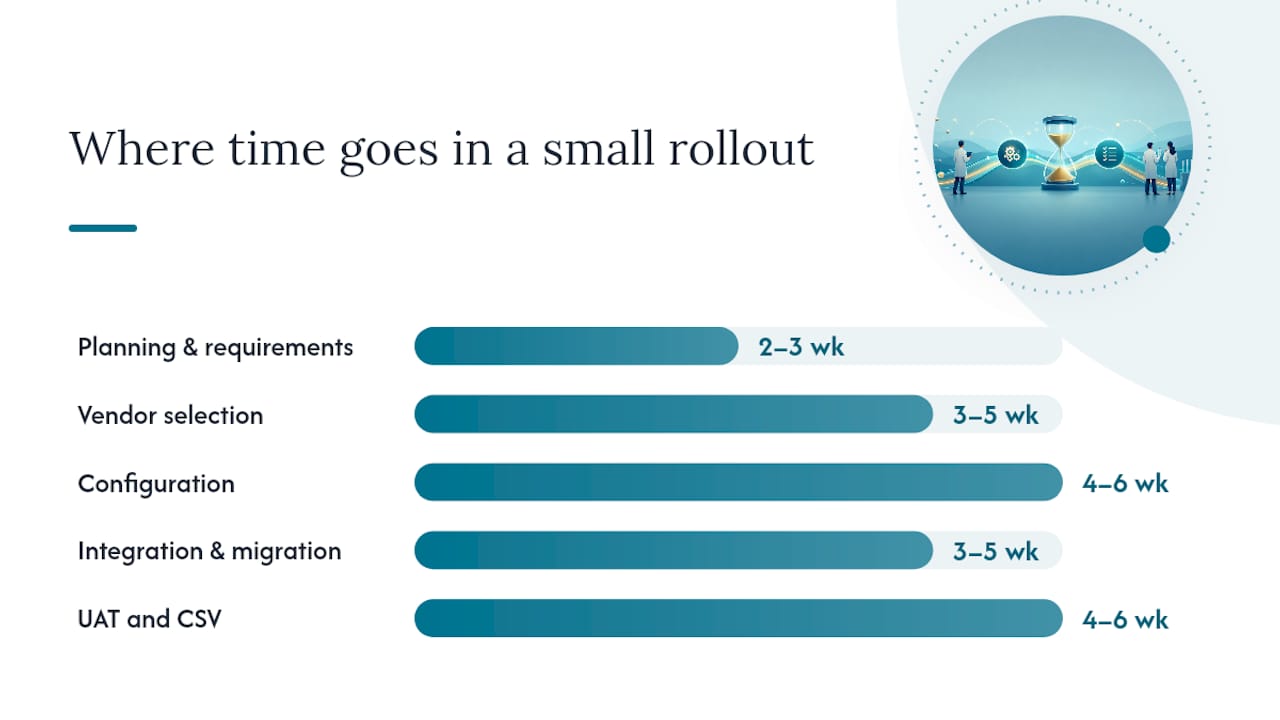
A new lab launch has one structural advantage over an existing lab migration: no legacy data to untangle on day one. Use that window to build the compliance architecture correctly before any samples run. The phases below apply to most new molecular or genetic labs; timelines compress for small startup labs and expand for multi-site deployments.
- Planning and requirements (weeks 1–4). Draft the URS, map regulated workflows, identify integration points (instruments, EHR, billing), and assign a validation lead. Deliverable: signed URS and project charter.
- Vendor selection and contracting (weeks 3–8). Issue RFP, score vendors against the compliance checklist, conduct demos, review security attestations, and negotiate CSV support terms. Deliverable: signed contract with validation deliverables listed.
- System configuration (weeks 6–12). Configure roles, workflows, test codes, document templates, and instrument interfaces per the URS. Deliverable: configured system in a validation environment.
- Instrument integration and data migration (weeks 10–16). Connect instruments, validate bidirectional data flows, migrate any reference data (test codes, reference ranges, provider records), and verify data integrity. Deliverable: integration test report and migration verification log.
- UAT and CSV execution generally take place over several weeks, often scheduled between weeks 14 and 20. Run user acceptance testing against documented test scripts, execute IQ/OQ/PQ protocols, resolve defects, and produce the traceability matrix. Deliverable: completed validation package.
- Go-live and stabilization (weeks 18–24). Activate production environment, run parallel operations if required, monitor for defects, and enforce SOP read-confirmation. Deliverable: go-live sign-off and stabilization report.
- Optimization (weeks 22–ongoing). Review KPIs, close open CAPAs, schedule first internal audit, and plan periodic revalidation. Deliverable: post-launch performance report.
| Phase | Small Startup Lab | Multi-Site Molecular Lab |
|---|---|---|
| Planning and requirements | 2–3 weeks | 4–6 weeks |
| Vendor selection | 3–5 weeks | 6–10 weeks |
| Configuration | 4–6 weeks | 8–14 weeks |
| Integration and migration | 3–5 weeks | 6–12 weeks |
| UAT and CSV | 4–6 weeks | 8–14 weeks |
| Go-live and stabilization | 2–4 weeks | 4–8 weeks |
| Total estimate | 18–29 weeks | 36–64 weeks |
The most common gating decision: do not start UAT until configuration is frozen. Changes made during UAT invalidate completed test scripts and force re-execution, which is the single biggest schedule killer in LIMS implementations.
How do you evaluate LIMS vendors for compliance capability?
Vendor demos are designed to show you what works. Your job is to find what doesn't. The questions below are built for procurement and IT leads who need to score vendors on compliance, not just features.
Vendor capability checklist
- Does the vendor supply IQ/OQ/PQ scripts, a traceability matrix, and a validation summary report as part of the contract?
- Is the audit trail immutable — meaning no user, including system administrators, can edit or delete log entries?
- Are electronic signatures compliant with 21 CFR Part 11 (unique ID, second authentication, linked to record)?
- Does the system support SSO and MFA for remote access?
- What encryption standards are used at rest and in transit, and can the lab bring its own encryption keys?
- What HL7, FHIR, and API capabilities are available, and is there published API documentation?
- Which instrument drivers are pre-built, and what is the process for adding a new instrument?
- What is the backup frequency, retention period, and recovery time objective (RTO)?
- What security attestations relevant to SOC 2 Type II or HIPAA compliance has the vendor completed, and can they share the report?
- What is the support SLA for critical issues, and is validation support included or billed separately?
Pro Tip: Ask vendors to demonstrate a live audit trail export during the demo — not a screenshot. If they can't show you a tamper-evident, time-stamped export in under five minutes, that's a gap worth probing.
RFP questions focused on compliance
- "Describe your change-control process for system updates. How are validated states protected after a software release?"
- "Provide a sample traceability matrix from a previous implementation."
- "How does your e-signature workflow meet 21 CFR Part 11 Section 11.200?"
- "What is your data retention policy, and how does it align with CLIA and HIPAA retention requirements?"
- "Do you offer bring-your-own-key (BYOK) encryption for PHI at rest?"
On pricing: startup labs typically see subscription costs in the range of a few thousand dollars per month for core LIMS modules, with professional services for integrations and CSV validation billed separately. Enterprise multi-site deployments can run significantly higher. No exact dollar figure is provided here due to variability by deployment scope; clarify all line items with each vendor. Always clarify whether CSV deliverables, instrument driver development, and training are included or quoted as add-ons — those line items are where budget surprises live. For genetic lab customization options, the configuration scope directly affects both timeline and cost.
What CSV deliverables and regulatory documentation does your LIMS need?
Computer system validation (CSV) is the documented proof that your LIMS does what it claims to do, consistently and under controlled conditions. Auditors from the FDA, CAP, and accreditation bodies expect a complete validation package before they accept electronic records as trustworthy. FDA technical guidance and cGMP regulations set the baseline expectations.
Required CSV artifacts
- User Requirements Specification (URS). Written before configuration begins; defines what the system must do in regulatory and operational terms.
- Functional Specification (FS) and Design Specification (DS). Vendor-supplied documents describing how the system meets the URS.
- Installation Qualification (IQ). Confirms the system is installed correctly in the intended environment.
- Operational Qualification (OQ). Tests that the system functions as specified under normal and boundary conditions.
- Performance Qualification (PQ). Validates the system performs correctly in the actual production environment with real workflows.
- Traceability matrix. Maps every URS requirement to at least one test script and its pass/fail result.
- Change control log. Documents every configuration change post-validation, with impact assessment and re-test evidence.
- Data migration verification report. Confirms migrated data is complete, accurate, and traceable to the source.
- Final validation report. Summarizes the validation effort, open defects, risk acceptance, and sign-off by the validation lead and lab director.
How these tie to specific regulations: FDA 21 CFR Part 11 requires validated systems for electronic records and signatures — the IQ/OQ/PQ package is your primary evidence. ISO 17025 requires documented procedures and traceability for all measurement results, which the traceability matrix and equipment calibration records satisfy. CLIA requires that labs maintain records sufficient to reconstruct test results, which the audit trail and data migration report address.
Labs performing regulated food testing should also review FDA FSMA traceability requirements, which impose additional record-linkage obligations beyond standard LIMS audit trails.
For deeper guidance on LIMS data integrity controls and how they map to audit evidence, that resource covers the practical documentation chain in detail.
How do you migrate data and connect instruments and EHR systems safely?
Data migration and system integration are where most LIMS projects accumulate hidden compliance risk. A clean migration plan and a tested integration architecture prevent data integrity failures that can invalidate your validation package.
Data migration steps
- Inventory all source systems. List every database, spreadsheet, and paper record that contains data the new LIMS needs (test codes, reference ranges, patient demographics, historical results).
- Map data model differences. Document field-by-field mappings between source and target schemas. Unmapped fields are a common source of silent data loss.
- Extract, transform, and validate. Run a test migration in the validation environment, then verify record counts, field values, and referential integrity against the source.
- Audit-proof the import. Log every migrated record with its source identifier, migration timestamp, and the user or process that performed the import.
- Define rollback criteria. Specify the conditions under which migration will be halted and the production environment restored to its pre-migration state.
- Run acceptance tests. Spot-check a statistically representative sample of migrated records against source documents before go-live sign-off.
Integration checklist
| Integration Type | Supported Protocols | Key Validation Step |
|---|---|---|
| Instrument connectivity | ASTM, HL7 v2, proprietary drivers | Bidirectional result verification |
| EHR/EMR order exchange | HL7 v2, FHIR R4 | Order-result round-trip test |
| Billing platform | API, HL7 v2 | Claim generation accuracy test |
| Reference lab exchange | FHIR, SFTP, API | Turnaround time and error-handling test |
For labs deciding between direct instrument connections and middleware, middleware adds a layer of message transformation and error handling that simplifies multi-instrument environments but introduces an additional validated component. Direct connections are simpler to validate for single-instrument setups. The LIMS vs. EHR integration differences are worth reviewing before finalizing your integration architecture.
Security controls during migration and integration: all data transfers must use TLS 1.2+ in transit, and migrated files should carry checksums verified at both source and destination. HIPAA security rules require that PHI be protected during transmission — signed exports and encrypted transfer channels are the practical implementation. Log every integration message at the middleware or API layer so that any data integrity question can be traced to a specific transaction.
How do you run UAT and prepare your team for go-live?
UAT is not a formality. It is the last checkpoint before real patient data enters the system, and it is where compliance gaps that survived configuration and OQ testing finally surface.
- Build UAT scenarios from real workflows. Each scenario should reflect an actual lab process: accessioning a sample, generating a PGx report, creating a CAPA, closing a CAPA, running an audit trail report, and executing an e-signature workflow.
- Assign testers by role. Lab directors, bench scientists, IT leads, and billing staff should each test the workflows they will own in production. Role-specific testing catches permission gaps that generic testing misses.
- Document every defect. Log defects with severity, steps to reproduce, and the URS requirement affected. Critical defects (system crashes, data loss, failed e-signatures) must be resolved and re-tested before go-live.
- Verify audit trail completeness. After each UAT session, export the audit log and confirm that every action performed during the session appears with the correct user, timestamp, and record reference.
- Confirm SOP read-confirmation. Have each tester acknowledge a test SOP within the system and verify the acknowledgment appears in the audit log.
Pro Tip: Run at least one UAT scenario where a user attempts to perform an action outside their role permissions. If the system allows it, that's a critical defect — not a configuration note.
Training and change management
- Build role-based training curricula: a lab director's training covers approval workflows and audit reports; a bench scientist's covers accessioning, result entry, and SOP acknowledgment.
- Use a sandbox environment for training so staff can make mistakes without affecting the validation environment.
- Record training modules for onboarding future staff and for demonstrating competency during audits.
- Require competency sign-offs before production access is granted — log these in the LIMS or an integrated training module.
- Identify two or three internal champions early. Staff who are enthusiastic about the system before go-live reduce resistance across the broader team.
Measure adoption in the first 30 days with three KPIs: percentage of workflows completed without supervisor override, percentage of SOPs acknowledged on schedule, and number of open CAPAs with no assigned owner.
What does post-launch compliance operations actually look like?
Go-live is not the finish line. The compliance posture of a LIMS degrades without deliberate operational practices, and most inspection findings in established labs trace back to post-launch drift rather than initial implementation gaps.
Support and SLA expectations
- Critical issue (system down, data loss risk): response within 1–4 hours, resolution SLA of 24–48 hours.
- High-priority issue (workflow blocked, audit trail gap): response within 4–8 hours.
- Validation support: confirm whether the vendor provides re-validation support after software updates, and whether that support is included in the subscription or billed separately.
- Maintenance windows: require advance notice of at least 72 hours for planned downtime, with a documented change control record for each update.
KPIs to track for compliance and performance
- Audit trail completeness rate: percentage of system events with a complete, time-synchronized log entry. Target: 100%.
- Mean time to resolve CAPA: average days from CAPA creation to verified closure. Track monthly.
- System uptime: measured against the vendor SLA; 99.5% or higher is a reasonable baseline for cloud-hosted LIMS.
- Instrument connectivity rate: percentage of connected instruments with active, error-free data feeds. Any drop below 95% warrants investigation.
Labs that track these four metrics consistently tend to enter inspections with a defensible operational record rather than scrambling to reconstruct evidence. Purpose-built compliance platforms that embed CAPA, document control, and audit dashboards into the LIMS workflow reduce the manual evidence-assembly burden that typically spikes before an inspection.
Operational tasks to schedule on a recurring basis: monthly backup restoration tests (verify you can actually recover data, not just that backups are running), quarterly log retention audits, semi-annual internal audits against your compliance checklist, and a revalidation assessment whenever a major software update or configuration change affects a validated workflow.
How does Labrynix support a compliance-first new lab launch?
Labrynix maps directly to the compliance checklist above. The platform was built from real genetic and molecular laboratory experience, which means the workflow architecture reflects how these labs actually operate rather than how a generic LIMS vendor assumes they do.
Feature-to-compliance checklist mapping
- Audit trail and e-signatures: Labrynix LIMS logs all workflow events with user IDs and timestamps and supports e-signature workflows designed to align with 21 CFR Part 11 requirements.
- Role-based access and permissions: configurable roles and least-privilege access controls are built into the platform, with audit logging of permission changes.
- HL7/FHIR and API integrations: Labrynix Connect supports HL7, FHIR, APIs, webhooks, and direct instrument connectivity, with published API documentation for technical review during vendor evaluation.
- PGx reporting controls: Labrynix Reports keeps clinical review, interpretation, and final approval under laboratory control, with version-controlled templates and lab-approved interpretation rules — a compliance requirement that generic LIMS reporting modules typically don't address.
- Encryption and HIPAA-conscious design: the platform is built with HIPAA-conscious workflow principles, including encrypted data handling, secure report delivery, and configurable permissions.
- Billing workflow visibility: Labrynix Billing provides claim-stage visibility that supports the audit trail for test ordering through result delivery and billing handoff.
Implementation support
- Onboarding support for new lab launches, including configuration guidance and workflow setup.
- Integration services for connecting instruments, EHR/EMR systems, and billing platforms.
- Documentation and validation artifacts to support your CSV process.
- Training programs and role-based onboarding for lab staff.
For a full picture of how Labrynix maps to LIMS compliance requirements for new healthcare facilities, that resource covers the accreditation body alignment in detail.
What most lab launch teams get wrong about compliance sequencing
The conventional wisdom on LIMS compliance is that you validate after you configure. That sequencing is technically correct but practically dangerous. The real risk is that teams treat CSV as a documentation exercise that happens at the end of implementation rather than a design constraint that shapes every configuration decision from week one.
Here is what that looks like in practice: a lab configures workflows for six weeks, then hands the system to a validation consultant who discovers that three critical workflows weren't included in the URS. Now the team faces a choice between re-scoping the URS (which requires re-executing test scripts) or accepting a validation gap. Neither option is cheap.
The fix is straightforward: write your URS before your first configuration session, not after. Every workflow that will touch regulated data needs a documented requirement before anyone touches a configuration screen. This also applies to integrations. Instrument connectivity and EHR order exchange are validated components — they need their own test scripts and acceptance criteria, not a verbal confirmation from the vendor that "it works."
Two other pitfalls that consistently derail timelines: understaffing the validation effort (one part-time person cannot execute IQ/OQ/PQ, manage UAT, and write the final report simultaneously) and skipping real-world UAT scenarios in favor of happy-path testing. Auditors don't test happy paths. They test what happens when a user tries to do something they shouldn't, when a result is amended after sign-off, and when an instrument goes offline mid-run.
For teams launching genetic and molecular labs specifically, the PGx reporting layer deserves its own validation scope. It is a regulated output, and the chain from LIMS result to delivered report needs to be as auditable as the sample tracking workflow.
Labrynix is built for labs that need compliance from day one
New lab launches don't get a grace period on compliance. Labrynix gives genetic and molecular labs a connected platform that covers LIMS workflow management, PGx reporting, HL7/FHIR integrations, role-based access, and audit logging without stitching together separate tools.
During a new lab launch, Labrynix can support your team with:
- Validation artifacts and documentation to support your CSV process
- HL7, FHIR, and API integrations for instruments, EHR/EMR, and billing platforms
- Role-based onboarding and training for lab staff
- PGx reporting controls that keep clinical review and final approval under your lab's authority
Request a demo or implementation consultation to see how Labrynix fits your launch timeline and compliance requirements.
Sources
The following authoritative references were used as the basis for the compliance checklist, CSV guidance, and regulatory alignment in this guide:
This article is general information, not a substitute for advice from a qualified lawyer. Consult a qualified legal professional about your own circumstances before acting on anything here.