
LIMS report distribution rules configuration is the process of defining automated, criteria-based routing logic that determines which report pages reach which recipients, when, and through which delivery channel. For genetic testing and pharmacogenomics laboratories, getting this right is not optional. A misconfigured rule sends a CYP2D6 result to the wrong clinic, delays a physician's prescribing decision, or creates a compliance gap that surfaces during an FDA inspection. This guide covers distribution tables, filter logic, compliance controls, and the configuration practices that separate labs running clean workflows from those managing constant exceptions.
What are distribution tables and how do they control report routing in LIMS?
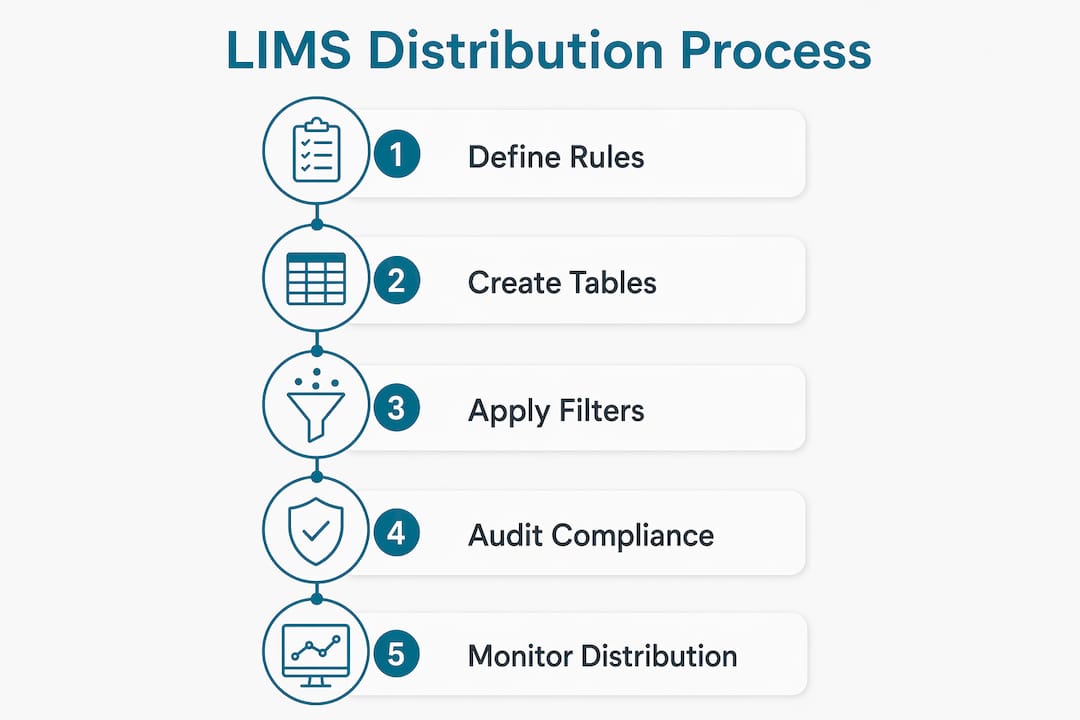
Distribution tables are the structural backbone of any LIMS report distribution rules configuration. Rather than hardcoding a recipient list into each report definition, a distribution table maps variable values from the report itself to specific recipients and delivery parameters. Systems like Broadcom CA Deliver demonstrate this architecture at scale: distribution tables support up to 65,535 records, each specifying variable column headers and distribution identifiers matched to page content for routing. That capacity matters when your lab runs dozens of test panels across multiple ordering physicians, clinics, and regulatory bodies simultaneously.
The table structure typically includes three components: the variable column (the field being evaluated, such as department code, ordering physician ID, or test panel type), the distribution identifier (the recipient or recipient group), and the matching page value (the specific content that triggers the match). One distribution table can serve multiple recipients with layered conditions. A pharmacogenomics lab might configure a single table where CYP2C19 results route to cardiology clinics, while TPMT results route to oncology departments, all within the same report run.

| Feature | Distribution tables | Static recipient lists |
|---|---|---|
| Maintenance | Update the table once; all reports reflect the change | Must update each report definition individually |
| Scalability | Handles thousands of routing rules in one structure | Becomes unmanageable beyond a few dozen recipients |
| Audit clarity | Centralized logic is easier to validate and inspect | Distributed logic creates inconsistent audit trails |
| Flexibility | Supports dynamic, variable-driven routing | Fixed routing regardless of report content |
| Compliance fit | Aligns with parameterized, documented configuration | Prone to undocumented manual overrides |
Reusable distribution tables are the correct design pattern for multi-channel delivery in genetic testing environments. When a recipient's fax number changes or a new portal replaces email delivery, you update the table once. Every report definition that references that table inherits the change automatically, with no risk of missing an instance buried in a legacy report definition.
Pro Tip: Adopt a naming convention for distribution tables that encodes the test panel, recipient category, and version number. A table named PGX_CARDIO_PHYS_v3 is immediately identifiable during an audit or a configuration review. Generic names like TABLE_001 create confusion at exactly the wrong moment.
How do filtering criteria refine report distribution in LIMS?
Filtering criteria are the conditional logic layer that sits on top of distribution tables. Where a distribution table defines who receives what, filter criteria define the precise conditions under which a distribution event fires. Dynamic report definitions use WHEN, OR, and AND statements with IN and EX operators to include or exclude specific report pages based on values found in the distribution table.
The IN operator triggers distribution when a page value matches a specified criterion. The EX operator suppresses distribution when a match is found. In practice, this means you can configure a rule that sends a pharmacogenomics summary page to a patient portal (IN: report type = PGX_SUMMARY) while excluding the raw genotype data from that same delivery (EX: page type = RAW_GENOTYPE). The patient receives a clinically appropriate result. The raw data stays within the lab's internal system. Both outcomes are controlled by the same distribution event.
Here is how filtering criteria interact with distribution tables during a report run:
- The LIMS evaluates each report page against the active distribution table
- WHEN statements define the primary condition that must be true for distribution to proceed
- OR statements add alternative conditions, expanding the recipient pool when any condition is met
- AND statements narrow conditions, requiring multiple criteria to be simultaneously true before distribution fires
- IN and EX operators then include or exclude specific pages from each recipient's delivery package
A real-world example from hereditary cancer testing: a lab runs a BRCA1/BRCA2 panel. The ordering physician receives the full clinical report (WHEN: order type = HEREDITARY AND recipient = PHYSICIAN). The patient portal receives a patient-friendly summary (WHEN: order type = HEREDITARY AND page type = PATIENT_SUMMARY). A regulatory body receives only aggregate, de-identified data (WHEN: recipient = REGULATORY AND page type = AGGREGATE). Three recipients, three filtered outputs, one report run.
Pro Tip: When configuring filter logic for complex genetic test scenarios, map your conditions on paper before entering them into the system. A logic diagram showing WHEN/AND/OR relationships catches contradictions that are invisible in a configuration interface but cause missed or duplicate deliveries at runtime.
What compliance and security considerations influence LIMS report distribution configuration?
Compliance requirements do not exist alongside distribution configuration. They are embedded in it. Under 21 CFR Part 11, any LIMS distributing electronic records must maintain audit trails and electronic signatures tied to unique individual users, not shared accounts. eLeaP identifies shared user accounts as one of the most common compliance deficiencies that invalidate electronic signatures in regulated laboratory systems. When a distribution event is triggered under a shared login, there is no individual attribution. That is a direct compliance failure.
LIMS embedded compliance controls include audit trails, version control, electronic signatures, and permission-based access to support GMP requirements. Broughton's LabHQ LIMS demonstrates how integrating these controls into the workflow itself, rather than bolting them on afterward, produces audit-ready evidence of every distribution decision. The distinction matters: a system that logs access is not the same as a system that logs distribution. A user viewing a result internally and a result being routed externally to a physician are two separate events requiring separate audit records.
ISO 15189 requires that electronic records remain accessible and reliable long-term, not just retrievable through an active portal. This means your distribution configuration must account for record preservation and retention, not just delivery. A report delivered to a physician portal that becomes inaccessible when the portal is decommissioned is a retention failure, regardless of whether the initial delivery was compliant.
Separating the LIMS system of record from the signing service is the architecture that sealed.info recommends for resilient compliance. An event-driven model where the LIMS triggers a signing event, the signing service returns an immutable receipt, and both records are preserved independently creates the kind of audit evidence that survives regulatory inspection.
The compliance controls relevant to LIMS report distribution configuration include:
- Individual user attribution: Every distribution event must be traceable to a named, authenticated user
- Audit trail completeness: Logs must capture what was distributed, to whom, when, and under which rule version
- Role-based access controls: Distribution rights must be separate from viewing rights, with explicit permission grants
- Electronic signature integrity: Signatures must be tied to unique credentials and cannot be shared or delegated informally
- Change documentation: Any update to a distribution rule requires a documented change impact assessment to maintain validated system status
- Record retention: Distributed reports must remain accessible for the required retention period independent of portal availability
One critical distinction that trips up many labs: access control and distribution rules are not the same thing. A user having permission to view a report in the LIMS does not constitute evidence that the report was formally distributed to an external recipient. Explicit distribution logic and its audit evidence are required separately.
What are common challenges and best practices when configuring LIMS report distribution rules?
The most damaging mistake in LIMS distribution settings configuration is treating viewing permissions as a proxy for distribution. A physician who can log into a portal and pull a result has not received a formally distributed report under 21 CFR Part 11 or ISO 15189 standards. The distribution event, its triggering rule, and its delivery confirmation must all be logged independently. Labs that conflate these two concepts discover the gap during inspections, not during routine operations.
Over-complicated static recipient lists are the second major pitfall. When each report definition carries its own hardcoded recipient list, a single address change requires touching every affected definition. In a lab running 40 test panels with 15 recipients each, that is 600 potential update points for one change. Data-driven distribution tables eliminate this problem by centralizing recipient logic. Updating the table propagates the change across all referencing report definitions automatically.
| Approach | Maintenance burden | Audit clarity | Adaptability |
|---|---|---|---|
| Static recipient lists per report | High: each report updated individually | Low: logic scattered across definitions | Poor: changes require multiple edits |
| Centralized distribution tables | Low: one update propagates everywhere | High: single source of truth for routing | Strong: adapts to new recipients without touching report definitions |
| Hybrid (tables plus filter criteria) | Moderate: tables maintained centrally, filters per report | High: both layers are documented and auditable | Excellent: handles complex multi-recipient, multi-channel scenarios |
Ignoring long-term data access requirements during initial configuration creates problems that surface years later. Distribution rules that route reports to a portal without a parallel archival pathway leave labs exposed when portal contracts end or systems are replaced. Pairing distribution configuration with a preservation strategy from the start satisfies ISO 15189 lifecycle reliability requirements and avoids expensive remediation later.
For pharmacogenomics and genetic testing labs specifically, distribution rules must account for recipient variability across the care pathway. An ordering physician, a clinical pharmacist, a patient, and a regulatory body each require a different report format, a different delivery channel, and potentially a different retention policy. Designing distribution tables with recipient category as a primary variable, rather than individual recipient identity, makes the configuration adaptive to staff turnover and network expansion without requiring rule rewrites.
Pro Tip: Build reusable distribution tables organized by recipient category rather than individual recipient. When a new cardiologist joins a referring practice, you add them to the CARDIOLOGY_PHYSICIAN category in the table. Every report rule referencing that category automatically includes the new recipient. No rule edits required, and the change is fully auditable.
Key takeaways
Effective LIMS report distribution rules configuration requires centralized distribution tables, precise filter logic, and compliance controls embedded directly in the workflow, not added as an afterthought.
| Point | Details |
|---|---|
| Use distribution tables over static lists | Centralized tables reduce maintenance burden and create a single auditable source of routing logic. |
| Layer filter criteria for precision | WHEN, AND, OR, IN, and EX operators control exactly which report pages reach which recipients. |
| Separate access rights from distribution | Viewing permissions do not constitute formal distribution; each requires its own audit record. |
| Embed compliance from the start | Audit trails, individual user attribution, and e-signature architecture must be built into distribution workflows. |
| Plan for long-term record retention | Distribution configuration must include archival pathways to satisfy ISO 15189 lifecycle requirements. |
What I've learned configuring distribution rules in regulated labs
The labs that handle distribution configuration well share one habit: they treat every routing decision as a compliance event from day one, not after the first inspection finding. I have seen labs invest months in building elegant report templates and then route them through a shared service account with no individual attribution. The report looks perfect. The audit trail is worthless.
The architecture that actually holds up under regulatory scrutiny decouples the LIMS workflow from the signing and delivery services. Embedding compliance controls directly in the distribution workflow, rather than relying on downstream checks, removes the manual steps where errors and omissions accumulate. An event-driven model where distribution triggers a signing event, the signing service returns an immutable receipt, and both records are preserved independently is the architecture that survives both routine audits and unannounced inspections.
The tension I see most often is between flexibility and validation. Labs want distribution rules that adapt quickly to new ordering physicians, new test panels, and new delivery channels. Validated systems require documented change impact assessments for every configuration update. The resolution is not to choose one over the other. It is to design distribution tables that absorb recipient variability without requiring rule changes. When the table handles the variability and the rule stays stable, you get both adaptability and a clean validation record.
Evolving standards, particularly around long-term record accessibility under ISO 15189, are pushing labs to think about distribution and preservation as a single workflow rather than two separate concerns. Labs that configure distribution rules today without a parallel archival pathway are building a problem they will solve expensively in three to five years.
— Tarek
How Labrynix simplifies LIMS report distribution configuration

Labrynix is built for exactly the configuration complexity this article describes. The platform gives genetic testing and pharmacogenomics labs configurable distribution rules and compliance features within a single connected system that spans LIMS workflow management, PGx report generation, provider and patient portals, and audit-ready delivery tracking. You can manage distribution tables, filter criteria, role-based access controls, and electronic signature workflows without stitching together separate tools. Labrynix Intelligence adds workflow automation that flags distribution anomalies before they become compliance findings. If your lab is ready to move beyond manual routing and disconnected reporting, Labrynix gives you the infrastructure to do it correctly from the start.
FAQ
What is LIMS report distribution rules configuration?
LIMS report distribution rules configuration is the process of defining automated routing logic within a laboratory information management system that determines which report pages are delivered to which recipients based on dynamic criteria such as test type, department, or ordering physician.
How do distribution tables differ from static recipient lists?
Distribution tables map variable values from report content to recipients in a centralized structure, so updating the table propagates changes to all referencing report definitions automatically. Static recipient lists require individual updates to each report definition, which creates maintenance risk and audit inconsistency.
What compliance standards apply to LIMS report distribution?
21 CFR Part 11, GMP guidelines, and ISO 15189 all impose requirements on how electronic reports are distributed, including individual user attribution for distribution events, complete audit trails, electronic signature integrity, and long-term record accessibility.
Why is access control different from distribution rights in LIMS?
Access control governs which users can view a report within the system. Distribution rights govern the formal routing of a report to an external recipient. Under 21 CFR Part 11, these are separate events requiring separate audit records, and one does not substitute for the other.
How often should distribution rules be reviewed in a validated LIMS?
Distribution rules should be reviewed whenever a recipient, delivery channel, or test panel changes, and any configuration update must be accompanied by a documented change impact assessment to maintain the validated state of the system.