
If your lab's biggest risk is a mislabeled sample or a broken chain of custody, you need a LIMS. If your biggest risk is losing the experimental context that explains why a result looks the way it does, you need an ELN. For genetic and molecular labs running both sample-intensive workflows and complex assay development, an integrated platform that handles both is usually the smarter long-term call. Three anchors that matter here: 21 CFR Part 11 compliance, chain-of-custody traceability, and platforms like Labrynix that connect those functions without requiring a separate integration project.
Table of Contents
- What is a LIMS and what does it actually manage?
- What is an ELN and what kind of records does it preserve?
- How do LIMS and ELN differ? A feature-by-feature comparison
- What are the real operational trade-offs of each system?
- What compliance requirements apply to U.S. regulated labs?
- How do you decide between LIMS, ELN, or both?
- When should you run both systems vs. choose an integrated platform?
- What should you budget and expect for implementation?
- Key Takeaways
- Why integration is the real differentiator for genetic and molecular labs
- Labrynix connects LIMS, reporting, and integrations for genetic labs
- Authoritative sources and further reading
What is a LIMS and what does it actually manage?
A Laboratory Information Management System is built around one core job: tracking what happens to a sample from the moment it enters your lab until the result leaves it. The design goal is structured, repeatable workflow execution with a complete, auditable record of every sample state change. That is different from capturing scientific reasoning. A LIMS does not care why you ran the assay; it cares that the right sample went through the right steps in the right order.
Core LIMS functions cover the full sample lifecycle:
- Sample receiving and accessioning: Assigns unique identifiers, records collection metadata, and flags discrepancies at intake before they propagate downstream.
- Workflow automation: Routes samples through defined processing queues, enforces step sequencing, and triggers QC holds when criteria are not met.
- Inventory management: Tracks reagents, consumables, and storage locations so a sample can be located or its aliquots traced at any point.
- Instrument integration: Pulls result data directly from analyzers, sequencers, and liquid handlers, eliminating manual transcription errors.
- Audit trail: Logs every action, user, and timestamp in a computer-generated record that QA can query without touching raw data.
Modern LIMS have expanded well beyond simple sample tracking. A five-phase processing model covering reception, scheduling, processing and QC, storage, and approval/compilation is now standard in most implementations, which means configuration effort is spread across all five phases, not just intake.
Where LIMS logic is the right starting point:
A high-volume clinical accessioning operation processing hundreds of specimens per shift needs LIMS first. So does a molecular lab running stability studies where sample lineage must be reconstructed months later. Reference labs managing split aliquots across multiple storage locations rely on LIMS to answer the question "where is this sample and what has been done to it?" without a manual search.
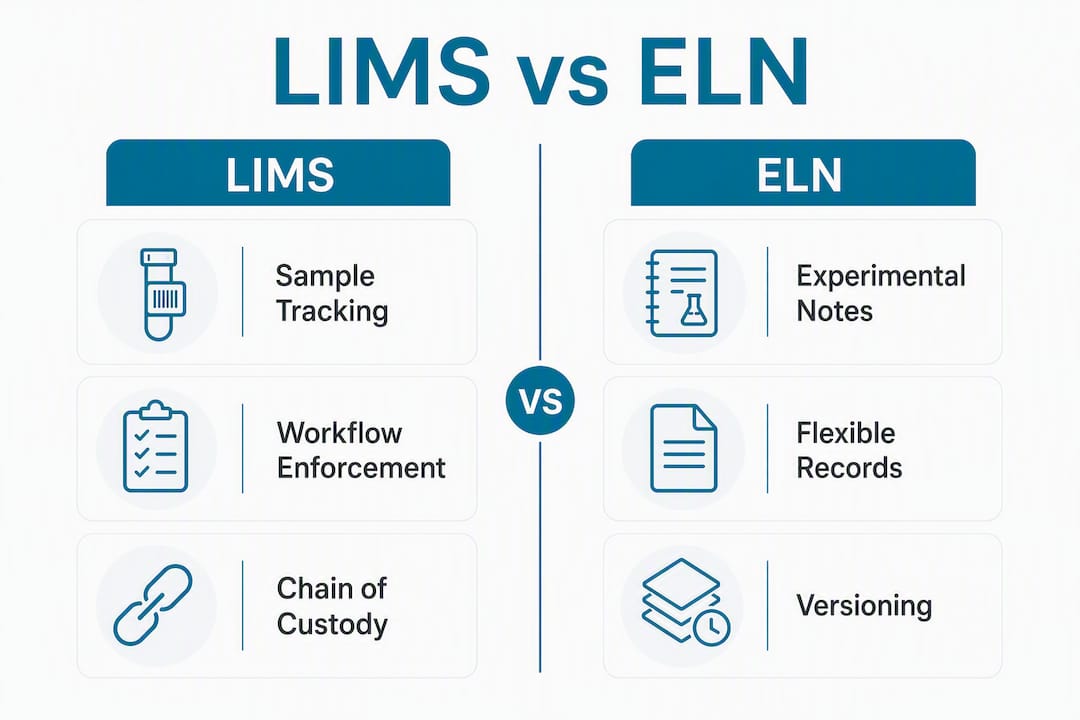
LIMS alone is usually sufficient when your workflows are well-defined, repeatable, and the primary compliance risk is sample identity or chain-of-custody. It starts to fall short when scientists need to document the reasoning behind a protocol change, capture free-text observations, or attach raw data files that do not fit a structured field. That is where an ELN picks up.
What is an ELN and what kind of records does it preserve?
An Electronic Laboratory Notebook replaces the paper lab notebook. Its primary design goal is flexible, timestamped, attributable experimental narrative. Where a LIMS enforces structure, an ELN accommodates the messiness of real scientific work: a protocol that changed mid-experiment, an unexpected observation worth documenting, a gel image attached alongside the interpretation.

ELN features are built around that flexibility:
Free-text entries and templates. Scientists can write in natural language, use structured templates for recurring assay types, or mix both. A PCR run entry might include the template fields for cycle conditions alongside a free-text note explaining why the annealing temperature was adjusted.
Attachments and rich data. Sequence files, chromatograms, microscopy images, and raw instrument exports can be embedded directly in the record. This matters for reproducibility: the data and the interpretation live together.
Collaboration and version history. Multiple contributors can annotate the same experiment, and every edit is versioned with a timestamp and user attribution. That version history is what makes an ELN record defensible in an IP dispute or a regulatory review.
Timestamped, attributable records. Every entry carries a creation timestamp and a user signature, which is the foundation of the ELN's compliance value.
A well-kept ELN entry for a pharmacogenomics assay validation might include the protocol version used, the lot numbers of critical reagents (cross-referenced to the LIMS inventory), the scientist's interpretation of the results, a supervisor's co-signature, and the date/time of each action. That record is what an auditor or a patent examiner actually reads.
ELN logic should be the primary choice when your dominant risk is losing experimental context: a method development lab, an R&D group running exploratory assays, or a team building the validation package for a new genetic test. It is a supporting tool, not the primary system, when the workflow is already fully defined and the main compliance need is sample traceability rather than experimental narrative.
How do LIMS and ELN differ? A feature-by-feature comparison
The core distinction is design intent: LIMS is operational and sample-centric; ELN is experimental and narrative-centric. That difference drives every downstream decision about data models, integrations, and regulatory fit.

| Dimension | LIMS | ELN |
|---|---|---|
| Primary design goal | Sample lifecycle management and workflow execution | Experimental documentation and scientific narrative |
| Typical data model | Structured, relational (sample ID, test, result, status) | Semi-structured to unstructured (entries, attachments, annotations) |
| Best-fit lab types | Clinical, diagnostic, QC, high-throughput reference labs | Research, method development, assay validation, R&D |
| Sample handling | Core function: accessioning, lineage, chain-of-custody | Peripheral: referenced by ID, not natively managed |
| Instrument integration | Native, bidirectional data pulls from analyzers and instruments | Variable; often manual import or lightweight connectors |
| Regulatory readiness | Strong for sample-level audit trails and chain-of-custody | Strong for experimental record integrity and e-signatures |
| Scalability | Scales with sample volume and workflow complexity | Scales with research team size and project diversity |
| Implementation complexity | Moderate to high (workflow configuration, validation) | Low to moderate (template setup, user training) |
A few use-case pairs that clarify where each system belongs:
- Clinical accessioning vs. exploratory protocol development. Accessioning a patient specimen for a genetic test is a LIMS job. Documenting the three protocol iterations your team tried before landing on the final method is an ELN job.
- Stability study sample tracking vs. assay optimization notes. Tracking which aliquot went into which timepoint belongs in a LIMS. Recording why you changed the incubation time at week four belongs in an ELN.
- Instrument result capture vs. raw data interpretation. Pulling a sequencer's output into a structured result field is a LIMS function. Writing the scientist's interpretation of an ambiguous variant call is an ELN function.
- Chain-of-custody audit vs. IP documentation. A LIMS audit trail answers "who touched this sample and when." An ELN record answers "who developed this method and what decisions were made."
The line between these systems is blurring. Many modern platforms now offer ELN-like note fields inside LIMS records, or LIMS-like sample registries inside ELN environments. Evaluate by primary design intent, not by feature checklists, because a LIMS with a notes field is still not an ELN, and an ELN with a sample registry is still not a LIMS.
What are the real operational trade-offs of each system?
LIMS: what you gain and where it costs you
Operational benefits: A LIMS eliminates sample mix-ups, enforces workflow sequencing, and produces the kind of structured audit record that a CAP inspector or FDA reviewer can navigate without a guided tour. For high-volume labs, the throughput gains from automated routing and instrument integration are substantial. The LIMS compliance role in chain-of-custody and traceability is difficult to replicate with any other tool.
Operational costs: Configuration is not trivial. Mapping your lab's actual workflows into a LIMS requires time, subject-matter expertise, and often a validation cycle before go-live. Customization adds cost. Instrument integrations require IT involvement and ongoing maintenance. And if your workflows change frequently, a rigidly configured LIMS can become a bottleneck rather than an accelerator.
Red-flag scenario: A molecular lab that runs its LIMS without linking sample records to the experiment entries where those samples were processed will eventually face an audit reconstruction problem. When a QA reviewer asks "what protocol version was used when this sample was processed on this date," the LIMS alone cannot answer that question. The answer lives in a paper notebook or a disconnected ELN, and reconstructing it manually takes hours.
ELN: what you gain and where it costs you
Operational benefits: Scientists adopt ELNs faster than LIMS because the interface resembles something they already know. Experiment records are searchable, shareable, and version-controlled from day one. For method development teams, the ability to link a protocol version to a specific result set is a direct reproducibility gain.
Operational costs: An ELN without a connected LIMS has no reliable sample identity layer. Scientists reference samples by whatever identifier they wrote down, which creates reconciliation problems when those identifiers do not match the accessioning system. Training is lighter than LIMS, but governance is harder: free-form entry means data quality depends on user discipline rather than system enforcement.
Red-flag scenario: A lab that uses only an ELN for a regulated genetic testing workflow will struggle to produce a complete chain-of-custody record. The ELN can show what the scientist did and when, but it cannot prove that the sample in the record is the same physical specimen that was received, accessioned, and stored under controlled conditions. That gap is exactly what a 21 CFR Part 11 audit will expose.
What compliance requirements apply to U.S. regulated labs?
For regulated work, verify these three things before signing a contract: the system produces independently generated, computer-generated, time-stamped audit trails; electronic signatures carry signer name, date/time, and the meaning of the signature; and the vendor can provide validation documentation you can submit to a regulator.
21 CFR Part 11 sets the federal standard for electronic records and electronic signatures in FDA-regulated environments. The key requirements are not optional for labs running clinical genetic tests, pharmacogenomics assays, or any workflow subject to FDA oversight.
Compliance checklist for LIMS and ELN evaluation:
- Audit trail independence. The audit trail must be computer-generated and must record operator actions independently of the operator. A user should not be able to edit or delete audit entries.
- Electronic signature metadata. Every e-signature must capture the signer's full name, the date and time of signing, and the meaning of the signature (e.g., "reviewed," "approved," "witnessed").
- User access controls. Role-based permissions must restrict who can view, enter, modify, and approve records. Access logs must be auditable.
- Validation documentation. The vendor must provide Installation Qualification (IQ), Operational Qualification (OQ), and Performance Qualification (PQ) documentation, or support your lab's own validation effort.
- Data retention policies. The system must support configurable retention periods aligned with your regulatory obligations (typically two years minimum for FDA-regulated records, longer for some genetic testing categories).
- Instrument integration validation. Any bidirectional instrument connection must be validated as part of the system's compliance scope, not treated as a separate IT project.
- Data export and portability. You must be able to export records in a readable format without vendor assistance, so records remain accessible if you change systems.
For GxP-adjacent labs, compliance evidence depends on the specific auditable artifact the system can produce. Knowing which artifact a regulator will ask for, and verifying the system can produce it, is more useful than a vendor's generic "Part 11 compliant" claim.
Pro Tip: Run this test before go-live: ask your QA lead to reconstruct the complete who/what/when/why of a specific sample event using only the system's standard audit report UI, without any help from IT or system administrators. If they cannot do it in under 15 minutes, the audit trail granularity is insufficient for a real inspection.
How do you decide between LIMS, ELN, or both?
Choose the system that mitigates your dominant failure mode. If your lab's worst-case scenario is a sample mix-up, a broken chain of custody, or a missing result, start with a LIMS. If your worst-case scenario is losing the experimental context that explains a result, or being unable to reproduce a method, start with an ELN. If both failure modes are real risks, which is true for most molecular and genetic labs, you need both or an integrated platform.
Vendor question checklist for demos and RFPs
| Question | Why it matters | Acceptable answer |
|---|---|---|
| Can QA reconstruct a sample event from the audit UI without IT help? | Confirms audit trail granularity meets Part 11 standards | Yes, with a live demo |
| What validation documentation do you provide? | Confirms IQ/OQ/PQ support for regulated workflows | Full IQ/OQ/PQ package or support for lab-led validation |
| How are sample records linked to experiment entries? | Reveals integration depth and provenance chain | Bidirectional links with explicit sample ID references |
| What does data export look like, and who controls it? | Protects against vendor lock-in | Lab-controlled export in standard formats (CSV, JSON, HL7) |
| What is the sandbox/pilot timeline before full deployment? | Flags implementation risk | Sandbox available within 2–4 weeks of contract |
| How are instrument integrations validated? | Confirms integration is within compliance scope | Vendor-supported validation with documentation |
Red flags to watch for:
- A vendor who cannot show a live audit trail during a demo.
- No sandbox environment before a multi-month implementation commitment.
- Vague answers about data export formats or API access.
- "Part 11 compliant" claims with no validation documentation to back them.
- A single implementation timeline with no pilot phase.
Include QA, at least two bench scientists, IT, and the lab manager in every demo. QA will ask the compliance questions; bench scientists will catch usability gaps that managers miss; IT will surface integration and security requirements the vendor may have glossed over.
Picking the wrong LIMS tier is one of the most common and costly mistakes in lab software procurement. "LIMS" covers a spectrum from a basic sample tracker to a fully GMP-validated system with automated workflow execution and bidirectional instrument integration. Clarify your validation requirements, automation depth, and API needs before you evaluate vendors, not after.
When should you run both systems vs. choose an integrated platform?
Run both a standalone LIMS and a standalone ELN only when you genuinely need best-in-class depth in each domain and have the IT resources to build and maintain the integration between them. For most molecular and genetic labs, that is a higher bar than it sounds.
Integrated platforms reduce handoffs and preserve provenance by linking sample records and experiment entries in a single data model. The operational benefits are concrete:
- A single provenance chain from sample receipt through experiment execution to final report, with no manual reconciliation step between systems.
- Audit reconstruction that pulls both sample-level and experiment-level records in one query, rather than requiring a reviewer to cross-reference two separate systems.
- Fewer manual data entry points, which is where transcription errors and compliance gaps accumulate.
- Combined reporting that connects sample identity, assay results, and experimental context in one output.
The most failure-prone boundary in a two-system setup is the experiment-to-sample linkage. When an ELN entry references a sample by a free-text ID string rather than a validated link to the LIMS record, that connection breaks the moment someone types the ID slightly differently. Design workflows so sample records carry explicit experiment provenance, not just an ID field.
Where standalone best-of-breed still wins:
- High-throughput core facilities running thousands of samples per day with fully defined, stable workflows may find a purpose-built LIMS outperforms any integrated platform on raw throughput and instrument connectivity.
- GMP manufacturing environments with validated, locked workflows often require a dedicated, fully validated LIMS that a general-purpose integrated platform cannot match without significant customization.
For genetic testing, pharmacogenomics, and molecular diagnostics labs, the integrated model is usually the pragmatic path. The sample-to-report workflow in these labs requires both sample traceability and experimental narrative, and the cost of maintaining a clean integration between two separate systems typically exceeds the cost of a purpose-built integrated platform within two to three years.
What should you budget and expect for implementation?
The honest answer: timelines and costs vary more than most vendors will tell you upfront, and the variables that drive them are almost entirely within your control.
Implementation phases and typical durations
| Phase | Small research lab | Growing academic/clinical lab | Regulated molecular/genetic lab |
|---|---|---|---|
| Discovery and scoping | 2–4 weeks | 4–6 weeks | 6 weeks |
| Configuration and customization | 4 weeks | 8 weeks | 12 weeks |
| Validation (IQ/OQ/PQ) | Minimal or none | 4 weeks | 8 weeks |
| Pilot with core users | 2–4 weeks | 4–6 weeks | 6 weeks |
| Full rollout and training | 2–4 weeks | 4 weeks | 6 weeks |
| Total estimate | 2–5 months | 5 months | — |
SaaS pricing for LIMS and ELN platforms is almost universally custom-quoted, based on the number of users, sample volume, modules selected, integration complexity, and validation support required. Expect the cost drivers to cluster around three buckets: configuration depth (how much the platform needs to be adapted to your specific workflows), integration scope (how many instruments, EHRs, billing systems, and external APIs need to connect), and validation burden (whether you need a vendor-supported IQ/OQ/PQ package or are running your own).
A five-phase LIMS implementation covering reception, scheduling, processing, storage, and approval means configuration effort is distributed across all five phases. Labs that underestimate the configuration work in phases two through four are the ones that blow their timelines.
Common pitfalls:
- Skipping a formal discovery phase and configuring against assumptions rather than actual workflows.
- Underestimating the SOP update burden: every workflow change the system enforces requires a corresponding SOP revision and staff training.
- Launching to all users simultaneously instead of running a pilot with two to four power users who can surface configuration gaps before they affect the whole lab.
- Treating instrument integration as an IT project rather than a validation activity.
Change management is not optional. Staff who understand why the system works the way it does adopt it faster and make fewer workaround errors. A two-hour workflow walkthrough for bench staff before go-live is worth more than a 50-page user manual delivered the day of launch.
Key Takeaways
LIMS and ELN solve different problems; choosing by dominant failure mode, not feature count, is what determines whether the system actually reduces operational risk.
| Point | Details |
|---|---|
| Choose by failure mode | LIMS mitigates sample identity and chain-of-custody risk; ELN mitigates loss of experimental narrative and context. |
| Integration beats two silos | Maintaining a clean link between a standalone LIMS and ELN typically costs more than a purpose-built integrated platform within a few years. |
| Compliance requires specific artifacts | Verify the system can produce an independently generated, time-stamped audit trail and Part 11-compliant e-signatures before signing a contract. |
| Implementation timelines are long | Regulated molecular and genetic labs should budget 8–18 months for full implementation, including validation phases. |
| Labrynix for molecular and genetic labs | Labrynix combines LIMS workflow management, PGx reporting, and HL7/FHIR integrations in one platform built for genetic and molecular lab workflows. |
Why integration is the real differentiator for genetic and molecular labs
The debate between LIMS and ELN often gets framed as a feature comparison, but that framing misses the actual operational problem. The real question is where records are created and how they are linked, because disconnected records are what create audit reconstruction delays, rework, and compliance gaps.
Genetic and molecular labs face a specific version of this problem. A pharmacogenomics lab, for example, runs a workflow that spans sample receipt, DNA extraction, genotyping, variant interpretation, and report generation. Each step produces a different kind of record: a sample state change, an instrument output, a scientist's interpretation, a clinical reviewer's sign-off, and a final report delivered to a provider. If those records live in separate systems with no enforced linkage, reconstructing the full picture for a single patient result requires pulling from multiple sources, cross-referencing by hand, and hoping nothing was entered inconsistently.
The labs that handle audits well are not the ones with the most sophisticated individual systems. They are the ones where a reviewer can pull a single record and follow it from sample receipt to report delivery without leaving the platform. That is an integration problem, not a feature problem. Treating it as a luxury to address after go-live is what creates the operational debt that accumulates into a compliance crisis.
For labs evaluating platforms now, the practical question is not "does this system have an audit trail?" Every modern LIMS and ELN has one. The question is "can this system produce a single, linked record that connects my sample lineage to my experimental decisions to my final report?" That is the artifact that matters.
Labrynix connects LIMS, reporting, and integrations for genetic labs
Genetic and molecular labs do not need a generic LIMS bolted to a generic ELN. They need a platform where the sample-to-report workflow is the design center, not an afterthought.
Labrynix was built from real genetic laboratory experience, and it shows in the architecture. The platform connects LIMS workflow management, covering accessioning, sample tracking, workflow queues, and audit logs, with PGx report generation, provider and patient portals, and HL7/FHIR integrations in one system. Sample lineage links directly to report output. Audit trails cover the full workflow, not just the sample receipt step. And integrations with EMRs, billing platforms, and lab instruments are built into the platform rather than bolted on.
For labs evaluating their options, the practical next step is a scoped demo where you walk through your actual workflow, not a generic product tour. Request a sandbox environment, ask to see the audit trail UI during the demo, and bring your QA lead. See what Labrynix offers for genetic testing labs and molecular diagnostic labs, or explore the full solutions overview to find the configuration that fits your lab's size and workflow.
Authoritative sources and further reading
| Source | What it covers |
|---|---|
| 21 CFR Part 11 — Electronic Records and Electronic Signatures (summary PDF) | Federal requirements for audit trails, e-signatures, and electronic record integrity in FDA-regulated environments |
| ELNs vs LIMS: Understanding the Differences — Benchling | Practical comparison of design goals, use cases, and integration considerations for ELN and LIMS |
| Do I need an ELN, a LIMS or both? — Lab Thread | Decision framework covering LIMS spectrum, integration failure modes, and procurement guidance |
| What Is a LIMS? — LabKey | Overview of core LIMS functions including sample lifecycle, workflow automation, and instrument integration |
| ELN vs LIMS decision heuristic — VerbalExperiment | Failure-mode-based decision framework for choosing between ELN and LIMS |
| Laboratory Information Management System — Wikipedia | Five-phase LIMS processing model and general implementation scope |
| Difference between ELN and LIMS — IDBS | Vendor-neutral explanation of ELN and LIMS distinctions for lab decision-makers |
| ELN audit-readiness checklist — Xevalics | Practical audit-readiness verification methodology for ELN implementations |
| LIMS in lab compliance — Labrynix | How LIMS supports chain-of-custody, traceability, and regulatory readiness in molecular labs |
| LIS/LIMS software for genetic and molecular labs — Labrynix | Labrynix LIMS capabilities, integrations, and workflow architecture for genetic testing labs |