
Plan for $10,000 to $45,000 per HL7v2 interface depending on whether it's single-direction or bidirectional, with full multi-EHR integration suites running well into six figures. Timelines run 3 to 12 weeks for a standard build. The number that trips up most budgets isn't the build cost, though. It's the annual maintenance, which can add 15% to 25% of that initial price every single year the interface stays live.
TL;DR:
- Connecting multiple hospitals or clinics significantly increases costs due to custom mapping and certification requirements, especially with higher endpoint volume.
- Ongoing maintenance costs typically range between 15% and 25% of the initial implementation each year, adding substantial long-term expenses.
- Using a shared integration engine instead of point-to-point connections can greatly reduce both initial build costs and future expansion expenses.
- Vendor certification, security reviews, and testing against external environments often add unexpected delays and costs beyond initial quotes.
- Budgeting should include detailed questions about scope, change processes, and support terms to avoid hidden costs and ensure long-term value.
Table of Contents
- How Much Does an HL7 Interface Cost?
- What Actually Drives HL7 Implementation Expenses Up?
- What Does an HL7 Project Actually Cost by Scope?
- How Much Should You Budget for Ongoing Maintenance?
- How Can You Lower HL7 Integration Pricing Without Cutting Corners?
- What Should You Ask Vendors Before Signing?
- Labrynix Perspective: Lessons From Lab-Focused Integrations
- How Labrynix Reduces HL7 Integration Cost and Risk
- Standards and Analyses Worth Reviewing
- Sources
How Much Does an HL7 Interface Cost?
The spread in HL7 interface cost comes down almost entirely to direction and scope. A single-direction HL7v2 interface, say, sending ADT (admit, discharge, transfer) messages one way into a downstream system, typically runs $10,000 to $20,000 and takes 3 to 6 weeks to build and test. That's the floor for most real-world projects.
Bidirectional builds cost more because they carry more logic and more failure points. An interface handling ADT plus orders plus results, moving data in both directions, commonly lands between $25,000 and $45,000 and takes 6 to 12 weeks. A single FHIR connector built into an existing product follows a similar pattern but with a wider band: $15,000 to $60,000 for one connection, depending on how much custom resource mapping and authentication work it needs.
Enterprise projects live in a different universe entirely. Multi-tenant clinical platforms connecting to several EHR vendors at once can climb past $150,000, and that's before certification fees or annual support.
Here's how the bands typically break down:
- Single HL7v2, one direction: $10,000 to $20,000, 3 to 6 weeks
- Bidirectional HL7v2 (ADT + orders + results): $25,000 to $45,000, 6 to 12 weeks
- Single FHIR connector: $15,000 to $60,000, 4 to 10 weeks
- Multi-EHR enterprise suite: $150,000+, 4 to 9 months
A mid-size reference lab connecting to one hospital's ADT feed sits comfortably in the first band. A lab network pulling results and orders from three different EHR vendors, each with its own certification process, is a different project altogether, and the price tag reflects that.
What Actually Drives HL7 Implementation Expenses Up?
Direction and volume explain part of the price, but the line items that blow past initial quotes usually come from somewhere else.
Each new health system you connect to behaves like its own project, not a bolt-on. Every additional endpoint multiplies the work rather than adding to it incrementally, because each hospital or clinic implements HL7v2 slightly differently, despite it being a "standard."
That inconsistency is the real cost driver. HL7v2 leaves enough optional fields and Z-segments (custom, non-standard segments) that two hospitals running the same EHR platform can still send messages that don't match. Mapping those quirks takes analyst time nobody quotes up front.
Other factors that push HL7 interface development cost higher:
- EHR vendor effort and certification. Some vendors require formal certification programs (comparable to Epic's App Orchard model) before you can connect, adding both fees and calendar time.
- Sandbox testing and acceptance criteria. Real testing against a vendor's test environment, not just your own, takes weeks you should plan for, not squeeze out.
- Security review. HIPAA-conscious data handling adds review cycles, especially for anything touching PHI in transit.
- Interface drift. Once live, interfaces degrade as source systems update, silently breaking mappings nobody notices until a report goes missing.
Pro Tip: Ask every vendor upfront how many Z-segments or custom fields their HL7v2 implementation uses. If they can't answer quickly, budget extra mapping time, because it means nobody has documented it well.
What Does an HL7 Project Actually Cost by Scope?
Procurement teams need line items, not just ranges. Every HL7 or FHIR project, regardless of size, breaks into the same cost categories:
- Discovery and requirements. Mapping current workflows, identifying data sources, and confirming which messages you actually need.
- Interface mapping. Translating each system's fields into a shared format, the single biggest source of hidden HL7 integration pricing surprises.
- Development. Writing and configuring the actual interface logic, whether custom-coded or built on an engine.
- Testing. Unit testing, sandbox testing against the partner system, and end-to-end validation.
- Certification and vendor approval. Required for some EHR platforms before go-live.
- Ports and endpoints. Each connection point often carries its own setup and sometimes ongoing licensing fee.
- Training and documentation. Getting your team ready to support the interface after launch.
- Cutover and go-live support. The transition window where issues surface fastest.
Three profiles illustrate how this plays out:
Profile A: Small single feed. One lab sending results to one hospital EHR via a single ADT or ORU feed. Expect $10,000 to $20,000 and 3 to 6 weeks.
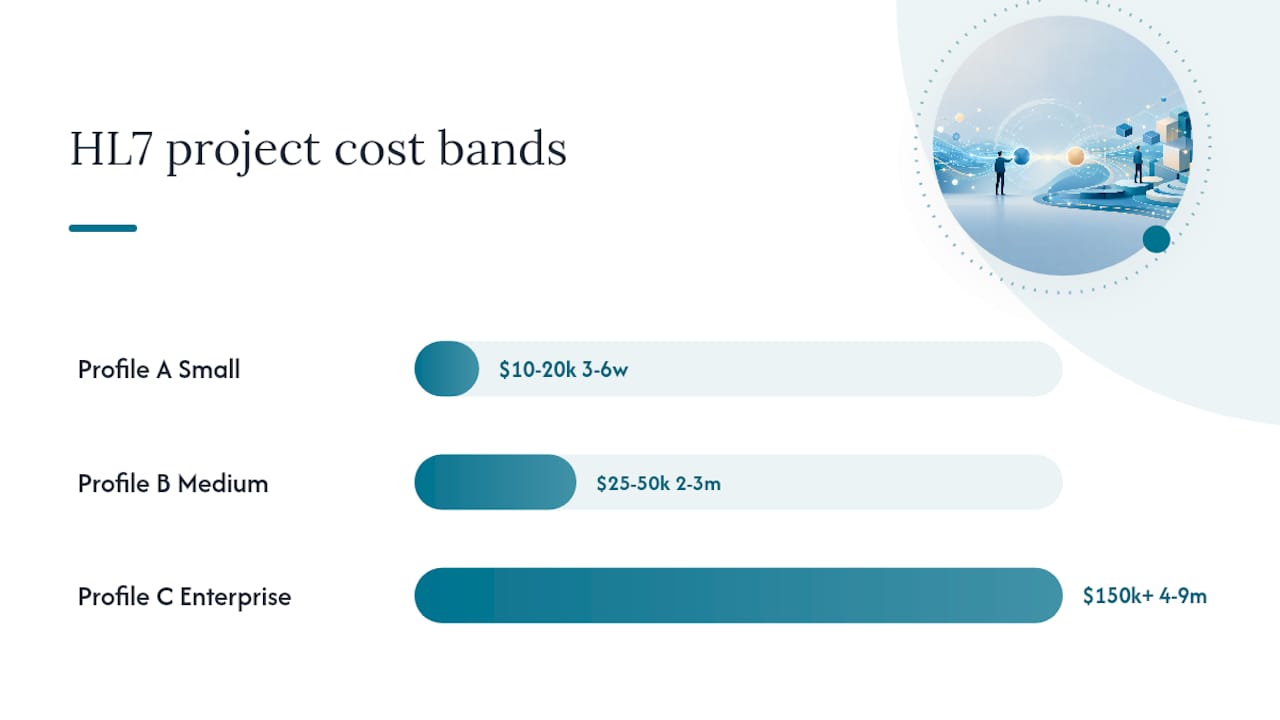
Profile B: Medium bidirectional. A lab exchanging orders and results with two or three referring systems. Expect $25,000 to $50,000 and 2 to 3 months.
Profile C: Enterprise multi-platform. A lab network integrating with five or more EHR vendors, each requiring separate certification. Expect $150,000 or more and 4 to 9 months.
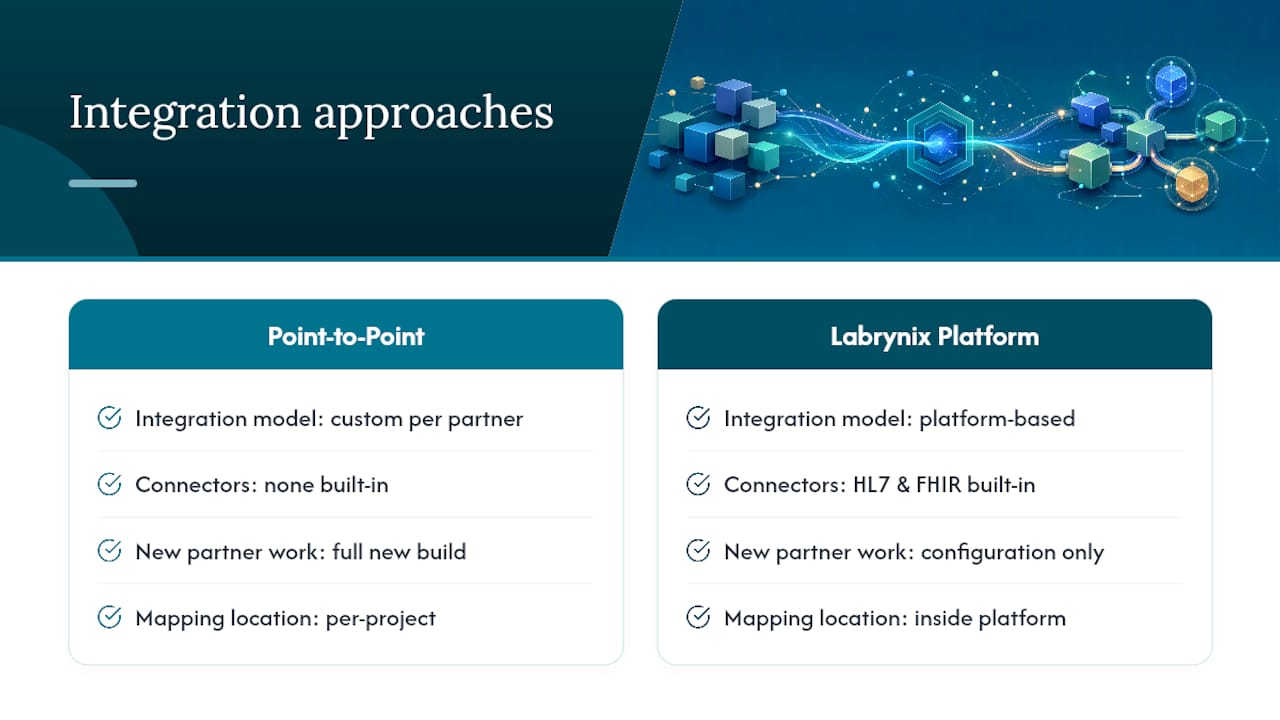
Running everything through a shared integration engine rather than point-to-point connections changes this math meaningfully. Point-to-point setups multiply cost with every new partner; a shared engine centralizes mapping logic so each new connection costs a fraction of the first one.
How Much Should You Budget for Ongoing Maintenance?
The build price is the easy number. The one that catches finance teams off guard is the recurring bill.
Industry guidance consistently points to 15% to 25% of the initial implementation cost per year as a realistic maintenance budget for an active HL7 interface. The annual maintenance costs typically amount to a notable fraction of the initial build cost per year for each active interface.
The number to remember: a $30,000 HL7 interface can cost $22,500 to $37,500 in maintenance alone over five years, on top of the original build.
That spend covers real, recurring work:
- Monitoring for silent failures when a source system changes a field without warning
- Remapping after EHR vendor upgrades or version changes
- Adjusting for regulatory updates, like new reporting requirements from public health agencies
- Patching and revalidating after security updates on either end
Skipping this budget line doesn't make the cost disappear. It just means you pay for it later as an emergency fix, usually at a rush rate.
How Can You Lower HL7 Integration Pricing Without Cutting Corners?
The biggest lever most teams overlook is architecture, not negotiation. Routing connections through a shared integration engine instead of building point-to-point links means new endpoints cost a fraction of the first one, since the mapping infrastructure already exists.
Beyond that, a few tactics consistently bring down both build and lifetime cost:
- Phase the rollout. Build your highest-volume, highest-value workflow first; defer nice-to-have feeds until the core system is stable.
- Negotiate fixed-scope milestones. Pin down port fees, per-endpoint costs, and SLA terms in the contract before work starts, not after.
- Demand transparent change-order pricing. Know exactly what a scope change costs before you request one.
- Reuse mappings across similar systems. Two hospitals on the same EHR platform often share 80% of their mapping logic.
- Insist on automated test harnesses. Manual retesting after every vendor update is where budgets quietly bleed.
Pro Tip: Ask vendors to quote monitoring and alerting as a line item, not a bundled "support" fee. If they can't isolate that cost, you can't compare it against a competing quote.
What Should You Ask Vendors Before Signing?
Bring these questions into every RFP and vendor call:
- How many endpoints does this quote cover, and what does adding one more cost?
- Who owns the mapping documentation, us or you, after the contract ends?
- What's the monitoring SLA, and how fast is a broken interface fixed?
- What's the process and cost for a change request after go-live?
- How much sandbox testing time is included before acceptance sign-off?
Beyond those five, check that the contract spells out discovery assumptions, rollback procedures if go-live fails, documentation handoff, training, and the annual support fee in writing. Weight your scoring toward ongoing maintenance and monitoring terms more heavily than the initial price. A cheap build with vague support terms almost always costs more by year two.
Labrynix Perspective: Lessons From Lab-Focused Integrations
Lab integrations carry hidden cost most generic HL7 guides miss: result formatting quirks, specimen identifiers, and PGx-specific data fields that standard ADT mapping doesn't anticipate. That extra validation work adds real time. Our practical recommendation: consolidate your LIMS and integration layer where you can. Fewer handoffs means fewer places for interface drift to start.
— Tarek
How Labrynix Reduces HL7 Integration Cost and Risk
Building custom point-to-point interfaces for every EHR partner is one path. Labrynix offers a different one: a lab platform with HL7 and FHIR connectors already built into the core system, so you're not pricing a new integration project from zero every time a referring provider changes.
Because mapping logic and report pipelines live inside one connected platform, adding a new referring system typically means configuration work, not a fresh build cycle. That reusability is where most of the long-term savings in this article actually come from. Labrynix's genetic testing lab solutions fold LIMS workflow, PGx reporting, and interoperability into one system, so integration cost doesn't compound every time you connect to a new hospital or clinic.
If you're budgeting an HL7 or FHIR project right now, start by reviewing Labrynix pricing for genetic and molecular lab platforms and request a walkthrough of the API documentation to see what's already built versus what your team would need to custom-develop.
Standards and Analyses Worth Reviewing
Before finalizing a budget, cross-check your assumptions against primary sources, not just vendor quotes:
- HL7 FHIR specifications for protocol details that affect long-term maintainability
- AHRQ's EMR systems guidance for safety and integration complexity context
- PMC research on interoperability challenges for evidence on interface governance and drift
- Independent HL7 integration cost guides to sanity-check vendor pricing against market bands
Sources
- EHR Integration Cost Guide 2026 | HL7, FHIR Pricing |
- HL7 and FHIR Integration: Cost, ADT Merges, US Core
- HL7 Integration Costs: Why They're So Expensive + Ways to Reduce Them