
Multi-site labs that run separate LIMS instances at each location are not just inefficient — they are creating compliance exposure, data integrity gaps, and a ceiling on what their operations can ever become. A unified LIMS is the single most consequential infrastructure decision a multi-location lab network can make, because it determines whether CLIA and HIPAA obligations are met consistently across every site, whether patient identity conflicts get caught before they cause harm, and whether your data is ever clean enough to support AI-driven analytics. Platforms like Labrynix are built around exactly this problem: one governed data model, one audit trail, one source of truth. The practical payoff is measurable: shorter turnaround times, fewer rework cycles, and enterprise-wide visibility that a patchwork of local tools simply cannot provide.
Table of Contents
- What breaks when your lab network runs disconnected systems
- How a unified LIMS actually fixes the architecture problem
- What capabilities a unified LIMS must actually deliver
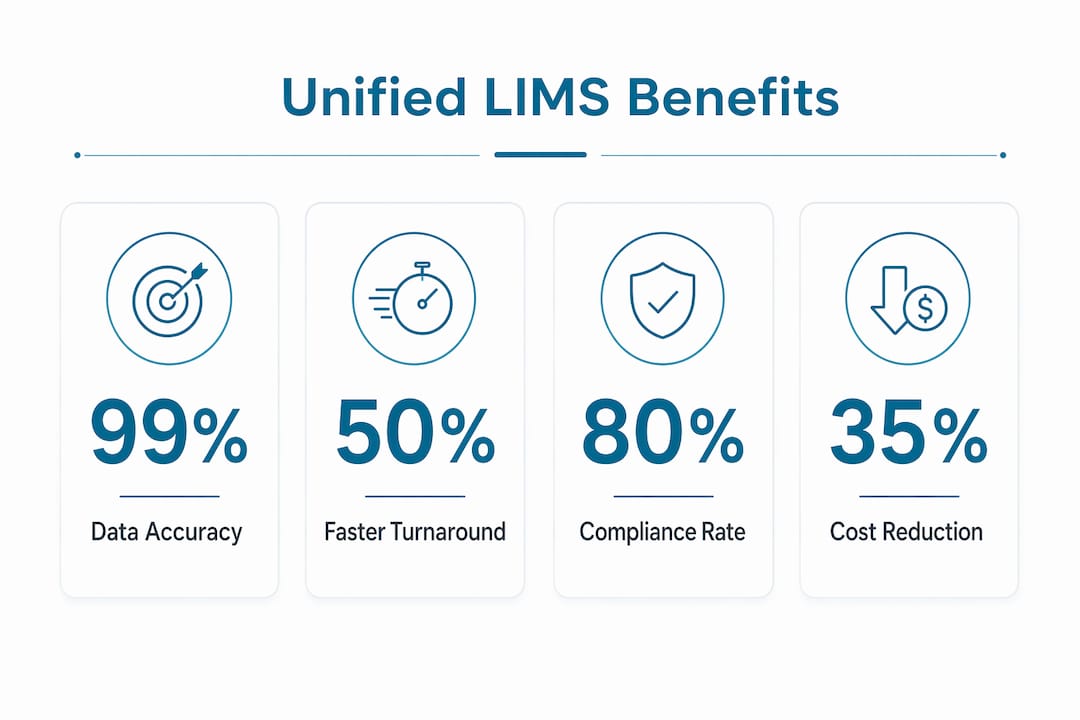
- What operational improvements to expect and how to measure them
- How to plan the rollout: phased vs. rip-and-replace
- Regulatory implications for U.S. multi-site labs
- How to evaluate unified LIMS options before you commit
- Why unified data is the prerequisite for AI readiness
- Key Takeaways
- The consolidation mistakes labs keep making
- Labrynix gives multi-site labs a practical starting point
- Useful sources and further reading
What breaks when your lab network runs disconnected systems
The failure mode is predictable. Each site installs its own LIMS, builds its own master test menu, and develops its own report templates. Within months, the network has three versions of the same test code, two different reference ranges for the same analyte, and no reliable way to reconcile patient records across locations.
The daily operational consequences include:
- Duplicate patient registrations — the same individual appears under different IDs at different sites, creating identity conflicts that require manual reconciliation before results can be released
- Inconsistent turnaround time reporting — each site measures TAT differently, so network-level dashboards are meaningless or misleading
- Manual cross-site sample transfers — staff must email or call to confirm sample status when a specimen collected at one site is processed at another
- Fragmented test catalogs — pricing, methodology, and result interpretation vary by site with no governed change-control process
- Audit trail gaps — local systems generate local logs, and assembling a complete chain of custody for a multi-site specimen requires pulling records from multiple databases
Disconnected systems cause delayed reporting, inconsistent workflows, and limited visibility into cross-site operations — a combination that compounds with every new location added to the network. Labs relying on spreadsheets or instrument-specific tools to bridge these gaps are not solving the problem; they are deferring it until an audit or a patient safety event forces the issue.
The hidden cost is rework. Every hour a technician spends reconciling duplicate records or chasing sample status across sites is an hour not spent on testing. At scale, that overhead is the difference between a lab network that grows profitably and one that adds headcount just to manage its own complexity.
How a unified LIMS actually fixes the architecture problem
The solution is not simply "one system instead of many." The architecture matters. Three patterns define how enterprise LIMS platforms handle multi-site harmonization effectively.
Single data model with role-based site views
One database, one patient identity schema, one test catalog — but each site sees only the data and workflows relevant to its scope. A regional manager sees aggregate performance across three sites; a bench technician sees only the queue for their instrument. This is the foundational pattern, and it is what separates a true enterprise LIMS from a multi-tenant system that just replicates local databases in the cloud.

Central master data hub with local configuration layers
Standardize what must be consistent: patient identifiers, test codes, reference ranges, QC rules, and report templates. Then allow sites to configure what legitimately varies: instrument interfaces, local SOP steps, staffing-driven workflow sequences. Forcing identical workflows across sites with different instruments and staffing realities creates pushback and workarounds. The right model locks the data core and opens the workflow periphery.
API and HL7/FHIR integration fabric
A unified LIMS does not replace every instrument or external system — it becomes the integration hub. HL7 messaging handles order and result exchange with EMRs and reference labs. FHIR APIs support patient-facing portals and payer integrations. Webhooks trigger downstream billing and notification workflows. Enterprise platforms make data interoperable and accessible for analytics tools, which is the prerequisite for anything more sophisticated than a static report.

Governed cross-site processes become possible once this architecture is in place. Centralized QC rules apply uniformly before any result is released. Batch release workflows require sign-off from a designated reviewer regardless of which site processed the specimen. Sample genealogy — tracking a specimen from collection through processing, aliquoting, and archiving — is visible in a single audit trail rather than reconstructed from three separate logs.
What capabilities a unified LIMS must actually deliver
Not every system marketed as "enterprise" or "multi-site" delivers the governance controls that a networked lab actually needs. The checklist below separates genuine capability from marketing language.
Non-negotiable technical capabilities:
- Single patient/subject identity with deduplication logic and merge/unmerge audit history
- Centralized test catalog with versioned test codes, methodology references, and governed change-approval workflows
- Instrument interfacing via bidirectional connections to analyzers, sequencers, and accessioning equipment at each site
- HL7/FHIR/API support for EMR order intake, result delivery, and third-party integrations
- Immutable audit trails that capture every data change, user action, and result modification with timestamp and user ID
- Role-based access with scoped enterprise views — site-level staff cannot see or modify data outside their scope; network managers can see everything
- Centralized reporting templates with site-level branding options but governed clinical content
Data governance controls:
Master data changes — adding a test, modifying a reference range, updating a report template — should require a documented change request, a review step, and an approval before the change goes live. Version history must be retained. This is not optional for labs operating under 21 CFR Part 11 or seeking ISO 15189 accreditation.
Pro Tip: Lock the data model centrally (patient ID schema, test codes, QC thresholds, report templates) and open the workflow layer locally (instrument routing, shift assignments, local SOP steps). Labs that try to standardize everything create adoption resistance; labs that standardize nothing never achieve data consistency.
A modern LIMS extends well beyond sample tracking — it automates workflows, enforces SOPs, and centralizes reporting in ways that make it foundational infrastructure for a networked lab, not an optional add-on.
What operational improvements to expect and how to measure them
Features matter less than outcomes. The table below gives lab managers a baseline-vs.-target framework to document the ROI case before and after consolidation.
| KPI | Baseline (pre-consolidation) | Target (post-consolidation) | How to measure |
|---|---|---|---|
| Average turnaround time | Site-specific, inconsistently tracked | Consistent network-wide measurement; reduction expected | LIMS timestamp: order receipt to result release |
| Duplicate patient registrations | Frequent; manual reconciliation required | Near-zero with deduplication logic active | Monthly duplicate-ID report from LIMS |
| Sample rejection rate | Varies by site; no network view | Reduced through standardized accessioning SOPs | Rejections / total accessions per period |
| First-pass result yield | Unknown or site-specific | Improved through centralized QC rules | Results released without amendment / total results |
| Inventory stock-outs | Reactive ordering per site | Proactive with centralized inventory visibility | Stock-out events per period across network |
| Cross-site reconciliation time | Hours per week of manual effort | Eliminated or near-eliminated | Staff hours logged to reconciliation tasks |
Real-time dashboards provide visibility into patient footfall, sample status, turnaround times, and revenue across the network — the kind of visibility that makes these KPIs trackable in the first place rather than estimates assembled from site-level spreadsheets.
SaaS-based LIMS deployments also reduce the time required to onboard new collection centers, cutting setup from weeks or months down to days through configuration-driven templates rather than hardware installation and local server setup.
How to plan the rollout: phased vs. rip-and-replace
The implementation decision that causes the most regret is choosing the wrong rollout strategy. Both approaches have legitimate use cases.
Phased rollout (pilot → regional → full network) is the right choice for most multi-site networks. It limits blast radius, allows the team to refine master data and integration configurations before scaling, and gives staff time to build competency. The tradeoff is a longer period of running parallel systems, which adds temporary overhead.
Big-bang / rip-and-replace works when the existing systems are so fragmented that parallel operation is itself a risk, or when a regulatory deadline makes a prolonged transition untenable. It requires more upfront preparation and carries higher cutover risk.
Implementation steps, in order:
- Discovery and current-state mapping — document every site's existing LIMS, instrument interfaces, test catalog, and data formats; identify master data conflicts
- Master data cleanup — deduplicate patient records, reconcile test codes, and establish the canonical data model before migration begins
- Pilot site selection — choose one site with motivated staff and representative workflow complexity; avoid the highest-volume site for the first deployment
- System configuration and integration build — configure the unified LIMS, build instrument interfaces, and connect EMR/EHR integrations for the pilot site
- Validation — execute IQ/OQ/PQ protocols; document validation artifacts for regulatory review
- Staff training — role-specific training for bench staff, supervisors, and administrators; do not use a single generic session for all roles
- Parallel run — operate old and new systems simultaneously for a defined period; compare outputs and resolve discrepancies
- Cutover and decommission — migrate remaining data, cut over to the unified system, and formally retire the legacy instance
- Regional and network rollout — repeat steps 4–8 for remaining sites, applying lessons from the pilot
Common migration risks and mitigations:
- Data loss during migration — mitigate with pre-migration data exports, checksums, and post-migration reconciliation audits
- Interface failures at cutover — test every instrument interface under load before go-live; maintain rollback procedures
- Staff resistance — involve site leads in configuration decisions early; resistance is almost always about not being consulted, not about the system itself
- Scope creep — freeze the feature scope for the pilot; enhancements come after validation
You can find a detailed implementation timeline and checklist that covers validation milestones and cutover planning for molecular and genetic testing labs.
Regulatory implications for U.S. multi-site labs
Compliance is not a byproduct of a good LIMS implementation — it is one of the primary justifications for it. U.S. multi-site labs operate under a layered regulatory framework, and a fragmented LIMS stack makes audit readiness structurally difficult.
Applicable U.S. regulations and standards:
- CLIA (Clinical Laboratory Improvement Amendments) — requires each laboratory site to maintain proficiency testing, quality control, and personnel records. A unified LIMS centralizes QC documentation and makes it auditable across all CLIA-certified sites simultaneously.
- HIPAA — requires access controls, audit logs, and breach notification capabilities for all systems handling protected health information. A single LIMS with role-based access and immutable audit trails is far easier to defend in a HIPAA audit than five separate systems with five separate log formats.
- 21 CFR Part 11 — applies to labs that submit electronic records to the FDA (including certain molecular diagnostic and pharmacogenomics labs). It requires electronic signatures, audit trails, and validated systems. A unified LIMS with a documented validation package satisfies these requirements in one place rather than requiring separate validation for each site's local system.
- ISO 15189 / ISO 17025 — international standards increasingly required by reference lab clients and hospital systems. Both require documented quality management systems, controlled documents, and traceable calibration records — all of which a centralized LIMS supports more reliably than a distributed stack.
A unified LIMS does not guarantee compliance — but a fragmented stack almost guarantees audit findings. Inspectors reviewing a multi-site lab network expect to see a single, consistent chain of custody and a centralized evidence repository. When those don't exist, the burden of proof falls on the lab to reconstruct them manually, which is both time-consuming and unconvincing.
Practical audit preparation for multi-site deployments:
- Maintain a centralized validation package that covers all sites, with site-specific appendices for local instrument configurations
- Export audit trail evidence from a single interface rather than assembling logs from multiple systems
- Document change control for every master data modification, including who approved it and when
- Conduct annual internal audits that use the LIMS's own reporting tools to generate evidence, not manual spreadsheet compilations
How to evaluate unified LIMS options before you commit
The RFP and demo process for a multi-site LIMS is where labs most often make avoidable mistakes. The questions below are the ones that separate vendors who have actually deployed enterprise systems from those who have repackaged a single-site product.
Vendor questions to ask in every demo:
- Does your system use a single data model across all sites, or does each site have its own database instance?
- How does your system handle patient identity deduplication across sites with different legacy ID schemas?
- What HL7 message types and FHIR resources do you support natively, and what requires custom development?
- Can you show a reference implementation at a lab network with three or more sites in production?
- What does your validation documentation package include, and is it site-specific or network-level?
- How are software updates deployed across a multi-site network, and what is the validation obligation for each update?
- What is your data export format, and can we perform a full data rollback if the migration fails?
- What security attestations do you hold (SOC 2 Type II, HITRUST, or equivalent)?
Selection criteria:
- Scalability — the system should add new sites through configuration, not through new deployments or database instances
- Governance controls — master data changes must require approval workflows, not just admin access
- Implementation support — ask specifically about the vendor's multi-site migration experience and whether they provide a dedicated implementation team or hand you a manual
- Total cost of ownership — SaaS pricing should include updates, support, and validation documentation; watch for per-site licensing that makes the network cost unpredictable
Red flags:
- The vendor cannot name a multi-site reference customer willing to speak with you
- The "enterprise" version is just the single-site product with a shared login
- API integrations are described as "available" but require a separate statement of work for every connection
- The audit trail is a report you run, not an immutable log the system maintains automatically
- Validation documentation is a template you fill in yourself rather than a vendor-supplied package
For molecular and genetic testing labs, the vendor evaluation criteria specific to this space add another layer: PGx reporting integration, CPIC guideline support, and pharmacogenomics-specific workflow requirements that generic LIMS platforms rarely address.
Why unified data is the prerequisite for AI readiness
The conversation about AI in laboratory operations almost always starts in the wrong place. Labs ask which AI tools to buy before asking whether their data is in a state where AI can do anything useful with it.
Integrated platforms make data interoperable and accessible for analytics and AI tools — this is the necessary condition for scaling discovery-to-manufacturing workflows. An AI model trained on harmonized, contextualized data from a unified LIMS can flag a stalled sample before a technician notices, predict reagent stock-outs before they cause a delay, or surface a QC drift pattern across sites before it becomes a reportable deviation. The same model trained on fragmented, inconsistently labeled data from five separate systems produces noise.
The multi-vendor stack liability argument follows directly from this. Short-term flexibility — choosing the best-of-breed tool for each site or each workflow — becomes long-term cost when those tools cannot share data without custom integrations that break on every software update. Multi-vendor stacks increase TCO and slow analytics because every new insight requires a data pipeline that someone has to build and maintain. A unified platform eliminates that overhead and makes the data available by default.
Labs that want to use AI-powered analytics for bottleneck detection, result review prioritization, or operational forecasting need to solve the data harmonization problem first. The AI capability is the reward for getting the infrastructure right.
Key Takeaways
A unified LIMS is the operational and compliance foundation that multi-site lab networks cannot build without: it resolves identity conflicts, enforces governed workflows, and creates the harmonized data that makes AI-driven analytics possible.
| Point | Details |
|---|---|
| Fragmentation is the core problem | Disconnected systems create duplicate patient IDs, inconsistent TAT reporting, and audit trail gaps that compound with every new site. |
| Architecture determines outcomes | A single data model with role-based site views and a local configuration layer is the pattern that balances governance with operational flexibility. |
| Phased rollout reduces risk | Pilot on one representative site, validate, then scale — rip-and-replace is only appropriate when parallel operation is itself a compliance risk. |
| Compliance requires centralization | CLIA, HIPAA, and 21 CFR Part 11 obligations are structurally easier to meet with one governed system than with five separate audit trails. |
| Labrynix for multi-site networks | Labrynix provides centralized master data, HL7/FHIR/API integrations, audit-ready logs, and AI-powered insights in one platform built for molecular and genetic testing labs. |
The consolidation mistakes labs keep making
The most consistent surprise in multi-site LIMS consolidations is not the technology — it is the master data. Labs routinely discover, mid-migration, that their test catalog has three versions of the same CPT code, that patient records have been entered under six different name formats, and that no one has documented which reference range is actually current. The technical migration is often the easy part. The data archaeology is what takes months.
The three adoption failures worth naming directly: inadequate master data planning (starting migration before the data is clean), under-invested training (one generic session for all roles rather than role-specific workflows), and skipping parallel runs (going live without a period of side-by-side comparison that catches interface failures and data discrepancies before they affect patients). Each of these is avoidable with planning. None of them are avoidable by choosing a better vendor.
Vendor partnerships and reference customers reduce risk in a specific way: they let you see what the implementation actually looked like at a comparable lab, not what the sales deck says it looked like. Ask for a reference call with a multi-site network that went live at least 12 months ago. The questions that come out of that conversation are worth more than any RFP response.
Labrynix gives multi-site labs a practical starting point
Multi-site molecular and genetic testing labs face a specific version of the LIMS consolidation problem: PGx reporting, CPIC guideline integration, pharmacogenomics-specific workflows, and the compliance obligations of precision medicine all sit on top of the standard multi-site challenges. Generic LIMS platforms were not built for that combination.
Labrynix addresses this directly. The platform provides centralized master data management, HL7/FHIR/API integrations through Labrynix Connect, immutable audit logs, role-based access controls, and AI-powered workflow insights through Labrynix Intelligence — all in a SaaS architecture that onboards new sites through configuration rather than new deployments. For labs that need PGx reporting alongside LIMS governance, Labrynix Reports handles branded, provider-ready pharmacogenomics reports with FDA labeling references and CPIC guideline support built in.
Labs evaluating a pilot can start with Labrynix LIMS for core workflow management and governance, then extend to reporting, portals, and AI analytics as the network matures. For genetic testing networks specifically, the genetic testing lab solution page covers the full platform scope and includes options to request a demo or discuss a pilot deployment.
This article provides general operational and informational guidance. Each laboratory remains responsible for its own regulatory compliance, clinical validation, and patient-care decisions. Consult the applicable regulatory authority or a qualified compliance professional for your specific situation.
Useful sources and further reading
- Why multi-location lab operations are hard to control in the U.S. — LIMS Digital: covers U.S.-specific operational complexity and the data silo problem
- Leveraging an enterprise laboratory informatics platform to maximize scientific data advantage — Chromatography Online: primary source for AI-readiness and enterprise data harmonization arguments
- Why enterprise labs are shifting from multi-vendor stacks to integrated SaaS LIMS — CrelioHealth: covers TCO, SaaS onboarding speed, and the multi-vendor liability argument
- Global LIMS and multi-site considerations — FP-LIMS: practical guidance on balancing standardization with local configurability
- Multi-location LIMS services — Healthonier: real-time dashboard capabilities and cross-site visibility use cases
- Laboratory Information Management Systems (LIMS) — Illumina: authoritative overview of LIMS purpose and core capabilities for networked labs
- Optimizing clinical diagnostic lab workflows — Sapio Sciences: enterprise-scale example of unified LIMS applied to large diagnostic networks