
What are the top Pathagility.com alternatives for genetic and molecular labs?
The strongest Pathagility.com alternatives for molecular and genetic testing laboratories, as recognized in CAP Today's 2025 product guides, are:
- CloudLIMS — cloud-hosted LIMS with compliance and data management features built for clinical and molecular diagnostic workflows
- LabLynx — modular laboratory informatics platform covering LIMS, electronic lab notebooks, and document management
- Accelerated Technology Laboratories (ATL) — LIMS vendor with a consulting-forward model focused on custom technology integration
- Quality Systems International (QSI) — workflow and data management software designed for clinical and molecular lab operations
Each of these platforms positions itself as a LIMS or workflow solution for clinical and molecular environments. The right choice depends on your lab's specific test menu, reporting requirements, integration needs, and compliance obligations. Understanding where each one excels, and where it falls short for genetic testing, is what this comparison is built to answer.
How do leading Pathagility alternatives compare for molecular diagnostics?

Choosing among these platforms requires looking past general feature lists. For molecular and genetic labs, the critical differentiators are PGx reporting support, instrument integration, and data governance. The table below maps each platform across the dimensions that matter most to lab managers in this space.
| Platform | Best For | Core LIMS Features | PGx/Molecular Reporting | Integration Capabilities | Compliance and Security | Deployment |
|---|---|---|---|---|---|---|
| CloudLIMS | Molecular diagnostics, clinical labs | Sample tracking, workflow management, test code management | Limited native PGx support | HL7, instrument interfaces, API | HIPAA-aligned, role-based access, audit logs | Cloud |
| LabLynx | Labs needing flexible LIMS and ELN | LIMS, ELN, document management | Configurable reporting modules | Broad instrument and system integration | Compliance-ready, audit trails | Cloud and on-premises |
| Accelerated Technology Laboratories | Labs requiring custom integration and consulting | LIMS with consulting-led configuration | Depends on customization scope | Custom integration focus | Standard compliance features | Cloud and on-premises |
| Quality Systems International | Operational workflow optimization | Workflow and data management | Clinical workflow focus, limited PGx depth | Clinical system integration | Clinical compliance support | On-premises, cloud options |
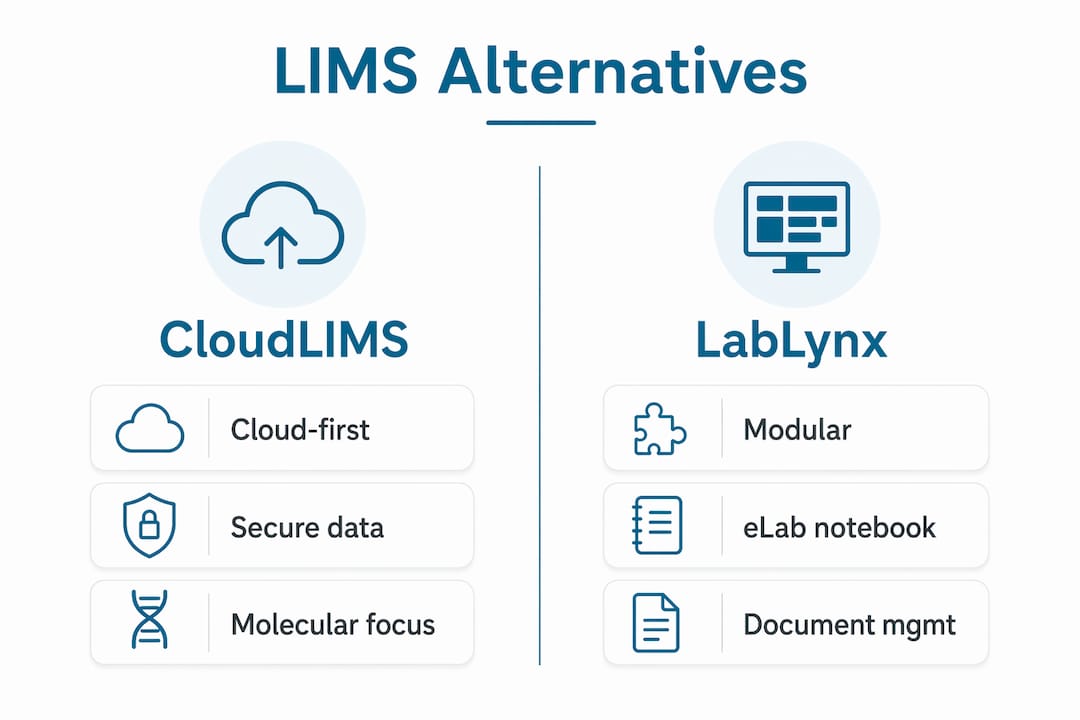
CloudLIMS targets clinical and molecular labs with a cloud-first architecture. Its strength is secure data management and compliance features, including role-based access controls and audit logging. Native support for pharmacogenomics reporting guidelines like CPIC is not prominently documented, so labs with heavy PGx report volumes should verify this directly before committing.
LabLynx takes a modular approach. You get a LIMS core, but you can layer on an electronic lab notebook and document management system, which matters for labs that need to manage SOPs and validation records alongside sample workflows. Its flexibility is genuine, though that flexibility comes with configuration work upfront.
Accelerated Technology Laboratories pairs LIMS software with hands-on consulting. For labs that have complex or unusual workflow requirements, this model can be an advantage. The tradeoff is that your feature set depends heavily on what gets scoped during implementation, making it harder to evaluate on paper before you engage.
Quality Systems International focuses on operational workflow and data management for clinical environments. It suits labs where the priority is process consistency and operational visibility rather than specialized molecular or PGx reporting output.
One consistent gap across these platforms: generic LIMS often lack the specialized PGx reporting rule support that molecular diagnostic labs require, including CPIC guideline integration and FDA pharmacogenomic labeling references. Labs running pharmacogenomics panels should treat this as a first-order evaluation question, not an afterthought.
How to choose the right alternative for your genetic or molecular diagnostic lab
The wrong LIMS costs more than its license fee. It costs time in manual workarounds, compliance gaps, and provider relationships strained by slow or inconsistent reporting. Evaluating pathagility.com competitors with the right criteria upfront prevents that.
Start with these questions:
- Does the platform support your specific test menu? A general clinical LIMS handles chemistry and hematology well. Molecular genetics and pharmacogenomics require different data structures, reporting logic, and result interpretation workflows.
- What are the PGx reporting capabilities? Ask vendors specifically whether they support CPIC guidelines, PharmGKB annotations, and FDA pharmacogenomic labeling. Marketing materials rarely answer this clearly.
- How does it integrate with your instruments and external systems? HL7 and FHIR support for EMR and EHR connectivity, plus direct instrument interfaces, reduce manual data entry and transcription errors.
- What does compliance look like in practice? Role-based access, audit logs, encryption at rest and in transit, and HIPAA-aligned data governance are baseline requirements for genetic data. Ask for documentation, not just assurances.
- What is the total cost of ownership? Pricing structures vary from subscription-based to one-time license models, and customization scope significantly affects final cost. Factor in implementation, training, and ongoing support.
- How does the platform scale? A startup lab and a multi-location reference lab have different needs. Confirm that the system can grow with your volume and test menu without requiring a full re-implementation.
- What does customer support actually look like? Response times, dedicated account management, and access to technical resources during go-live are worth asking about directly, not just reading in a brochure.
For labs evaluating LIMS options for genetic labs, workflow alignment is often the deciding factor. A system that fits your sample-to-report process without heavy customization will outperform a feature-rich platform that requires months of configuration to match your actual workflow.
Pro Tip: Ask every vendor to demonstrate CPIC rule integration and PGx report generation with a real test case from your menu. A live demo with your data reveals gaps that a feature checklist never will.
Deployment options also shape the decision. Cloud-hosted systems reduce IT overhead and support faster updates, while on-premises deployments give labs with strict data residency requirements more control. Neither is universally better. The right answer depends on your IT infrastructure, budget, and regulatory environment.
Labrynix is built specifically for genetic and molecular labs
If the platforms above feel like general-purpose tools adapted for molecular use, that is because most of them are. Labrynix was built differently. The team behind it came from genetic and molecular laboratory operations, which means the platform reflects how these labs actually work, not how a software company imagines they work.
The core of Labrynix is a complete sample-to-report workflow covering order intake, accessioning, sample tracking, workflow queues, and result delivery. On top of that sits a PGx reporting engine that generates branded, provider-ready pharmacogenomics reports using customizable templates, AI-assisted summaries, CPIC guideline support, PharmGKB-informed annotations, and FDA pharmacogenomic labeling references. Clinical review, interpretation, and final approval stay under laboratory control throughout.
Key differentiators for molecular and genetic labs:
- Labrynix LIMS manages test orders, patient and provider data, accessioning, workflow queues, user roles, and audit activity in one connected system
- Labrynix Reports generates modern, branded PGx and genetic testing reports with lab-approved interpretation rules and AI-assisted drafting
- Labrynix Connect supports HL7, FHIR, APIs, webhooks, EMR/EHR connections, billing platforms, and instrument interfaces
- Labrynix Portal gives providers and patients secure, branded access to orders, results, and communication workflows
- Labrynix Intelligence adds AI-powered analytics, bottleneck detection, and review queue management
Security and compliance are built into the architecture. Role-based access, audit logs, configurable permissions, and secure report delivery support HIPAA-conscious and GDPR-conscious operations. Labrynix scales from startup labs to multi-location reference networks without requiring a platform change.
For labs that have outgrown Pathagility or need a platform built around genetic testing lab software, Labrynix offers a direct path from where you are to where your lab needs to go.
Key Takeaways
The strongest Pathagility.com alternatives vary significantly in PGx reporting depth, and choosing the wrong one means building workarounds from day one.
| Point | Details |
|---|---|
| Recognized alternatives | CloudLIMS, LabLynx, Accelerated Technology Laboratories, and Quality Systems International are the leading Pathagility replacement options for molecular labs. |
| PGx reporting is the key gap | Most generic LIMS lack native CPIC guideline and FDA pharmacogenomic labeling support; verify this before selecting any platform. |
| Deployment and pricing vary | Pricing ranges from subscription to one-time license models; total cost of ownership depends heavily on customization scope and lab size. |
| Evaluation criteria that matter | Lab type fit, PGx reporting capability, integration depth, compliance features, and scalability should drive the decision, not marketing claims. |
| Labrynix for PGx and molecular labs | Labrynix is built from genetic lab experience, combining LIMS, native PGx reporting with CPIC and PharmGKB support, and full integration capabilities in one platform. |