
Choosing a laboratory information system for genetic testing that connects workflows, instrument data, and compliance often involves manual handoffs and disconnected functions. Many LIMS platforms lack transparent pricing and demand custom sales quotes, so labs face uncertain costs and delays. This list covers feature sets, integrations, and pricing approaches across top competitors so laboratories can match a platform to their process and budget.
Table of Contents
- Labrynix
- LigoLab
- Labbit
- AminoCloud
- LabWare
- STARLIMS Laboratory Information Management System (LIMS)
- Comparison of alternatives
Labrynix
At a Glance
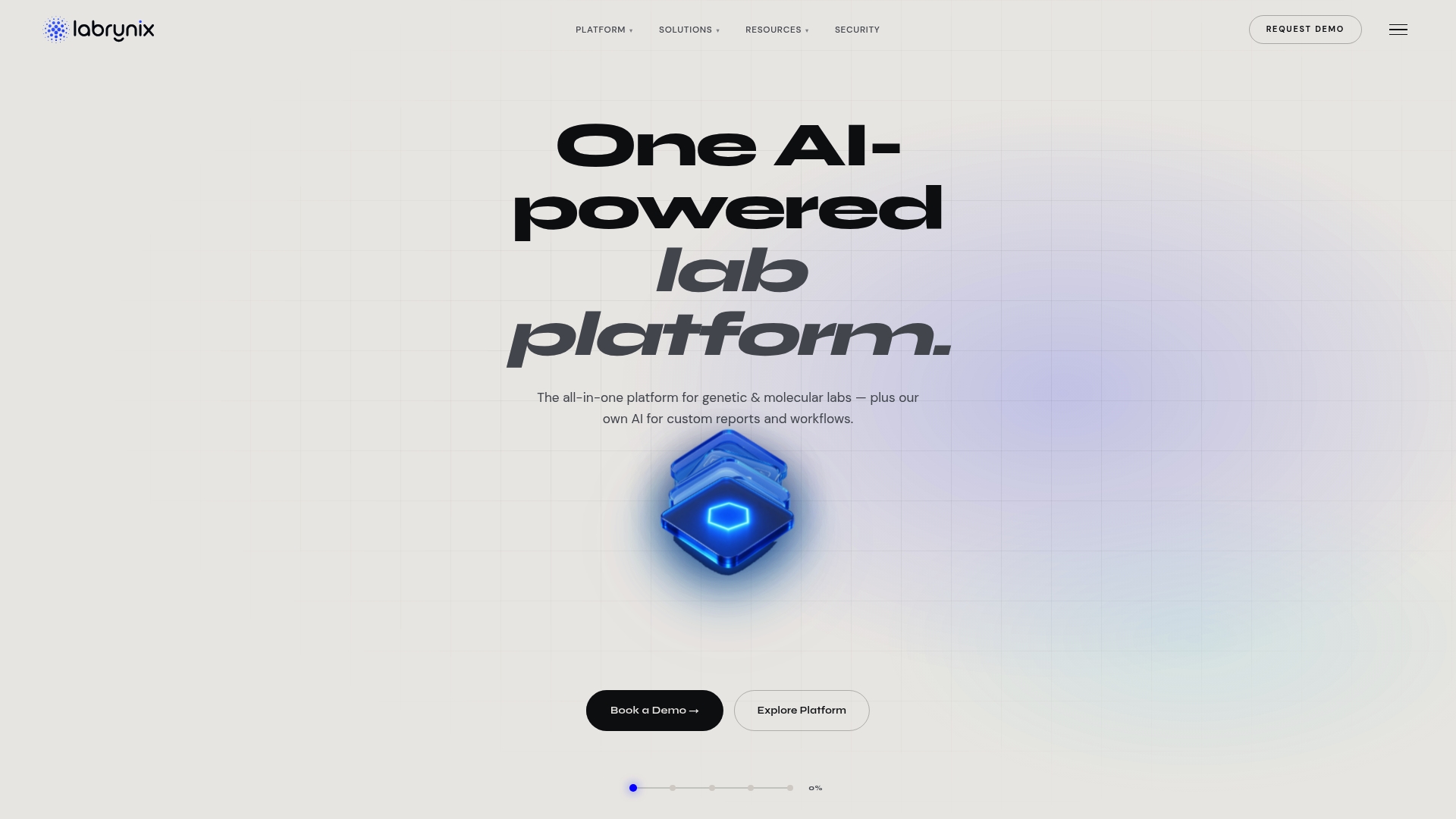
Labrynix uses a lab trained AI to build custom workflows, agents, and specialty reports for genetic and molecular laboratories. The vendor says a CLIA certified genetic lab team developed the platform. The system combines sample tracking, reporting, billing, and interoperability in one product to reduce tool handoffs and manual reentry.
Core Features
Labrynix provides a LIMS style workflow for orders, accessioning, sample status, and user roles while storing audit activity and operational queues. The reporting module creates branded PBX, oncology, and neurology reports with customizable templates, AI generated draft summaries, and rule driven interpretation controls. Connectors support HL7, FHIR, APIs, and device level integrations so results and billing stages move into EMR and billing systems.
Key Differentiator
Built by people with hands on lab experience, Labrynix focuses on pharmacogenomics and molecular reporting needs while embedding a lab trained AI to draft reports and automate review queues within a single environment.
Pros
The platform replaces separate accessioning, reporting, and billing tools and centralizes sample to report visibility for multi location labs. Its lab trained AI can draft reports and suggested interpretations that save review time while keeping clinical sign off under lab control. The system supports healthcare interoperability standards and device integrations, which helps push results into EMR environments and connect sequencing instruments to the workflow.
Cons
- Custom pricing can be complex to scope for smaller labs that need limited modules
Notable Integrations
- HL7
- FHIR
- APIs for EMR and EHR systems
- Instrument and sequencing device integrations
Who It's For
Labrynix fits genetic testing, molecular diagnostic, and pharmacogenomics labs that need a single platform for operations, reporting, and billing. It suits hospital laboratories, reference labs, and startup labs that require lab specific report templates and device connectivity. Labs with internal IT resources will find the platform easier to customize and deploy.
Unique Value Proposition
The platform centers a lab trained AI that drafts specialty reports and builds workflow agents inside the same system used for accessioning and billing. That configuration reduces manual handoffs and keeps clinical review and final approval inside the laboratory while letting you reuse the AI generated drafts across specialties.
Real World Use Case
A CLIA certified genetic testing lab migrates its legacy IS, reporting, and billing tools into Labrynix. The lab gains end to end operational visibility and fewer manual steps in accessioning and sign out. The AI drafts PBX reports and lab approved templates speed clinical review and shorten turnaround time for provider delivery.
Pricing
Pricing is by custom quote and depends on selected modules, sample volume, and deployment scope. Expect implementation and specialty customization to affect total cost and timeline.
Website: https://labrynix.com
LigoLab
At a Glance
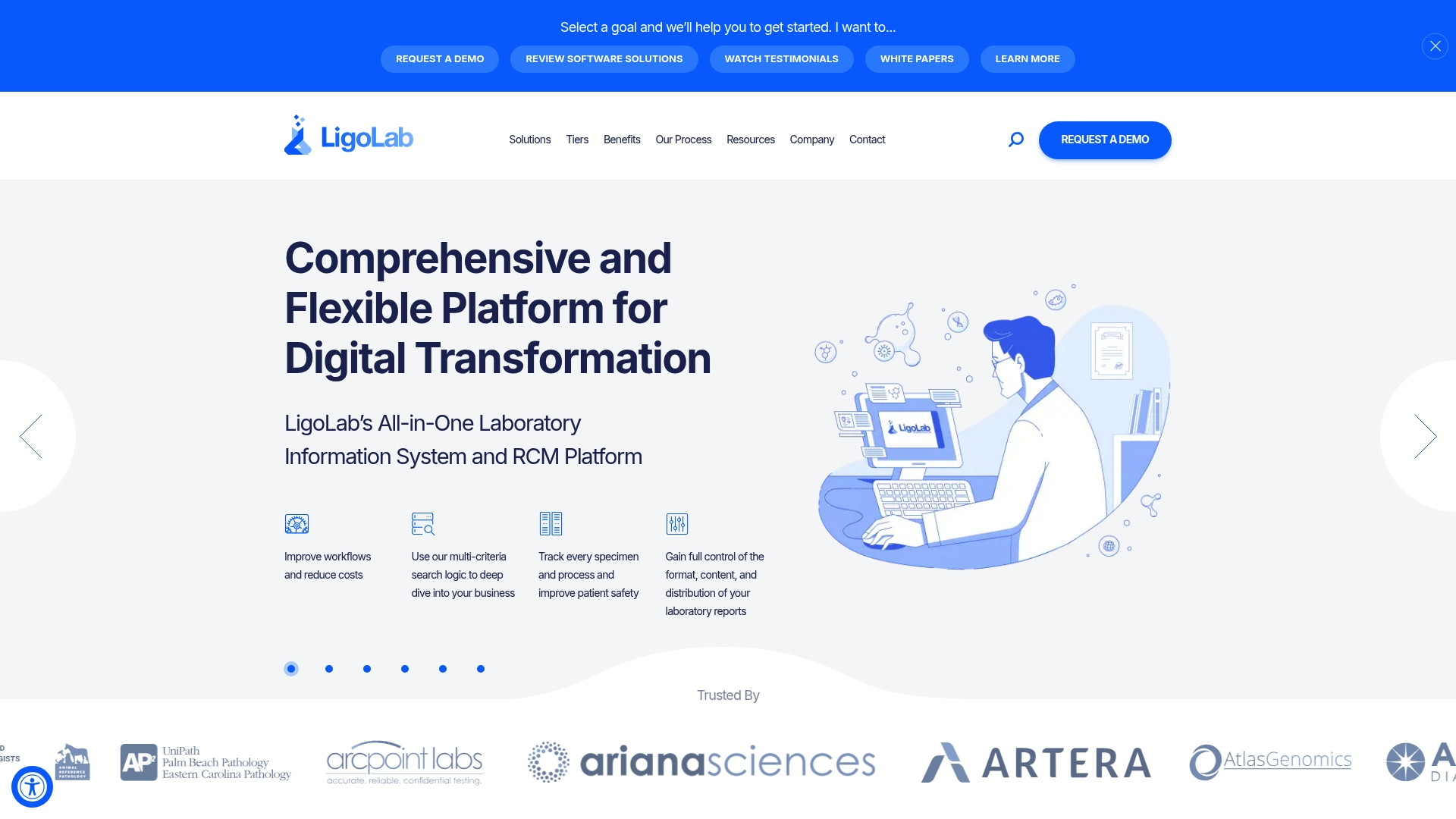
LigoLab reports receiving Frost & Sullivan’s Competitive Strategy Leadership Award and high ratings on independent review sites. The vendor positions the product as an all-in-one laboratory information IS and revenue cycle management platform for pathology and diagnostic labs. That combination aims to reduce manual handoffs and centralize clinical and billing workflows.
Core Features
The platform combines a unified laboratory IS for multiple departments with rules-based automation and an automation engine to handle complex procedures. It includes instrument and EHR integrations, billing system connections, and real-time dashboards that surface operational insights. Support for pathology, microbiology, genomics, and toxicology appears across the core modules.
Key Differentiator
LigoLab’s main distinction is the tight integration of the information IS and revenue cycle management with award-winning support. That pairing reduces the need to maintain separate billing systems. For labs that require both clinical workflow control and financial visibility in one system, this merged approach shortens administrative loops.
Pros
High configurability lets labs adapt workflows to their processes without extensive custom coding. The vendor advertises 24/7 customer support, which helps labs maintain uptime and address issues outside normal business hours. Strong automation features reduce manual entry and lower the chance of transcription errors while the unified IS and RCM stack simplifies reporting and revenue tracking. Recognition on review platforms and industry awards lends credibility to the vendor’s market position.
Cons
- Potentially high cost for smaller labs with limited budgets, making it more attractive to growth-ready operations.
- Implementation and onboarding can demand significant time and training for staff new to a consolidated system.
- Detailed pricing is limited publicly, so procurement requires custom quotes and a sales engagement.
When It May Not Fit
Very small laboratories with minimal testing volume or budgets below the reported threshold may find the platform too large or expensive. If you run a single-location clinic with only a handful of tests monthly, the total cost of ownership and implementation effort may outweigh the operational gains. Labs seeking out-of-the-box low-cost solutions will likely prefer simpler, lower-feature products.
Who It's For
Medium and large pathology labs and clinical laboratories preparing to scale will get the most from LigoLab. Organizations that need combined clinical workflow management and billing visibility will benefit from the integrated IS and RCM. Teams that can invest in training and want 24/7 vendor support are the best match.
Real World Use Case
A midsize pathology lab moved from multiple point solutions to LigoLab’s unified platform. The lab reported faster turnaround times after automating accessioning rules and consolidating billing. Automation and shared dashboards improved throughput and reduced administrative reconciliation work.
Pricing
Pricing is not explicitly detailed on the vendor site and likely varies by lab size, needed modules, and scope of implementation. Expect a custom quote based on your number of users, interfaces, and whether RCM services are included. Contact sales for an itemized proposal and deployment timeline.
Website: https://ligolab.com
Labbit
At a Glance
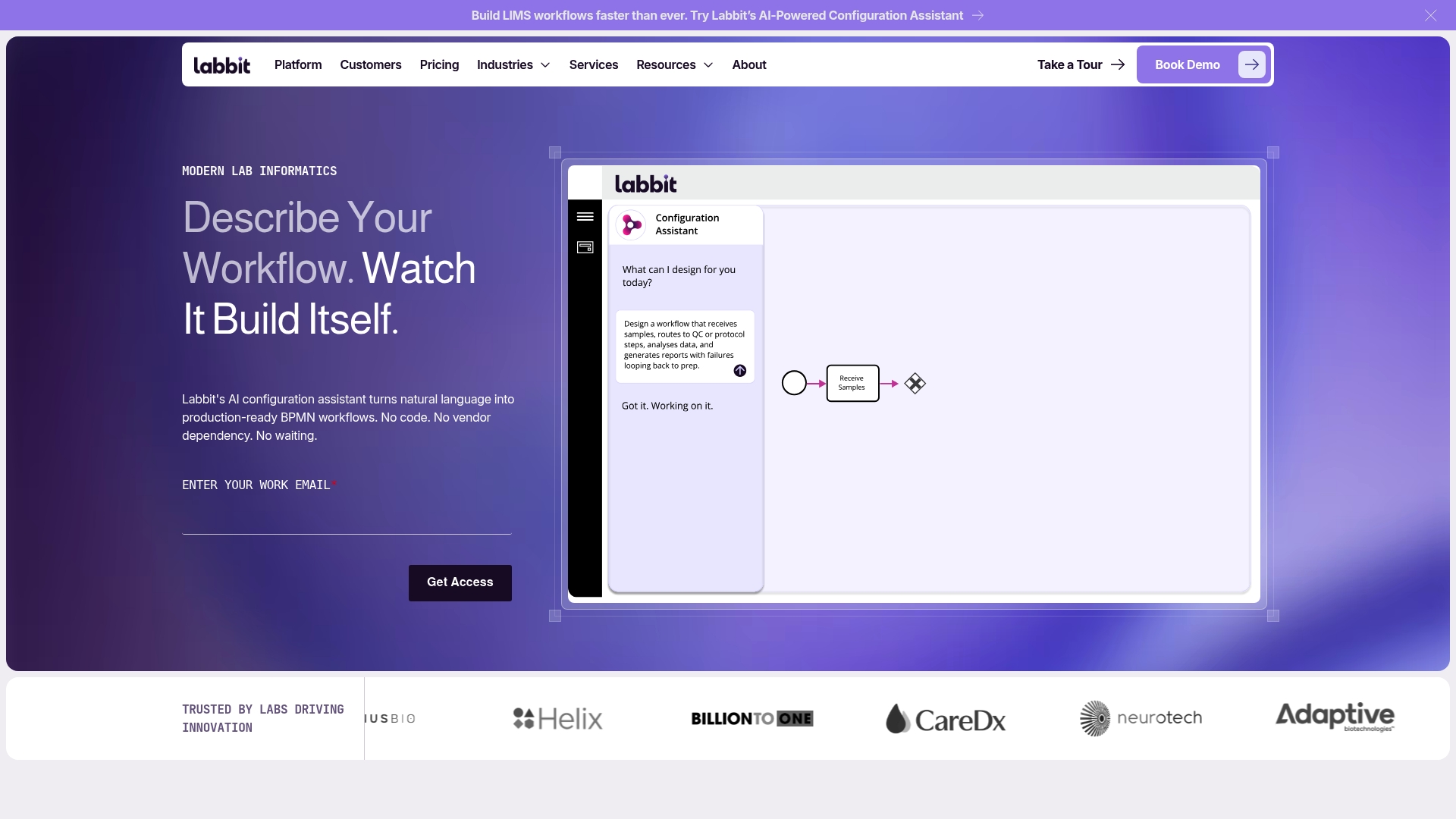
Labbit's graph database design makes laboratory data FAIR and AI-ready for complex, cross‑query investigations. The platform combines visual BPMN workflow configuration with a Live View for sample status and flow. It runs on AWS and supports no code workflow configuration, letting teams adapt processes without rebuilding core systems.
Core Features
Labbit exposes visual BPMN workflow configuration, a Live View of workflows and samples, and graph powered queries for complex data investigations. It provides comprehensive sample and inventory tracking with genealogy and chain of custody, plus instrument monitoring, order processing, and results tracking. The vendor advertises automated audit trails and secure data handling for HIPAA, FDA, ISO, and GxP, and it offers compliance ready reporting and export features.
Key Differentiator
The standout technical difference is the graph database architecture. That architecture keeps relationships explicit and queryable, which simplifies lineage analysis and root cause investigation. For labs that run complex workflows and frequent data investigations, the graph model reduces time spent assembling context from siloed tables.
Pros
Flexible visual workflow modeling reduces the need for scripting and lets lab staff map processes directly to operations. Built-in compliance features cover audit trails, secure handling, and exports that target regulatory review. Cloud hosted on AWS, the platform supports high throughput labs and instrument integration. The graph design makes dataset joins and genealogy queries easier and leaves data ready for downstream AI or analytics.
Cons
- Complexity may challenge very small or less technical labs during setup and daily use.
- Customization options may not match a fully custom built system for niche workflows.
- Transitioning from legacy LIMS or paper systems requires planning and a nontrivial migration effort.
When It May Not Fit
If your lab has only a handful of tests and limited IT resources, the platform could feel heavy. Teams that need deeply bespoke database schemas or proprietary report engines may find customization constrained. Organizations unwilling to invest time in migration and workflow modeling will struggle to realize the platform's benefits.
Who It's For
Mid sized to large laboratories that need flexible, regulatory focused informatics to support complex science workflows will get the most value. The platform suits molecular, genomic, and reference labs that run many branching protocols and require explicit sample genealogy. It also fits teams planning to adopt AI or advanced analytics on lab data.
Real World Use Case
Helix replaced a legacy LIMS with Labbit to support evolving workflows and scale genomic test volume. That migration let Helix automate instrument integration, preserve sample genealogy, and keep operational visibility as throughput rose. The move maintained regulatory controls while reducing manual handoffs during high volume processing.
Pricing
The vendor lists pricing as Not applicable and does not publish public tiers. Labs must contact sales for a deployment estimate and implementation scope, which will reflect workflow complexity and migration needs.
Website: https://labbit.com
AminoCloud
At a Glance
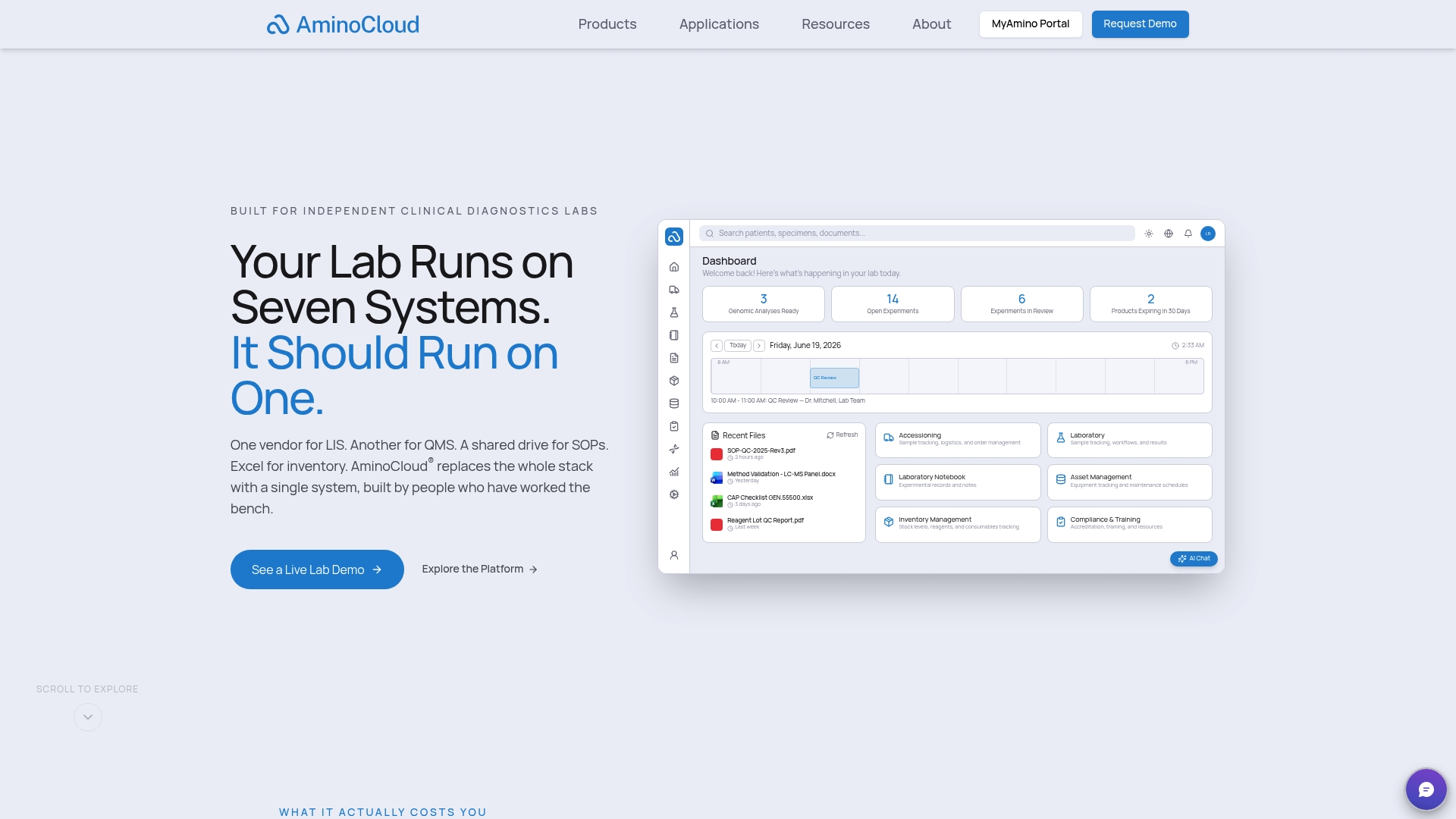
According to the company, AminoCloud runs on dedicated Azure infrastructure and meets HIPAA, 21 CFR Part 11, SOC 2, and ISO 27001 compliance. The platform consolidates inventory, ELN, compliance, LIS, and genomics pipelines into a single cloud environment for clinical and research labs.
Core Features
AminoCloud combines inventory management, asset tracking, electronic lab notebooks, document control, and a genomics suite with an integrated LIS. The platform supports connections to instruments and EHR systems using HL7 and FHIR, and it includes GitHub integration for pipeline version control and a custom API for bespoke links to lab systems.
Key Differentiator
AminoCloud centers on scientist input during product development. That focus yields workflows and data models tailored to lab technicians, bench scientists, and bioinformatics staff, helping reduce manual handoffs while keeping regulatory records and audit trails tightly controlled.
Pros
The product was built by laboratory scientists, which shows in practical workflow mapping and field-oriented configuration options. The single-platform design reduces the need to copy results between systems and lowers repetitive data entry for accessioning and reporting. Security and compliance are a major emphasis, with vendor statements about formal standards and controls that help labs prepare for audits and inspections. Modular deployment lets labs buy just the modules they need and add genomics or LIS components later.
Cons
- Implementation complexity may require dedicated training for staff. Smaller teams will need time and resources to learn the system.
- Deployment time depends on the number and type of integrations, so rollout can stretch longer for labs with many instruments and EHR links.
- Pricing is customized and not publicly posted, which means you must contact sales for a budget estimate.
When It May Not Fit
Very small or resource constrained labs may find the implementation effort disproportionate to their immediate needs. Labs that prefer fixed, off the shelf pricing may be frustrated by a customized quote process. Organizations that need a lightweight, single-function inventory or simple ELN may be better served by a narrower tool.
Notable Integrations
AminoCloud lists standards and vendor connections including HL7, FHIR, Epic EHR, Cerner Oracle Health, Illumina sequencing platforms, Thermo Fisher analyzers, Roche and Beckman protocols, and Siemens analyzers. The platform also exposes a custom API for additional, lab specific integrations.
Who It's For
Independent clinical, research, and genomic laboratories that require integrated workflows, formal audit trails, and instrument level connectivity will find this platform relevant. Larger reference labs and hospital research programs that need genomics pipelines plus LIS functionality benefit most. Labs expecting future growth and modular expansion will see value in the architecture.
Real World Use Case
A research hospital replaced several legacy tools with AminoCloud to centralize sample tracking and archive records. The lab gained real time visibility into sample status and moved genomic analysis pipelines into a version controlled environment. That migration reduced manual handoffs and improved readiness for inspections.
Pricing
AminoCloud does not publish list pricing. Costs are typically tailored by module selection, integration scope, and the number of laboratory sites. Expect to request a sales consultation for an implementation estimate and a formal quote.
Website: https://aminocloud.com
LabWare
At a Glance
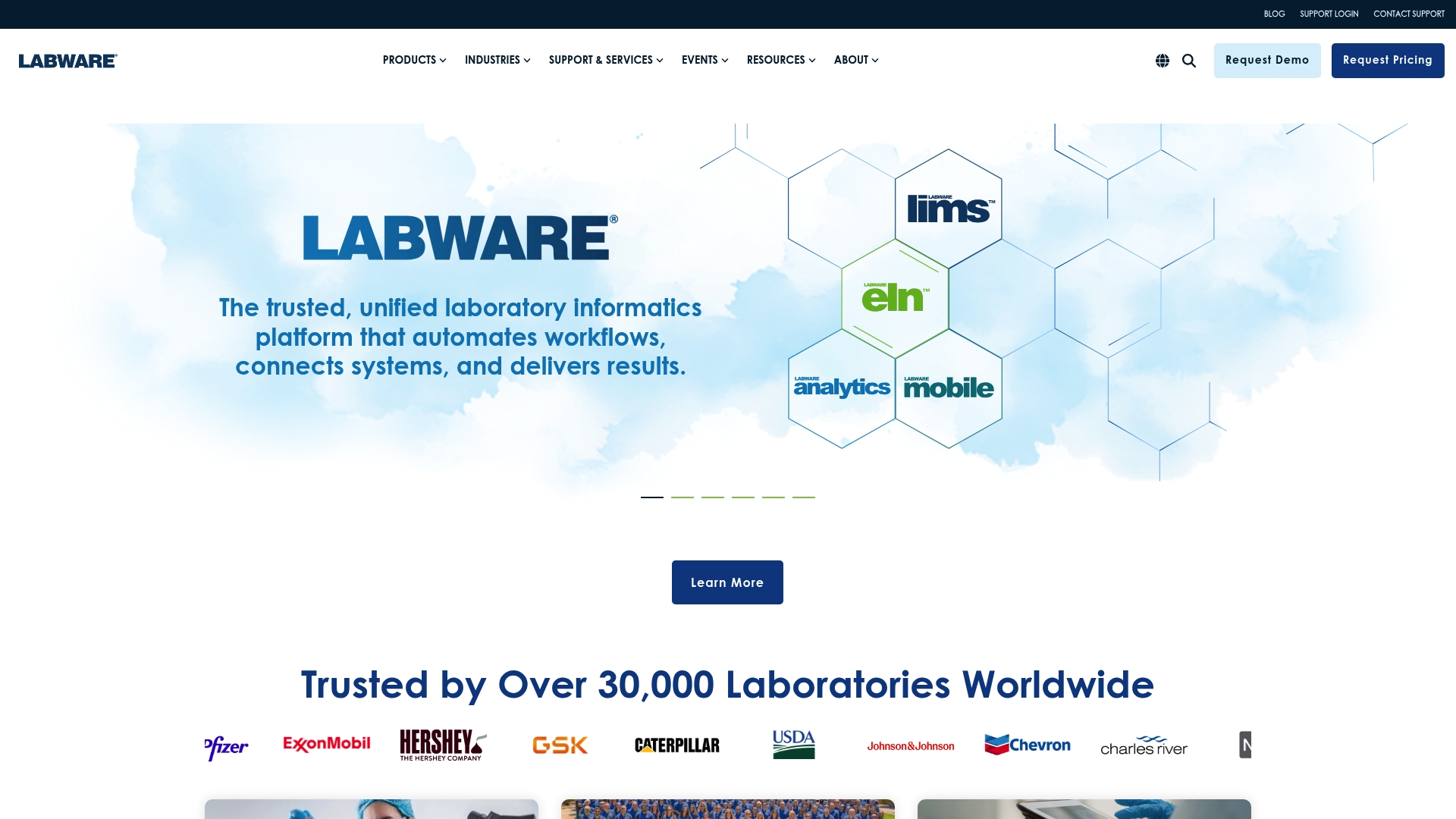
LabWare reports use by over 30,000 laboratories worldwide. That figure reflects broad adoption across research, clinical, manufacturing, and government settings. The vendor emphasizes rapid deployment and long term evolution without wholesale replacement of existing systems.
Core Features
LabWare automates laboratory workflows while connecting instruments and external systems to a single platform. The system supports electronic lab notebooks and AI integration, and it maintains data integrity with audit trails and electronic signatures. Its architecture targets complex IT ecosystems and scales to support distributed labs and varied testing needs.
Key Differentiator
LabWare focuses on configurable depth for complex operations, letting teams adapt workflows rather than conform to a fixed process. The platform advertises rapid deployment methods that reduce disruption during rollout. That combination makes the product suitable where heavy customization and integration with legacy systems are required.
Pros
LabWare is widely used across large organizations, and that scale often aligns with proven enterprise deployments. The platform offers deep configuration options to map complex laboratory logic into software rather than forcing operational change. Strong support for regulatory record keeping and data governance helps labs meet audit and compliance needs while improving traceability.
Cons
-
No public pricing details. Procurement requires vendor engagement and likely targets enterprise licensing.
-
Integration and customization can be complex. Projects often need specialist consultants or internal informatics resources.
-
Potentially high initial investment and training costs. Smaller labs may face a longer ramp to full operational use.
Who It's For
Large research, clinical, and manufacturing laboratories that need a configurable laboratory informatics platform fit this product profile. Teams that operate across multiple sites or that must integrate legacy systems will find the customization options valuable. Organizations focused on high throughput and strict audit requirements will get the most from the platform.
Real World Use Case
A pharmaceutical company implemented LabWare LIMS to manage compound testing across globally dispersed sites. The deployment tied instrument outputs into standardized workflows and created an auditable record from sample receipt to final report. Lab teams used the system to reduce manual transcription and improve traceability during regulatory inspections.
Pricing
LabWare does not publish standard list prices. Pricing appears to be enterprise oriented and assigned per contract, so labs must contact the vendor for a formal quote. Expect licensing, implementation, and support to be scoped separately based on deployment size and customization needs.
Website: https://labware.com
STARLIMS Laboratory Information Management System (LIMS)
At a Glance
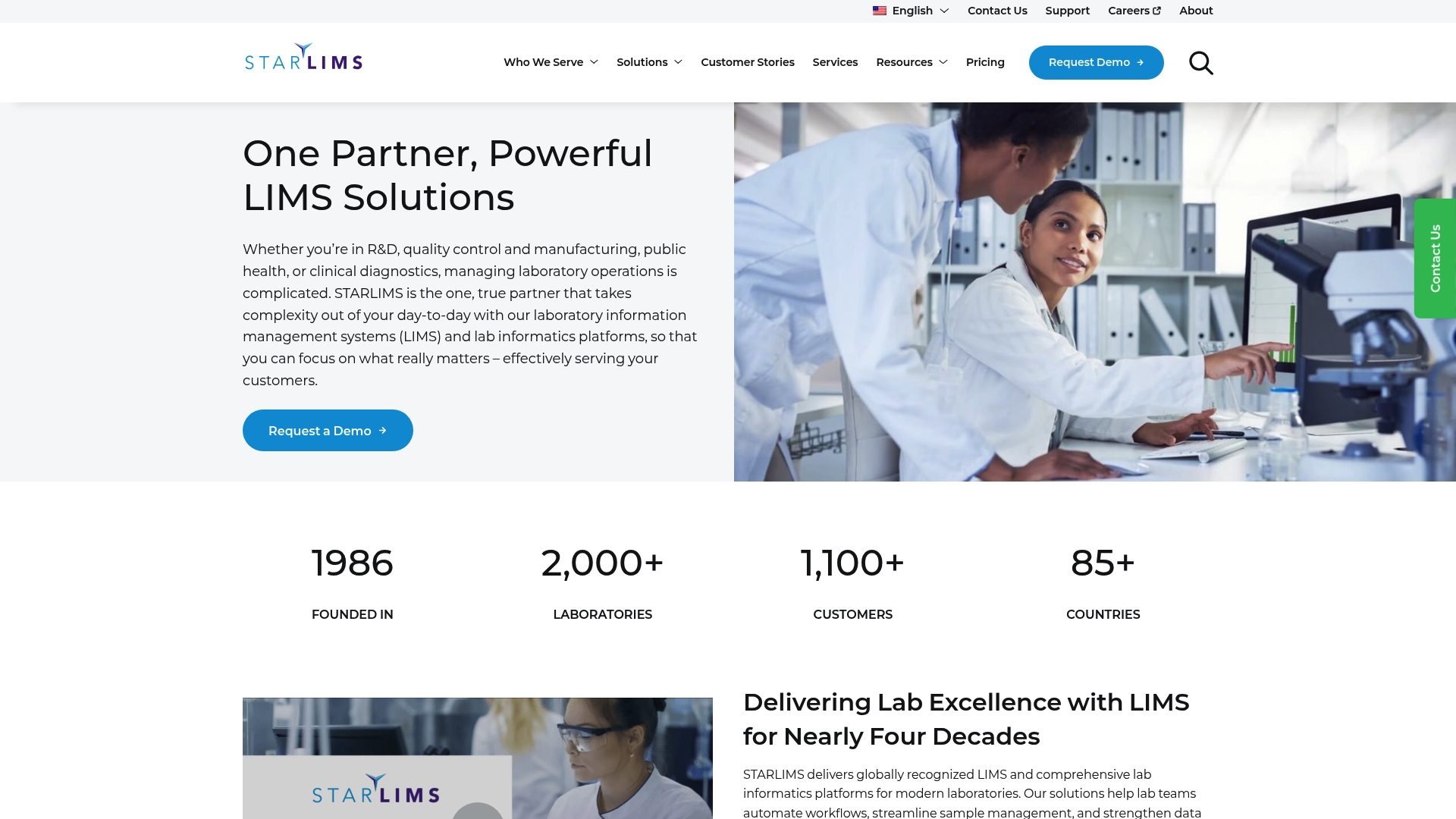
Deployment options include cloud and on premise, and the platform covers quality control, public health, clinical diagnostics, R&D, and environmental sciences. The product offers modules for each sector and support for certification workflows such as ISO. Pricing is not publicly disclosed and requires a direct quote from the vendor.
Core Features
STARLIMS groups laboratory capabilities into modular areas for sample tracking, data management, analytics, and quality control, and it includes electronic lab notebooks and scientific data capture. The platform provides workflow automation and process management that connect instrument outputs to records and reporting. Compliance features help manage audit trails and certification workflows across regulated operations.
Key Differentiator
STARLIMS focuses on tailoring deployments to specific industries while emphasizing integration and data integrity. That industry specific approach pairs sector modules with configurable workflows and certification support to meet regulated lab requirements.
Pros
The product offers extensive industry specific modules for clinical diagnostics, public health, and R&D, which reduces the need for separate niche systems. Deployment options include both cloud and on premise, giving labs choice over data residency and operational control. The platform emphasizes compliance and certification support, which helps labs manage audit trails and documentation for regulated reporting.
Cons
- Pricing is not publicly listed, so budgeting requires vendor engagement and a quote.
- Complex setup may require professional services and configuration time before live use.
- Some users report a steep learning curve when working with the larger module set.
When It May Not Fit
STARLIMS may not fit small labs that need a lightweight, off the shelf LIMS with transparent pricing. Teams without budget for professional services will likely struggle with initial deployment and customization. Organizations that need rapid trial deployment on a fixed price may find the quote based model slow.
Who It's For
Laboratories in regulated industries that need modular, sector tailored LIMS will benefit most. The product suits hospital labs, public health agencies, reference labs, and pharmaceutical R&D groups that require certification workflows and broad instrument integration.
Real World Use Case
A clinical laboratory uses STARLIMS to centralize sample tracking and automate regulatory reporting for diagnostic tests. The lab integrates instrument output with the LIMS and links records to its electronic health record system. That setup reduces manual handoffs and improves traceability for audits.
Pricing
Not publicly disclosed. STARLIMS requires interested buyers to request a quote or demo through the company contact channels. Custom pricing reflects chosen modules, deployment option, and any professional services for implementation.
Website: https://starlims.com
Comparison of alternatives
An analysis of the diverse laboratory information systems highlights significant trade-offs to help facilities implement tailored solutions effectively.
Integrated workflows and AI-enhanced operations
Labrynix stands out with its lab-trained AI that specializes in genetic and molecular workflows, automates report drafting, and assists in workflow customization within its unified platform. This allows laboratories to enhance their operational visibility and efficiency.
compliance and dataset governance
AminoCloud excels in providing compliance features, inclusive of advanced certifications and data governance tools. This focus allows labs to maintain regulatory integrity, embedding audit trails, and enabling rigorous data protection protocols. This capability is particularly valued in scenarios demanding compliance with stringent regulations.
Integration with revenue cycle management
LigoLab distinguishes itself by tightly integrating laboratory workflows with revenue management. This approach simplifies the billing process and financial oversight, beneficial for labs aiming to unify clinical and administrative operations into a cohesive structure.
Best fit
- Laboratories specializing in genetic and molecular diagnostics requiring AI-driven report drafting would benefit most from Labrynix.
- Facilities emphasizing compliance and data security as operational priorities should evaluate AminoCloud’s compliance capabilities.
- Organizations aiming to optimize clinical and billing operations concurrently may find LigoLab’s unified platform particularly advantageous.
Our pick
For laboratories prioritizing efficient and specialized genetic and molecular operations, Labrynix.com offers advantages due to its integrated laboratory-specific AI, designed to address challenges specific to modern lab demands.
For laboratories searching for the ideal platform tailored to their diagnostic and operational needs, the table below compares several key tools, highlighting their unique advantages and limitations.
| Product | Key Differentiator | Best For | Pricing | Notable Limitation |
|---|---|---|---|---|
| Labrynix | Lab-trained AI for integrated operations and reporting | Molecular and genetics labs needing AI-supported workflows | Price not published | Custom pricing complexity for smaller labs |
| LigoLab | Unified LIMS and Revenue Cycle Management (RCM) | Medium to large pathology and diagnostic labs | Price not published | Potentially high cost for smaller operations |
| Labbit | Graph database design for relational data queries | Regulatory-compliant labs performing complex data investigations | Price not published | Challenges for less technical labs during implementation |
| AminoCloud | Development centric on scientist input | Genomic and research labs requiring integrated workflows | Price not published | Implementation complexity requires staff training |
| LabWare | Depth of configurability for enterprise environments | Large, multi-site labs with diverse operations | Price not published | Cost and training needs may be prohibitive for small labs |
| STARLIMS LIMS | Modular and industry-specific certification workflows | Regulated sectors with distinct operational needs | Price not published | Complex deployment and training requirements |
Challenges When Searching for LabLynx.com Alternatives
Many genetic and molecular laboratories face frustration with disconnected tools and outdated reporting systems. These complications slow down workflows, cause manual errors, and weaken the provider and patient experience. Labs focused on pharmacogenomics, molecular diagnostics, and genetic testing need software tailored to their unique workflows, not broad clinical products.
Labrynix addresses these challenges by combining LIMS workflow management, advanced PGx reporting, portals, billing visibility, and AI-powered insights into one system. Built by genetic lab experts, Labrynix sharpens sample-to-report operations with customizable templates, FDA and CPIC guideline support, and seamless interoperability using HL7, FHIR, and APIs.
Ready to reduce manual handoffs and speed your lab’s clinical review process? Explore how Labrynix helps laboratories focused on pharmacogenomics and molecular diagnostics stay efficient and compliant.
Labrynix offers provider and patient portals, AI-assisted report summaries, and billing workflow visibility designed specifically for modern molecular labs. Visit the site to learn how this solution can fit your lab's needs.
FAQ
How does Labrynix support genetic testing workflows?
Labrynix offers a LIMS style workflow that integrates orders, accessioning, and sample status management within one platform. The system's comprehensive features include sample tracking and an audit activity log, making it ideal for labs focused on genetic testing. Engaging with Labrynix will streamline your lab operations and enhance visibility.
What is the difference between Labrynix and LigoLab?
LigoLab excels in its tight integration of laboratory information systems and revenue cycle management, which is beneficial for labs needing strong financial oversight. In contrast, Labrynix targets genetic testing and pharmacogenomics specifically, providing custom workflows and AI-driven report drafting for these fields. Choose Labrynix if your primary focus is clinical genetic workflows rather than broader laboratory accounting needs.
Which platforms offer instrument integrations for laboratory systems?
Labrynix supports multiple integrations, including HL7, FHIR, and APIs, allowing seamless connectivity with EMR systems and laboratory instruments. These capabilities enhance interoperability and ensure data flows effectively throughout laboratory processes. Opting for Labrynix will help maintain consistent data linkage across your testing workflows.
Can I use Labrynix if my lab is smaller and has limited IT resources?
Labrynix is designed for genetic testing and molecular diagnostic labs but may pose challenges for smaller labs with limited IT resources due to its extensive customization options. Nonetheless, its user-friendly interface can simplify operations, making it a viable choice even for smaller setups willing to invest in training and support.
How does Labrynix address compliance and regulatory needs?
Labrynix ensures compliance by embedding audit trails and secure data handling systems, which support regulatory requirements. Its focus on laboratory-specific features guarantees that your processes remain compliant while streamlining reporting. This makes Labrynix a suitable choice for labs that prioritize maintaining rigorous compliance standards.