
For molecular and pharmacogenomics labs, the right answer is a specialist LIS system with native PGx reporting and HL7/FHIR connectivity built in, not a broad clinical platform retrofitted for genetics. Labrynix fits that description for labs whose core deliverable is a PGx or molecular report, though your final pick depends on volume, test mix, and how deep your digital pathology needs go.
Here's the shortlist worth demoing in 2026:
- Enterprise HIS-integrated platform — best for large hospital systems already standardized on one vendor's EHR ecosystem.
- Reference-lab automation specialist — built for outreach volume, courier logistics, and high-throughput billing.
- Cloud-native PGx-first platform (Labrynix) — purpose-built for molecular, genetic, and pharmacogenomics labs that need report quality and interoperability without enterprise overhead.
- Anatomic pathology specialist — strongest at gross description, synoptic reporting, and digital slide integration.
- Legacy on-prem workhorse — deep instrument libraries built up over decades, slower to modernize.
Laboratory data makes up roughly 70% of the information in a patient's medical record, which is exactly why the system managing that data can't be an afterthought.
Key Takeaways
Molecular and PGx labs get the strongest fit from a cloud-native LIS with native PGx templating and built-in HL7/FHIR connectivity rather than a retrofitted general clinical platform.
| Point | Details |
|---|---|
| Lab data is high-stakes | Laboratory results make up about 70% of a patient's medical record, so the system managing it deserves real scrutiny. |
| Instrument mapping is not automatic | Bidirectional interfacing needs documented mapping and testing against protocols like ASTM E1381 before go-live. |
| Weight PGx depth heavily | For molecular labs, native PGx templating and citation sourcing matter more than generic reporting flexibility. |
| Demo with your own data | A sandbox trial using real PGx edge cases exposes template gaps that a vendor's polished demo never will. |
| Labrynix fits PGx-first labs | Labrynix pairs native PGx report templating with HL7/FHIR connectivity and billing visibility built for genetic and molecular labs. |
Table of Contents
- What Is an LIS System and Why Does It Matter for Molecular Labs?
- 2026 Shortlist at a Glance: Comparing Deployment, Fit, and Capabilities
- How We Evaluated LIS Platforms in 2026
- Vendor Profiles: Strengths, Tradeoffs, and Best-Fit Guidance
- Which Vendor Category Fits Your Lab Type and Scale?
- How to Choose an LIS: Checklist, Demo Questions, and Red Flags
- Final Recommendation and Next Steps
- Why Labrynix Fits Molecular and PGx Lab Needs
- Ready to See a PGx-Focused LIS in Action?
- Sources
What Is an LIS System and Why Does It Matter for Molecular Labs?
A laboratory information system manages the full diagnostic lifecycle: patient demographics, order intake, specimen tracking, instrument interfacing, result validation, and reporting back to EHRs. That's the standard industry term, and it's worth stating plainly because "lis systems" gets searched more often than the formal name, even though laboratory information system (LIS) is what shows up in regulatory documents and vendor contracts.
For a molecular or PGx lab specifically, the stakes are different than for a general chemistry lab running routine panels. A pharmacogenomics report has to pull from variant call data, apply CPIC or PharmGKB-informed interpretation rules, and output something a provider without a genetics background can actually act on. Generic LIS software treats that report like any other lab result: a value, a reference range, a flag. It wasn't built for gene-drug interaction tables or FDA label citations, and it shows.
One clarifying note before going further: the acronym LIS shows up outside health care too. NASA's Land Information System is a land-surface modeling framework, and Lis is also the name of an unrelated open-source library for solving linear equations. If you're researching vendors and keep landing on satellite data or numerical computing pages, that's why.
2026 Shortlist at a Glance: Comparing Deployment, Fit, and Capabilities
The vendor landscape splits along a few clear lines: deployment model, how deep the molecular and PGx capabilities go, and whether digital pathology and outreach billing are core strengths or bolted-on afterthoughts.
| Category | Best For | Deployment | Molecular/PGx Depth | Digital Pathology | Interoperability | Typical Customer | Implementation Time | Reporting/Analytics | Billing/RCM | Notable Tradeoff |
|---|---|---|---|---|---|---|---|---|---|---|
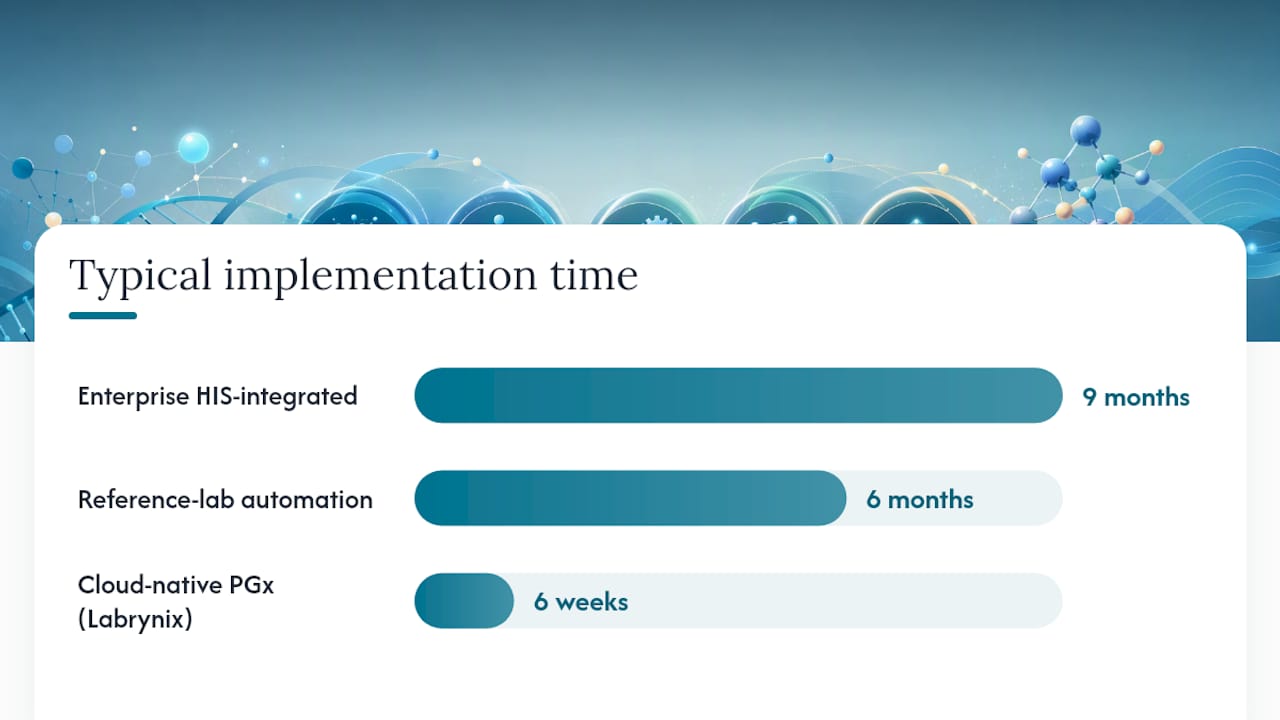
| Enterprise HIS-integrated platform | Large hospital networks | On-prem or hosted | Moderate, add-on modules | Strong, tied to imaging suite | Deep HL7, mature APIs | Health systems, multi-site | 9 months | Broad but generic templating | Bundled with hospital billing | Slow to customize; heavy IT lift |
| Reference-lab automation specialist | High-volume outreach labs | On-prem or hybrid | Light to moderate | Limited | Strong HL7, EDI billing | Reference/outreach labs | 6 months | Volume-focused dashboards | Strong RCM tooling | Less suited to niche PGx reporting |
| Cloud-native PGx-first platform (Labrynix) | Genetic, molecular, PGx labs | SaaS, cloud-hosted | Deep, native PGx templating | Emerging integrations | HL7, FHIR, APIs, webhooks | Startups to mid-size labs | 6 weeks typical | Purpose-built PGx/CPIC-informed templates | Billing visibility, not full RCM | Newer platform, smaller install base than legacy players |
| Anatomic pathology specialist | Surgical and cytopathology | On-prem or hosted | Strong pathology, lighter molecular | Deep, whole-slide imaging | HL7 for orders/results | Pathology groups, hospital labs | 4 months | Synoptic and CAP-aligned templates | Basic | Molecular workflows often need a bolt-on |
| Legacy on-prem workhorse | Established clinical labs | On-prem | Variable by module | Minimal | ASTM-heavy, older HL7 versions | Long-tenured clinical labs | 6 months | Configurable but dated UI | Mature but rigid | Modernization requires significant rework |
If your lab's core output is a PGx or molecular report, weight your evaluation toward three things: how the platform's report template engine handles variant interpretation and citation updates, whether audit logging covers every touch on a report before sign-out, and how cleanly billing status flows without a separate reconciliation step. Digital pathology integration matters mostly if you're running anatomic or surgical pathology alongside molecular work. In that case, ask specifically whether whole-slide image links attach to the same case record as the molecular result, or live in a separate silo.
How We Evaluated LIS Platforms in 2026
The shortlist above and the profiles below were built against eight weighted criteria, with molecular and PGx capability weighted heaviest given the audience this guide serves.
- Interoperability: HL7 version support, FHIR readiness, open APIs, and webhook availability.
- PGx and reporting depth: native templating, CPIC/PharmGKB-informed content, and report versioning.
- Instrument connectivity: bidirectional interfacing and adherence to protocols like ASTM E1381.
- Deployment flexibility: SaaS, hosted, or on-prem options and the upgrade path between them.
- Analytics and reporting: turnaround dashboards, bottleneck visibility, and exportable audit data.
- Security and compliance posture: role-based access, audit trails, and HIPAA-conscious design.
- Implementation effort and total cost of ownership: timeline realism and hidden fees.
- Vendor support model: post-launch responsiveness and update cadence.
Vendor-supplied claims about implementation time, uptime, and reference counts were treated as marketing input, not independent findings, unless corroborated elsewhere. No formal lab-by-lab benchmark testing was performed here. Treat every timeline and capability claim as a starting point for your own demo and reference calls, not a guarantee.
Vendor Profiles: Strengths, Tradeoffs, and Best-Fit Guidance
Enterprise HIS-integrated platform Strengths: deep hospital system integration, mature revenue cycle tie-ins, broad instrument library built over years, strong governance tooling, large installed base for reference checks. Tradeoffs: customization requests often route through lengthy IT change control, and PGx-specific reporting usually requires a third-party add-on. Best for: multi-hospital networks already standardized on one EHR vendor.
Cloud-native PGx-first platform (Labrynix) Strengths: native PGx report templating with CPIC and PharmGKB-informed annotation support, HL7/FHIR and API connectivity built for external system handoffs, provider and patient portals for direct result delivery, billing workflow visibility without a separate reconciliation tool, and AI-assisted report drafting to cut manual formatting time. Tradeoffs: newer to market than decades-old legacy systems, so the reference base skews toward genetic and molecular labs rather than general chemistry. Best for: genetic testing labs, molecular diagnostic labs, and PGx-focused reference labs that need reporting quality without enterprise-scale overhead. (Feature list reflects Labrynix's own published platform description; validate specifics against your workflow in a sandbox demo.)

Reference-lab automation specialist Strengths: built for outreach volume, with courier and specimen logistics tracking, EDI-based billing connections, and client portal tools for referring providers. Tradeoffs: PGx and molecular reporting tends to be a secondary module rather than a core strength, and report templating can feel generic for gene-drug interaction content. Best for: high-volume outreach and reference labs where logistics and billing throughput matter more than specialized reporting.
Anatomic pathology specialist Strengths: synoptic reporting aligned to pathology college protocols, whole-slide imaging integration, and strong gross description workflows. Tradeoffs: molecular and PGx capabilities are usually add-on modules rather than native, and interoperability sometimes lags behind cloud-native competitors. Best for: surgical pathology and cytopathology groups running molecular testing as a smaller share of volume.
Legacy on-prem workhorse Strengths: extensive instrument interface libraries accumulated over long tenures, proven stability for established clinical workflows, and deep configurability for labs with unusual test menus. Tradeoffs: modernization to cloud or hybrid deployment often means a rebuild rather than an upgrade, and vendor claims about update cadence should be checked against actual release history. Best for: established clinical labs with complex legacy interfaces that aren't ready to migrate platforms.
Hospital-affiliated pathology platform Strengths: tight coupling with hospital billing and scheduling systems, strong CAP-aligned templating, and dedicated support for cancer program reporting. Tradeoffs: standalone deployment outside a hospital system is uncommon, and pricing structures often assume a bundled hospital contract. Best for: hospital-based pathology departments running high case volumes tied to inpatient services.
Mid-market general clinical LIS Strengths: balanced feature set across chemistry, hematology, and microbiology, moderate implementation timelines, and reasonable customization without enterprise complexity. Tradeoffs: molecular and PGx modules are typically licensed separately and vary in maturity. Best for: independent clinical labs running a broad test menu without heavy molecular specialization.
Cloud-hosted general-purpose LIS Strengths: faster deployment than legacy on-prem systems, subscription pricing, and reasonable interoperability out of the box. Tradeoffs: PGx-specific reporting depth and instrument interface catalogs can be thinner than specialist platforms. Best for: startup or small labs prioritizing speed to launch over specialized reporting.
Every vendor-supplied claim about interoperability, outreach portals, or compliance tooling in this list should be treated as marketing input pending your own verification through a sandbox trial and direct reference calls, not an independently confirmed fact.
Which Vendor Category Fits Your Lab Type and Scale?
Matching lab type to vendor category saves weeks of wasted demo cycles.
| Scenario | Recommended Category | Priority Evaluation Criteria |
|---|---|---|
| Small in-house clinical lab | Mid-market general clinical LIS | Cost, implementation speed, core instrument connectivity |
| Large hospital pathology department | Enterprise HIS-integrated or hospital-affiliated platform | EHR tie-in, digital pathology, billing integration |
| Reference/outreach lab | Reference-lab automation specialist | Outreach portals, EDI billing, courier logistics |
| Molecular/PGx startup or focused lab | Cloud-native PGx-first platform | PGx templating, HL7/FHIR, provider/patient portals |
For molecular and PGx labs specifically, demo priorities should include reviewing a sample PGx report template with citation sourcing, walking through the variant curation and sign-out workflow, confirming HL7/FHIR output formats against your EHR partners, checking audit log granularity, and testing the provider and patient portal experience end to end.
How to Choose an LIS: Checklist, Demo Questions, and Red Flags
Run every finalist through the same checklist:
- Confirm HL7 version support and FHIR readiness against your existing EHR and referral network.
- Verify bidirectional instrument interfacing and ask which analyzers use ASTM E1381 mapping versus a custom interface.
- Request a documented data export process, not just a claim that "export is supported."
- Ask to see audit trail granularity, down to who touched a report before final sign-out.
- Review the actual PGx or molecular report template, not a generic mockup.
- Confirm billing and RCM visibility, including how claim status surfaces without manual reconciliation.
- Ask how the platform scales if your test volume triples in 18 months.
Bring these exact questions into every demo: What does your interface catalog look like for our specific analyzers? How is audit logging structured, and can we export it for an inspection? What's the real implementation timeline based on your last three go-lives of similar size? Can we run a sandbox with our own sample PGx cases before signing?
Red flags that should stop procurement cold: no native PGx templating (only generic report builders), incomplete or non-exportable audit logs, HL7 support that stops at old message versions with no FHIR roadmap, reference customers who are all vendor-selected with no way to reach others independently, and a pricing model that won't specify implementation and integration costs upfront.
Pro Tip: Insist on a hands-on sandbox trial using your own PGx edge cases, not the vendor's polished demo data, before signing anything. Edge cases expose template gaps that a scripted demo never will.
Final Recommendation and Next Steps
For molecular and PGx labs, the clearest path forward is a cloud-native, PGx-first platform with proven HL7/FHIR connectivity. This class of system, which Labrynix was purpose-built for, matches report quality and interoperability needs without the multi-year enterprise rollout.
Realistic timelines: a fast track (cloud-native, focused scope) runs procurement through go-live in roughly two to four months; a medium track with moderate integrations runs four to nine months; a slow track involving enterprise HIS integration or heavy legacy migration can run nine to eighteen months.
- Draft an RFP naming your must-have instrument interfaces and PGx template requirements.
- Request a sandbox trial with your own sample cases before any contract discussion.
- Run reference checks with at least one lab of similar size and test mix.
- Budget for license fees, implementation labor, training time, and integration work as separate line items, not one bundled number.
Why Labrynix Fits Molecular and PGx Lab Needs
Labrynix was built around the sample-to-report workflow molecular and PGx labs actually run, not a generic clinical template. That shows up in a few concrete ways:
- Native PGx report templating with CPIC and PharmGKB-informed interpretation support.
- HL7, FHIR, API, and webhook connectivity for EMR, EHR, and billing platform handoffs.
- Provider and patient portals for direct, secure result delivery.
- Billing workflow visibility alongside AI-assisted report drafting and operational analytics.
The platform follows HIPAA-conscious and GDPR-conscious design principles, including role-based access and audit logging, though each lab remains responsible for its own clinical validation and regulatory compliance.
Field Perspective: What Labs Learn During Molecular LIS Implementations
Three lessons show up repeatedly across molecular lab implementations: map every instrument interface before go-live rather than during it, plan data migration as its own project with its own timeline, and stress-test PGx templates against real edge cases, not clean sample data. One lab traced a recurring reporting delay back to unmapped instrument fields, not staffing. Fixing the interface mapping and tightening audit logging solved it in days.

Ready to See a PGx-Focused LIS in Action?
If your lab runs genetic, molecular, or pharmacogenomics testing and you're tired of retrofitting generic software to fit PGx workflows, a Labrynix demo is worth the hour.
Come prepared with a sample PGx report you currently generate, a list of your active analyzers and instruments, and your top two or three workflow bottlenecks. That lets the demo focus on your actual case volume and reporting needs instead of a generic walkthrough. Ask to see the PGx reporting module with a live template, and push for a sandbox environment loaded with your own test cases before any contract talk starts. If your lab's primary output is genetic or molecular testing rather than broad clinical panels, the Labrynix LIMS platform built specifically for genetic testing labs is worth putting at the top of your shortlist. Request a demo and bring your hardest edge case.
Sources
This article is general information, not a substitute for advice from a qualified doctor. Consult a qualified healthcare professional about your own circumstances before acting on anything here.