AI lab workflow automation means AI-enabled LIMS and reporting software, not bench robotics: it covers order intake, accessioning, review queues, and pharmacogenomics report drafting under human sign-off. If you're evaluating platforms, prioritize ones that unify PGx reporting aligned to CPIC and PharmGKB, HL7/FHIR interoperability, and secure portals. Labrynix builds toward exactly that stack.
TL;DR:
- Platforms that unify PGx reporting with current guidelines and provide HL7/FHIR interoperability enable more efficient and compliant lab workflows.
- AI-assisted drafting significantly reduces report creation time, but manual human review remains crucial for maintaining accuracy and compliance.
- Successful automation projects typically start with high-volume, standardized assays like PGx and focus on automating accessioning and interpretation-to-report handoffs first.
- Training staff to review AI drafts and establishing clear acceptance criteria before pilot testing improves deployment outcomes and regulatory compliance.
- Consistent monitoring of turnaround time, rework rates, and audit logs is essential to evaluate automation effectiveness and detect bias or validation issues early.
Table of Contents
- What Features Should an AI Lab Workflow Automation Platform Include?
- Do AI Automation Tools Actually Improve Lab Turnaround and Accuracy?
- How Do You Roll Out AI-Driven Lab Automation Without Breaking Compliance?
- What Do Successful AI Lab Automation Deployments Actually Look Like?
- Labrynix: Where This Fits and What to Do Next
- What Actually Separates a Good Automation Rollout From a Failed One
- Sources
What Features Should an AI Lab Workflow Automation Platform Include?
A platform earns the "automation" label when it removes manual steps at every handoff between order and report, not just one corner of the process. Here's what to actually require during evaluation.
Order intake and accessioning. Look for barcode and plate-mapping support, configurable acceptance rules (rejecting samples that fail volume or labeling checks before they enter a queue), and automatic patient/provider matching against existing records. Manual accessioning is where a surprising share of downstream errors originate, since a mistyped accession number propagates through every later step.
Routing and review queues. The system should route samples to the correct assay pipeline automatically and surface cases in prioritized review queues, so technical reviewers see the oldest or highest-risk cases first instead of whatever lands on top of a pile.
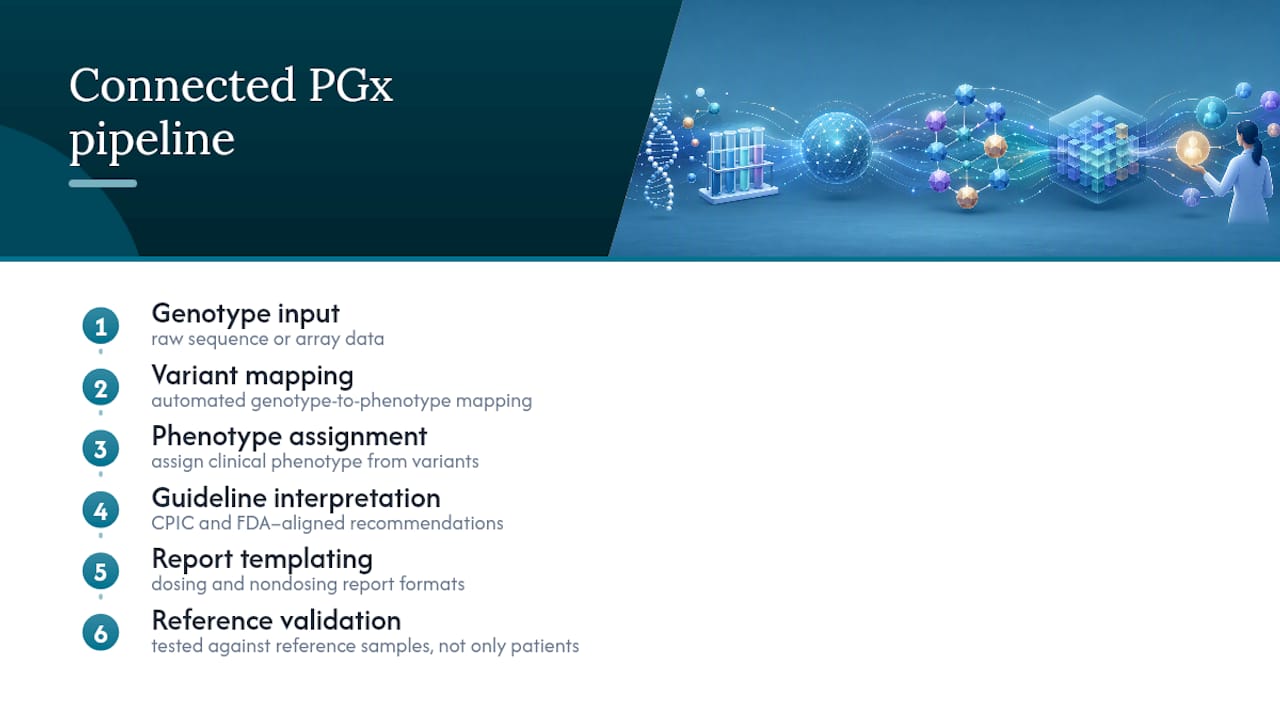
AI-assisted drafting. Rather than writing narrative summaries from scratch, staff should get a populated template with an AI-generated draft they edit and approve. The lmPGX pipeline is a documented example of this pattern working at scale: it automates genotype-to-phenotype mapping and generates both dosing and nondosing report formats, validated against reference samples.
Beyond drafting, a genuinely PGx-capable platform needs:
- Star-allele and phenotype mapping tied to current CPIC and PharmGKB references
- Dosing and nondosing report templates that can be toggled per test or per ordering provider
- HL7 v2 ORU and FHIR R4 DiagnosticReport/Observation output for EHR delivery
- APIs and webhooks for billing and CRM integration, not just one-way file drops
- Role-based provider and patient portals with delivery confirmation and audit trails
- Operational dashboards tracking turnaround time (TAT), bottleneck alerts, and staff workload forecasting
Pro Tip: Ask any vendor demo to show you a report going from raw variant call to signed-off PDF in one continuous screen recording. If they can't do that live, the "integration" is probably several disconnected tools stitched together after the sale.
Do AI Automation Tools Actually Improve Lab Turnaround and Accuracy?
The honest answer: yes, but as decision support, not as a replacement for clinical judgment. A 2026 review in laboratory diagnostics frames this as "augmented intelligence": AI drafts, ranks, and flags, while laboratory staff retain final sign-off. That framing matters because it's also the safest path to adoption. Labs that try to automate away human review tend to hit compliance resistance long before they hit any technical ceiling.
Industry case reporting on end-to-end PGx workflows found a reduction from roughly 30 minutes to about 5 minutes for single-report drafting after automating the pipeline — a six-fold change in one specific deployment, not a universal benchmark.
A separate 2025 systematic review of AI in diagnostic laboratory workflows found consistent gains in workflow efficiency and turnaround, alongside high diagnostic performance scores across the studies it examined. The same review flags the catch: much of the evidence comes from controlled settings, and external validation across different lab populations remains thin.
Track these KPIs to know whether automation is actually working in your lab, rather than just feeling faster; understanding these metrics is vital in the context of early detection biomarkers monitoring.
- Turnaround time from accession to signed report
- Manual-hours spent per report before and after automation
- Rework rate (reports requiring correction after initial sign-off)
- Audit completeness (percentage of pipeline steps with a logged, timestamped record)
Watch for data bias in training sets, interpretability gaps in AI-drafted language, and validation drift as guideline references update. None of these disqualify automation. They just mean you monitor it like any other clinical process, not a black box you trust blindly.
How Do You Roll Out AI-Driven Lab Automation Without Breaking Compliance?
Start narrow. Trying to automate an entire test menu on day one is how pilots die quietly six months in.
- Build the evaluation checklist first. Confirm CPIC, PharmGKB, and FDA labeling support for PGx content; verify FHIR/HL7/API integration paths; check for a configurable rules engine, full audit trail, and report template version control.
- Scope a single pilot. Pick one assay or one PGx panel, not your whole catalog. Establish baseline TAT and manual-hours-per-report before you flip anything on, so you have a real comparison later.
- Set acceptance criteria in advance. Define what "working" means numerically (target TAT, acceptable rework rate) before the pilot starts, not after you see the results.
- Validate against reference samples. Run known samples through the automated path and confirm every pipeline step logs to an auditable record. This is non-negotiable for CAP/CLIA inspection readiness, and documented sign-off rules need to exist for every template version, not just the current one.
- Train staff on the new review posture. Reviewers shift from writing reports to editing and approving drafts. That's a different skill and a different pace, and it needs its own training session, not a five-minute mention in a team meeting.
- Monitor, then expand. Track your KPIs through a full reporting cycle before adding a second assay or panel to the automated workflow.
Pro Tip: Keep your pilot's baseline metrics in a separate document from your rollout dashboard. Labs that only compare "before" numbers from memory almost always overstate the improvement once someone checks the math.
What Do Successful AI Lab Automation Deployments Actually Look Like?
The clearest published example centers on pharmacogenomics reporting, where the manual burden is heaviest and the guideline structure (CPIC, FDA labeling) is standardized enough to automate against reliably. The lmPGX pipeline documented in The Journal of Molecular Diagnostics automated genotype-to-phenotype mapping and produced both dosing and nondosing report formats aligned to CPIC and FDA guidance, validated against reference samples rather than live patient data alone. That distinction matters for any lab building its own validation plan: reference-sample testing is the baseline expectation, not an optional extra step.
Industry case reporting on automated PGx workflows describes a similar pattern outside peer review: labs that integrated variant mapping, phenotype assignment, and report templating into one pipeline saw drafting time drop sharply. What's consistent across both the peer-reviewed pipeline and the industry case is the same architectural choice: replacing a chain of separate tools (variant caller, spreadsheet, Word template, PDF export) with one connected system. A systematic review of AI adoption in clinical laboratory diagnostics found that while lab medicine is well positioned for this kind of automation, many labs still have gaps in how far machine learning actually reaches into their day-to-day workflow. The deployments that succeed tend to be the ones that started with PGx or another high-volume, guideline-standardized assay rather than trying to automate everything at once.
Labrynix: Where This Fits and What to Do Next
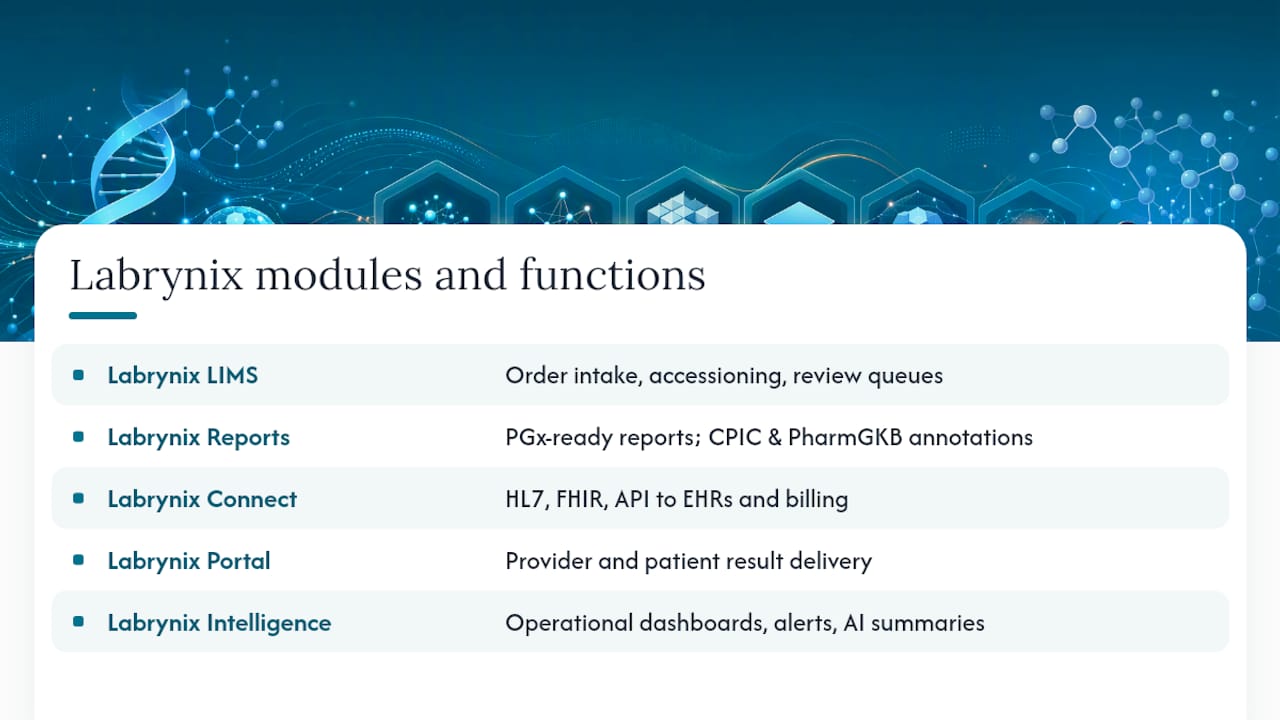
Every capability covered above maps directly to a Labrynix module. Order intake, accessioning, and review queues run through Labrynix LIMS. PGx-ready reporting, with CPIC and PharmGKB-informed annotations and dosing/nondosing templates, runs through Labrynix Reports. HL7, FHIR, and API connections to your EHR and billing systems run through Labrynix Connect. Provider and patient result delivery runs through Labrynix Portal, and the operational dashboards, bottleneck alerts, and AI-drafted summaries described earlier run through Labrynix Intelligence.
 None of that works without governance behind it. Labrynix is built around role-based access, full audit logs, and HIPAA-conscious security controls, so the same audit trail your CAP/CLIA inspector expects is already running in the background, not bolted on afterward. If your lab runs genetic or molecular testing and you're weighing a connected LIMS and reporting platform, the practical next step is a scoped demo built around your actual assay mix, not a generic walkthrough. Bring one high-volume panel, your current TAT numbers, and a list of the systems you need to integrate, and start there.
What Actually Separates a Good Automation Rollout From a Failed One
Most labs get automation wrong in the same place: they try to fix the whole pipeline at once instead of the two handoffs that create the most rework. Accessioning and the interpretation-to-report step are where errors compound, so start there. Everywhere else can wait a quarter.
Keep humans in the loop on purpose, not as a compliance afterthought. An AI-drafted summary that a reviewer edits and signs is a completely different risk profile than an AI system that ships a report unattended, and regulators, insurers, and your own quality team will treat those two setups very differently.
Invest in FHIR and HL7 integration earlier than feels urgent. Labs that bolt on interoperability after their reporting workflow is already built end up rebuilding data mappings twice, which costs more in engineering hours than doing it right the first time would have.
And preserve your audit trail from day one, even during the pilot. The lab that starts logging pipeline steps and template versions before go-live is the lab that sails through its next CAP inspection instead of scrambling to reconstruct history from memory.
— Tarek
Sources
- Artificial intelligence review in laboratory diagnostics (Springer, 2026)
- lmPGX pipeline for pharmacogenomic reporting (J Mol Diagn, 2022)