
AI-powered insights in pharmacogenomics are defined as machine-driven analysis systems that convert raw genetic and clinical data into evidence-linked, guideline-aligned clinical guidance. PGx labs need AI-powered insights because manual interpretation cannot keep pace with the volume, complexity, and clinical urgency of modern pharmacogenomic testing. AI-powered platforms reduce interpretation time from weeks or months to minutes per report. That speed shift is not incremental. It changes what a lab can deliver, how fast providers receive guidance, and how well patients receive personalized medication management aligned with FDA pharmacogenomic labeling and CPIC guidelines.
Why PGx labs need AI-powered insights for faster, better reporting
Pharmacogenomics report interpretation is one of the most time-intensive tasks a molecular lab performs. A single PGx report may require cross-referencing dozens of gene-drug interactions against FDA labeling, CPIC guidelines, and PharmGKB annotations. Without AI, that process depends on manual lookup, institutional memory, and individual reviewer bandwidth.
AI-powered PGx platforms provide evidence-linked outputs with human-in-the-loop review. That combination speeds report generation while keeping final clinical authority with the laboratory director. The AI drafts. The scientist validates. The result is faster sign-out without sacrificing oversight.
The clinical decision support dimension matters just as much as speed. AI systems integrate multi-gene interaction data, patient medication lists, and real-world evidence to surface the most clinically relevant findings first. That prioritization reduces the cognitive load on reviewers and cuts the risk of a critical interaction being buried in a long report.
- Faster turnaround: AI reduces interpretation from weeks to minutes, freeing lab staff for higher-value review tasks.
- Guideline alignment: Outputs map directly to FDA pharmacogenomic labeling and CPIC recommendations, reducing manual cross-referencing.
- EHR and LIMS integration: Real-time data exchange between AI reporting tools and clinical systems eliminates redundant data entry.
- Reduced drafting time: AI-assisted summaries handle boilerplate interpretation language, letting scientists focus on edge cases.
- Audit-ready outputs: Evidence-linked report drafts create a traceable record of interpretation logic for compliance review.
Pro Tip: Set up your AI reporting tool to flag gene-drug pairs with CPIC level A or B evidence first. That single filter alone cuts reviewer time on routine cases significantly.
What separates AI-powered insights from basic lab automation
Basic automation executes a fixed sequence of steps. AI-powered insights do something fundamentally different. They learn from data patterns, adapt to new evidence, and generate guidance that no static rule set could produce.

AI systems shift lab workflows from standalone tool use to connected ecosystems that guide adaptive decision-making. That means the wet-lab and dry-lab sides of a PGx operation stop working in silos. Instrument data, sequencing outputs, clinical metadata, and interpretation logic all feed into one continuously improving system.
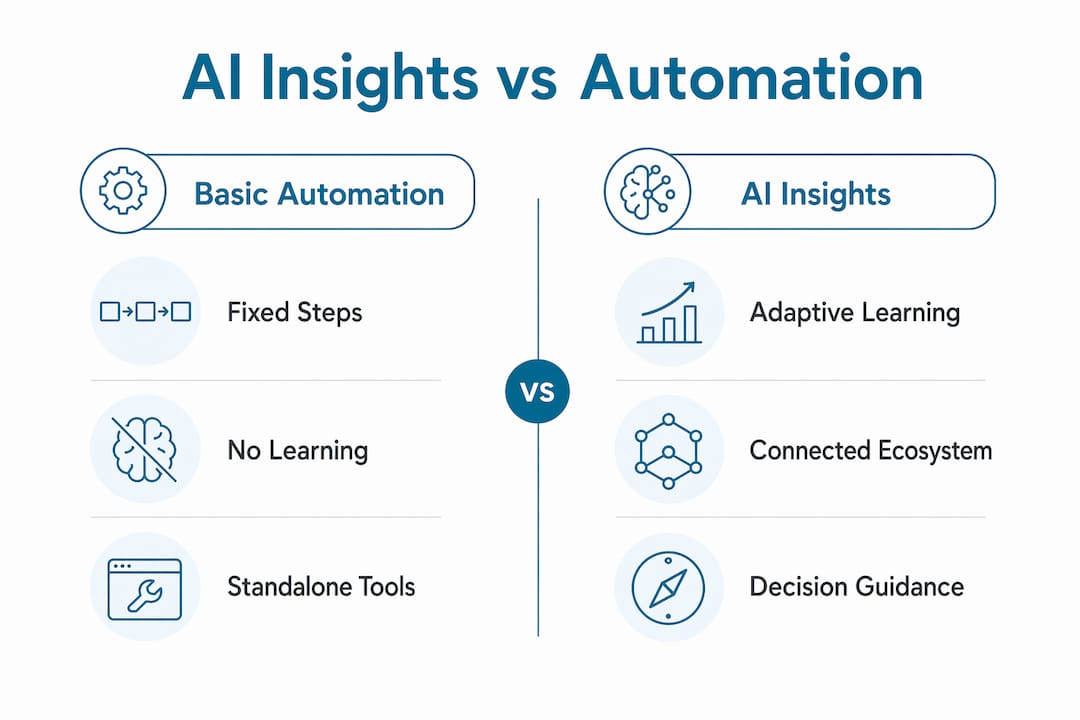
The distinction also shows up in protocol optimization. AI-guided systems improve high-throughput experiment performance by up to 40% after just six iterations through autonomous optimization. A rule-based automation system cannot do that. It can repeat a protocol. It cannot improve one.
Data quality is where this distinction becomes most consequential. AI that receives poorly structured or incomplete input produces unreliable outputs. The intelligence is only as good as what feeds it.
- Establish a clean data backbone. AI requires structured, consistently formatted input from your LIMS or ELN. Inconsistent metadata breaks the feedback loop.
- Require explainability. Every AI output should trace back to a specific guideline, database entry, or evidence source. Black-box outputs have no place in clinical reporting.
- Maintain human oversight. AI identifies patterns and drafts interpretations. A qualified scientist must review and approve every final report.
- Update continuously. CPIC guidelines and FDA labeling change. Your AI system must ingest those updates and reflect them in real time.
- Audit the AI itself. Track where AI recommendations diverge from final approved reports. That gap data tells you where the model needs refinement.
Pro Tip: Treat your AI system's error log as a training asset. Every case where a reviewer overrides an AI draft is a data point that improves future output quality.
How AI improves lab efficiency beyond the report itself
The importance of AI insights extends well past report generation. Operational efficiency is where many labs see the fastest return on their AI investment.
Predictive maintenance powered by AI detects instrument drift before failure occurs. That proactive monitoring reduces unplanned downtime and protects the validity of results generated during the monitoring window. A sequencer that fails mid-run does not just cost repair time. It invalidates a batch of samples and delays patient results.
AI also acts as a filter in data-saturated environments, separating reliable, actionable findings from noise. PGx labs generate enormous volumes of variant data. Most of it is not clinically relevant for a given patient. AI triage surfaces what matters and suppresses what does not, so reviewers spend their time on decisions rather than data sorting.
| Operational area | Without AI | With AI |
|---|---|---|
| Instrument monitoring | Reactive repair after failure | Predictive alerts before downtime |
| Workflow bottleneck detection | Manual review of queue logs | Automated flagging of delay patterns |
| Report drafting | Full manual interpretation per case | AI-drafted summaries with reviewer sign-off |
| Data integration | Manual export and re-entry across systems | Real-time sync between LIMS, EHR, and reporting |
- AI pattern recognition identifies which workflow steps consistently cause delays, giving lab managers specific targets for process improvement.
- Connected lab environments with interoperable systems, built on standards like HL7 and FHIR, allow AI to pull data from multiple sources without manual intervention.
- Faster hypothesis-to-result cycles mean labs can validate new gene-drug associations and update their interpretation rules more frequently.
What PGx labs must do to implement AI insights successfully
AI does not deliver value on day one without preparation. The labs that get the most from AI are the ones that treat data infrastructure as a prerequisite, not an afterthought.
Successful AI integration requires structured, quality data from a LIMS or ELN. Clinical metadata, instrument outputs, and patient identifiers must map consistently across systems. A lab running on spreadsheets and disconnected databases cannot extract meaningful AI insights from that foundation.
AI-driven extraction tools can validate phenotype assignments against clinical databases with over 27,000 entries. That capability only works when the input data is clean enough for the AI to parse accurately. Garbage in, garbage out is not a cliché in this context. It is a clinical risk.
Regulatory alignment is non-negotiable. Every AI output used in a clinical report must trace back to a recognized evidence source, whether that is FDA pharmacogenomic labeling, a CPIC guideline, or a PharmGKB annotation. Labs should review CPIC guideline requirements before selecting or configuring any AI reporting tool.
- Audit your current data structure before deploying AI. Identify gaps in how samples, orders, and results are recorded across systems.
- Select AI tools with explainable outputs. Clinical and regulatory reviewers need to see the evidence chain behind every AI recommendation.
- Integrate without disrupting clinician workflows. AI should surface insights within the tools providers already use, not require a separate login or manual data transfer.
- Plan for continuous learning. Build a process for updating AI models as new guidelines are published and real-world evidence accumulates.
- Keep scientists in the loop. AI accelerates interpretation. It does not replace the scientific judgment required for complex or ambiguous cases.
Labrynix Intelligence supports this implementation path by connecting AI-powered insights directly to the LIMS workflow, so labs do not need to build a separate data pipeline to get started.
The real shift AI brings to PGx laboratory practice
What I find most underappreciated about AI in PGx labs is not the speed gain. Speed is easy to measure and easy to sell. The deeper value is what happens when scientists stop spending 80% of their time on data retrieval and formatting, and start spending it on the cases that actually require their expertise.
I have seen labs where talented molecular scientists spend hours cross-referencing gene-drug tables that an AI system could resolve in seconds. That is not a workflow problem. It is a talent allocation problem. AI fixes it by handling the routine so that the expert can focus on the exception.
The explainability requirement is where I think labs need to be most disciplined. An AI that cannot show its reasoning is a liability in a clinical setting. The labs that will build lasting trust with providers and regulators are the ones that treat AI transparency as a design requirement, not a feature to add later. Labrynix Intelligence is built with that principle in mind, linking every AI-assisted interpretation to its evidence source before it reaches the reviewer.
The future I expect is a lab where AI continuously monitors instruments, flags workflow delays, drafts reports, and updates interpretation rules as new evidence arrives. Scientists will spend their time on edge cases, novel variants, and clinical consultations. That is a better use of a PhD. The labs that get there first will have a real operational advantage in the precision medicine market.
— Tarek
How Labrynix brings AI-powered insights to PGx labs
Labrynix was built specifically for the workflows PGx labs run every day, from order intake and accessioning through report generation and provider delivery.
Labrynix Intelligence adds AI-powered analytics and workflow automation directly inside the platform, so labs do not need a separate tool to get the benefits described in this article. Reports drafted with AI-assisted PGx sign-out align with FDA pharmacogenomic labeling, CPIC guidelines, and PharmGKB annotations out of the box. The LIMS backbone ensures that the data feeding those AI outputs is structured, auditable, and clinically reliable. Labs looking for a connected system covering LIMS, reporting, portals, billing visibility, and AI insights can explore Labrynix PGx reporting software to see how it fits their current workflow.
Key takeaways
AI-powered insights are the most direct path PGx labs have to reduce interpretation time, improve report accuracy, and shift from reactive to adaptive lab operations.
| Point | Details |
|---|---|
| Speed of interpretation | AI reduces PGx report interpretation from weeks to minutes, freeing reviewers for complex cases. |
| Data quality is foundational | Structured LIMS data is a prerequisite for meaningful AI outputs. Poor input produces unreliable results. |
| AI vs. automation | AI adapts and improves with each iteration; basic automation only repeats fixed steps. |
| Operational efficiency | Predictive maintenance and bottleneck detection extend AI value well beyond report drafting. |
| Human oversight is required | AI drafts and prioritizes. A qualified scientist must review and approve every final clinical report. |
Perspective
The real shift AI brings to PGx laboratory practice is a move from data generation to decision quality. Labs have never lacked data. They have lacked the capacity to turn that data into reliable, timely guidance at scale. AI closes that gap, but only when labs invest in the data infrastructure and explainability standards that make AI outputs trustworthy.
— Tarek
FAQ
What are AI-powered insights in pharmacogenomics?
AI-powered insights in pharmacogenomics are machine-generated, evidence-linked interpretations of genetic and clinical data that align with FDA labeling and CPIC guidelines. They reduce manual interpretation time and support faster, more consistent PGx report generation.
How does AI improve lab efficiency in PGx settings?
AI improves lab efficiency by automating report drafting, detecting workflow bottlenecks, and monitoring instrument health through pattern recognition. These capabilities shift lab operations from reactive problem-solving to proactive management.
Does AI replace the scientist in PGx report review?
AI does not replace the scientist. Evidence-linked AI outputs are designed for human-in-the-loop review, where the AI drafts and the laboratory director or qualified reviewer approves the final report.
What data infrastructure does a lab need before adopting AI?
A lab needs a structured, consistently formatted data backbone from a LIMS or ELN before AI can deliver reliable outputs. Poor data quality directly undermines AI performance and clinical trustworthiness.
How does AI handle updates to CPIC guidelines or FDA labeling?
AI systems designed for PGx reporting should ingest guideline updates continuously and reflect them in real-time interpretation outputs. Labs should verify that any AI tool they adopt has a defined process for incorporating new evidence as CPIC and FDA labeling evolve.