
Modern Laboratory Information System platforms need AI capabilities because the volume, complexity, and speed of today's diagnostic data have simply outpaced what manual workflows can handle. A static system that stores results and routes orders was adequate when test menus were narrow and turnaround expectations were measured in days. Neither of those conditions holds anymore. AI integration allows predictive analytics and smart reflex testing protocols that optimize workflows and resource use in ways no rule-based system can replicate.
The shift is not incremental. Modern LIS platforms are evolving from passive repositories to active, AI-driven systems that enable real-time operational decisions, significantly improving diagnostic accuracy and throughput. For genetic and molecular labs specifically, where pharmacogenomics panels generate complex multi-dimensional data per patient, that evolution is not optional.
Key capabilities driving this transformation include:
- Predictive analytics that forecast test demand and flag abnormal result patterns before they become bottlenecks
- Pattern recognition and machine learning that surface novel biomarkers and disease correlations invisible to traditional analysis
- Workflow automation including smart reflex testing, automated report drafting, and review queue management
- Metadata and peridata frameworks that give AI algorithms the structured context needed to interpret lab data accurately
- Interoperability standards such as HL7 and FHIR that connect the LIS to EMR, EHR, and billing systems without manual data bridges
- Ethical and regulatory guardrails including transparency requirements, bias mitigation protocols, and human oversight mechanisms
Each of these capabilities addresses a specific failure mode in traditional LIS design. The sections below explain how they work, what they deliver, and what it takes to implement them responsibly.

How LIS platforms evolved from static records to intelligent systems
Traditional LIS platforms were built around a single purpose: capture the result, attach it to the right patient, and make it retrievable. That was genuinely useful. But it also meant the system was entirely reactive. Nothing happened until a human initiated it, and the system offered no opinion on what should happen next.

The first meaningful shift came with the adoption of structured metadata. When labs began tagging data with context, such as collection time, instrument ID, specimen type, and ordering provider, the system could start doing more than filing. Queries became richer. Audit trails became meaningful. But the real inflection point arrived with big data analytics and machine learning, which gave LIS platforms the ability to learn from accumulated data rather than just store it.
Three milestones mark the modern era of LIS evolution:
- Metadata and peridata adoption — standardized contextual layers that let AI algorithms interpret lab data with operational and clinical meaning, not just raw values
- AI-enhanced reflex testing — machine learning models that predict whether a follow-up test is warranted based on initial results, reducing unnecessary orders and speeding up diagnosis
- Digital pathology integration — connecting image analysis tools to the LIS so that morphological findings feed the same data environment as chemistry and molecular results
Industry 4.0 principles accelerated all three. Automation, connected instruments, and real-time data pipelines became standard expectations in manufacturing and logistics, and clinical labs followed. The result is a generation of LIS platforms that do not wait to be queried. They monitor, flag, and recommend continuously.
The practical consequence for lab managers is significant. A system that once required a technologist to notice an unusual result pattern now surfaces that pattern automatically, often before the result leaves the review queue.
What AI capabilities actually look like inside a modern LIS
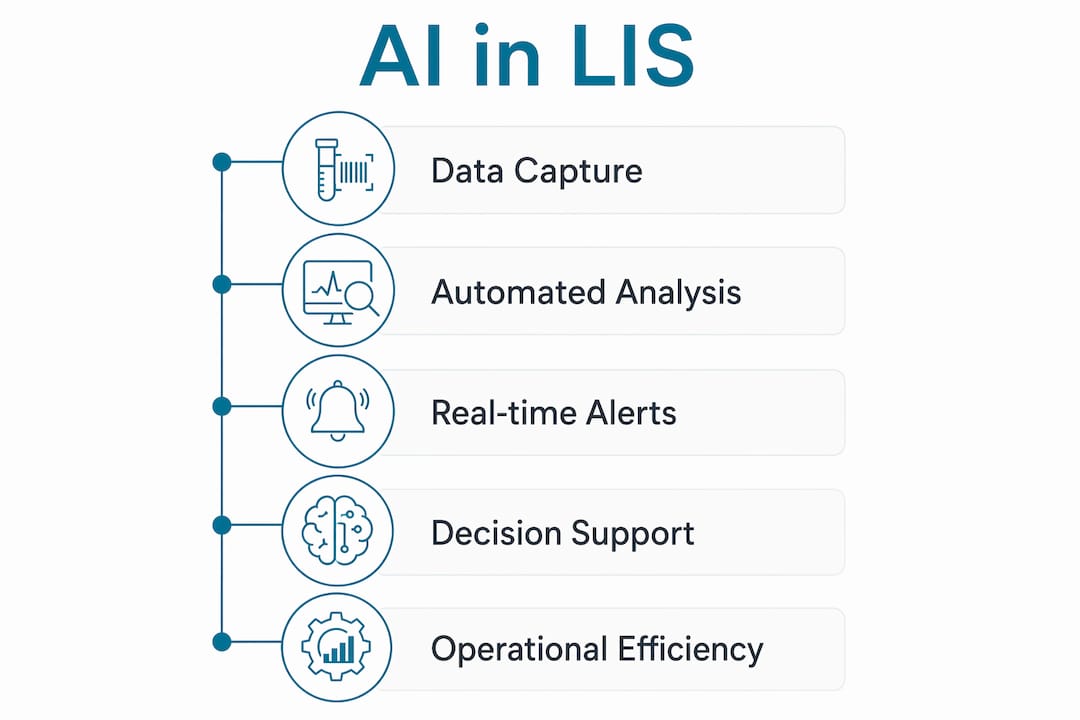
The phrase "AI-powered LIS" covers a wide range of actual functionality. Understanding what each capability does operationally helps labs evaluate whether a platform's AI is substantive or cosmetic.
- Predictive analytics model historical test volumes, seasonal patterns, and ordering behavior to forecast demand. Labs use this to pre-position reagents, staff appropriately, and avoid the kind of supply shortages that delay results.
- Pattern recognition is where AI earns its most dramatic clinical returns. AI-powered LIS improve data mining by identifying hidden patterns and biomarkers unrecognizable via traditional analysis, which directly supports personalized medicine in molecular and genetic diagnostics.
- Smart reflex testing uses machine learning to evaluate initial results and automatically trigger follow-up tests when clinical criteria are met. This removes a manual decision point that is both time-consuming and inconsistently applied across shifts.
- Automated report drafting applies AI to generate structured report language from structured data, with lab-approved interpretation rules governing what gets written. The pathologist or geneticist reviews and approves; the AI handles the first draft.
- Bottleneck detection monitors workflow queues in real time and flags where samples are accumulating, which instrument is underperforming, or which review step is creating delays.
- HL7 and FHIR integration ensures that AI-generated insights and results flow cleanly to EMR and EHR systems without manual re-entry, which is where a large share of transcription errors originate.
Pro Tip: When evaluating an AI-enabled LIS, ask the vendor to show you the metadata schema. If the platform cannot explain how it structures peridata, the AI layer is almost certainly operating on incomplete context, which limits both its accuracy and its auditability.
The metadata and peridata point deserves emphasis. Standardized metadata and peridata provide critical context enabling AI algorithms to accurately interpret complex lab data, which is essential to mitigate algorithmic bias and maintain diagnostic consistency. Without that structured foundation, even a sophisticated model produces unreliable outputs.
What AI-enabled LIS actually delivers for lab operations
The operational case for AI in LIS comes down to four concrete improvements: fewer errors, faster turnaround, better resource use, and more consistent clinical decisions.
Diagnostic accuracy improves because AI does not have bad days, does not skip steps at the end of a shift, and does not miss a pattern it has been trained to recognize. AI-driven platforms improve diagnostic throughput, accuracy, and efficiency, supporting laboratory staff and enabling more automated workflows. For molecular labs running high-complexity panels, that consistency across hundreds of simultaneous results is genuinely difficult to replicate manually.
AI combined with big data analytics allows laboratories to manage increasingly large datasets effectively, providing meaningful insights into disease mechanisms and improving diagnostic consistency, not only supporting pathologists but also enabling more automated workflows that mitigate the impact of workforce shortages.
Turnaround time improvements follow directly from removing manual handoffs. When a reflex test triggers automatically, when a report draft populates without a technologist typing it, and when a bottleneck alert fires before a supervisor notices the queue backing up, the cumulative time savings across a day's worth of samples is substantial. Labs running AI-powered analytics in molecular workflows consistently report that the biggest gains come not from any single automation but from eliminating the gaps between steps.
Personalized patient care is the downstream benefit that often gets underemphasized in operational discussions. When an AI-enabled LIS can correlate a patient's current results with their longitudinal history, their pharmacogenomic profile, and population-level biomarker data, the report that reaches the ordering provider carries clinical context that a standalone result never could. That is the difference between a number and a recommendation. For labs supporting chronic condition monitoring, this longitudinal data integration is where AI creates the most direct patient-care value.
Challenges you will face when implementing AI in your LIS
AI in LIS is not a plug-in. The implementation challenges are real, and labs that underestimate them tend to end up with expensive tools that underperform.
- Data quality is the single biggest obstacle. Without clean, structured data, AI algorithms cannot perform effectively. Garbage in, garbage out applies with particular force in clinical settings where a biased training dataset can produce systematically wrong recommendations.
- Regulatory and ethical compliance requires active management, not just a checkbox. Frameworks like the EU AI Regulation emphasize human oversight and explainability, and U.S. labs operating under CLIA and CAP accreditation face analogous expectations around validation and documentation.
- Algorithmic bias is a genuine clinical risk. If the training data over-represents certain patient populations, the model's outputs will be less reliable for underrepresented groups. This is not a theoretical concern in genetic and molecular diagnostics, where population-specific allele frequencies matter directly.
- Integration complexity with existing instruments, EMR systems, and billing platforms adds both technical and project-management burden. Most labs do not have the internal IT capacity to manage this without vendor support.
- Financial investment in infrastructure, validation work, and trained personnel is non-trivial. The cost is not just the software license; it includes the time required to validate AI outputs against known standards before clinical deployment.
Pro Tip: Never deploy an AI feature in a clinical LIS without a defined validation protocol and a human review step. Hybrid AI architectures that combine rule-based logic with generative or machine learning components improve reliability precisely because the rule-based layer provides an auditable check on the model's outputs.
The workforce dimension is worth naming directly. AI does not replace laboratory expertise. It augments it. Labs that position AI as a headcount reduction tool tend to underinvest in the human oversight that makes the system trustworthy. The labs that get the most out of AI are the ones where experienced staff are freed from repetitive tasks and redirected toward interpretation, validation, and clinical communication.
How Labrynix approaches AI in genetic and molecular lab software
Labrynix was built specifically for the operational reality of genetic testing, molecular diagnostics, and pharmacogenomics labs. That specificity shapes how AI is integrated throughout the platform, not as a generic analytics layer bolted on top, but as functionality woven into the workflows that matter most to these labs.
Labrynix Intelligence delivers AI-powered insights across report drafting, bottleneck detection, review queue management, and operational analytics. The report drafting capability is particularly relevant for PGx labs: AI-assisted summaries draw on FDA pharmacogenomic labeling references, CPIC guideline support, and PharmGKB-informed annotations to generate structured report language, with final clinical review and approval remaining under laboratory control. That distinction matters for compliance and for the lab's professional accountability.
Key capabilities within the Labrynix platform include:
- AI-assisted PGx report generation using customizable templates, lab-approved interpretation rules, and real-time annotation from CPIC and PharmGKB
- Workflow automation across order intake, accessioning, sample tracking, and review queues, reducing manual handoffs at every stage
- Labrynix Connect supporting HL7, FHIR, and API integrations with EMR, EHR, billing platforms, and lab instruments, enabling AI-generated data to flow cleanly across the full care pathway
- Role-based access, audit logs, and configurable permissions supporting HIPAA-conscious and GDPR-conscious operations
- Labrynix Portal giving providers and patients secure, branded access to results and communication workflows, with AI-assisted result summaries where appropriate
Labrynix Intelligence adds AI-powered insights and workflow automation to support report drafting, operational analytics, bottleneck detection, review queue management, and lab performance visibility, giving genetic and molecular labs the infrastructure to move beyond disconnected tools and manual processes.
The compliance architecture in Labrynix reflects the ethical and regulatory requirements that govern AI deployment in clinical settings. Transparency, human oversight, and explainability are not afterthoughts. They are built into the approval workflows, the audit trail, and the way AI outputs are presented to laboratory staff for review. Each laboratory remains responsible for its own clinical validation and regulatory compliance, and Labrynix is designed to support that responsibility rather than obscure it.
For labs evaluating whether their current platform can support the AI capabilities their workflows now require, the molecular diagnostics solutions page details how Labrynix addresses the specific operational challenges of high-complexity genetic testing environments.
Genetic and molecular labs that are still running disconnected reporting tools and manual review queues are leaving measurable efficiency and accuracy on the table. Labrynix brings together LIMS, PGx reporting, AI-powered insights, portals, billing visibility, and integrations into one platform built around real laboratory workflows. Explore the full range of AI-enabled LIMS solutions to see how Labrynix fits your lab's specific needs.
Key Takeaways
Modern LIS platforms need AI capabilities because the complexity and volume of today's diagnostic data require systems that actively support decisions, not just store results.
| Point | Details |
|---|---|
| AI shifts LIS from passive to active | Modern platforms use predictive analytics and smart reflex testing to drive real-time operational decisions. |
| Data quality determines AI performance | Standardized metadata and peridata frameworks are prerequisites for accurate, bias-free AI outputs. |
| Workflow automation reduces manual handoffs | Automated report drafting, bottleneck detection, and reflex testing remove the gaps between workflow steps. |
| Human oversight remains non-negotiable | Hybrid AI architectures and defined validation protocols keep clinical accountability with laboratory staff. |
| Interoperability enables end-to-end data flow | HL7 and FHIR integration connects AI-generated insights to EMR, EHR, and billing systems without manual re-entry. |