
An online laboratory management system is a cloud-hosted LIMS that centralizes sample tracking, automates workflows, and produces audit-ready reports without a server room down the hall. For genetic testing, molecular diagnostics, and pharmacogenomics labs, that translates into three concrete wins: samples never go missing between accessioning and result delivery, technicians stop re-entering the same data three times across disconnected tools, and auditors get a clean trail instead of a scavenger hunt through spreadsheets. A LIMS manages the sample lifecycle from intake through final report, and that scope is exactly why generic systems built for broad clinical use tend to buckle under PGx reporting demands.
- Reliable sample tracking from accessioning to disposal, with chain-of-custody intact
- Workflow automation that removes manual handoffs between accessioning, testing, and review
- Audit-ready reporting that satisfies CLIA, ISO 17025, and internal QA reviews without extra prep
Fast fact: Laboratories that adopt configurable LIMS platforms report improved data provenance and adoption rates because instrument data gets captured automatically instead of transcribed by hand.
Labrynix was built specifically for genetic and molecular labs that need PGx-grade reporting, not a generic clinical module bolted onto a broader platform. If your lab is evaluating options, the genetic testing lab solutions page and a live demo are the fastest way to see whether the fit is real.
Key Takeaways
Online laboratory management systems succeed when configurable workflows, clean instrument integrations, and audit-ready reporting are matched to a lab's actual SOPs rather than forced into a generic template.
| Point | Details |
|---|---|
| Define the core job | A LIMS centralizes sample tracking, workflow automation, and reporting into one auditable system. |
| Prioritize configurability | Choose platforms that model your existing SOPs instead of forcing process changes to fit the software. |
| Vet integrations early | Confirm HL7, FHIR, EHR, and instrument interface support before signing any contract. |
| Pilot before scaling | Run a small pilot with measurable success criteria and validate parsers in a sandbox before full cutover. |
| Match specialty needs | Labrynix is built specifically for PGx and genetic lab workflows, with configurable reporting, HIPAA-conscious design, and AI-ready integrations that generic LIMS platforms typically lack. |
Table of Contents
- What does an online lab management system actually do?
- Core features to prioritize in a cloud-based lab system
- Choosing a deployment model: cloud, private, or self-hosted
- How to choose a lab management system: a vendor checklist
- Implementation tips from lab-built experience
- User access controls and role management
- Data backup and disaster recovery
- Training and support services for users
- Interoperability with electronic health records
- A lab-built view: configurability beats generic features
- Why Labrynix fits labs running genetic and molecular testing
- Frequently asked questions
- Sources
What does an online lab management system actually do?
Strip away the marketing language and a laboratory information management system performs four jobs. Get these right and everything else, reporting, billing visibility, provider communication, tends to follow.
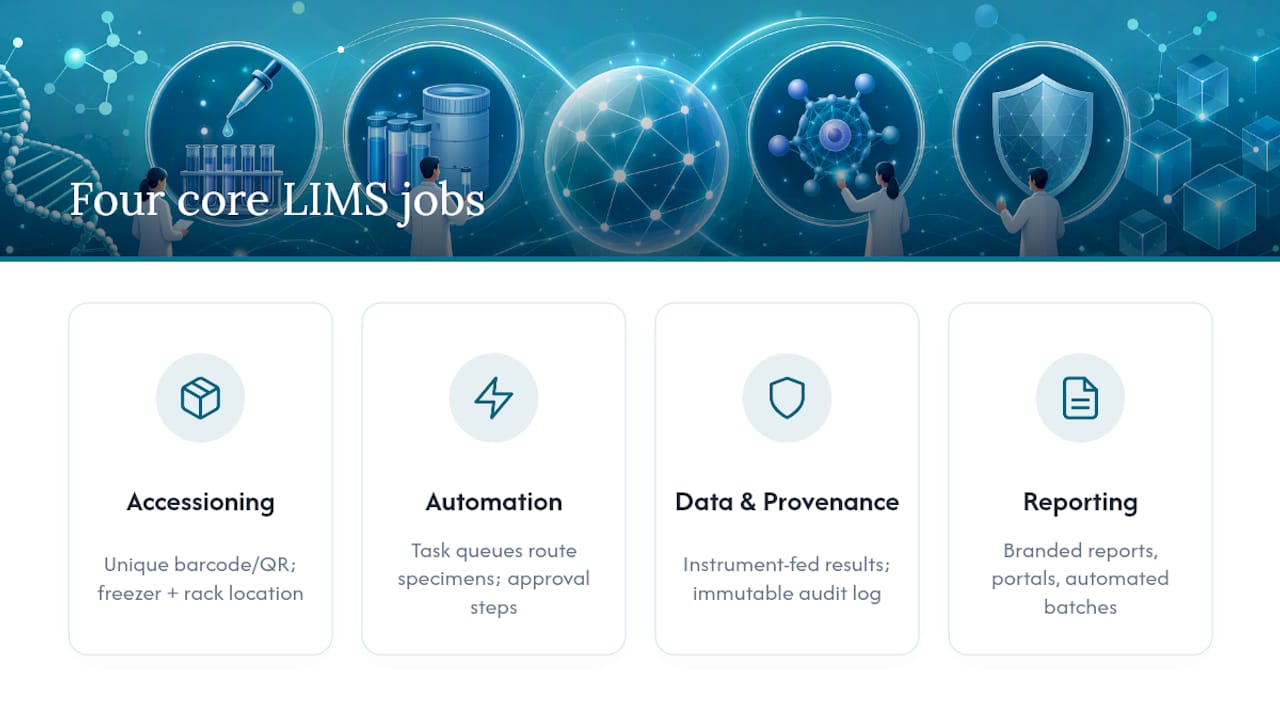
Sample accessioning and tracking. Every specimen gets a unique barcode or QR code at intake, which the system then follows through storage, testing, and disposal. Storage mapping tells you exactly which freezer, rack, and position holds a sample, and chain-of-custody logging satisfies both internal QA and external audit requests.
Workflow automation. Task queues route specimens to the right technician or instrument automatically. Approval steps, deviation capture, and electronic lab notebook (ELN) integration mean a flagged result doesn't sit in someone's inbox for two days waiting for a signature.
Data management and provenance. Modern platforms pull results directly from instruments rather than relying on manual transcription, which cuts transcription errors and keeps an immutable audit log of who touched what and when. Structured results storage also makes it possible to search and report on historical data instead of digging through PDFs.
Reporting and delivery. Branded reports, provider and patient portals, and automated batch reports or certificates of analysis close the loop. For labs running high test volumes, this is often where the most time gets saved, because reports that used to take a technician twenty minutes to format now generate in seconds.
Core features to prioritize in a cloud-based lab system
Not every feature on a vendor's checklist matters equally. Some choices affect daily throughput; others only surface as problems eighteen months into a contract, usually right when you're trying to add a new test.
- Configurable workflows that map to your SOPs. A platform that forces you to restructure your accessioning process to fit its defaults is solving the wrong problem. Look for systems where workflows can be modeled around existing procedures rather than the other way around.
- Instrument interfacing and API support. Ask specifically how the vendor handles data parsers for your existing sequencers, thermocyclers, or analyzers. A platform with open APIs and webhook support will integrate with tools you haven't bought yet.
- Security architecture built around role-based access. Encryption at rest and in transit, granular permissions, and detailed audit trails aren't optional extras for labs handling genetic data. HIPAA-conscious design should be a baseline expectation, not a premium add-on.
- Scalability for volume growth and multi-site operations. A system that performs fine at 200 samples a week can slow to a crawl at 2,000. Ask vendors directly about performance benchmarks at your projected volume.
- Specialty reporting for PGx and genetic workflows. Annotation support, CPIC guideline references, and PharmGKB-informed interpretation aren't standard in general-purpose lab software. This is where most off-the-shelf LIMS fall short for precision medicine labs.
- AI-ready infrastructure. Platforms that expose clean, structured data through APIs make operational analytics and bottleneck detection possible down the line, even if you're not using AI features on day one.
Pro Tip: Ask any vendor to walk through a real instrument integration during the demo, not a slide about integrations. If they can't show a live data parser working, assume it doesn't exist yet.
Choosing a deployment model: cloud, private, or self-hosted
Deployment choice shapes everything from your IT staffing needs to how fast you can onboard a new test panel. Enterprise LIMS vendors typically offer three paths: full SaaS, private hosted cloud, or self-hosted infrastructure, and each carries real trade-offs.
- SaaS deployment minimizes IT overhead since the vendor manages servers, updates, and uptime. This suits labs without a dedicated infrastructure team, though it means less direct control over validation timing.
- Private cloud or hosted deployment gives you more control over data residency and validation schedules while still offloading hardware maintenance, a common middle ground for CLIA-regulated labs.
- Self-hosted infrastructure offers maximum control, useful for labs with strict internal IT policies, but it demands more internal resources for maintenance and upgrades.
Whatever model you pick, integration priorities matter more than the deployment label. Confirm support for HL7 and FHIR standards, EMR/EHR connectors, and instrument interfaces before signing anything. Data governance questions, retention policies, backup frequency, encryption standards, deserve the same scrutiny as the sample tracking features, since a system that manages samples brilliantly but backs up poorly is a liability waiting to surface.
How to choose a lab management system: a vendor checklist
A rushed LIMS purchase tends to reveal its problems about six months in, right when you try to add a new integration or scale past your pilot volume. Work through these questions before signing.
Evaluation checklist:
- Does the platform support your specific instrument interfaces out of the box, or will they need custom development?
- How configurable are workflows, and can changes happen without vendor tickets for every adjustment?
- What compliance features are built in for GLP, CLIA, or ISO 17025 support?
- What's the documented uptime guarantee, and what happens when it's missed?
- What does onboarding actually include, and how is pricing structured, per-user, per-sample, or flat subscription?
Ask vendors directly about their data migration approach, request a sandbox environment to test real workflows before committing, and get specifics on the change control process for future updates. Free and open-source LIMS options exist, but they usually trade lower cost for less specialty configuration and more internal IT burden, worth knowing before you assume "free" means "cheaper overall."
Costs typically scale with reporting volume, integration complexity, and the number of specialty modules, PGx reporting or provider portals, you add. A realistic pilot-to-production timeline runs several weeks to a few months depending on integration depth. Watch for hidden fees tied to custom connectors, and treat any vendor unwilling to discuss data export terms as a lock-in red flag.
Implementation tips from lab-built experience
The single biggest predictor of a failed LIMS rollout isn't the software. It's skipping the workshop where someone actually maps existing SOPs into discrete digital tasks before configuration starts. Automating a broken process just makes the process break faster.
Start with a small pilot, define measurable success criteria before you begin, and validate every instrument parser and integration endpoint in a sandbox before cutover. Expand only after the pilot proves out.
Pro Tip: Treat your vendor relationship as a multi-year partnership, not a one-time purchase. Budget for future connectors, storage growth, and validation work, not just the initial license fee.
Vendors who understand this, and who built their platform from real lab operations rather than generic clinical software, tend to make better long-term partners than ones selling a one-size-fits-all package.
User access controls and role management
Genetic and molecular data carries a different risk profile than routine lab work, which makes role-based access control (RBAC) non-negotiable rather than a nice-to-have. A well-built system lets you assign permissions by function: accessioning staff see intake queues, reviewing scientists see validation dashboards, and billing staff see claim status without touching clinical interpretation fields.
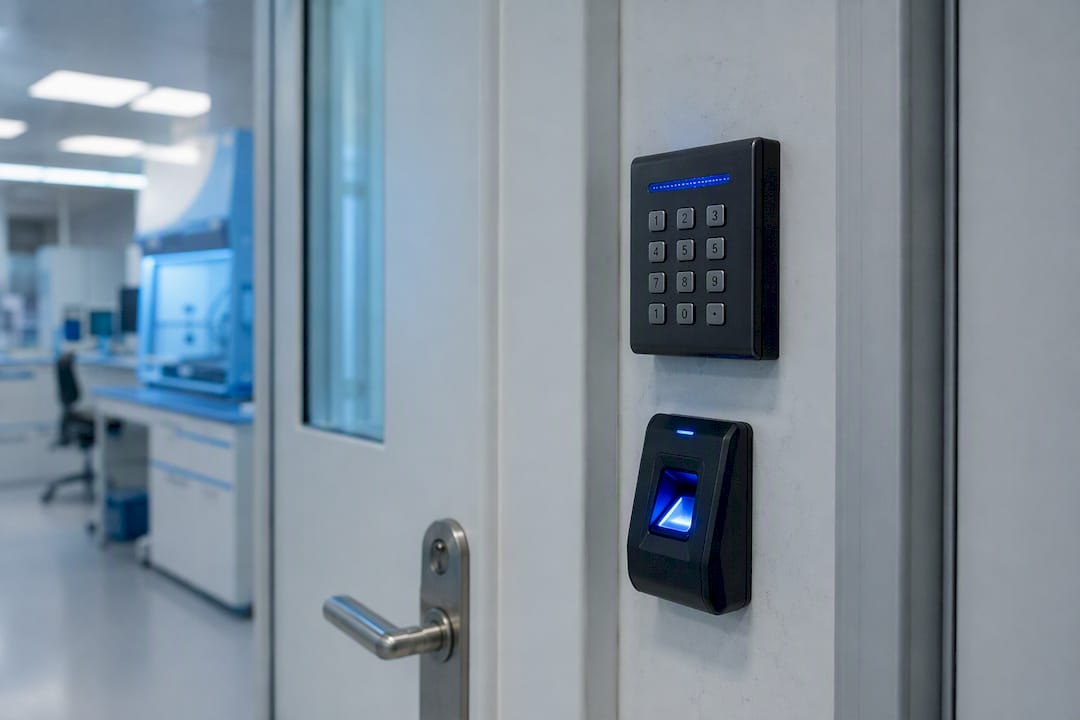
Granular permissions matter most at the edges. Can a technician edit a result after it's been signed off? Can a provider portal user see raw sequencing data, or only the final interpreted report? These boundaries need to be configurable, not hardcoded, because your review hierarchy today probably won't match your hierarchy after you double headcount.
Audit logging ties directly into access control. Every login, every field edit, every report approval should generate a timestamped record tied to a specific user identity. That log becomes your best friend during a CLIA inspection and your worst enemy if it's incomplete. Ask vendors specifically whether audit trails are immutable, meaning nobody, including administrators, can quietly edit history.
Multi-site labs add another layer: role definitions often need to work consistently across locations while still allowing site-specific permission tweaks for local SOPs. A system that handles this well saves you from building parallel permission structures for every new lab you open.
Data backup and disaster recovery
A lab management system that loses data is worse than no system at all, because by the time you notice the gap, the paper trail you replaced is already gone. Backup architecture deserves the same scrutiny you'd give sample storage protocols.

Ask vendors how frequently backups run, whether they're automated, and where redundant copies live. Geographic redundancy, storing backups in a physically separate data center from primary operations, protects against regional outages, natural disasters, or infrastructure failures that could otherwise take down both your live system and your backup simultaneously.
Recovery time matters as much as backup frequency. A vendor might back up hourly but take three days to restore full functionality after an outage, which is a meaningful gap if you're running time-sensitive genetic panels. Ask for documented recovery time objectives (RTO) and recovery point objectives (RPO), the maximum data loss window a vendor guarantees.
Encryption at rest protects backup data from exposure even if storage infrastructure is compromised. Combined with encryption in transit for active data transfers, this forms the baseline expectation for any HIPAA-conscious or GDPR-conscious platform handling genetic information.
Finally, ask about disaster recovery testing. A backup system nobody has ever actually restored from is a theory, not a plan. Vendors with mature operations run periodic recovery drills and can describe the last one specifically, not vaguely.
Training and support services for users
Even the best-configured system fails if your team doesn't know how to use it, or worse, works around it because the learning curve felt too steep on launch day. Support quality varies enormously between vendors, and it's one of the hardest things to evaluate from a sales demo.
Ask what onboarding actually includes: live training sessions, self-paced documentation, or both? Does the vendor assign a dedicated implementation contact, or do you get routed through a general ticket queue? For labs running specialty workflows like PGx reporting, generic support documentation often won't cover the nuances that matter.
Ongoing support matters more than initial training. Systems evolve, new tests get added, regulations shift, and staff turn over. A vendor that treats support as a one-time onboarding event rather than a continuing relationship will leave you stranded the first time something breaks at 4 p.m. on a Friday.
Response time guarantees, whether support is available by phone, chat, or email only, and whether there's a dedicated account manager versus a rotating support pool are all worth asking about directly. Labs with complex integration needs should also confirm technical support extends to integration troubleshooting, not just software how-to questions.
The strongest signal of good support isn't a glossy service level agreement. It's whether the vendor's team includes people who've actually worked inside a lab and understand why a delayed report on a Friday afternoon is a real problem, not an abstract ticket.
Interoperability with electronic health records
For labs delivering results into clinical care pathways, interoperability with EHR systems separates software that fits into existing healthcare infrastructure from software that creates a new island of data. Providers don't want to log into a separate portal to find results if their EHR can display them directly.
HL7 and FHIR standards are the backbone of most modern EHR connections. HL7 has been the dominant messaging standard for lab results for decades, while FHIR is increasingly the preferred approach for newer integrations because it's built around web-friendly APIs rather than legacy message formats. Ask vendors which standard they support natively and whether they've built live connections with EHR platforms your referring providers actually use.
Genomic and PGx labs face an added wrinkle: EHR systems weren't originally designed to display complex genetic interpretation data cleanly. A results table built for a basic metabolic panel doesn't translate well to a multi-gene pharmacogenomic report. Platforms purpose-built for genetic testing tend to handle this better because they've solved the formatting problem already, rather than forcing a generic lab result template onto genomic data.
Integration depth also affects billing and care coordination. When results flow directly into an EHR, ordering providers get faster visibility, which shortens the time between a result and a clinical decision, a meaningful factor when pharmacogenomic findings affect an active prescription.
A lab-built view: configurability beats generic features
Most buying guides treat LIMS features as a checklist where more boxes checked wins. That framing misses what actually determines success: whether the system's configurability matches how your specific lab actually operates, not how a generic clinical lab operates.
Genetic and molecular labs have workflows that don't fit neatly into templates built for routine chemistry panels. PGx interpretation, multi-gene annotation, and guideline-referenced reporting need software that treats those as first-class features, not afterthoughts bolted onto a broader platform. The conventional advice to "pick the LIMS with the most integrations" undersells how much configurability determines whether those integrations actually get used well.
AI-readiness deserves more attention than it currently gets in most evaluation checklists. A platform that exposes clean, structured data through open APIs sets your lab up for operational analytics and automated report drafting later, even if you don't need those features on day one. The labs that will struggle in three years are the ones locked into rigid systems that can't expose their own data cleanly.
Prioritize configurability and clean data architecture over feature count. Everything else follows from that.
Why Labrynix fits labs running genetic and molecular testing
If you've been nodding along through the checklist above, integrations, configurable workflows, PGx reporting, HIPAA-conscious design, you're describing exactly what Labrynix was built to do. Unlike generic LIMS retrofitted for genetic labs, Labrynix started with molecular diagnostics and pharmacogenomics workflows as the baseline, not the exception.
The platform connects LIMS workflow management, branded PGx report generation with CPIC and PharmGKB-informed annotation support, provider and patient portals, and billing visibility into one system, so you're not stitching together four vendors to get one working lab operation. Labrynix Connect handles HL7, FHIR, and API integrations for instruments and EHR systems, and Labrynix Intelligence adds AI-assisted report drafting and bottleneck detection once your data is clean enough to use it.
On the questions that actually matter during evaluation, data migration support, sandbox testing before cutover, and a change control process that doesn't require a support ticket for every adjustment, Labrynix approaches vendor relationships as long-term partnerships rather than one-time software sales. If your lab is weighing a full LIMS replacement or just needs a stronger PGx reporting layer, start with the genetic and molecular lab solutions page or explore the molecular diagnostics workflow details to see the fit for your specific test menu, then request a demo to walk through your actual accessioning and reporting flow.
Frequently asked questions
What's the difference between a LIMS and an LIS? A LIMS is optimized for batch- and sample-centric research and manufacturing workflows, while an LIS is patient-centric and tightly woven into clinical care processes. Genetic and molecular labs often need capabilities from both worlds, which is why purpose-built platforms matter more than generic clinical software.
Can a small or startup lab afford a cloud-based LIMS? Costs typically scale with reporting volume and integration complexity, so a smaller lab pays less than a high-volume reference lab. Free and low-cost cloud LIMS options exist, though they usually trade lower cost for less specialty configuration and more internal IT effort.
How long does implementation usually take? Realistic pilot-to-production timelines run from several weeks to a few months, depending on integration depth and how much workflow mapping happens upfront. Skipping the SOP-mapping step is the most common reason timelines stretch far longer than planned.
Does a LIMS replace an electronic lab notebook (ELN)? Not necessarily. Many modern platforms integrate ELN functionality directly, but some labs run a separate ELN alongside their LIMS depending on how research-heavy their workflows are.
What should I ask about AI features before buying? Ask specifically whether the platform exposes structured data through open APIs, since that architecture is what makes operational analytics and automated report drafting possible later, even if you don't need those features immediately.