
Custom data processing for a genomic lab has one job: turn raw instrument output into validated, standards-compliant clinical data that lands correctly in a LIMS and, increasingly, in a provider's EHR. Get that pipeline wrong and you get transcription errors, delayed turnaround times, and reports that clinicians cannot reconcile with structured records.
A working solution needs to handle:
- Instrument file ingestion (sample sheets, run metrics, FASTQ manifests)
- ETL and transformation into LIMS-ready and EHR-ready formats
- Terminology mapping using LOINC and HGVS
- Alignment with the HL7 FHIR Genomics Reporting Implementation Guide (STU1)
Pro tip is not needed here, but the trust signal is: the Sync for Genes Phase 3 initiative found that labs acting as primary FHIR data producers, paired with translator tools and constrained implementation guides, surfaced interoperability gaps well before those gaps became production failures. Platforms like Labrynix build toward exactly this standard.
Key Takeaways
Custom data processing succeeds when a lab treats standards alignment, terminology mapping, and pilot validation as core requirements, not optional polish.
| Point | Details |
|---|---|
| Start with a translator | Convert existing LIMS output to FHIR first; move to native FHIR generation once volume justifies it. |
| Budget for mapping sheets | Field-level mapping work between instrument output and FHIR targets often takes longer than the code itself. |
| Validate before cutover | Run round-trip tests against your real EHR consumer, not a mock endpoint, before going live. |
| Lock down governance early | HIPAA-aligned access controls, audit logs, and immutable run manifests are needed from day one, not added later. |
| Labrynix maps to this pipeline | Labrynix Connect provides pre-built HL7/FHIR delivery, PGx reporting, and audit trails aligned to the Genomics Reporting IG. |
Table of Contents
- When Does a Lab Actually Need Custom Data Processing?
- What Are the Core Components of a Custom Processing Pipeline?
- Translator Tools or Native FHIR at the Source?
- How Do You Scope and Budget a Custom Processing Project?
- How Do You Validate the Pipeline Before Going Live?
- What Security and Governance Controls Are Required?
- How Labrynix Handles Custom Data Processing and Interoperability
- What This Means for Your Lab's Integration Strategy
- Get a Technical Scoping Call With Labrynix
- Frequently Asked Questions
- Sources
When Does a Lab Actually Need Custom Data Processing?
Not every lab needs a bespoke pipeline on day one. But a few situations make it close to mandatory:
- You're launching a new assay type such as whole genome sequencing, whole exome sequencing, or a new pharmacogenomics panel with different output formats than your existing pipeline handles.
- A health system client is demanding structured FHIR DiagnosticReport delivery instead of a PDF.
- You're running a heterogeneous instrument fleet, mixing Illumina sequencers with QIAGEN-based assay platforms, each with its own file conventions.
- You've committed to a formal interoperability pilot modeled on Sync for Genes.
Operationally, watch for the warning signs: staff manually reformatting result files before they reach the LIMS, recurring transcription errors during accessioning, turnaround times inflated by manual handoffs between bioinformatics and reporting, or an inability to produce structured Observation and DiagnosticReport resources when a partner asks for them.
Pro Tip: If you're not sure where to start, build a translator first. Converting existing LIMS and instrument output into FHIR resources gets you into a pilot fast. Push for native FHIR generation at the source only once you've proven the mapping works and volume justifies the engineering cost.
What Are the Core Components of a Custom Processing Pipeline?
A genomic data pipeline breaks into five layers, and skipping any one of them tends to be where projects fail later.
Ingest layer. This captures instrument artifacts as they're produced: sample sheets, InterOp and run metrics, Demultiplex_Stats.csv files, and FASTQ manifests. Illumina's Clarity LIMS integration packages show how much of this can be automated, including parsing Demultiplex_Stats.csv and attaching run metric bundles directly to LIMS steps.
Transformation and ETL. Parsers convert raw variant calls into Observation-ready data, normalizing against HGVS nomenclature and LOINC codes, handling VCF annotation, and generating PGx star-allele outputs alongside structured DiagnosticReport content.
Interoperability and transport. Legacy instrument middleware often still speaks HL7 v2, as QIAGEN's QIAlink interface documentation shows through its OUL result messages and OBX/OBR segmentation. Modern delivery increasingly runs through FHIR R4 resources aligned to the Genomics Reporting IG, plus APIs and webhooks for real-time delivery.
Orchestration. Pipeline triggers move data from sequencer to LIMS to bioinformatics to report generation, with retry logic and audit logs for regulatory traceability.
Data quality and governance. Validation gates, controlled terminologies, and immutable run manifests with provenance metadata.
During scoping, produce these artifacts before writing code:
- A field-level mapping sheet connecting instrument output to LIMS fields
- Sample-sheet examples for every instrument model in your fleet
- An OBX/OBR to FHIR mapping table for legacy HL7 v2 sources
Translator Tools or Native FHIR at the Source?
Two architecture patterns dominate this space, and picking the wrong one for your timeline wastes months.
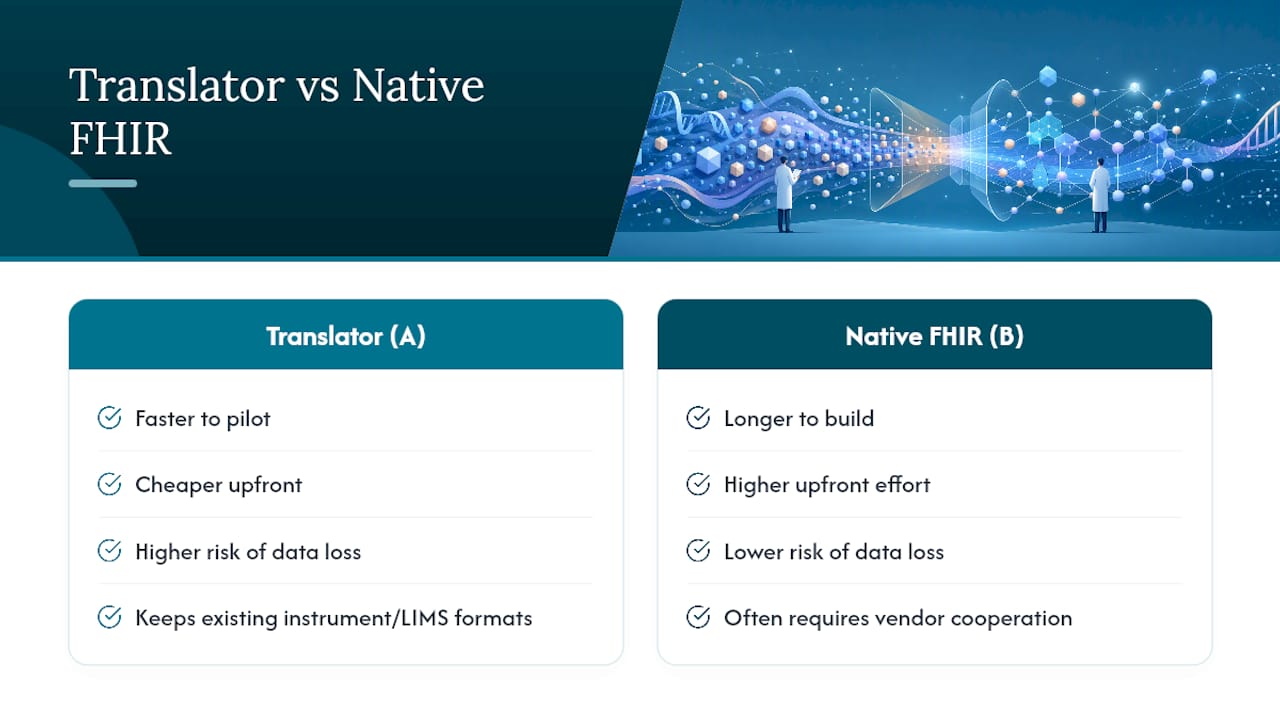
Pattern A: translator or middleware. You keep existing instrument and LIMS output formats and build an adapter layer that converts them into FHIR resources. This is faster to pilot and cheaper upfront, but every additional translation hop increases the risk of data loss, particularly when older HL7 v2 messages route through multiple intermediate formats before reaching FHIR.
Pattern B: native FHIR at the source. Instruments or LIMS emit FHIR resources directly, or generate output against a constrained implementation guide. This reduces long-term maintenance and interoperability friction but takes longer to build and often requires vendor cooperation you may not have.
Middleware implementations typically use one of a few patterns: event-driven microservices with a translator adapter per instrument type, a message broker like MQTT or AMQP for asynchronous processing, an enterprise service bus for larger multi-lab networks, or a FHIR server façade that presents a consistent interface to downstream receivers regardless of source format.
Sync for Genes Phase 3 demonstrated this trade-off directly: demonstration projects built customized implementation guides for eMERGE and HLA reporting use cases, layered on top of the base Genomics Reporting IG, and used translator tools to get labs producing valid FHIR output without rebuilding instrument firmware.
Pro Tip: Start every project with a translator-based pilot. It validates your IG mapping against real data fast. Once the pilot proves out, converge toward standardized profiles for production rather than maintaining a custom translator indefinitely.
How Do You Scope and Budget a Custom Processing Project?
Getting an accurate quote or internal budget requires collecting specific inputs before anyone estimates hours.
Stakeholders who need a seat at the table: the lab director, a bioinformatics lead, your LIMS administrator, IT and security, a clinical liaison who understands report content, and whatever implementation partner you select.
Deliverables worth writing into a statement of work:
- Ingest adapters for each instrument type in your fleet
- Field-level mapping sheets between instrument output and FHIR or LIMS targets
- A validation harness with synthetic and de-identified real test data
- Documented pilot acceptance criteria
- A support and SLA agreement
- Documentation suitable for CAP or CLIA accreditation review
Cost tends to scale with the number of distinct instrument types you're integrating, daily data volumes (FASTQ file sizes add up fast at scale), how much custom FHIR profile work is needed versus straightforward translation, whether you're hosting on-premises or in the cloud, and how much regulatory validation effort your accreditation body requires.
Most projects move through four milestones: discovery and mapping, pilot build, validation testing, and production cutover. Discovery alone often takes longer than teams expect, mostly because instrument configuration details (mount points, service accounts, credentials) surface late.
How Do You Validate the Pipeline Before Going Live?
Validation is where most custom processing projects either earn trust or lose it. A defensible test plan runs through these steps:
- Build a test corpus covering every instrument and assay type in production.
- Verify run-level metrics, including InterOp and demultiplex output, against expected values.
- Run both synthetic and de-identified real patient samples through the full pipeline.
- Execute round-trip tests against your actual EHR or FHIR consumer, not a mock endpoint.
- Compare output fields and codes, particularly LOINC and HGVS values, against expected references.
Interoperability checks need to confirm that DiagnosticReport and Observation relationships, specifically hasMember and derivedFrom, resolve correctly on the receiving end, since the Genomics Reporting IG requires consumers to navigate those links to see all clinically relevant results.
Set concrete acceptance criteria: completeness thresholds for every report field, zero data loss on critical values like PGx allele calls and HLA typings, and throughput baselines that match your daily volume.
Pro Tip: Mirror the Sync for Genes Phase 3 approach: use a constrained IG for your specialized use case during the pilot, document every gap you hit, and feed those lessons back into your standardization plan rather than treating the workaround as permanent.
What Security and Governance Controls Are Required?
Custom data processing touches protected health information at nearly every stage, so the baseline controls aren't optional.
- HIPAA-compliant handling with encryption at rest and in transit
- Role-based access controls tied to job function, not individual accounts
- Audit logging on every read, write, and report sign-out event
- Documented data retention policies aligned to your accreditation requirements
When evaluating a vendor or implementation partner, ask about SOC 2 and ISO 27001 certifications, whether they'll sign a Business Associate Agreement for cloud-hosted components, and whether their change-control process is validated for software used in clinical reporting.
Governance artifacts you'll need regardless of vendor: provenance metadata answering who touched what and when, immutable run manifests, and access logs tied directly to report sign-out events. Labs that follow a standards-aligned, pilot-tested approach, the kind Sync for Genes Phase 3 documented, consistently catch mapping errors and rework risks during the pilot phase instead of after go-live.
How Labrynix Handles Custom Data Processing and Interoperability
Labrynix was built around the exact pipeline described above, not retrofitted from generic clinical software. The platform maps directly to what a genomic lab actually needs:
- Instrument integrations and parser libraries that handle sample sheets, run metrics, and demultiplex output
- HL7 and FHIR delivery through Labrynix Connect, including API and webhook support for EHR and provider systems
- PGx report generation with CPIC and PharmGKB-aware annotations built into the reporting engine
- Audit trails and role-based access supporting HIPAA, SOC 2, and ISO 27001 posture
Because much of the mapping and translator work is pre-built, pilots move faster. Labs get mapping templates and API documentation instead of starting from a blank architecture diagram, which shortens the validation and cutover timeline described earlier.
Pro Tip: Request a technical scoping call before committing to a build timeline. A short conversation about your instrument fleet and reporting targets usually surfaces which parts of your pipeline are standard and which need custom work.
What This Means for Your Lab's Integration Strategy
Every genomic lab I've looked at closely runs into the same bottleneck: nobody budgets enough time for the mapping sheet. Teams estimate the parser code, the FHIR server, the LIMS hooks, but the actual work of deciding how a HGVS variant string maps to an Observation field takes longer than any of it. Labrynix's engineering approach treats that mapping work as the deliverable, not an afterthought, which is the difference between a pilot that ships and one that stalls in discovery. If your team is weighing a build versus a platform, start with a scoping call.
Get a Technical Scoping Call With Labrynix
If you're evaluating whether to build this pipeline in-house or bring in a platform that already handles instrument parsing, FHIR delivery, and PGx reporting, Labrynix is worth a direct conversation. Rather than assembling parsers, a FHIR server, and a reporting engine from three different vendors, labs get one connected system covering LIMS workflow, genetic testing lab integrations, and standards-aligned data delivery.
Labrynix fits labs at different stages: those needing a focused PGx reporting upgrade, those replacing a disconnected LIMS and reporting stack, and multi-location networks needing consistent instrument integration across sites. The platform's API documentation gives your IT lead enough detail to evaluate compatibility before committing to anything. If your lab is weighing a custom build against a platform that already implements the Genomics Reporting IG, request a technical scoping call and bring your instrument list.
Frequently Asked Questions
What is custom data processing in a genomic lab context? It's the bespoke ETL, instrument integration, and interoperability work that converts raw sequencer and assay output into validated, structured data your LIMS and downstream EHR systems can consume, typically formatted as FHIR resources aligned to the Genomics Reporting IG.
How do I optimize data processing for high-volume sequencing runs? Automate ingest of run metrics and demultiplex files at the point of generation, validate against acceptance thresholds before data enters your LIMS, and build retry logic into orchestration so a single failed run doesn't block the queue behind it.
Do I need a full FHIR implementation or can I start smaller? Most labs start with a translator that converts existing output into FHIR for a pilot, then expand toward native FHIR generation once the mapping is proven and reporting volume justifies the investment.
What's the difference between tailored data management and off-the-shelf reporting modules? Off-the-shelf modules assume generic clinical workflows. Tailored data management accounts for your specific instrument fleet, assay types, and terminology mapping needs, which matters most for labs running PGx or hereditary cancer panels with nonstandard output formats.
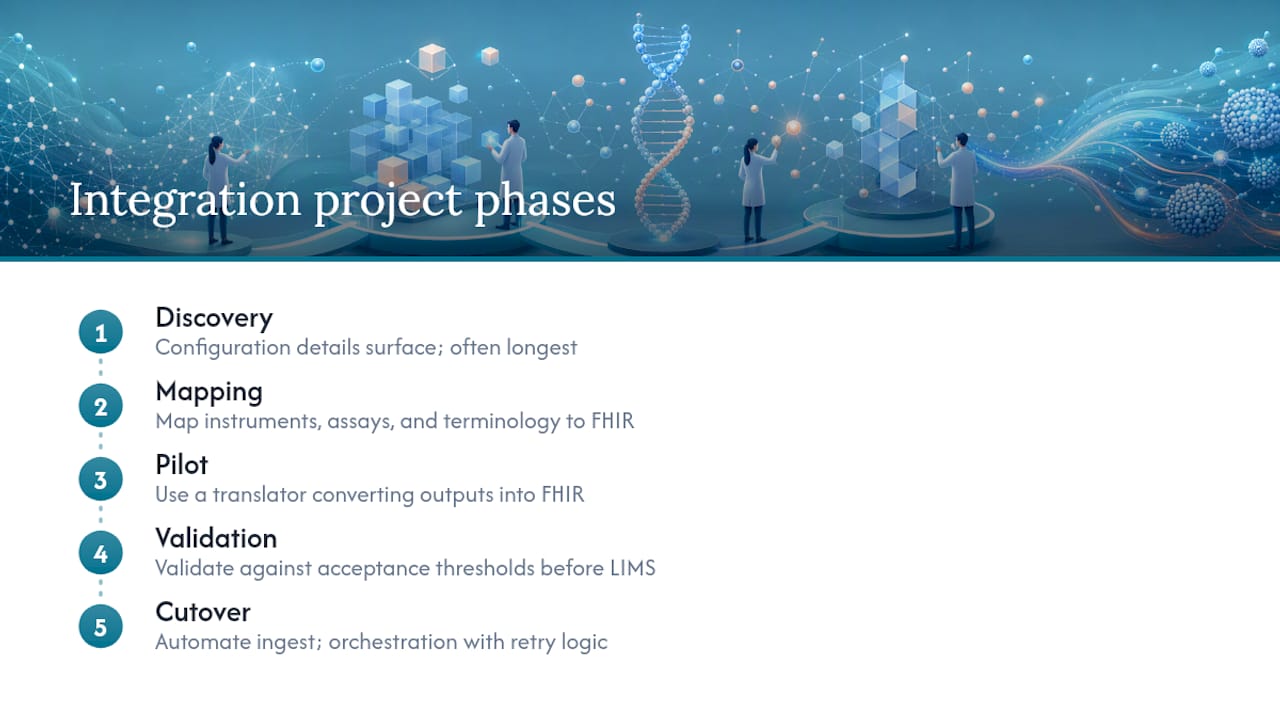
How long does a custom data integration project typically take? Timelines vary by instrument count and FHIR profile complexity, but most projects move through discovery, mapping, pilot, validation, and cutover in sequence, with discovery often taking longer than teams initially plan due to configuration details surfacing late.
Sources
- Sync for Genes Phase 3 Engaging Laboratories Final Report
- FHIR Genomics Reporting Implementation Guide (Build/Documentation)
- NextSeq 1000/2000 On-Prem Integration Package v1.1.0 (Clarity LIMS integration docs)
- QIAlink HL7 LIMS interface specification (QIAGEN)